









- Which channel has the highest ROI in the global traffic ecosystem? Comparative analysis of search, social media, and advertisingJul 10, 2026View details
- What multilingual website services are available in Sanya? Which model is more suitable for local businesses going global?Jul 08, 2026View details
- How to view the complete list of China SaaS companies in the top 100? Practical methods for screening website-building and marketing service providersJul 08, 2026View details
- How to view pricing in the global traffic ecosystem? Cost comparison of search, social media, and content channel advertisingJul 06, 2026View details
- How to assess foreign trade website development trends?Looking at 2026 changes from multilingual,AI content to conversion pathsJul 04, 2026View details
- What are the new trends in multilingual marketing data analytics tools in 2026? Focus on attribution、automation and complianceJul 04, 2026View details
- Is Brand Globalization Marketing Consulting Worth Buying? At What Stage Should Companies Bring It InJul 01, 2026View details
- Cross-Border Marketing Trend Research: Why More and More Companies Are Starting to Deploy AI Search and GEO OptimizationJun 30, 2026View details
How can AI-generated product descriptions be used on B2B websites? How to balance professionalism with indexing efficiency?
When using AI-generated product descriptions on a B2B website, first determine which conversion stage the content should serve.
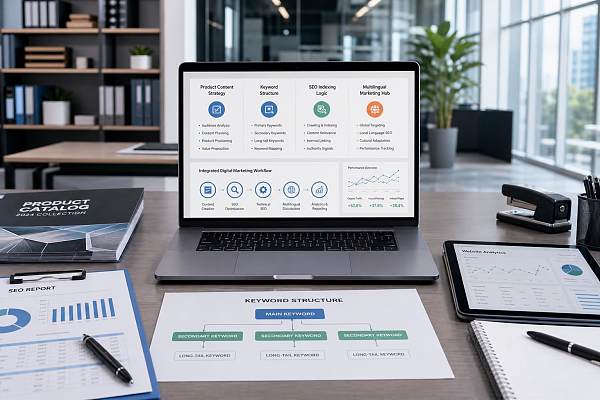
The real challenge in generating B2B website product descriptions using AI lies not in speed, but in accuracy. The product pages on the site must not only allow search engines to understand the topic, but also enable page visitors to quickly assess the product's capabilities, suitability, and the credibility of a partnership.
In a website + marketing service integrated scenario, this type of content is still part of the customer acquisition process. If the copy only has fluent expression but lacks keyword structure, landing page logic, and indexing friendliness, subsequent SEO, advertising support, and multilingual expansion will all be limited.
A more common approach is to first determine whether the product page serves as an inquiry entry point, an industry description page, or a long-tail search engine indexing page. Different pages have different tasks, and the writing style for AI-generated B2B website product descriptions cannot be entirely the same.
Why do product descriptions differ so much depending on the business scenario?
B2B websites often target multiple overseas markets simultaneously with their product information. Some people look at the technical specifications first, some look at the application industry, and others enter a specific model page through search. The focus of the page's presentation changes depending on the entry point.
For manufacturing businesses, AI-generated product descriptions for B2B websites place greater emphasis on specifications, processes, standards, and application limitations. For overseas brand websites, content must not only describe the product but also consider brand credibility, delivery capabilities, and regional search coverage.
This explains why many companies, despite using AI to write copy, still struggle to get their pages indexed by search engines. The problem usually lies not in the tool itself, but in the failure to break down the content structure according to the scenario and to map search terms, business terms, and conversion terms together.
Among frequently used pages, three types of pages most need the ability to generate B2B website product descriptions using AI.
Product detail pages place greater emphasis on professionalism and comparability.
These types of pages don't simply introduce products; they help visitors quickly complete the first round of screening. When generating B2B websites using AI-generated product descriptions, the focus should be on core parameters, applicable scenarios, optional configurations, delivery specifications, and differentiating capabilities.
Simply stating "stable performance and reliable quality" is insufficient for search engine indexing and page persuasiveness. A more effective approach is to have AI generate content based on specific operating conditions, materials, dimensions, tolerances, certifications, and compatibility requirements, followed by manual calibration of key terminology.
Industry solutions pages place greater emphasis on problem matching.
When a website serves as a customer acquisition tool for international trade, much of the traffic doesn't come from direct searches for a single product. Instead, it searches for information on how to choose the right solution for a particular industry or scenario. In this case, the approach for AI-generated product descriptions for B2B websites needs to shift from "what to sell" to "what problem to solve."
The page should link industry keywords, demand keywords, and product keywords. For example, clearly state the application environment, production cycle, durability requirements, and regional standards. This is beneficial for SEO and also more suitable for advertising landing pages and organic search results.
Long-tail indexed pages place greater emphasis on coverage efficiency and structural stability.
When there are many product models and deep categories, the value of AI-generated product descriptions for B2B websites becomes more apparent. Batch generation can improve deployment efficiency, but this requires that the template logic be sufficiently detailed; dozens of pages shouldn't simply be replacing model names.
Long-tail pages are best generated using fixed fields plus variable semantics, including keyword focus, parameter ranges, target audience, common complementary elements, and delivery instructions. This approach makes it easier to maintain both indexing efficiency and content distinctiveness simultaneously.
The key points to consider differ depending on the context.
If all pages are given the same prompt keyword, the resulting content is usually highly homogenized. The following set of differences better illustrates how to perform layered processing when generating B2B websites using AI-generated product descriptions.
In practice, it is more effective to first determine the business tasks that the page should undertake, and then design AI-generated fields, than to pursue fancy copywriting first.
To balance professionalism and indexing efficiency, the content is usually broken down in this way.
For B2B websites using AI-generated product descriptions, a more prudent approach is to break down the product copy into several controllable modules, rather than letting the AI write the entire page at once. This is more suitable for subsequent SEO optimization, website expansion, and multi-language version synchronization.
- Subject Section: Clearly state the product name, core purpose, and main keywords.
- Parameter section: Uses structured information to convey specific specifications and configurations.
- Application Section: Describes the applicable industries, operating conditions, and typical usage conditions.
- Differences Section: Explains the differences between this section and similar models or solutions.
- Conversion section: Retain the delivery time, customization and service information required for the inquiry.
This approach is particularly suitable for integrated website building and marketing operations. Platforms like YiYingBao, which have long served overseas markets, typically integrate intelligent website building, SEO optimization, advertising acceptance, and AI content generation into the same process. The clearer the content generation standards, the more stable the subsequent promotion efficiency.
The real problem isn't the generation speed, but rather a few common misjudgments.
A common misconception is that AI-generated product description B2B websites are simply replacing manual labor in mass production. The result is websites with seemingly coherent terminology but lacking in industry detail, with pages that look very similar, making it difficult for search engines to identify genuine differences.
Another problem is focusing solely on keyword coverage while ignoring the hierarchical relationship between pages. If product pages, category pages, and solution pages all compete for the same set of keywords, internal competition will be significant, leading to unstable indexing and ranking.
Another situation, often seen on multilingual overseas websites, involves directly translating the original Chinese text without considering regional search habits, certified expressions, and common industry terms. While the final product may appear to be multilingual, the actual search relevance is not high.
Compatibility conditions that need to be confirmed before landing
To effectively utilize AI-generated product descriptions on a B2B website, four things typically need to be confirmed first. The first is whether the product data on the site is standardized, including model naming, parameter definitions, and classification logic. Unstable foundational data will inevitably lead to inconsistent AI output.
Secondly, it's important to consider whether keyword strategies are differentiated by page type. Which sections should core keywords be placed in, which product pages should handle long-tail keywords, and which solution pages should cover problem keywords? These decisions need to be planned in advance.
Thirdly, are the manual review points clearly defined? Technical terminology, numerical parameters, regional compliance information, and delivery commitments cannot rely entirely on automatic generation. AI is suitable for improving efficiency, but key facts still need to be verified.
Fourthly, can the content be sustainably operated? For websites aiming for long-term SEO growth, product descriptions are not a one-time launch, but rather part of indexing monitoring, keyword expansion, and page iteration.
What's the next step to get closer to results that are indexable and convertible?
If you're planning to roll out AI-powered product description generation for a B2B website, a more pragmatic approach is to first select a group of product lines for testing, and then simultaneously observe indexing, dwell time, inquiry leads, and page duplication, rather than rolling it out across the entire site from the start.
We can start by identifying three types of pages: key product pages, industry solution pages, and long-tail product page pages. Next, we need to clarify the keyword scope, field templates, and review rules for each type of page, and then decide which content to have generated in batches by AI and which content to retain for in-depth manual editing.
In the long run, the value of AI-generated product descriptions for B2B websites lies not only in saving writing time, but also in integrating website building, SEO, advertising implementation, and multilingual operations into a single, reusable process. This creates a content system that is more likely to balance professionalism, indexing efficiency, and sustained customer acquisition capabilities.
Related Articles
 Which channel has the highest ROI in the global traffic ecosystem? Comparative analysis of search, social media, and advertising
 The Era of Cross-Border Earthquakes in 2026: The Era of Blindly Testing FB Products Has Ended!
 Three key points of domestic-to-foreign trade most important, see if you really did your homework! Don’t take shortcuts.
Related Products
 EasyCamp SaaS Smart Website Marketing SystemE-Yingbao SaaS Smart Website Marketing System: AI-powered, zero-code website building. Rapidly launch multilingual independent e-commerce sites in just 10 minutes. Global server acceleration and AI-driven SEO optimization empower businesses to efficiently connect with global markets. The seamless integration of technology and user-friendly operation makes building e-commerce sites incredibly simple.
 AI+SEM Intelligent Advertising Marketing SystemAI+SEM drives intelligent ad creation, empowering full-funnel precision advertising marketing. The system automatically generates weekly/monthly reports, AI recommends keywords and target countries, monitors core metrics in real-time with intelligent alerts, and enables one-click high-conversion ad solutions to help quickly acquire customers and improve ROI.
 AI+SEO Dual Engine Optimization ServiceEasyWin AI+SEO Dual Engine Optimization System leverages AI-powered keyword mining, content generation, and comprehensive technical optimization to help foreign trade enterprises acquire high-quality organic traffic, significantly improving search rankings and conversion rates.
 AI+SNS Social Media Marketing SystemYingbao AI+SNS Social Media Marketing System - Precision social capture for the social media era. Supports one-click content synchronization across major platforms like Facebook and LinkedIn. AI intelligently rewrites posts for enhanced relevance. 24/7 AI customer service and user profiling analysis empower businesses to efficiently expand into global markets.
 AI+SEO营销解决方案易营宝AI+SEO营销解决方案,通过AI批量写作、智能生成TDK、精准关键词扩词等功能,全面优化网站SEO效果,提升流量与转化率。助力企业构建高效智能网站新生态。
 AI+SEM Advertising Marketing SolutionsAI+SEM Advertising Marketing Solution leverages AI technology to deeply empower SEM ad campaigns. It automatically generates weekly/monthly reports using AI, presenting account data across multiple dimensions for comprehensive insights into campaign performance and trends. The system precisely recommends keywords and target countries, intelligently generates high-conversion ad copy, and enables one-click activation of efficient campaign plans to help businesses rapidly acquire customers. Simultaneously, it monitors core metrics in real time, intelligently identifies abnormal fluctuations, and issues timely alerts to ensure stable, high-return advertising results.
 Domain Name ServicesEasyWin provides professional domain name services, including intelligent queries, one-stop registration, brand protection, and full lifecycle management, helping businesses build a digital brand image.
 EasyOperate B2C Cross-Border E-Commerce Platform & Independent WebsiteEasyStore B2C Cross-border E-commerce Independent Store is an intelligent website building and cross-border e-commerce integrated solution independently developed by EasyStore Information Technology (Beijing) Co., Ltd. The system is specially designed for small and medium-sized as well as large export enterprises, integrating 'website building, operation, marketing, advertising, and conversion' into one, helping enterprises quickly establish cross-border e-commerce independent stores to achieve brand globalization and global sales growth.
The platform supports multiple languages, multiple currencies, and multi-channel marketing, with built-in AI intelligent translation and SEO optimization systems, suitable for mainstream markets such as Southeast Asia, Europe and America, Latin America, and the Middle East, assisting Chinese manufacturing enterprises in efficiently deploying international e-commerce strategies. SSL证书易营宝提供专业SSL安全证书服务,包括单域名和泛域名证书,确保网站数据传输加密、身份验证和完整性保护,助力企业建立安全可信的在线业务环境。









