









- Which channel has the highest ROI in the global traffic ecosystem? Comparative analysis of search, social media, and advertisingJul 10, 2026View details
- What multilingual website services are available in Sanya? Which model is more suitable for local businesses going global?Jul 08, 2026View details
- How to view the complete list of China SaaS companies in the top 100? Practical methods for screening website-building and marketing service providersJul 08, 2026View details
- How to view pricing in the global traffic ecosystem? Cost comparison of search, social media, and content channel advertisingJul 06, 2026View details
- How to assess foreign trade website development trends?Looking at 2026 changes from multilingual,AI content to conversion pathsJul 04, 2026View details
- What are the new trends in multilingual marketing data analytics tools in 2026? Focus on attribution、automation and complianceJul 04, 2026View details
How to choose a social media data monitoring company? Look at the depth of reports, early warning capabilities, and channel coverage.
Social media campaigns are becoming increasingly sophisticated, and data monitoring is no longer just about looking at views and follower counts. When choosing a social media data monitoring company, price is certainly a factor to compare, but what truly influences the quality of the assessment is often whether the reports can be drilled down, whether anomalies can be alerted in a timely manner, and whether the channels cover the entire value chain. This is even more crucial for integrated website and marketing services scenarios, because if social media data cannot be linked to site traffic, ad conversions, and inquiry results, many investments will struggle to generate verifiable growth conclusions.
First, understand what exactly social media data monitoring is monitoring.
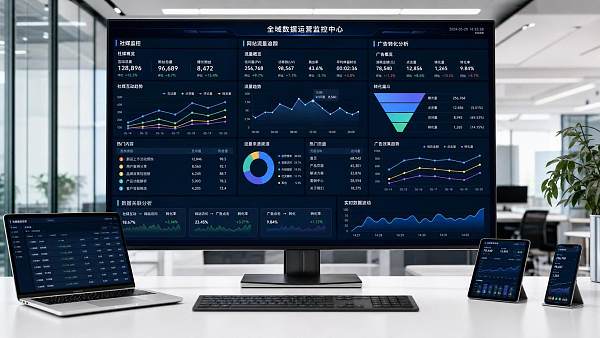
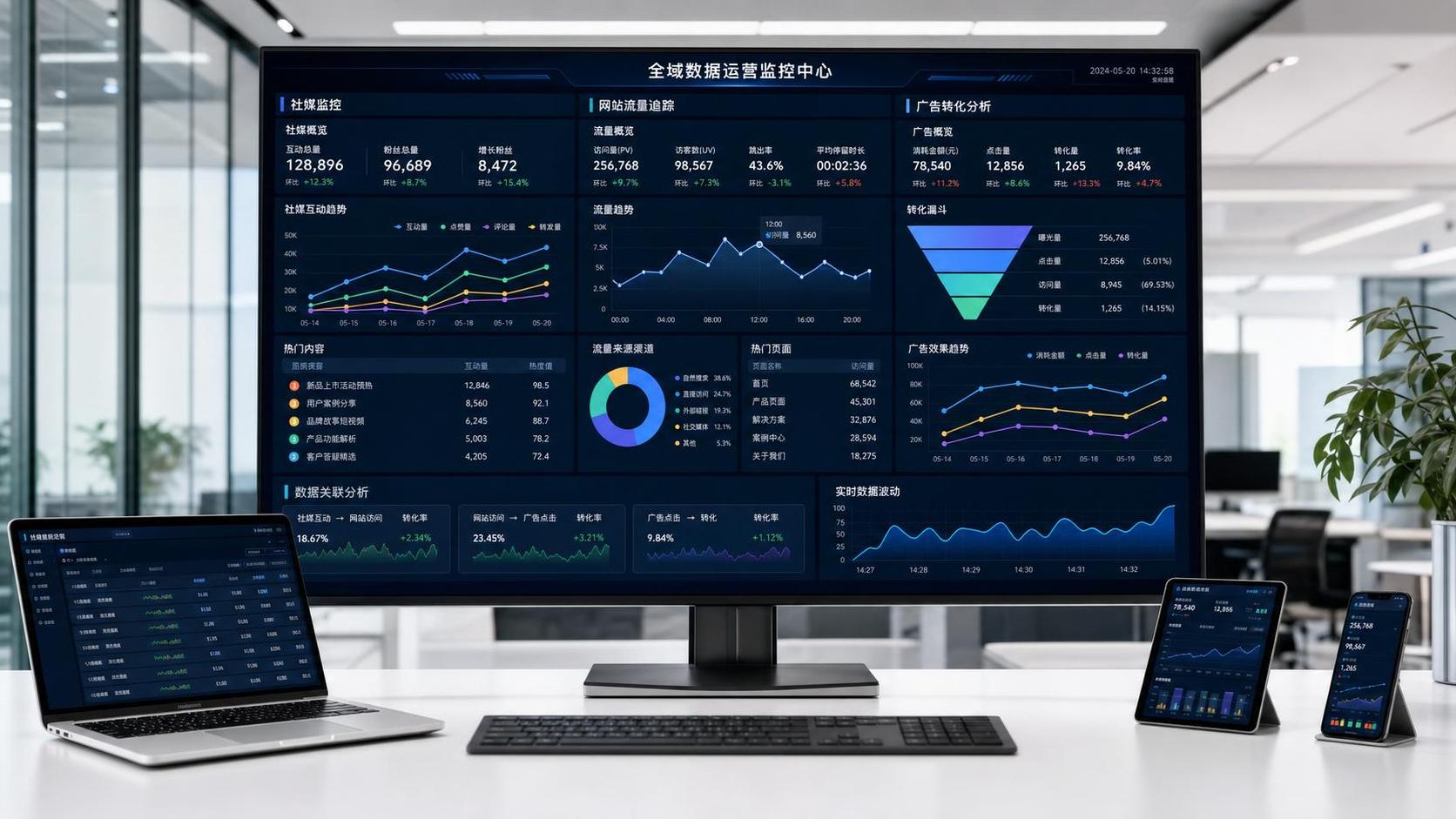
Many companies mistakenly believe that social media data monitoring is simply about compiling screenshots from the backend, which is a very superficial understanding. Reliable social media data monitoring companies monitor more than just surface-level platform data; they also monitor content performance, interaction quality, ad spend, lead generation, redirection behavior, and the dwell time, conversion, and remarketing value of social media traffic after it enters the website.
Simply put, it's not a tool for "spectating the action," but a decision-making system that helps businesses determine "which content is generating real opportunities, which channels are consuming budgets, and which anomalies need immediate attention." Especially when expanding overseas, data standards differ across regions, languages, and platforms; without deep monitoring capabilities, reports can easily become a facade of prosperity.
Why is it more important to focus on social media data monitoring companies now?
Social media channels have gradually evolved from brand exposure tools into important entry points for customer acquisition, remarketing, and user relationship management. Especially in scenarios such as foreign trade, cross-border e-commerce, and brand globalization, social media often does not exist in isolation but operates in conjunction with independent websites, search engine optimization, and advertising.
At this point, choosing a social media data monitoring company shouldn't just focus on whether the data from a single platform is complete, but rather on whether it can integrate social media behavior with subsequent website results. High engagement on a single post doesn't necessarily mean many inquiries; strong ad clicks don't guarantee high-quality orders. Without a cross-channel perspective, business evaluations easily remain at the level of "it looks good."
In this context, platforms with capabilities in website building, SEO, advertising, and social media collaboration are more likely to make comprehensive judgments. Platforms like YiYingBao, which have long served overseas businesses, offer core value not just in individual executions, but in integrating independent website building, multilingual content, search traffic, and social media operations into a unified growth logic, ensuring that data monitoring remains aligned with the actual transaction path.
The depth of the report determines whether you see the result or the cause.
When evaluating a social media data monitoring company, the depth of its reports is usually the first dividing line. Shallow reports only tell you how much it has increased or decreased, while in-depth reports go on to answer: why it increased, why it decreased, and from which country, which creative, which ad group, and which page entry point the changes originated.
A truly usable report should at least support multi-dimensional analysis. For example, it should allow for cross-analysis by time, platform, content type, audience region, device source, landing page path, and conversion action. Only in this way can the data have interpretability, rather than just being a collection of numbers.
Prioritize these types of reporting capabilities
- Content Performance Report: Differentiate between organic content and ad-supported content, and identify the topics that truly drive interaction and clicks.
- Traffic attribution report: Understand the quality of visits, bounce rates, and conversion actions after social media traffic enters the website.
- Regional comparison reports: Suitable for multilingual and multi-market promotion, making it easy to judge the differences in input and output in different regions.
- Lead quality report: Look not only at the number of leads, but also at the validity of inquiries, follow-up progress, and relevance to transactions.
If a social media data monitoring company can only export regular backend data but cannot combine it with website conversion data, then it is more like a data reporting tool than a decision support tool.
Early warning capabilities determine whether losses can be stopped in time when problems occur.
Many people underestimate the importance of anomaly alerts when choosing a service provider. In actual business, wasted budgets are often not due to a lack of data, but rather because they are discovered too late. An abnormal ad spend, a concentration of negative content, or a website redirect failure can all amplify losses in a short period of time.
A good social media data monitoring company should possess both rule-based early warning and trend-based early warning capabilities. The former is suitable for monitoring specific thresholds, such as a sudden increase in spending, a sharp drop in clicks, or a form becoming unresponsive; the latter emphasizes identifying abnormal fluctuations, such as a conversion rate consistently deviating from its historical range, a sudden distortion in interaction in a certain market, or a significant decline in the quality of traffic from a certain channel.
More noteworthy is the post-warning handling mechanism. Simply issuing a warning without providing location-specific suggestions limits efficiency. Ideally, a warning should indicate the source of the anomaly, related pages, affected channels, and suggested investigation directions, enabling internal or outsourced teams to respond quickly.
The extent of channel coverage affects whether data can truly be closed-loop.
The third key factor in determining whether a social media data monitoring company is worth choosing is its channel coverage. This coverage refers not only to accessing a few mainstream social media platforms, but more importantly, to its ability to connect websites, advertising accounts, search traffic, landing pages, and customer conversion paths.
If data is only collected from social media, many judgments will be incomplete. For example, a short video might generate high click-through rates, but the landing page might load slowly, resulting in poor conversion rates; or a market might have average social media engagement, but high website dwell time and high-quality inquiries. These conclusions require cross-channel observation to be valid.
From the perspective of integrated website and marketing services, a more mature approach is to extend the monitoring scope to the collaborative layer of independent website construction, SEO traffic, advertising placement, and social media operations. The value of platforms like YiYingBao lies in the fact that it does not only serve a single channel, but also manages the key nodes in the overseas customer acquisition chain from a unified perspective through its self-developed website building system, cross-border e-commerce system, AI advertising and marketing system, and AI+SEO/GEO optimization system.
What are some common problems when coverage is insufficient?
- Social media metrics look good, but website conversion rates haven't improved accordingly.
- Different platforms use inconsistent reporting methods, making it difficult to make horizontal comparisons of monthly reports.
- Looking at the ads and content separately, it's difficult to find a truly effective combination of materials.
- When operating in multiple overseas markets simultaneously, regional differences cannot be quickly identified.
Choosing based on business scenarios is more effective than simply comparing features.
When choosing a social media data monitoring company, the biggest mistake is treating the feature list as the final answer. In reality, different business models have vastly different priorities. For foreign trade inquiry websites, the focus is on lead quality and source tracking; cross-border e-commerce platforms prioritize the efficiency of adding to cart, repeat purchases, and remarketing after content engagement; and brands going global need to balance reputation, content interaction, and multi-regional dissemination performance.
If a company already has multilingual websites, independent sites, and overseas advertising, then a social media data monitoring company should ideally support cross-market management. The pace of campaign execution and content feedback differ significantly across regions such as North America, Europe, Southeast Asia, Japan and South Korea, and the Middle East; therefore, a unified dashboard, regional breakdown, and localized metric interpretation are all crucial.
In other words, the selection of a monitoring solution cannot be divorced from the business process. A truly valuable monitoring solution should be able to answer questions such as "which content brought high-quality visits", "which channels are closer to conversions", and "which pages dragged down conversion rates", rather than just "how many followers were gained this week".
During the implementation evaluation, these questions can be verified one by one.
Instead of being led astray by the demo interface, it's better to establish judgment criteria beforehand. When screening social media data monitoring companies, you can verify the following questions.
- Can the reports drill down to the content, ad group, landing page, and conversion action levels?
- Does the anomaly alert support custom rules and can it be associated with specific reasons?
- Can data from social media, websites, advertising, and search channels be integrated?
- In multi-regional and multi-language business scenarios, does it support a unified standard for comparison?
- In addition to dashboard displays, does it possess the ability to continuously optimize suggestions and implement collaborative processes?
If the service provider already has experience in website development and overseas marketing integration, they are usually better able to understand the business logic behind the data. After all, monitoring is not the end goal; the subsequent page adjustments, content optimization, and campaign adjustments are what truly produce results.
From comparing service providers to establishing your own judgment framework
Returning to the initial question of how to choose a social media data monitoring company, the core is not complicated: first, check the depth of the reports; second, check the timeliness and effectiveness of the alerts; and finally, check whether the channel coverage can form a complete closed loop. Service providers who excel in these three areas are more likely to help companies transform their social media investments into traceable, explainable, and optimizable growth assets.
The next, more practical step is to first analyze existing channels, sites, and conversion paths, and then compare the report structures, alert logic, and access scope of candidate solutions. Only by comparing them in real business scenarios will the answer be clear enough as to which social media data monitoring company is more suitable.
Related Articles
 How to determine content rhythm and conversion goals in overseas social media marketing strategy sharing
 Which teams is scheduled social media automation posting suitable for? Let’s clarify the tool capabilities and execution boundaries in one go
 How to choose a social media data monitoring company? Look at the depth of reports, early warning capabilities, and channel coverage.

Related Products
 EasyCamp SaaS Smart Website Marketing SystemE-Yingbao SaaS Smart Website Marketing System: AI-powered, zero-code website building. Rapidly launch multilingual independent e-commerce sites in just 10 minutes. Global server acceleration and AI-driven SEO optimization empower businesses to efficiently connect with global markets. The seamless integration of technology and user-friendly operation makes building e-commerce sites incredibly simple.
 AI+SEM Intelligent Advertising Marketing SystemAI+SEM drives intelligent ad creation, empowering full-funnel precision advertising marketing. The system automatically generates weekly/monthly reports, AI recommends keywords and target countries, monitors core metrics in real-time with intelligent alerts, and enables one-click high-conversion ad solutions to help quickly acquire customers and improve ROI.
 AI+SEO Dual Engine Optimization ServiceEasyWin AI+SEO Dual Engine Optimization System leverages AI-powered keyword mining, content generation, and comprehensive technical optimization to help foreign trade enterprises acquire high-quality organic traffic, significantly improving search rankings and conversion rates.
 AI+SNS Social Media Marketing SystemYingbao AI+SNS Social Media Marketing System - Precision social capture for the social media era. Supports one-click content synchronization across major platforms like Facebook and LinkedIn. AI intelligently rewrites posts for enhanced relevance. 24/7 AI customer service and user profiling analysis empower businesses to efficiently expand into global markets.
 AI+SEO营销解决方案易营宝AI+SEO营销解决方案,通过AI批量写作、智能生成TDK、精准关键词扩词等功能,全面优化网站SEO效果,提升流量与转化率。助力企业构建高效智能网站新生态。
 AI+SEM Advertising Marketing SolutionsAI+SEM Advertising Marketing Solution leverages AI technology to deeply empower SEM ad campaigns. It automatically generates weekly/monthly reports using AI, presenting account data across multiple dimensions for comprehensive insights into campaign performance and trends. The system precisely recommends keywords and target countries, intelligently generates high-conversion ad copy, and enables one-click activation of efficient campaign plans to help businesses rapidly acquire customers. Simultaneously, it monitors core metrics in real time, intelligently identifies abnormal fluctuations, and issues timely alerts to ensure stable, high-return advertising results.
 Domain Name ServicesEasyWin provides professional domain name services, including intelligent queries, one-stop registration, brand protection, and full lifecycle management, helping businesses build a digital brand image.
 EasyOperate B2C Cross-Border E-Commerce Platform & Independent WebsiteEasyStore B2C Cross-border E-commerce Independent Store is an intelligent website building and cross-border e-commerce integrated solution independently developed by EasyStore Information Technology (Beijing) Co., Ltd. The system is specially designed for small and medium-sized as well as large export enterprises, integrating 'website building, operation, marketing, advertising, and conversion' into one, helping enterprises quickly establish cross-border e-commerce independent stores to achieve brand globalization and global sales growth.
The platform supports multiple languages, multiple currencies, and multi-channel marketing, with built-in AI intelligent translation and SEO optimization systems, suitable for mainstream markets such as Southeast Asia, Europe and America, Latin America, and the Middle East, assisting Chinese manufacturing enterprises in efficiently deploying international e-commerce strategies. SSL证书易营宝提供专业SSL安全证书服务,包括单域名和泛域名证书,确保网站数据传输加密、身份验证和完整性保护,助力企业建立安全可信的在线业务环境。









