









- How to assess foreign trade website development trends?Looking at 2026 changes from multilingual,AI content to conversion pathsJul 04, 2026View details
- What are the new trends in multilingual marketing data analytics tools in 2026? Focus on attribution、automation and complianceJul 04, 2026View details
- Is Brand Globalization Marketing Consulting Worth Buying? At What Stage Should Companies Bring It InJul 01, 2026View details
- Cross-Border Marketing Trend Research: Why More and More Companies Are Starting to Deploy AI Search and GEO OptimizationJun 30, 2026View details
- Cross-Border Marketing Trend Research: How Independent Sites, AI Content, and Short-Video Customer Acquisition Are ChangingJun 30, 2026View details
- How Can a Brand Updates Page Be Made More SEO-Friendly? Analysis of Update Frequency, Content Structure, and Internal Linking StrategyJun 28, 2026View details
- What stages does the cross-border services ecosystem include? How do website building, promotion, payment, and compliance work togetherJun 22, 2026View details
- How will email marketing costs change in 2026Jun 22, 2026View details
Is AI+SEM advertising strategy consulting worthwhile?
With rising traffic costs and increasing pressure to convert leads, the question of whether AI+SEM advertising strategy consulting is worthwhile has become a key concern for business decision-makers. This article will analyze its true value from the perspectives of campaign efficiency, budget return, and growth path.
For the integrated website and marketing services industry, advertising is no longer simply about buying traffic; it's a systematic project encompassing customer acquisition cost, lead quality, landing page experience, and the subsequent conversion process. Especially for business decision-makers, when evaluating AI+SEM advertising strategy consulting, they are more concerned with whether the investment can shorten the trial-and-error cycle, improve budget control, and create synergy with website building, SEO, content, and data analysis.
Founded in 2013 and headquartered in Beijing, E-Creative Information Technology (Beijing) Co., Ltd. has long been committed to providing global digital marketing services driven by artificial intelligence and big data, covering the entire value chain of intelligent website building, search engine optimization, social media marketing, and advertising placement. For companies looking to improve their overseas customer acquisition efficiency, optimize their advertising structure, and build a sustainable growth model, the value of strategy consulting lies not in "whether to adopt AI," but in "whether to use AI correctly through professional methods."
Why are companies reassessing their AI+SEM advertising strategies?
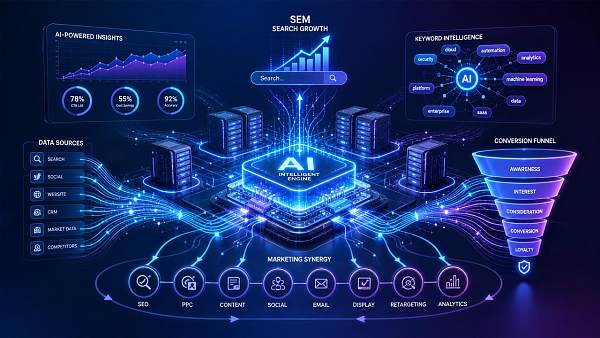
Over the past few years, the search advertising landscape has seen three significant changes: a general increase in cost-per-click, more segmented keyword competition, and longer user decision-making paths. Many companies, even with monthly budgets ranging from 30,000 to 300,000 yuan, may still face challenges such as unstable leads, fluctuating inquiry quality, and difficulty in attributing campaign results.
More expensive traffic doesn't necessarily mean advertising is ineffective.
Many managers attribute declining conversion rates to rising platform costs, but the real problems often lie in account structure, matching methods, keyword intent segmentation, and landing page engagement. The first layer of value in AI+SEM advertising strategy consulting is using data to identify whether the problem occurs at the "traffic entry point" or in the "conversion midway point."
For example, even within search advertising, the conversion cycles for brand keywords, category keywords, competitor keywords, and long-tail keywords differ. In B2B projects, brand keywords may generate valid leads within 7 days, while the decision-making cycle for high-priced industry keywords often extends to 15 to 45 days. If companies only look at the number of short-term forms, they can easily misjudge the channel's value.
The value of AI lies in improving efficiency, but this is contingent on the correct strategy.
While mainstream advertising platforms now possess strong automation capabilities in areas such as smart bidding, audience expansion, and creative combinations, automation does not equate to automatic growth. If conversion goals are set incorrectly, tracking points are missing, or the website loads slower than 3 seconds, AI will amplify the erroneous data instead of automatically fixing the problems for the business.
This is also a key reason why companies are introducing AI+SEM advertising strategy consulting: first calibrate the goals, then use AI to amplify the effective path. Professional teams typically complete the three phases of diagnosis, restructuring, and validation within 2 to 4 weeks, making it easier to establish a stable methodology than individual trials within the company.
The table below can help decision-makers quickly determine when a company needs to bring in consulting services rather than just account management.
From a decision-making perspective, AI+SEM advertising strategy consulting is best suited for three types of companies: those with existing budgets but stagnant growth, those planning global customer acquisition, and those with sales teams but lacking digital advertising methods. It doesn't replace execution, but rather reduces the probability of incorrect execution.
What core issues does AI+SEM advertising strategy consulting actually solve?
The core reason businesses are willing to pay for consulting services isn't simply for "an extra report," but rather to improve four key metrics: click quality, conversion rate, customer acquisition cost, and budget utilization. This is especially true in B2B websites and cross-border independent websites, where advertising effectiveness typically depends on the consistency between front-end traffic strategies and back-end site performance.
Question 1: Outdated account structure prevents AI from learning effective signals.
Many accounts use the same ad set, a limited number of keywords, and fixed creatives for a long time. While this may seem stable on the surface, it makes it difficult to provide intelligent systems with sufficiently clear learning samples. Strategy consulting typically restructures accounts along four dimensions: brand, category, scenario, and region, guiding users with different intentions through different conversion paths.
Recommended structural transformation steps
- We analyzed search term reports from the past 90 days and removed invalid click sources.
- Establish a three-tier account structure based on high-intent keywords, mid-intent keywords, and test keywords.
- Reset conversion goals and differentiate between actions such as forms, phone calls, WhatsApp, and emails.
- Use 2 to 3 versions of the landing page to test different industry requirements and form lengths.
- Review bidding and creative performance at 7-day, 14-day, and 30-day intervals.
Question 2: The advertisements and the website are disconnected, resulting in traffic being lost after entering the site.
In an integrated website and marketing service scenario, advertising inquiries cannot be assessed solely based on the platform's backend; the website's structure, loading speed, form navigation, and trust factors must also be evaluated. If a company's website has unclear homepage information, poor mobile interaction, or content that doesn't match search terms, even a 20% increase in click-through rate may result in very limited actual inquiries.
In such cases, consulting services often combine website building, content creation, and search engine optimization (SEO) adjustments. For independent cross-border e-commerce websites and B2B corporate websites, appropriately configuring SEO optimization capabilities can help supplement organic traffic and landing page content quality beyond ad testing, reducing reliance on paid traffic alone.
Question 3: Management cannot see real returns, making it difficult to sustain the budget.
Many businesses aren't unwilling to advertise, but rather lack an evaluation framework that can be used for business review. AI+SEM advertising strategy consulting typically translates "advertising data" into "business data," such as cost per valid lead, sales follow-up rate, lead conversion rate, and payment cycle, making budget discussions more in a management language.
If an evaluation model is established from a management perspective, the following indicators are the most worthy of priority tracking.
Truly valuable consulting doesn't just offer single suggestions like "increase the budget" or "change the keyword pack." Instead, it integrates the platform, website, content, conversion, and sales returns into a comprehensive growth roadmap. For management, this is far more meaningful for decision-making than simply pursuing increased exposure.
How can companies determine whether this consulting investment is worthwhile?
From a procurement perspective, whether AI+SEM advertising strategy consulting is worthwhile shouldn't be judged solely by the consulting fee, but rather by whether it can help the company establish a clearer advertising path within one quarter. If a company's monthly budget is only a few thousand yuan and it doesn't yet have a basic website, the priority might be to first build an official website and basic content; if the budget exceeds 20,000 yuan and there's been no improvement after more than three months of continuous advertising, then the return on investment for consulting is usually higher.
Four signals to consider before making a decision
- The number of clicks over the past 60 days has been considerable, but the number of inquiries is lower than expected.
- The results varied greatly after the handover between different agents or different operators.
- Sales leads are inaccurate, with a follow-up success rate of less than 10% to 15%.
- The official website updates slowly, and the advertising landing page has not been tested for a long time.
What to focus on when choosing a service provider?
We recommend that companies focus on evaluating five key capabilities: understanding the industry buyer journey, seamless integration of website and ad placement, data analytics methods, multilingual localization support, and continuous tracking and optimization. Teams that only have an ad placement perspective but lack website and content capabilities will find it difficult to achieve deep success in B2B and cross-border scenarios.
Taking integrated service providers like YiYingBao as an example, their advantage lies in their ability to simultaneously manage advertising accounts, website building, search content, and data monitoring. For instance, on the content side, leveraging SEO optimization capabilities, they can achieve AI-powered article writing, keyword recommendation, TDK generation, multilingual localization, and monitoring of over 200 metrics, making them more suitable for companies that need to accumulate search assets over the long term.
Service details that are worth asking about
- Is the initial diagnostic delivery cycle 7 days or 15 days?
- Does it offer keyword intent stratification and no-keyword strategy?
- Should the landing page, event tracking, forms, and customer service responses be reviewed simultaneously?
- Can it output actionable optimizations on a weekly basis, instead of just reports?
- Does it have a 24/7 monitoring and early warning mechanism for anomalies?
What common pitfalls should companies avoid during implementation?
Even if you decide to pursue AI+SEM advertising strategy consulting, the results will vary greatly depending on the implementation approach. The most common misconception among businesses is treating consulting as a one-time diagnosis rather than a continuous optimization mechanism. In fact, search advertising, especially in new markets and new product categories, typically requires at least two to three rounds of testing to develop a relatively stable campaign model.
Myth 1: Focusing only on surface data without verifying the quality of clues.
Click-through rate, impressions, and average ranking are all important, but the effective lead generation rate and sales acceptance rate are even more crucial. If the number of forms increases by 50%, but the percentage of invalid leads rises simultaneously, the actual cost to the company may be higher. It is recommended to establish at least a three-stage feedback mechanism: "advertising lead - sales follow-up - opportunity confirmation".
Myth 2: Ignoring the synergy between content and organic search
Many decision-makers treat SEM merely as a short-term customer acquisition tool, neglecting the guiding value of advertising data for SEO topic selection, product page optimization, and industry page layout. In fact, high-converting search terms, frequently asked questions, and click hotspots can all be used to improve website content, allowing businesses to gradually reduce their reliance on pure advertising over 6 to 12 months.
Myth 3: Insufficient internal coordination leads to the inability to execute strategies.
AI+SEM advertising strategy consulting typically involves at least four roles: marketing, sales, website operations, and management. Without a clearly defined person in charge, a fixed weekly meeting schedule, and a unified definition of conversion, even the best advice can easily remain just a document. A more prudent approach is to use a 30-day optimization cycle, setting clear acceptance criteria and assigning responsibilities.
The final judgment criteria for corporate decision-makers
If a company already has a basic website, a stable advertising budget, and clear customer acquisition goals, then AI+SEM advertising strategy consulting is generally worthwhile. This is because it can help the company find effective keyword combinations more quickly, optimize budget allocation, correct website conversion paths, and establish a reusable growth mechanism. If the company is still in a weak digital foundation stage, it should prioritize improving its official website, content, and data tracking capabilities before introducing more systematic advertising consulting.
For companies seeking to balance short-term customer acquisition with long-term brand growth, the advantages of an integrated service are particularly evident: advertising validates the market, the website fulfills demand, search content builds assets, and the data system provides continuous analysis. This approach ensures that every budget invested is more likely to translate into sustainable growth capabilities.
If you are evaluating whether AI+SEM advertising strategy consulting is suitable for your current business stage, we recommend conducting a comprehensive diagnostic based on your budget, website status, lead quality, and team collaboration capabilities. Obtaining customized solutions, consulting on product details, and learning more about alternatives as early as possible is often more cost-effective than continuing inefficient trial and error.
Related Articles
 How can video news production be made more efficient?Breaking down the standard process from topic selection to editing
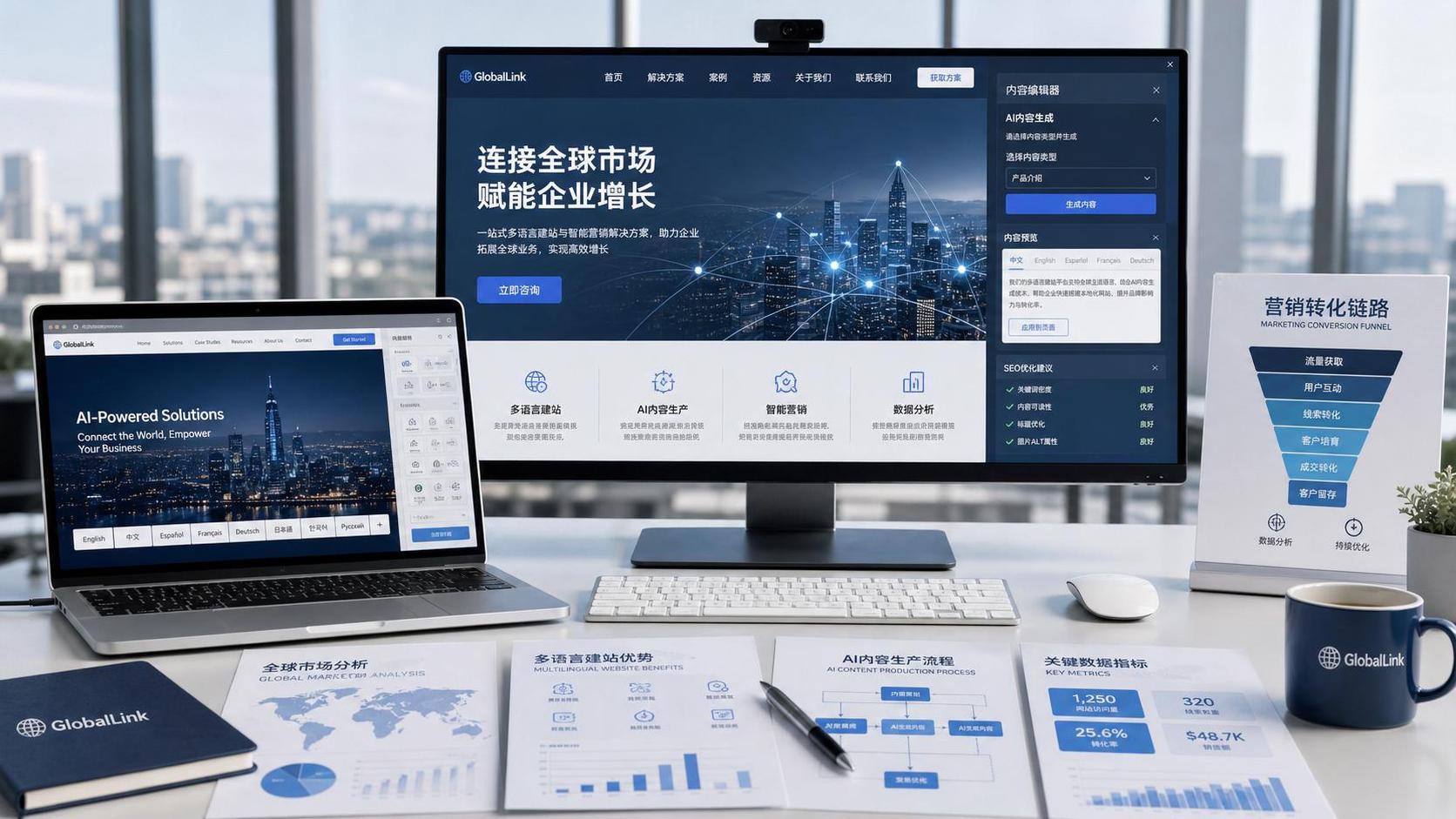
 How to assess foreign trade website development trends?Looking at 2026 changes from multilingual,AI content to conversion paths
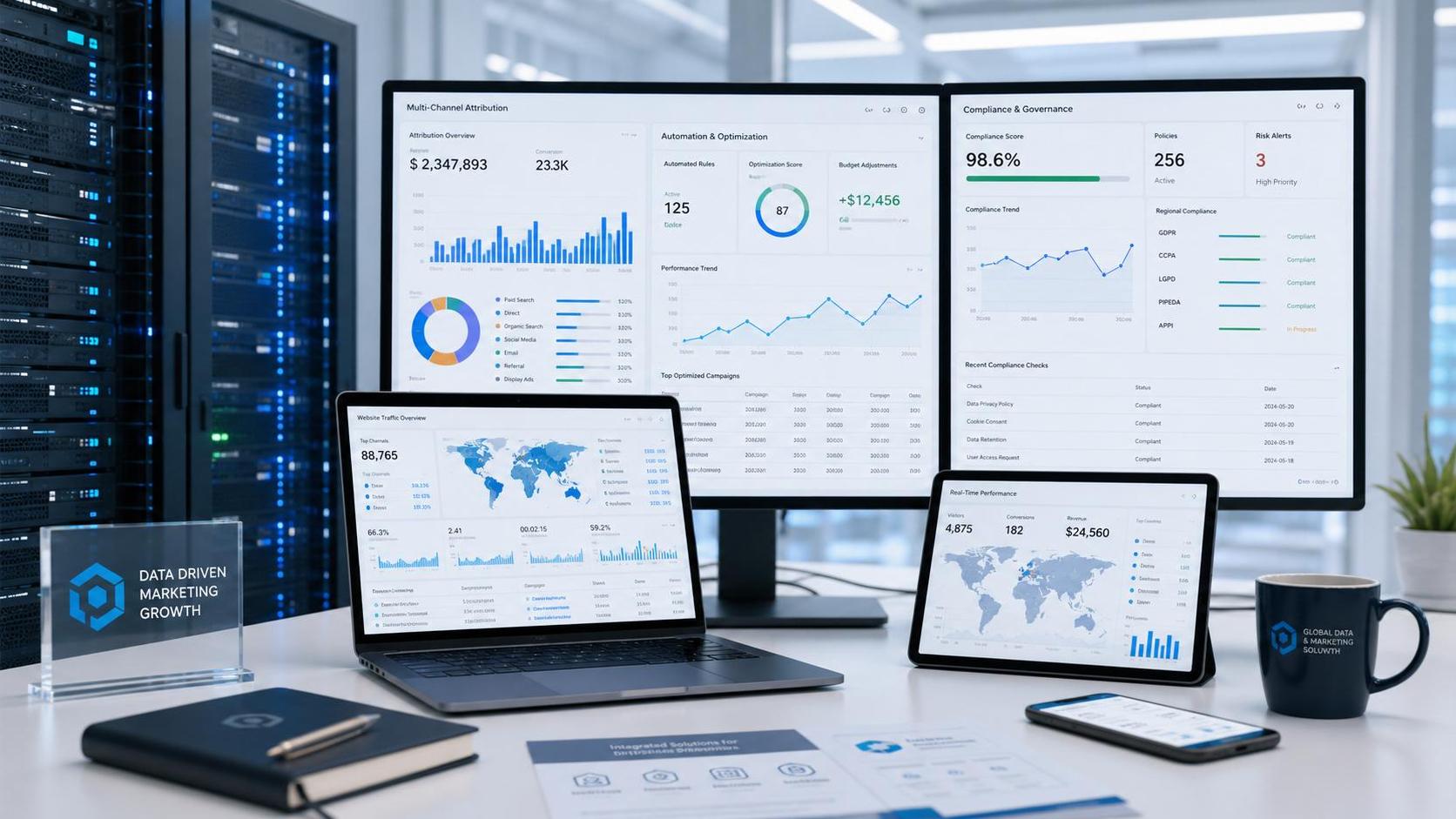
 What are the new trends in multilingual marketing data analytics tools in 2026? Focus on attribution、automation and compliance

Related Products
 EasyCamp SaaS Smart Website Marketing SystemE-Yingbao SaaS Smart Website Marketing System: AI-powered, zero-code website building. Rapidly launch multilingual independent e-commerce sites in just 10 minutes. Global server acceleration and AI-driven SEO optimization empower businesses to efficiently connect with global markets. The seamless integration of technology and user-friendly operation makes building e-commerce sites incredibly simple.
 AI+SEM Intelligent Advertising Marketing SystemAI+SEM drives intelligent ad creation, empowering full-funnel precision advertising marketing. The system automatically generates weekly/monthly reports, AI recommends keywords and target countries, monitors core metrics in real-time with intelligent alerts, and enables one-click high-conversion ad solutions to help quickly acquire customers and improve ROI.
 AI+SEO Dual Engine Optimization ServiceEasyWin AI+SEO Dual Engine Optimization System leverages AI-powered keyword mining, content generation, and comprehensive technical optimization to help foreign trade enterprises acquire high-quality organic traffic, significantly improving search rankings and conversion rates.
 AI+SNS Social Media Marketing SystemYingbao AI+SNS Social Media Marketing System - Precision social capture for the social media era. Supports one-click content synchronization across major platforms like Facebook and LinkedIn. AI intelligently rewrites posts for enhanced relevance. 24/7 AI customer service and user profiling analysis empower businesses to efficiently expand into global markets.
 AI+SEO营销解决方案易营宝AI+SEO营销解决方案,通过AI批量写作、智能生成TDK、精准关键词扩词等功能,全面优化网站SEO效果,提升流量与转化率。助力企业构建高效智能网站新生态。
 AI+SEM Advertising Marketing SolutionsAI+SEM Advertising Marketing Solution leverages AI technology to deeply empower SEM ad campaigns. It automatically generates weekly/monthly reports using AI, presenting account data across multiple dimensions for comprehensive insights into campaign performance and trends. The system precisely recommends keywords and target countries, intelligently generates high-conversion ad copy, and enables one-click activation of efficient campaign plans to help businesses rapidly acquire customers. Simultaneously, it monitors core metrics in real time, intelligently identifies abnormal fluctuations, and issues timely alerts to ensure stable, high-return advertising results.
 Domain Name ServicesEasyWin provides professional domain name services, including intelligent queries, one-stop registration, brand protection, and full lifecycle management, helping businesses build a digital brand image.
 EasyOperate B2C Cross-Border E-Commerce Platform & Independent WebsiteEasyStore B2C Cross-border E-commerce Independent Store is an intelligent website building and cross-border e-commerce integrated solution independently developed by EasyStore Information Technology (Beijing) Co., Ltd. The system is specially designed for small and medium-sized as well as large export enterprises, integrating 'website building, operation, marketing, advertising, and conversion' into one, helping enterprises quickly establish cross-border e-commerce independent stores to achieve brand globalization and global sales growth.
The platform supports multiple languages, multiple currencies, and multi-channel marketing, with built-in AI intelligent translation and SEO optimization systems, suitable for mainstream markets such as Southeast Asia, Europe and America, Latin America, and the Middle East, assisting Chinese manufacturing enterprises in efficiently deploying international e-commerce strategies. SSL证书易营宝提供专业SSL安全证书服务,包括单域名和泛域名证书,确保网站数据传输加密、身份验证和完整性保护,助力企业建立安全可信的在线业务环境。









