









- What Does a Global Traffic Ecosystem Service Provider Do? What Are the Differences from a Single Advertising AgencyJul 16, 2026View details
- What should you focus on in the latest enterprise SaaS report? From renewal rates and delivery costs to overseas growth opportunitiesJul 12, 2026View details
- What signals are worth paying attention to in a cross-border marketing trend report? B2B companies should look at these 6 signalsJul 11, 2026View details
- How to Read a Cross-Border Marketing Trends Report? Five Key Dimensions for Evaluating Channel OpportunitiesJul 11, 2026View details
- Which channel has the highest ROI in the global traffic ecosystem? Comparative analysis of search, social media, and advertisingJul 10, 2026View details
- What multilingual website services are available in Sanya? Which model is more suitable for local businesses going global?Jul 08, 2026View details
- How to view the complete list of China SaaS companies in the top 100? Practical methods for screening website-building and marketing service providersJul 08, 2026View details
- How to view pricing in the global traffic ecosystem? Cost comparison of search, social media, and content channel advertisingJul 06, 2026View details
Should you choose a new domain extension or a traditional one when registering a domain name
When registering a domain name, choosing a new extension or a traditional extension directly affects brand credibility, promotion costs, and long-term operational performance. For procurement professionals, what is truly needed is not an answer to “which one is more popular,” but a judgment of which option is better suited to the current business stage based on budget, industry characteristics, brand positioning, and campaign objectives.
When procurement makes domain registration decisions, first look at “whether it fits” rather than “whether it is new”
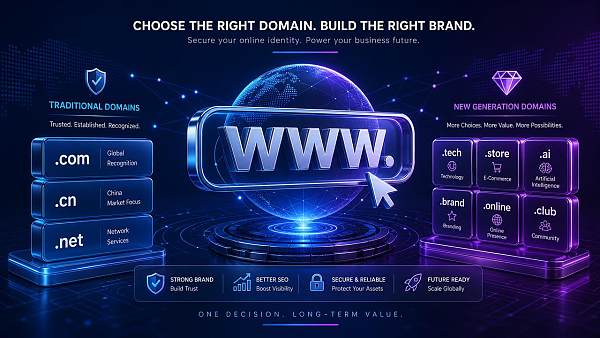
When many companies register domain names, they tend to oversimplify the issue: traditional extensions are more stable, while new extensions are more trendy. But for procurement professionals, the criteria should not stop at whether it looks good, but should return to usage scenarios, decision-making risks, and follow-up promotion costs.
If a company values brand credibility, customer trust, and long-term accumulation, traditional extensions are usually the safer choice. If a company hopes to highlight industry attributes, secure short domain name resources, or already has a mature brand system in place, new extensions may also be a highly cost-effective option.
In other words, there is no absolute standard answer for domain registration. A truly effective procurement strategy uses business goals to filter domain names, rather than being led astray by claims such as “traditional extensions are always better” or “new extensions are more innovative.”
Why traditional extensions are still the priority choice for most enterprise procurement
In enterprise procurement practice, traditional extensions such as .com, .cn, and .net still dominate the mainstream. The reason is not complicated: after long-term market education, users are familiar with them, typing habits are stable, and they naturally have a stronger foundation of trust.
Especially in industries such as B2B companies, manufacturing, foreign trade services, and consulting services, customers often regard a domain extension as part of a company’s legitimacy when visiting the official website. A common traditional extension is usually more effective at reducing user hesitation than an unfamiliar extension.
From a marketing perspective, traditional extensions are also more cost-efficient in brand communication. Whether on offline business cards, trade show materials, or online advertising campaigns, users have higher acceptance of traditional extensions, and companies do not need to spend extra effort explaining “whether this website address is legitimate.”
For procurement, this means lower communication friction and more stable asset value. A domain name is not only an access point, but also part of a brand’s digital assets. Choosing a traditional extension is essentially a way to reduce future uncertainty.
Where the advantages of new extensions lie, and which companies are better suited to choose them
New extensions do not mean unreliability. Their core advantages lie in richer resources and greater naming space, making it easier to obtain short, memorable domain names that highly match the brand or industry. This is especially attractive to new brands.
For example, technology companies may prefer .ai, creative businesses may consider .studio, and marketing services may choose .marketing or .digital. These new extensions can strengthen industry labels both visually and semantically, helping brands form differentiated memory points.
If a company’s target users themselves are highly receptive to the internet, or if traffic is mainly driven through social media, search advertising, or private-domain communication, the awareness threshold for new extensions will be lower than in traditional industries. At this time, domain registration can serve brand expression more flexibly.
However, procurement professionals should note that new extensions are more suitable for companies with a clear communication strategy, rather than simply for “looking new.” If the follow-up team cannot continuously explain, guide, and use them consistently, even the most creative extension may become a recognition cost.
The three things procurement cares about most: trust, cost, and long-term controllability
Procurement decisions are often not aesthetic judgments, but evaluations of overall input and output. In the context of domain registration, what most needs to be compared is user trust, ownership cost, and the difficulty of ongoing management. These three factors are more critical than “which extension is preferred.”
The first is trust cost. Traditional extensions are generally more conducive to building a sense of security for first-time visits, especially performing more steadily in scenarios such as official website lead generation, inquiry conversion, and corporate endorsement. If new extensions lack recognition, they may increase user hesitation.
The second is procurement and renewal cost. Some new extensions have very low first-year prices, but higher renewal fees, and may even have price fluctuations. Procurement cannot look only at the initial quotation, but must calculate the total ownership cost over three to five years to avoid losing budget control later.
The third is controllability. Once a company uses a domain name for its official website, email, advertising, SEO, and channel materials, the replacement cost will increase rapidly. Therefore, when registering a domain name, procurement should prioritize options that are stable, transferable, and suitable for long-term ownership.
From the perspective of SEO and marketing performance, extension selection cannot be separated from the overall operating strategy
Many companies ask whether a domain extension directly affects SEO rankings. A more accurate statement is: the extension itself is not the core factor determining rankings, but it indirectly affects click-through rate, trust, branded search, and the efficiency of backlink dissemination.
If two websites have similar content and technical capability, one using a widely familiar traditional extension and the other using an unfamiliar new extension, the former is often more likely to gain clicks and shares. These behavioral data may further affect overall marketing performance.
Especially for procurement professionals, domain registration should not only consider “whether it can be bought,” but also “whether it can be effectively promoted.” No matter how creative an extension is, if customers are unwilling to trust it in search, ad clicks, or email communication, its actual value will be weakened.
Against the backdrop of increasingly deep digital operations, domain names have already become part of the enterprise’s online management system. Research such as Research on Enterprise Business Management in the Context of Digital Transformation also reminds companies that the choice of foundational digital assets will affect subsequent management coordination and brand operation efficiency.
Under different business scenarios, procurement can judge like this whether to choose new or traditional
If a company is in traditional manufacturing, engineering services, cross-border B2B, or serves government and enterprise clients, it is generally recommended to prioritize traditional extensions such as .com or .cn. This is because such customers place more importance on formality and credibility, and stability is usually more important than individuality.
If a company is a startup technology brand, innovative platform, content service, or digital product, and its target audience is more open to internet-style expression, it may consider a combined strategy of “traditional extensions as the main option, with new extensions as a supplement” to balance brand and scalability.
If the traditional extension for the core domain name has already been registered, there is no need to rush into settling for the next best option. Procurement can first evaluate whether there are alternative naming methods such as brand abbreviations, regional combinations, or business-term combinations, and then decide whether to use a new extension as the primary domain name.
If a company plans to enter international markets, .com is still one of the highest-priority choices. If the brand already has a certain level of recognition, it can also simultaneously protect relevant new extensions to prevent traffic dispersion or brand squatting, which is more beneficial for long-term planning.
A domain registration evaluation checklist more suitable for procurement execution
In actual procurement, a simple evaluation form can be established. The first item is brand fit: whether the domain name is concise, easy to read, and easy to remember, and whether it can accurately correspond to the company name, product name, or core business. Do not sacrifice recognizability just to save money.
The second item is extension awareness: whether target customers are familiar with the extension and whether extra explanation is needed in usage scenarios. The third item is risk, including whether it is easy to misspell, whether it may be mistaken for a copycat site, and whether it involves trademark or compliance issues.
The fourth item is total cost, with at least a three-year cost estimate including registration, renewal, domain protection, and possible redirect configuration costs. The fifth item is resource combination: whether the primary domain name, email domain, and marketing campaign domains need unified planning to avoid later confusion.
For companies that value systematic management, domain procurement can also be incorporated into a broader digital asset governance framework. The related thinking is consistent with the management coordination logic mentioned in Research on Enterprise Business Management in the Context of Digital Transformation, with the focus on long-term efficiency rather than short-term cheapness.
Conclusion: for procurement, the optimal solution is usually not choosing one of two, but layered allocation
Returning to the original question, should domain registration choose a new extension or a traditional extension? If a company is in the stage of brand building or business expansion, the safest answer is usually: prioritize traditional extensions for the primary domain name, and consider new extensions for supplementary protection or campaign communication.
Traditional extensions are suitable for carrying the brand’s official website, corporate email, and core conversion entry points, because they are more stable and easier to trust. New extensions are more suitable for campaign pages, innovative businesses, brand extensions, and strengthening industry labels, so as to realize differentiated value.
For procurement professionals, what truly matters is not chasing trends, but ensuring that the domain name can support the long-term use of branding, marketing, and management. Only by evaluating trust, cost, communication, and operations together can domain registration become a plus rather than a later burden.
Therefore, when making decisions, it is worth remembering one sentence: traditional extensions protect the fundamentals, while new extensions create incremental value. Choosing around the company’s actual goals is the more professional and procurement-valuable way to judge.
Related Articles



Related Products
 EasyCamp SaaS Smart Website Marketing SystemE-Yingbao SaaS Smart Website Marketing System: AI-powered, zero-code website building. Rapidly launch multilingual independent e-commerce sites in just 10 minutes. Global server acceleration and AI-driven SEO optimization empower businesses to efficiently connect with global markets. The seamless integration of technology and user-friendly operation makes building e-commerce sites incredibly simple.
 AI+SEM Intelligent Advertising Marketing SystemAI+SEM drives intelligent ad creation, empowering full-funnel precision advertising marketing. The system automatically generates weekly/monthly reports, AI recommends keywords and target countries, monitors core metrics in real-time with intelligent alerts, and enables one-click high-conversion ad solutions to help quickly acquire customers and improve ROI.
 AI+SEO Dual Engine Optimization ServiceEasyWin AI+SEO Dual Engine Optimization System leverages AI-powered keyword mining, content generation, and comprehensive technical optimization to help foreign trade enterprises acquire high-quality organic traffic, significantly improving search rankings and conversion rates.
 AI+SNS Social Media Marketing SystemYingbao AI+SNS Social Media Marketing System - Precision social capture for the social media era. Supports one-click content synchronization across major platforms like Facebook and LinkedIn. AI intelligently rewrites posts for enhanced relevance. 24/7 AI customer service and user profiling analysis empower businesses to efficiently expand into global markets.
 AI+SEO营销解决方案易营宝AI+SEO营销解决方案,通过AI批量写作、智能生成TDK、精准关键词扩词等功能,全面优化网站SEO效果,提升流量与转化率。助力企业构建高效智能网站新生态。
 AI+SEM Advertising Marketing SolutionsAI+SEM Advertising Marketing Solution leverages AI technology to deeply empower SEM ad campaigns. It automatically generates weekly/monthly reports using AI, presenting account data across multiple dimensions for comprehensive insights into campaign performance and trends. The system precisely recommends keywords and target countries, intelligently generates high-conversion ad copy, and enables one-click activation of efficient campaign plans to help businesses rapidly acquire customers. Simultaneously, it monitors core metrics in real time, intelligently identifies abnormal fluctuations, and issues timely alerts to ensure stable, high-return advertising results.
 Domain Name ServicesEasyWin provides professional domain name services, including intelligent queries, one-stop registration, brand protection, and full lifecycle management, helping businesses build a digital brand image.
 EasyOperate B2C Cross-Border E-Commerce Platform & Independent WebsiteEasyStore B2C Cross-border E-commerce Independent Store is an intelligent website building and cross-border e-commerce integrated solution independently developed by EasyStore Information Technology (Beijing) Co., Ltd. The system is specially designed for small and medium-sized as well as large export enterprises, integrating 'website building, operation, marketing, advertising, and conversion' into one, helping enterprises quickly establish cross-border e-commerce independent stores to achieve brand globalization and global sales growth.
The platform supports multiple languages, multiple currencies, and multi-channel marketing, with built-in AI intelligent translation and SEO optimization systems, suitable for mainstream markets such as Southeast Asia, Europe and America, Latin America, and the Middle East, assisting Chinese manufacturing enterprises in efficiently deploying international e-commerce strategies. SSL证书易营宝提供专业SSL安全证书服务,包括单域名和泛域名证书,确保网站数据传输加密、身份验证和完整性保护,助力企业建立安全可信的在线业务环境。









