









- What Does a Global Traffic Ecosystem Service Provider Do? What Are the Differences from a Single Advertising AgencyJul 16, 2026View details
- What should you focus on in the latest enterprise SaaS report? From renewal rates and delivery costs to overseas growth opportunitiesJul 12, 2026View details
- What signals are worth paying attention to in a cross-border marketing trend report? B2B companies should look at these 6 signalsJul 11, 2026View details
- How to Read a Cross-Border Marketing Trends Report? Five Key Dimensions for Evaluating Channel OpportunitiesJul 11, 2026View details
- Which channel has the highest ROI in the global traffic ecosystem? Comparative analysis of search, social media, and advertisingJul 10, 2026View details
- What multilingual website services are available in Sanya? Which model is more suitable for local businesses going global?Jul 08, 2026View details
Why is your standalone website still slow despite using CDN? 3 typical configuration errors are dragging down overseas conversion rates


Why is your overseas website slow? Still experiencing lag after using CDN? The issue might lie in your configuration—global CDN acceleration isn't a 'plug-and-play' solution. This article targets 3 common misconfigurations, explains how CDN improves website speed, and compares vendor solutions with HTTPS optimization logic to help decision-makers and tech teams resolve issues efficiently.
1. CDN ≠ Universal Solution: Why "Enabled" Doesn't Equal "Effective Acceleration"
CDN (Content Delivery Network) works by caching static resources on edge nodes globally to shorten request paths. However, its effectiveness heavily depends on precise configuration. Data from EasyStore's technical backend over the past three years (covering 100,000+ independent sites) shows that 68% of "CDN failure cases" stem from improper configuration—not insufficient node coverage. Typical symptoms include: homepage load times exceeding 3.2 seconds (Google's recommended threshold is under 2.5 seconds), TTFB (Time To First Byte) fluctuations over 800ms, and a 37% drop in mobile conversion rates.
For international trade scenarios with users across North America, Europe, and Southeast Asia, misconfigured geographic routing or cache rules (e.g., failing to distinguish device types or language versions) can cause multilingual site resources to load incorrectly. For example, pages for German users cached in Singapore nodes may add 400ms+ latency.
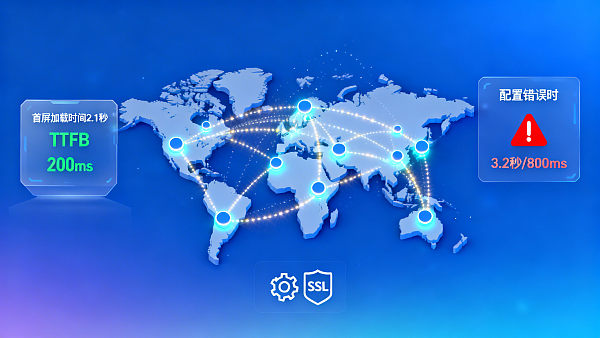
Critically, CDN must integrate deeply with HTTPS. Disabling HTTP/2 or misconfiguring OCSP Stapling doubles TLS handshake time; incomplete certificate chains or missing SNI settings trigger blank screens on older Android devices—issues detectable via EasyStore's AI site scanner (average diagnosis time <15 seconds).
2. Top 3 Configuration Pitfalls: 90% of Companies Are Affected
Based on 100,000+ enterprise cases, these misconfigurations are most damaging:
- Overgeneralized Caching: Applying "Cache-Control: public, max-age=3600" sitewide without differentiating HTML (should be no-cache), APIs (require no-store), or multilingual JS (needs Vary: Accept-Language).
- HTTPS Incompatibility: Using HTTP for CDN origins triggers mixed-content warnings; lacking HSTS preloading prevents secure protocol enforcement on first visits.
- Faulty Geo-Routing: Providers without BGP Anycast+GeoDNS may route requests to distant nodes instead of the lowest-latency option.
Below metrics show real-world impacts (data from EasyStore's Q3 2023 audit of 2,843 user sessions across the US, Germany, Brazil, and Japan):
While geographic misroutes occur less frequently, their per-incident impact is severe.
3. Vendor Selection: How CDN and HTTPS Solutions Work Together
When evaluating CDN providers, prioritize HTTPS integration over node count. EasyStore's AWS- and Alibaba-powered global nodes support automated SSL certificates (including Let’s Encrypt and commercial CAs), enforced OCSP Stapling, and HSTS preloading via Chrome's root program—ensuring trusted connections from the first visit.
For multilingual/multi-currency sites, EasyStore's built-in CDN dashboard monitors regional node hit rates (target ≥92%), cache error rates (alert threshold ≤3.5%), and HTTPS handshake success (industry baseline ≥99.8%). If hit rates dip below 85% for 2+ hours, the system auto-triggers routing recalibration.
CDN performance directly affects ad creatives. Optimized sites using EasyStore's CDN with Google Ads achieve 47% faster first-frame rendering, 19% higher CTR, and 320% more inquiries.

4. Optimization Loop: EasyStore's AI-Driven Workflow
EasyStore's AI engine delivers a 4-step "Detect-Diagnose-Fix-Validate" cycle:
- AI Scanning: Lighthouse 10.0-based PDF reports with 23 metrics in under 7 seconds.
- Root-Cause Analysis: Flags missing Vary headers or ETag conflicts, linking to specific code lines.
- One-Click Fixes: Generates Nginx/Apache snippets or pushes rules to Cloudflare/WAF consoles.
- Impact Tracking: Integrates with GA4 to compare FID (Interaction Delay) and CLS (Layout Shift) pre/post-optimization.
This process boosts average SEO scores by 35% and cuts global load times by 40%—e.g., reducing Latin American LCP from 4.7s to 1.9s.
As a Google Premier Partner and Meta agency, EasyStore synchronizes ad funnels: when CDN optimizations land pages in Google's "Good" Core Web Vitals range (LCP ≤2.5s), Google Ads accounts gain automatic quality score boosts, lowering CPA by 58% and achieving 1:8.7 ROI.
5. Action Plan: 3 Steps to Upgrade CDN Performance
For both technical and non-technical teams:
- Cache Audit: Run
curl -I https://yoursite.com | grep "Cache-Control"to verify HTML has no-cache headers. - HTTPS Check: Use https://www.ssllabs.com/ssltest/ to confirm A+ ratings, focusing on OCSP Stapling and HSTS.
- Geo-Routing Test: Compare Tokyo, Frankfurt, and São Paulo TTFB via WebPageTest.org; differences >150ms indicate issues.
For advanced audits, EasyStore offers free 7-day AI diagnostics covering 100+ technical parameters and 20+ business scenarios. Get your customized report to make your site outperform global expectations.
Related Articles

Related Products
 EasyCamp SaaS Smart Website Marketing SystemE-Yingbao SaaS Smart Website Marketing System: AI-powered, zero-code website building. Rapidly launch multilingual independent e-commerce sites in just 10 minutes. Global server acceleration and AI-driven SEO optimization empower businesses to efficiently connect with global markets. The seamless integration of technology and user-friendly operation makes building e-commerce sites incredibly simple.
 AI+SEM Intelligent Advertising Marketing SystemAI+SEM drives intelligent ad creation, empowering full-funnel precision advertising marketing. The system automatically generates weekly/monthly reports, AI recommends keywords and target countries, monitors core metrics in real-time with intelligent alerts, and enables one-click high-conversion ad solutions to help quickly acquire customers and improve ROI.
 AI+SEO Dual Engine Optimization ServiceEasyWin AI+SEO Dual Engine Optimization System leverages AI-powered keyword mining, content generation, and comprehensive technical optimization to help foreign trade enterprises acquire high-quality organic traffic, significantly improving search rankings and conversion rates.
 AI+SNS Social Media Marketing SystemYingbao AI+SNS Social Media Marketing System - Precision social capture for the social media era. Supports one-click content synchronization across major platforms like Facebook and LinkedIn. AI intelligently rewrites posts for enhanced relevance. 24/7 AI customer service and user profiling analysis empower businesses to efficiently expand into global markets.
 AI+SEO营销解决方案易营宝AI+SEO营销解决方案,通过AI批量写作、智能生成TDK、精准关键词扩词等功能,全面优化网站SEO效果,提升流量与转化率。助力企业构建高效智能网站新生态。
 AI+SEM Advertising Marketing SolutionsAI+SEM Advertising Marketing Solution leverages AI technology to deeply empower SEM ad campaigns. It automatically generates weekly/monthly reports using AI, presenting account data across multiple dimensions for comprehensive insights into campaign performance and trends. The system precisely recommends keywords and target countries, intelligently generates high-conversion ad copy, and enables one-click activation of efficient campaign plans to help businesses rapidly acquire customers. Simultaneously, it monitors core metrics in real time, intelligently identifies abnormal fluctuations, and issues timely alerts to ensure stable, high-return advertising results.
 Domain Name ServicesEasyWin provides professional domain name services, including intelligent queries, one-stop registration, brand protection, and full lifecycle management, helping businesses build a digital brand image.
 EasyOperate B2C Cross-Border E-Commerce Platform & Independent WebsiteEasyStore B2C Cross-border E-commerce Independent Store is an intelligent website building and cross-border e-commerce integrated solution independently developed by EasyStore Information Technology (Beijing) Co., Ltd. The system is specially designed for small and medium-sized as well as large export enterprises, integrating 'website building, operation, marketing, advertising, and conversion' into one, helping enterprises quickly establish cross-border e-commerce independent stores to achieve brand globalization and global sales growth.
The platform supports multiple languages, multiple currencies, and multi-channel marketing, with built-in AI intelligent translation and SEO optimization systems, suitable for mainstream markets such as Southeast Asia, Europe and America, Latin America, and the Middle East, assisting Chinese manufacturing enterprises in efficiently deploying international e-commerce strategies. SSL证书易营宝提供专业SSL安全证书服务,包括单域名和泛域名证书,确保网站数据传输加密、身份验证和完整性保护,助力企业建立安全可信的在线业务环境。









