









- What multilingual website services are available in Sanya? Which model is more suitable for local businesses going global?Jul 08, 2026View details
- How to view the complete list of China SaaS companies in the top 100? Practical methods for screening website-building and marketing service providersJul 08, 2026View details
- How to view pricing in the global traffic ecosystem? Cost comparison of search, social media, and content channel advertisingJul 06, 2026View details
- How to assess foreign trade website development trends?Looking at 2026 changes from multilingual,AI content to conversion pathsJul 04, 2026View details
- What are the new trends in multilingual marketing data analytics tools in 2026? Focus on attribution、automation and complianceJul 04, 2026View details
- Is Brand Globalization Marketing Consulting Worth Buying? At What Stage Should Companies Bring It InJul 01, 2026View details
- Cross-Border Marketing Trend Research: Why More and More Companies Are Starting to Deploy AI Search and GEO OptimizationJun 30, 2026View details
- Cross-Border Marketing Trend Research: How Independent Sites, AI Content, and Short-Video Customer Acquisition Are ChangingJun 30, 2026View details
What deliverables should be confirmed before outsourcing website optimization
Before outsourcing website optimization, the first thing procurement personnel should confirm is not the price level, but whether the deliverables are clear, whether the boundaries are well-defined, and whether the results can be accepted and verified. For most companies, website optimization is not about buying a “service promise,” but procuring an executable, trackable, and reviewable growth solution.
If the deliverables, execution frequency, data definitions, stage goals, and after-sales support are not clearly documented before cooperation begins, problems such as “a lot was done but the value cannot be clearly explained,” “ranking fluctuations cannot be traced for accountability,” and “the vendor and business department have inconsistent understandings” are very likely to arise later, ultimately affecting the ROI of website optimization.
Before purchasing website optimization services, first determine what exactly the other party will deliver
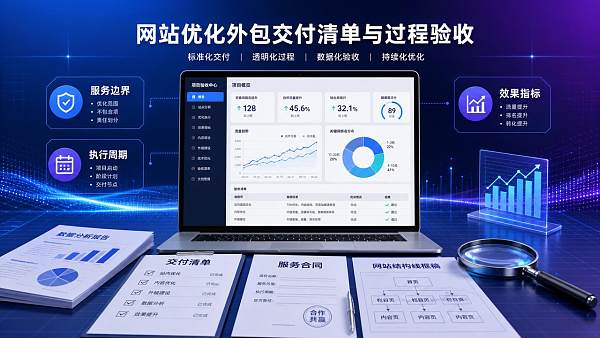
From a procurement perspective, the core search intent behind outsourcing website optimization is actually not to learn SEO concepts, but to know which deliverables need to be confirmed before signing the contract, so as to control risks, facilitate price comparison, and ensure the service can truly be implemented.
Procurement personnel usually care most about four things: whether the service scope is complete, whether performance metrics can be quantified, whether the execution process is transparent, and who is responsible if problems occur. Only by establishing acceptance standards around these four points can outsourcing cooperation avoid getting out of control.
Therefore, the main text should not stay at broad introductions such as “what website optimization is,” but should focus on contract terms, deliverable lists, timelines, reporting mechanisms, risk boundaries, and acceptance methods, because these are the things that truly help procurement make decisions.
Item 1: Confirm the service boundaries of website optimization outsourcing to avoid continuous scope additions later
When many companies purchase website optimization services, the thing they most easily overlook is boundary definition. The “website optimization” mentioned by vendors may only include keyword placement and content recommendations, or it may also include technical adjustments, backlink building, page revamps, and even data analysis.
If the scope is not clearly written before signing, common disputes later include: who will handle technical modifications, who will provide articles, whether landing pages will be restructured, whether old site issues will be fixed, and whether multilingual sites are included. If the boundaries are unclear, even a low price may turn into a high-cost cooperation.
It is recommended that procurement break down deliverables into several modules for confirmation: on-page optimization, technical SEO, content optimization, keyword strategy, backlinks or brand exposure, data monitoring, and monthly reviews. For each module, it should be clearly stated “what will be done, what will not be done, and to what extent it will be done.”
Technical items in particular should be questioned in detail. For example, whether website speed optimization, broken link handling, title and meta description standards, structured data, mobile adaptation, and indexing issue troubleshooting are included. If the vendor only provides recommendations but is not responsible for driving implementation, this should also be clearly stated in the contract.
Item 2: Confirm whether the deliverable list is specific enough to reach the “verifiable for acceptance” level
What procurement fears most is vague wording such as “continuous monthly optimization.” It sounds broad in coverage, but when it comes to acceptance, it is difficult to prove whether the other party has completed the agreed work. The key to judging whether a vendor is professional lies in whether the deliverable list can be detailed enough to be inspected.
For example, keyword research should not simply say “complete keyword placement,” but should clearly output a keyword hierarchy table, strategies for core keywords and long-tail keywords, corresponding page recommendations, and competition analysis. Page optimization should also not simply say “optimize pages,” but should specify the number of pages and the optimization items.
Content deliverables also need to be clear. Is the output monthly topic suggestions and content outlines, or direct article writing? The number of articles, word count range, number of revisions, and whether publishing support is included all need to be confirmed in advance. Otherwise, the content part is the most likely area to create a responsibility gap.
If the company has relatively standardized processes, it can also require the vendor to provide a project-management-style checklist. When evaluating marketing services, many mature procurement teams refer to methodologies such as Research on Building an Internal Control System for Public Institutions Based on Risk Prevention and Control, which emphasize process and risk control, and the core logic is equally applicable to outsourced project management.
Item 3: Confirm the execution cycle and stage goals, and do not treat short-term fluctuations as delivery failure
Website optimization itself is cyclical, especially for new sites, revamped sites, and websites with weak indexing foundations, where it is impossible to see stable ranking improvements within a very short period. During negotiations, procurement must require the service provider to give a reasonable timeline, rather than only listening to promises like “quickly reach the first page.”
A more practical approach is to split the cooperation into stage goals. For example, complete diagnosis and repair plans in the first month, complete optimization of key pages and keyword deployment in the second month, and start observing changes in indexing, rankings, traffic, and inquiries in the third month. This is more conducive to process management.
If the vendor only promises results without explaining the process, the risk is actually higher. This is because website optimization is affected by multiple factors such as industry competition, site foundation, content update frequency, technical permissions, and brand foundation. Without a stage plan, it is ultimately difficult to determine which link the problem lies in.
Before signing, procurement should specifically confirm: what fixed actions will be carried out each month, what reports will be delivered at each stage, how delays will be remedied, and what cooperation items Party A needs to provide. Clearly documenting the execution rhythm in advance is more effective at ensuring smooth project progress than simply pushing down the price.
Item 4: Confirm performance metrics and data definitions to avoid “everyone speaking from their own perspective”
The most common dispute in website optimization cooperation is not whether work was done, but that both parties have different understandings of “results.” The vendor may emphasize indexing growth and the number of keywords, the business department may care more about valid traffic and inquiry conversions, while procurement needs verifiable acceptance evidence.
Therefore, performance metrics must be unified in advance. Common trackable metrics include: changes in target keyword rankings, growth in organic traffic, indexing volume, page impressions, click-through rate, bounce rate, conversion performance of key pages, as well as changes in inquiry leads or form submissions.
At the same time, the data source must be confirmed. Will GA, Search Console, webmaster tools, or the company’s own analytics system be used as the standard? If the definitions differ across different tools, which platform will serve as the basis for contract acceptance? These issues are best clarified once and for all before the cooperation begins.
It should also be noted that it is not recommended to use “guaranteed No.1 ranking” as the sole procurement criterion. Truly professional website optimization services place more emphasis on sustainable traffic growth, high-quality page development, and the accumulation of search assets, rather than short-term ranking promises. Procurement should also be able to identify such high-risk sales language.
Item 5: Confirm who is responsible for execution, and do not end up buying only a plan without implementation capability
Some vendors create very impressive proposals in the early stage, but in actual execution, the project is handled by inexperienced newcomers, or relies only on templated operations, resulting in outcomes that differ greatly from the proposal. Procurement cannot only look at the company introduction, but must also assess the project team and role allocation.
It is recommended to confirm whether at least four types of roles are clearly defined: project manager, SEO strategist, content executor, and technical support personnel. If cross-language or overseas business is involved, it is also necessary to see whether they have the capability for localized content and an understanding of local search habits, as this has a major impact on results.
For companies with strong integrated website + marketing service needs, simply improving rankings is no longer enough. It is more suitable to choose a team that understands both website architecture and traffic acquisition and conversion paths. Only in this way can website optimization work in coordination with content, advertising, and social media, rather than being executed in isolation.
For companies like Easy Business Treasure that have long been deeply engaged in full-chain services covering smart website building, SEO optimization, social media marketing, and advertising placement, the advantage lies in being able to advance collaboratively across three levels—website foundation, technical capability, and marketing conversion—rather than merely performing superficial optimization actions.
Item 6: Confirm after-sales support and risk-handling mechanisms to avoid having no response after problems occur
Purchasing website optimization services is not only about buying execution, but also about buying ongoing service capability. During cooperation, issues such as algorithm fluctuations, page anomalies, traffic decline, accidental content deletion, and technical revamps affecting indexing often occur. Without an after-sales mechanism, the losses are often borne by Party A itself.
Therefore, it is necessary to confirm in advance: whether there is a fixed communication contact, how long the issue response time is, whether monthly meetings or weekly reports are provided, whether major anomalies trigger proactive alerts, and whether page changes during the cooperation period will be reviewed synchronously. The more mature the vendor, the more importance they attach to these institutional arrangements.
If the company’s internal procurement process emphasizes risk control, the vendor’s incident-handling capability can also be included as an evaluation item. Because what truly affects cooperation quality is often not the smooth stages, but whether the other party can quickly identify the cause and provide a remedy plan when ranking fluctuations or traffic declines occur.
Likewise, when process governance and responsibility allocation are involved, some procurement teams also draw on approaches such as Research on Building an Internal Control System for Public Institutions Based on Risk Prevention and Control, layering responsibilities, approvals, execution, and feedback to improve the controllability of outsourced projects.
Item 7: During procurement evaluation, it is recommended to use this deliverable checklist
To facilitate practical operation, when comparing website optimization vendors, procurement personnel can focus on checking the following: whether there is a complete diagnostic report, whether there is a clear keyword strategy, whether the number of optimized pages is listed, whether technical items are included, and whether there are content delivery standards.
Looking further, it should also be confirmed whether there is a monthly execution plan, whether data dashboards and reporting frequency are agreed upon, whether acceptance metrics are clearly defined, whether cooperation items for both Party A and Party B are defined, whether anomaly fluctuation handling mechanisms are explained, and whether excluded service contents are listed.
If most of the above items can only receive verbal responses, or the vendor is consistently unwilling to form a written checklist, it indicates that its level of standardization and delivery transparency is insufficient. For procurement, such projects usually have higher management costs later and may even be difficult to pass internal review.
Conversely, the clearer the deliverables, the easier it is to compare vendors. Because what is truly worth comparing is not simply the quotation, but under the same budget, who can provide a more complete website optimization path, clearer process management, and more stable result assurance.
Conclusion: When purchasing website optimization services, review deliverables first, then discuss price
For procurement personnel, the most important action before outsourcing website optimization is not to be attracted by “low-price packages” or “ranking promises,” but to confirm the delivery scope, execution cycle, performance metrics, team configuration, and after-sales mechanism item by item, forming a practical basis for cooperation.
As long as the deliverables are clear enough, website optimization can be transformed from a vague service into a manageable project; as long as the acceptance standards are clear enough, procurement can better control risks, promote internal coordination, and make every optimization investment closer to real growth value.
Ultimately, a good website optimization partnership is not one where the vendor says a lot was done, but one where procurement, the business team, and the service provider can all clearly see: what was done, why it was done, to what extent it was done, and what changes it brought. This is the kind of website optimization outsourcing service worth signing for.
Related Articles
 What multilingual website services are available in Sanya? Which model is more suitable for local businesses going global?
 How to view the complete list of China SaaS companies in the top 100? Practical methods for screening website-building and marketing service providers
 There are so many used heavy-duty construction machines for foreign trade. How exactly should we acquire customers?


Related Products
 EasyCamp SaaS Smart Website Marketing SystemE-Yingbao SaaS Smart Website Marketing System: AI-powered, zero-code website building. Rapidly launch multilingual independent e-commerce sites in just 10 minutes. Global server acceleration and AI-driven SEO optimization empower businesses to efficiently connect with global markets. The seamless integration of technology and user-friendly operation makes building e-commerce sites incredibly simple.
 AI+SEM Intelligent Advertising Marketing SystemAI+SEM drives intelligent ad creation, empowering full-funnel precision advertising marketing. The system automatically generates weekly/monthly reports, AI recommends keywords and target countries, monitors core metrics in real-time with intelligent alerts, and enables one-click high-conversion ad solutions to help quickly acquire customers and improve ROI.
 AI+SEO Dual Engine Optimization ServiceEasyWin AI+SEO Dual Engine Optimization System leverages AI-powered keyword mining, content generation, and comprehensive technical optimization to help foreign trade enterprises acquire high-quality organic traffic, significantly improving search rankings and conversion rates.
 AI+SNS Social Media Marketing SystemYingbao AI+SNS Social Media Marketing System - Precision social capture for the social media era. Supports one-click content synchronization across major platforms like Facebook and LinkedIn. AI intelligently rewrites posts for enhanced relevance. 24/7 AI customer service and user profiling analysis empower businesses to efficiently expand into global markets.
 AI+SEO营销解决方案易营宝AI+SEO营销解决方案,通过AI批量写作、智能生成TDK、精准关键词扩词等功能,全面优化网站SEO效果,提升流量与转化率。助力企业构建高效智能网站新生态。
 AI+SEM Advertising Marketing SolutionsAI+SEM Advertising Marketing Solution leverages AI technology to deeply empower SEM ad campaigns. It automatically generates weekly/monthly reports using AI, presenting account data across multiple dimensions for comprehensive insights into campaign performance and trends. The system precisely recommends keywords and target countries, intelligently generates high-conversion ad copy, and enables one-click activation of efficient campaign plans to help businesses rapidly acquire customers. Simultaneously, it monitors core metrics in real time, intelligently identifies abnormal fluctuations, and issues timely alerts to ensure stable, high-return advertising results.
 Domain Name ServicesEasyWin provides professional domain name services, including intelligent queries, one-stop registration, brand protection, and full lifecycle management, helping businesses build a digital brand image.
 EasyOperate B2C Cross-Border E-Commerce Platform & Independent WebsiteEasyStore B2C Cross-border E-commerce Independent Store is an intelligent website building and cross-border e-commerce integrated solution independently developed by EasyStore Information Technology (Beijing) Co., Ltd. The system is specially designed for small and medium-sized as well as large export enterprises, integrating 'website building, operation, marketing, advertising, and conversion' into one, helping enterprises quickly establish cross-border e-commerce independent stores to achieve brand globalization and global sales growth.
The platform supports multiple languages, multiple currencies, and multi-channel marketing, with built-in AI intelligent translation and SEO optimization systems, suitable for mainstream markets such as Southeast Asia, Europe and America, Latin America, and the Middle East, assisting Chinese manufacturing enterprises in efficiently deploying international e-commerce strategies. SSL证书易营宝提供专业SSL安全证书服务,包括单域名和泛域名证书,确保网站数据传输加密、身份验证和完整性保护,助力企业建立安全可信的在线业务环境。









