









- What should you focus on in the latest enterprise SaaS report? From renewal rates and delivery costs to overseas growth opportunitiesJul 12, 2026View details
- What signals are worth paying attention to in a cross-border marketing trend report? B2B companies should look at these 6 signalsJul 11, 2026View details
- How to Read a Cross-Border Marketing Trends Report? Five Key Dimensions for Evaluating Channel OpportunitiesJul 11, 2026View details
- Which channel has the highest ROI in the global traffic ecosystem? Comparative analysis of search, social media, and advertisingJul 10, 2026View details
- What multilingual website services are available in Sanya? Which model is more suitable for local businesses going global?Jul 08, 2026View details
- How to view the complete list of China SaaS companies in the top 100? Practical methods for screening website-building and marketing service providersJul 08, 2026View details
- How to view pricing in the global traffic ecosystem? Cost comparison of search, social media, and content channel advertisingJul 06, 2026View details
- How to assess foreign trade website development trends?Looking at 2026 changes from multilingual,AI content to conversion pathsJul 04, 2026View details
Why Website Design Style Affects Conversion Rates
Website design style is not just an aesthetic issue; it more directly affects user trust, dwell time, and inquiry conversion. This article will combine website design style, search engine optimization services, and website traffic analytics tools to explain why good design is more capable of driving growth.
Why do similar traffic levels lead to vastly different conversion results?
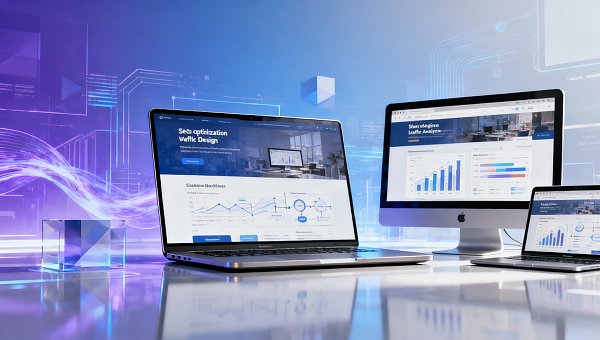
Many companies treat their websites as brochures, but in an integrated website + marketing services scenario, the website is actually the core touchpoint in the customer acquisition journey. From the moment a user enters the homepage to submitting a form, it often takes only 30 seconds to 3 minutes. Whether the design style is clear, professional, and trustworthy will directly affect this critical decision-making window.
For information researchers and technical evaluators, whether the page structure is easy to read, whether the navigation is accurate, and whether cases and capabilities are visible at a glance determine whether they will continue digging deeper. For business decision-makers, whether the style matches the industry often tends to be directly equated with the supplier’s level of professionalism and execution capability.
If the website design style is inconsistent with the business positioning, typical problems such as high bounce rates, low dwell time, and few inquiries will appear. For example, industrial clients tend to value standards, parameters, processes, and a sense of delivery assurance, but if the page is overly entertainment-oriented, users will form the judgment of “not stable enough” within the first 10 seconds.
Easimon Information Technology (Beijing) Co., Ltd. has been deeply engaged in digital marketing for ten years, with services covering smart website building, SEO optimization, social media marketing, and advertising placement, and understands the browsing intent of different audiences at different stages. Design style is not completed in isolation, but needs to advance in coordination with keyword layout, content paths, and data tracking in order to truly convert traffic into business opportunities.
4 core mechanisms by which website design style affects conversion rates
- Above-the-fold judgment mechanism: users usually form a first impression within 3 seconds to 8 seconds, determining whether they continue browsing.
- Trust-building mechanism: color scheme, layout, case presentation, and qualification descriptions affect the perception of reliability.
- Decision-guidance mechanism: button placement, content hierarchy, and the number of conversion entry points affect whether the inquiry path is smooth.
- Search collaboration mechanism: a clearly structured design is more conducive to search engines understanding the page topic and also makes it easier for users to read.
These 4 mechanisms may seem like design details, but in fact they are related to procurement lead quality, sales follow-up efficiency, and subsequent transaction costs. For project managers, after-sales maintenance personnel, and even agents, a website with a stable structure and complete information can also reduce repeated communication and ineffective inquiries.
Where do different design styles lead users?
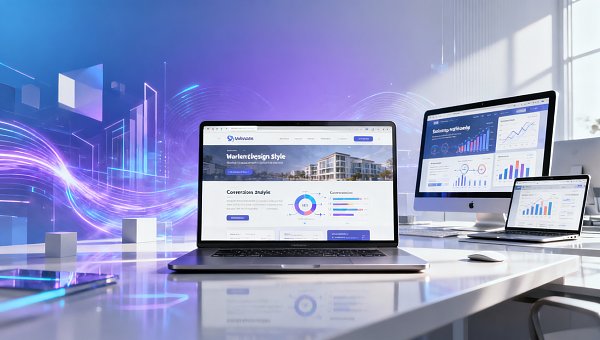
In actual website building, website design style is not simply the more “visually appealing” the better, but should match the industry, customer acquisition goals, and user identities. This is especially true for B2B service websites, because visitors are often not impulse buyers, but leave leads only after going through 4 stages: research, evaluation, comparison, and review.
The following table is suitable for companies to make a preliminary judgment before redesigning: is your website better suited to a brand showcase type, a conversion-oriented type, or an integrated type that also takes search-driven acquisition into account? Different choices will also create obvious differences in the data performance of website traffic analytics tools.
As can be seen from the table, what truly affects conversion rates is not a single visual element, but whether the design style serves the business goals. Usually, 2 weeks to 4 weeks after a website goes live, metrics such as heatmaps, bounce paths, and button click-through rates can reveal whether the style matches user intent.
Which roles are most easily affected by website style?
Technical evaluators pay more attention to whether the page provides solution logic, implementation processes, compatibility explanations, and data interface descriptions; business decision-makers care more about brand stability, past service capability, and risk controllability; end consumers are more affected by visual usability and the clarity of action entry points.
When dealers, distributors, and agents visit a website, they usually focus on cooperation models, regional support, delivery capabilities, and ongoing operational support. If this information is buried too deeply, even if the website has traffic, it will still be difficult to generate high-quality partnership inquiries.
Some companies also integrate knowledge-based content into the site to serve the long-term decision-making of specific groups. For example, content pages centered on topics such as management optimization and digital transformation can extend user dwell time and enhance professionalism. Content-type pages like How to optimize personnel and labor management in public institutions in the digital economy era, if their design style is consistent with the logic of the main site, can also capture search traffic and improve trust within the site.
When purchasing or redesigning, which metrics should be prioritized?
For companies preparing to build a new website or rebuild their official site, the most common misconception is to look only at page mockups and not at subsequent operational capabilities. In fact, a website suitable for conversion should at least simultaneously meet 3 types of core metrics: search visibility, user experience, and lead handling efficiency.
If a supplier can only deliver pages without considering SEO architecture, content expansion, and data feedback, then after the website goes live it will often fall into the trap of “looks usable but isn’t.” This is also why more and more companies choose integrated website + marketing service solutions instead of handing website building, optimization, and ad placement to different teams separately.
The following table is suitable for use by project owners, quality control personnel, and procurement decision-makers, and can be directly used as an evaluation checklist during communication with suppliers. Usually, the preliminary review can be divided into 5 inspection items, and formal acceptance can be expanded to 6 items, including page standards, tracking tags, form logic, mobile adaptation, and more.
The dimensions in the table may seem basic, but they directly determine whether the website can generate long-term value. If a page looks beautiful but has no tracking tags, it will be impossible later to determine whether the issue lies in the headline, the button, or a mismatch in the traffic channel, and optimization will lose direction.
It is recommended to follow a 4-step process when implementing a redesign
- First, conduct a current-state diagnosis: review the pages visited, bounce rate, conversion entry points, and search term distribution over the past 30 days to 90 days.
- Then perform user segmentation: distinguish the content needs and entry sequence of information researchers, technical evaluators, and decision-makers.
- Then determine the design style and content framework: unify the visual language, copy tone, CTA placement, and page hierarchy.
- Finally, carry out data review: after launch, check the performance of core pages and iterate on day 7, day 15, and day 30 respectively.
Easimon’s advantage lies not only in page presentation, but also in integrating smart website building, SEO optimization, advertising placement, and social media communication. In this way, design style will not remain at the “visual draft stage,” but will truly be transformed into an operable, trackable, and scalable growth asset.
Common business misconception: if the page is very refined, why doesn’t it still convert?
The first misconception is equating “premium feel” with “high conversion.” Many companies place a large number of full-screen visuals on the homepage, yet fail to provide industry scenarios, service scope, cooperation process, and clear entry points. Users can sense the brand image, but do not know what to do next, so inquiries naturally decrease.
The second misconception is neglecting mobile. At present, many industry visitors first conduct initial screening on mobile devices and then browse in depth on desktops. If users still cannot see the core value proposition on the mobile first screen after more than 2 swipes, or if the form-filling experience is poor, the first round of potential customers will be lost directly.
The third misconception is focusing only on visits and not on effective behavior. Truly valuable metrics are not just UV, but also include page dwell time, scroll depth, clicks on inquiry buttons, document downloads, and form completion rates. The role of website traffic analytics tools is precisely to turn “someone viewed it” into “what they viewed, why they left, and how to improve.”
The fourth misconception is a disconnect between content and style. For example, if a technical service page uses light and playful copy and graphics, or if a security and compliance scenario page lacks process diagrams, timelines, and delivery boundary explanations, quality control personnel and project owners will develop doubts about execution stability.
FAQ: the questions users ask most often
How long does it take for website design style to affect conversion data?
If the website already has stable traffic, changes in bounce rate, dwell time, and key page clicks can usually be seen within 7 days to 15 days after the redesign goes live; if you want to observe inquiry volume and lead quality, it is recommended to monitor continuously for at least 2 weeks to 6 weeks and evaluate together with traffic sources.
Is a simpler website design style always better?
Not necessarily. Simplicity is suitable for reducing comprehension costs, but if the target audience is technical evaluators, engineering project owners, or procurement teams, the page still needs to supplement parameters, processes, service boundaries, and frequently asked questions. What is truly effective is “clear structure,” not blindly cutting information.
What is the relationship between search engine optimization services and design style?
The relationship is very direct. Design style affects page hierarchy, heading structure, content readability, internal link distribution, and mobile experience, and all of these affect how search understands the page and user behavior data. In other words, good style does not replace optimization; it makes optimization easier to be effective.
Should content pages have a unified style with the official website?
It is recommended to keep them unified. Whether it is knowledge articles, topic pages, or content entry pages such as How to optimize personnel and labor management in public institutions in the digital economy era, as long as the style, navigation, and conversion entry points are consistent, users will find it easier to build continuous trust and move from reading into the consultation or solution discussion stage.
Why choose us: we don’t just build websites, we help you turn traffic into business opportunities
For companies that need to balance brand presentation, search-driven customer acquisition, and sales conversion, simply creating a “good-looking website” is no longer enough. The more practical needs are: can the pages support SEO content layout, can they connect to website traffic analytics tools, and can they form a closed loop from click to inquiry?
Easimon Information Technology (Beijing) Co., Ltd., driven by artificial intelligence and big data at its core, has long served global growth needs and can unify the planning of smart website building, SEO optimization, social media marketing, and advertising placement. This not only reduces information loss caused by multi-team collaboration, but is also more conducive to continuously optimizing conversion performance within 1 quarter to 2 quarters.
If you are evaluating whether your website design style needs adjustment, or preparing to build a new marketing-oriented official website, it is recommended to first confirm the following: who the target customers are, which the key pages are, which type of conversion you hope to improve, whether the delivery cycle requirement is 2 weeks, 4 weeks, or longer, and whether multilingual and localization service support is needed.
You can further consult on page structure planning, keyword layout, website redesign priorities, forms and inquiry paths, mobile adaptation, data tracking setup, delivery cycles, and customized solutions. Only by putting design style back into the context of business goals can a website truly upgrade from an “online business card” to a marketing asset for sustained growth.
Related Articles
Related Products
 EasyCamp SaaS Smart Website Marketing SystemE-Yingbao SaaS Smart Website Marketing System: AI-powered, zero-code website building. Rapidly launch multilingual independent e-commerce sites in just 10 minutes. Global server acceleration and AI-driven SEO optimization empower businesses to efficiently connect with global markets. The seamless integration of technology and user-friendly operation makes building e-commerce sites incredibly simple.
 AI+SEM Intelligent Advertising Marketing SystemAI+SEM drives intelligent ad creation, empowering full-funnel precision advertising marketing. The system automatically generates weekly/monthly reports, AI recommends keywords and target countries, monitors core metrics in real-time with intelligent alerts, and enables one-click high-conversion ad solutions to help quickly acquire customers and improve ROI.
 AI+SEO Dual Engine Optimization ServiceEasyWin AI+SEO Dual Engine Optimization System leverages AI-powered keyword mining, content generation, and comprehensive technical optimization to help foreign trade enterprises acquire high-quality organic traffic, significantly improving search rankings and conversion rates.
 AI+SNS Social Media Marketing SystemYingbao AI+SNS Social Media Marketing System - Precision social capture for the social media era. Supports one-click content synchronization across major platforms like Facebook and LinkedIn. AI intelligently rewrites posts for enhanced relevance. 24/7 AI customer service and user profiling analysis empower businesses to efficiently expand into global markets.
 AI+SEO营销解决方案易营宝AI+SEO营销解决方案,通过AI批量写作、智能生成TDK、精准关键词扩词等功能,全面优化网站SEO效果,提升流量与转化率。助力企业构建高效智能网站新生态。
 AI+SEM Advertising Marketing SolutionsAI+SEM Advertising Marketing Solution leverages AI technology to deeply empower SEM ad campaigns. It automatically generates weekly/monthly reports using AI, presenting account data across multiple dimensions for comprehensive insights into campaign performance and trends. The system precisely recommends keywords and target countries, intelligently generates high-conversion ad copy, and enables one-click activation of efficient campaign plans to help businesses rapidly acquire customers. Simultaneously, it monitors core metrics in real time, intelligently identifies abnormal fluctuations, and issues timely alerts to ensure stable, high-return advertising results.
 Domain Name ServicesEasyWin provides professional domain name services, including intelligent queries, one-stop registration, brand protection, and full lifecycle management, helping businesses build a digital brand image.
 EasyOperate B2C Cross-Border E-Commerce Platform & Independent WebsiteEasyStore B2C Cross-border E-commerce Independent Store is an intelligent website building and cross-border e-commerce integrated solution independently developed by EasyStore Information Technology (Beijing) Co., Ltd. The system is specially designed for small and medium-sized as well as large export enterprises, integrating 'website building, operation, marketing, advertising, and conversion' into one, helping enterprises quickly establish cross-border e-commerce independent stores to achieve brand globalization and global sales growth.
The platform supports multiple languages, multiple currencies, and multi-channel marketing, with built-in AI intelligent translation and SEO optimization systems, suitable for mainstream markets such as Southeast Asia, Europe and America, Latin America, and the Middle East, assisting Chinese manufacturing enterprises in efficiently deploying international e-commerce strategies. SSL证书易营宝提供专业SSL安全证书服务,包括单域名和泛域名证书,确保网站数据传输加密、身份验证和完整性保护,助力企业建立安全可信的在线业务环境。









