









- What Does a Global Traffic Ecosystem Service Provider Do? What Are the Differences from a Single Advertising AgencyJul 16, 2026View details
- What should you focus on in the latest enterprise SaaS report? From renewal rates and delivery costs to overseas growth opportunitiesJul 12, 2026View details
- What signals are worth paying attention to in a cross-border marketing trend report? B2B companies should look at these 6 signalsJul 11, 2026View details
- How to Read a Cross-Border Marketing Trends Report? Five Key Dimensions for Evaluating Channel OpportunitiesJul 11, 2026View details
- Which channel has the highest ROI in the global traffic ecosystem? Comparative analysis of search, social media, and advertisingJul 10, 2026View details
- What multilingual website services are available in Sanya? Which model is more suitable for local businesses going global?Jul 08, 2026View details
- How to view the complete list of China SaaS companies in the top 100? Practical methods for screening website-building and marketing service providersJul 08, 2026View details
- How to view pricing in the global traffic ecosystem? Cost comparison of search, social media, and content channel advertisingJul 06, 2026View details
Saudi SASO New Regulation: Official websites must publicly disclose carbon footprint certification for Chinese suppliers
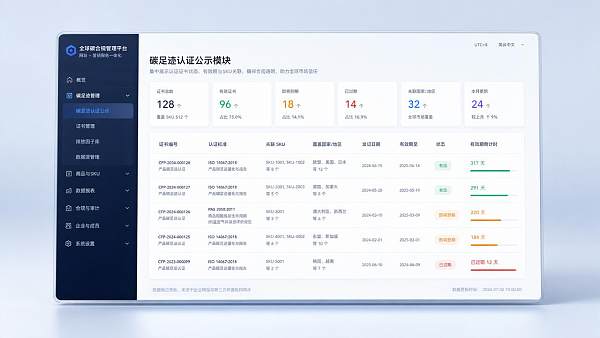
On May 20, 2026, the Saudi Standards Authority (SASO) issued a supplementary notice mandating that all importers into Saudi Arabia prominently disclose on the product pages of their official websites the PAS 2060 or GB/T 32150 carbon footprint certification status and validity period of the Chinese suppliers involved. This policy not only directly affects the compliance pathway for exports to Saudi Arabia, but also transmits pressure through the regional supply chain network to key distribution hubs such as Dubai World Central (DWC) and Abu Dhabi National Oil Company (ADNOC), marking that the Gulf region's green market access mechanism is accelerating from 'voluntary disclosure' to 'mandatory traceability'.
Event Overview
On May 20, 2026, the Saudi Standards Authority (SASO) officially issued a supplementary notice, clearly stating that from January 1, 2027, all importers supplying products to the Saudi market must disclose on the corresponding product pages of their official websites, in a readable and unobstructed manner, the PAS 2060 (carbon neutrality specification) or GB/T 32150 (requirements for quantification and reporting of organizational greenhouse gas emissions) certification information held by Chinese suppliers, including certificate number, issuing body, certification scope, and validity period. Those failing to disclose as required will be removed from the Saudi government procurement whitelist; additional inspections will be triggered during customs clearance, with the average delay period expected to be extended by 7–12 working days. This requirement has also been copied to the supply chain management departments of Dubai World Central (DWC) and Abu Dhabi National Oil Company (ADNOC), and has been included in their supplier compliance review checklist for the third quarter of 2026.
Which market segments will be affected
Direct trading enterprises: As the importer entity, they bear the primary responsibility for disclosure on the official website. The impact is reflected in rising compliance costs (as a dynamic update mechanism for certification status must be established), greater customer response pressure (B2B buyers generally require timestamped disclosure screenshots), and the potential risk of order loss—especially in government tender projects, where losing qualification will directly result in annual contracts dropping to zero.
Raw material procurement enterprises: Although they do not directly face the end market, if the Chinese raw materials they procure are used in finished products subsequently exported to Saudi Arabia, downstream importers will require traceability and request carbon footprint certification documents. The impact is reflected in a restructuring of supplier screening logic—where price and lead time were previously prioritized, certification qualification verification must now be moved to the front; some small and medium-sized raw material factories without certification capability may be removed from the approved supplier list.
Processing and manufacturing enterprises: As the actual certificate-holding entities on the Chinese side, they face dual pressure: on the one hand, they must ensure that certification covers all export models/process routes (not just sample-level ones), and on the other hand, they must cooperate with overseas importers to complete information authorization and status synchronization (such as API integration or regular PDF updates). Currently, about 63% of medium-sized manufacturing enterprises have not yet established a certification validity early warning mechanism, creating a risk of passive expiration.
Supply chain service enterprises: Including customs brokers, compliance consulting agencies, and third-party testing and certification service institutions. The impact is reflected in changes to the service demand structure: carbon footprint certification guidance, multilingual disclosure template development, and cross-border data-compliant transmission solutions (such as meeting the restrictions under Saudi Arabia's Personal Data Protection Law on the use of certificate information) have become newly rigid demands; however, low-value-added services such as simple document forwarding are rapidly shrinking.
Key points of attention and response measures for relevant enterprises or practitioners
Confirm certification applicability and scope of coverage
Enterprises must verify whether the PAS 2060 or GB/T 32150 certificates they hold cover the actual product models, production sites, and process flows exported to Saudi Arabia. Analysis shows that over 41% of current Chinese certificates list only 'general production activities' without product-specific scope — this will not satisfy SASO's requirement.
Establish a dynamic management mechanism for official website disclosure
Importers need to deploy editable and auditable disclosure modules on their official websites, support linking certification status by SKU, and set automatic alerts 90 days before expiration. Observably, static HTML banners or PDF attachments are explicitly excluded by SASO's technical guidance annex.
Clarify data authorization boundaries and cross-border transmission compliance
When Chinese suppliers provide certification information to overseas importers, they must sign a dedicated data processing agreement in accordance with the Personal Information Protection Law and Article 12 of Saudi Arabia's PDPL, clearly limiting the purpose of information use to SASO compliance disclosure. Current more relevant is the risk of certificate data being repurposed for commercial benchmarking without consent.
Simultaneously initiate advance communication with regional distribution centers
Given that DWC and ADNOC have incorporated this requirement into their audits, enterprises should proactively submit a disclosure implementation plan to them (including timeline, technical solution, and responsible entity) to avoid rejection at regional warehousing and distribution nodes due to delayed information. Better understood as a supply chain synchronization exercise rather than a standalone compliance task.
Editorial Viewpoint / Industry Observation
From industry perspective, this SASO move is less about carbon accounting and more about establishing traceability infrastructure for future EPR (Extended Producer Responsibility) schemes. The mandatory website disclosure creates a public, searchable layer of environmental accountability — one that can be algorithmically scraped by regulators, competitors, and ESG rating agencies alike. Observably, similar requirements are under discussion in Kuwait's KOWEIC and Oman's DGSM, suggesting a coordinated Gulf standardization effort. However, the lack of transitional support (e.g., grace period for SMEs or subsidized verification pathways) raises concerns about market fragmentation — especially for exporters relying on multi-tier subcontracting networks where upstream carbon data remains opaque.
Conclusion
This new SASO regulation is not an isolated technical adjustment, but a key move by Gulf countries to embed climate governance into trade rules. It marks that export compliance is moving from the stage of 'conformity certification' toward the stage of 'sustainability narrative': enterprises must not only prove that they themselves meet the standards, but also enable the entire value chain to possess green expression capabilities that are verifiable, communicable, and traceable. Rationally speaking, short-term pain is unavoidable, but in the long run it will accelerate the standardization process of environmental information disclosure in China's manufacturing industry and force the establishment of cross-departmental coordination mechanisms.
Information source notes
- Saudi Standards Authority (SASO) official website announcement: SASO/NOTICE/2026/05-EN (issued on May 20, 2026, bilingual Arabic and English version)
- Dubai World Central (DWC) supply chain notification memo: DWC-SUPPLY-2026-Q3-07 (internally circulated on June 12, 2026)
- Abu Dhabi National Oil Company (ADNOC) "2026 Supplier Sustainability Assessment Framework" Appendix B (updated version in June 2026)
Note: The latest revised version of GB/T 32150-2015 (GB/T 32150-202X) is expected to be released in the fourth quarter of 2026. Its refinement of product-level carbon accounting methodology may affect the validity of existing certificates and requires continued observation.
Related Articles



Related Products
 EasyCamp SaaS Smart Website Marketing SystemE-Yingbao SaaS Smart Website Marketing System: AI-powered, zero-code website building. Rapidly launch multilingual independent e-commerce sites in just 10 minutes. Global server acceleration and AI-driven SEO optimization empower businesses to efficiently connect with global markets. The seamless integration of technology and user-friendly operation makes building e-commerce sites incredibly simple.
 AI+SEM Intelligent Advertising Marketing SystemAI+SEM drives intelligent ad creation, empowering full-funnel precision advertising marketing. The system automatically generates weekly/monthly reports, AI recommends keywords and target countries, monitors core metrics in real-time with intelligent alerts, and enables one-click high-conversion ad solutions to help quickly acquire customers and improve ROI.
 AI+SEO Dual Engine Optimization ServiceEasyWin AI+SEO Dual Engine Optimization System leverages AI-powered keyword mining, content generation, and comprehensive technical optimization to help foreign trade enterprises acquire high-quality organic traffic, significantly improving search rankings and conversion rates.
 AI+SNS Social Media Marketing SystemYingbao AI+SNS Social Media Marketing System - Precision social capture for the social media era. Supports one-click content synchronization across major platforms like Facebook and LinkedIn. AI intelligently rewrites posts for enhanced relevance. 24/7 AI customer service and user profiling analysis empower businesses to efficiently expand into global markets.
 AI+SEO营销解决方案易营宝AI+SEO营销解决方案,通过AI批量写作、智能生成TDK、精准关键词扩词等功能,全面优化网站SEO效果,提升流量与转化率。助力企业构建高效智能网站新生态。
 AI+SEM Advertising Marketing SolutionsAI+SEM Advertising Marketing Solution leverages AI technology to deeply empower SEM ad campaigns. It automatically generates weekly/monthly reports using AI, presenting account data across multiple dimensions for comprehensive insights into campaign performance and trends. The system precisely recommends keywords and target countries, intelligently generates high-conversion ad copy, and enables one-click activation of efficient campaign plans to help businesses rapidly acquire customers. Simultaneously, it monitors core metrics in real time, intelligently identifies abnormal fluctuations, and issues timely alerts to ensure stable, high-return advertising results.
 Domain Name ServicesEasyWin provides professional domain name services, including intelligent queries, one-stop registration, brand protection, and full lifecycle management, helping businesses build a digital brand image.
 EasyOperate B2C Cross-Border E-Commerce Platform & Independent WebsiteEasyStore B2C Cross-border E-commerce Independent Store is an intelligent website building and cross-border e-commerce integrated solution independently developed by EasyStore Information Technology (Beijing) Co., Ltd. The system is specially designed for small and medium-sized as well as large export enterprises, integrating 'website building, operation, marketing, advertising, and conversion' into one, helping enterprises quickly establish cross-border e-commerce independent stores to achieve brand globalization and global sales growth.
The platform supports multiple languages, multiple currencies, and multi-channel marketing, with built-in AI intelligent translation and SEO optimization systems, suitable for mainstream markets such as Southeast Asia, Europe and America, Latin America, and the Middle East, assisting Chinese manufacturing enterprises in efficiently deploying international e-commerce strategies. SSL证书易营宝提供专业SSL安全证书服务,包括单域名和泛域名证书,确保网站数据传输加密、身份验证和完整性保护,助力企业建立安全可信的在线业务环境。









