









- What should you focus on in the latest enterprise SaaS report? From renewal rates and delivery costs to overseas growth opportunitiesJul 12, 2026View details
- What signals are worth paying attention to in a cross-border marketing trend report? B2B companies should look at these 6 signalsJul 11, 2026View details
- How to Read a Cross-Border Marketing Trends Report? Five Key Dimensions for Evaluating Channel OpportunitiesJul 11, 2026View details
- Which channel has the highest ROI in the global traffic ecosystem? Comparative analysis of search, social media, and advertisingJul 10, 2026View details
- What multilingual website services are available in Sanya? Which model is more suitable for local businesses going global?Jul 08, 2026View details
- How to view the complete list of China SaaS companies in the top 100? Practical methods for screening website-building and marketing service providersJul 08, 2026View details
- How to view pricing in the global traffic ecosystem? Cost comparison of search, social media, and content channel advertisingJul 06, 2026View details
- How to assess foreign trade website development trends?Looking at 2026 changes from multilingual,AI content to conversion pathsJul 04, 2026View details
Where the Problem May Lie When SEO Content Optimization Fails to Deliver Results
When SEO content optimization consistently fails to deliver results,it is often not because you have not written enough,but because the direction,structure,and user intent are misaligned。For an integrated website + marketing service business,content needs to support search rankings while also taking on the task of lead generation and conversion。If you only focus on indexing,publishing volume,and keyword frequency,SEO content optimization can easily become an ineffective investment that results in “traffic but no inquiries” or “not even traffic”。
Why Use a Checklist to Diagnose SEO Content Optimization Issues
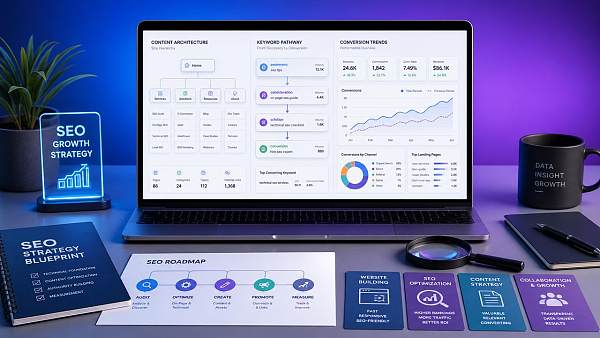
When SEO content optimization fails,it is usually not caused by a single issue,but by the combined impact of topic selection,pages,technology,and the conversion funnel。Checking each item with a checklist helps identify the real weaknesses faster and prevents teams from repeatedly spending effort on low-value actions。
Especially when intelligent website building,SEO optimization,social media marketing,and advertising are advanced together,content should not exist in isolation。Through long-term work on global growth projects,Eyingbao Information Technology (Beijing) Co.,Ltd. has found that truly effective SEO content optimization often balances three layers of goals:search demand,brand trust,and conversion paths。
Core Checklist for Diagnosing Ineffective SEO Content Optimization
- First,verify keyword intent。If the target keyword is mainly informational,but you write the page as hard-selling copy,SEO content optimization may rank,but it will still struggle to earn clicks and engagement。
- Recheck titles and descriptions。If the title only stuffs keywords without answering a question,and the description lacks a clear benefit,you may get impressions while the click-through rate remains low for a long time。
- Review the page structure。Overly long paragraphs,confusing hierarchy,and a lack of subheadings and lists will reduce readability and affect both user engagement and search engine understanding。
- Check content depth。If the content only explains concepts without steps,cases,data,or evaluation criteria,SEO content optimization will find it difficult to build authority and differentiation。
- Compare competing pages。If top-ranking results are solving specific problems while your content remains generic,it will be hard to enter an effective ranking range。
- Review the internal linking structure。If articles are isolated from one another and key pages do not receive authority flow,content may be indexed but still have little chance to grow in traffic over time。
- Check the update mechanism。If old content is not maintained for a long time and data,cases,and screenshots become outdated,page freshness will decline and affect SEO content optimization performance。
- Validate the technical foundation。Slow loading,poor mobile compatibility,indexing issues,or too many duplicate pages can drag down even high-quality content。
- Complete the conversion entry points。If a page only offers reading value without inquiry buttons,solution entry points,or related services,traffic may come in but still fail to convert into leads。
- Focus on the data closed loop。If you only look at rankings and ignore bounce rate,time on page,inquiry rate,and conversion paths,SEO content optimization will lose its business judgment basis。
The Most Easily Overlooked Evaluation Criteria
- Before looking at rankings,look at clicks first。If there are no clicks,it means there is already a problem with topic expression and how the search result is presented。
- Before looking at time on page,look at relevance first。Short engagement does not necessarily mean poor writing;more often,visitors find that the content does not match what they came for。
- Before looking at conversions,look at the path first。If a content page has no solution handoff,even highly targeted traffic may be lost in vain。
In Different Scenarios,SEO Content Optimization Issues Do Not Look the Same
Scenario 1:A Corporate Website Publishes Articles for a Long Time,but Still Gets No Inquiries
This situation is common when there is “a lot of content,but no content strategy”。Article topics are scattered;they neither build topic clusters around core business keywords nor guide users from awareness to solution comparison and then to the inquiry page。As a result,the content appears rich,but lacks a real commercial path。
A more effective approach is to build content clusters around services,such as website development solutions,SEO content optimization,overseas promotion,and conversion improvement,then use internal links to guide articles to service pages,case pages,and form pages,forming a complete handoff。
Scenario 2:Pages Are Indexed and Ranked,but Traffic Growth Is Slow
This type of issue is mostly related to keyword selection and search result click-through rate。If the content only covers keywords with very low search volume,or the title does not clearly express the solution,even reaching the first two pages may not bring substantial traffic。
At this point,you should review keyword library segmentation and distinguish brand keywords,industry keywords,question keywords,and conversion keywords。SEO content optimization should not only cover broad terms,but also target search terms closer to decision-making,such as “how to do it”,“which provider is better”,“cost”,and “solution comparison”。
Scenario 3:The Content Is Good,but Customer Acquisition Cost Remains High
When the SEO growth cycle is relatively long,many projects connect search content with paid traffic。For example,in cross-border e-commerce or B2B corporate promotion,high-intent content pages can be used together with Facebook advertising promotion,allowing content to build trust while ads quickly expand reach。
If the advertising side has precise targeting,remarketing tracking,daily data dashboards,and 7×24-hour monitoring capabilities,it is usually easier to identify which content topics truly drive conversions。Data such as click-through rate increases of more than 40% and customer acquisition cost reductions of 37% often comes from synchronized optimization across “content + advertising + pages”,rather than simply increasing publishing volume。
Commonly Overlooked Items and Risk Reminders
Ignoring differences between search stages is the most common risk。Awareness-stage content,comparison-stage content,and decision-stage content require completely different writing approaches。If one article tries to cover all stages,it often serves no one well。
Ignoring page handoff design will also directly affect results。Buttons placed too deep,forms that are too long,and missing case study entry points can all cause SEO content optimization to lose conversion capability。
Ignoring the rhythm of data review is equally risky。If there is no review mechanism 30 days,60 days,and 90 days after content goes live,it is impossible to determine whether the issue lies in the wrong keywords,weak pages,or insufficient backlink and authority support。
Ignoring channel collaboration will increase the cost of trial and error。If website content,organic search,social media reach,and advertising operate independently,it will be difficult to continuously improve overall customer acquisition efficiency。
Practical Execution Advice:Use These 5 Steps to Correct SEO Content Optimization
- First,organize existing content and classify it by traffic,rankings,and conversions into four categories:keep,rewrite,merge,and retire。
- Then rebuild the keyword map,mapping core keywords,long-tail keywords,question keywords,and commercial keywords to different pages。
- Next,standardize page templates,including title structure,subheading logic,internal link positions,and conversion entry points。
- Then build a monthly review table to continuously track impressions,clicks,time on page,bounce rate,and inquiry changes。
- Finally,promote channel linkage so that content works together with website building,advertising,and social media to form a growth closed loop。
Summary and Action Guide
When SEO content optimization consistently fails,the root cause is usually not “writing too little”,but “writing inaccurately,organizing unclearly,and failing to capture demand”。As long as you diagnose keyword intent,page structure,content depth,technical foundation,and conversion paths one by one,most issues can be clearly identified。
A more reliable approach is not to keep blindly increasing volume,but to first complete a systematic review:which content deserves continued investment,which pages need restructuring,and which channels should work together to amplify results。Only when SEO content optimization is upgraded from “publishing articles” to “driving growth” will the results truly begin to appear。
Related Articles



Related Products
 EasyCamp SaaS Smart Website Marketing SystemE-Yingbao SaaS Smart Website Marketing System: AI-powered, zero-code website building. Rapidly launch multilingual independent e-commerce sites in just 10 minutes. Global server acceleration and AI-driven SEO optimization empower businesses to efficiently connect with global markets. The seamless integration of technology and user-friendly operation makes building e-commerce sites incredibly simple.
 AI+SEM Intelligent Advertising Marketing SystemAI+SEM drives intelligent ad creation, empowering full-funnel precision advertising marketing. The system automatically generates weekly/monthly reports, AI recommends keywords and target countries, monitors core metrics in real-time with intelligent alerts, and enables one-click high-conversion ad solutions to help quickly acquire customers and improve ROI.
 AI+SEO Dual Engine Optimization ServiceEasyWin AI+SEO Dual Engine Optimization System leverages AI-powered keyword mining, content generation, and comprehensive technical optimization to help foreign trade enterprises acquire high-quality organic traffic, significantly improving search rankings and conversion rates.
 AI+SNS Social Media Marketing SystemYingbao AI+SNS Social Media Marketing System - Precision social capture for the social media era. Supports one-click content synchronization across major platforms like Facebook and LinkedIn. AI intelligently rewrites posts for enhanced relevance. 24/7 AI customer service and user profiling analysis empower businesses to efficiently expand into global markets.
 AI+SEO营销解决方案易营宝AI+SEO营销解决方案,通过AI批量写作、智能生成TDK、精准关键词扩词等功能,全面优化网站SEO效果,提升流量与转化率。助力企业构建高效智能网站新生态。
 AI+SEM Advertising Marketing SolutionsAI+SEM Advertising Marketing Solution leverages AI technology to deeply empower SEM ad campaigns. It automatically generates weekly/monthly reports using AI, presenting account data across multiple dimensions for comprehensive insights into campaign performance and trends. The system precisely recommends keywords and target countries, intelligently generates high-conversion ad copy, and enables one-click activation of efficient campaign plans to help businesses rapidly acquire customers. Simultaneously, it monitors core metrics in real time, intelligently identifies abnormal fluctuations, and issues timely alerts to ensure stable, high-return advertising results.
 Domain Name ServicesEasyWin provides professional domain name services, including intelligent queries, one-stop registration, brand protection, and full lifecycle management, helping businesses build a digital brand image.
 EasyOperate B2C Cross-Border E-Commerce Platform & Independent WebsiteEasyStore B2C Cross-border E-commerce Independent Store is an intelligent website building and cross-border e-commerce integrated solution independently developed by EasyStore Information Technology (Beijing) Co., Ltd. The system is specially designed for small and medium-sized as well as large export enterprises, integrating 'website building, operation, marketing, advertising, and conversion' into one, helping enterprises quickly establish cross-border e-commerce independent stores to achieve brand globalization and global sales growth.
The platform supports multiple languages, multiple currencies, and multi-channel marketing, with built-in AI intelligent translation and SEO optimization systems, suitable for mainstream markets such as Southeast Asia, Europe and America, Latin America, and the Middle East, assisting Chinese manufacturing enterprises in efficiently deploying international e-commerce strategies. SSL证书易营宝提供专业SSL安全证书服务,包括单域名和泛域名证书,确保网站数据传输加密、身份验证和完整性保护,助力企业建立安全可信的在线业务环境。









