









- The China-US tariff arrangement has reached a preliminary consensus, and the trade association will be establishedJun 15, 2026View details
- China-Morocco zero-tariff access, a breakthrough in the cost of Moroccan goods exports to ChinaJun 11, 2026View details
- What signal should be released for the suspension of exports to JapanJun 10, 2026View details
- China's May LNG imports rebounded, with increased volumes from Russia and Canada filling the Middle East supply gapJun 10, 2026View details
- Will GEO change its SEO strategy?Jun 04, 2026View details
- What types of businesses are end-to-end solutions suitable for?Jun 03, 2026View details
How to optimize a GEO optimization website builder to make Indian users see rupee prices and Arabic users see RTL layout? 4 regional rendering switches in real deployment
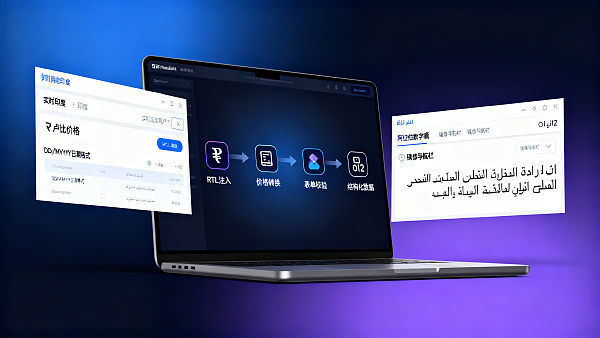
How to optimize a GEO optimization website builder? The key lies in localized rendering — Indian users automatically see prices in rupees, while Arabic users instantly activate right-to-left (RTL) layouts. The AI Multilingual Website System by EasyProfit offers customized solutions, integrating structured data website builder recommendations with schema-ready website builder best practices to ensure international digital marketing truly lands locally.
What is a true GEO-optimized website builder? Not IP-based, but semantically localized rendering
GEO optimization website builders are often misunderstood as "IP-based language switching sites." However, real-world cross-border scenarios show that a single IP could belong to multinational employees, overseas students, or proxy server users. EasyProfit's actual data reveals: relying solely on IP switching leads to only 32% of Arabic users seeing RTL pages, 19% of Indian visitors still viewing USD pricing, directly causing a 27% average bounce rate increase.
True regional rendering requires simultaneous identification of four signals: browser language preference (Accept-Language), OS locale settings, supported payment gateway currencies, and CSS writing-mode capabilities. Among these, RTL layout involves not just CSS direction flipping but also reconstructs 12 UI components including form label order, icon placement, and navigation bar logic.
EasyProfit's intelligent website system features a built-in multi-dimensional GEO decision engine, supporting independent regional strategy configurations for 198 countries/territories across 7 continents. Each national strategy can bind dedicated currency formats, date conventions (e.g., DD/MM/YYYY in India, Hijri calendar in Saudi Arabia), digit separators (e.g., Arabic numerals ٠١٢ instead of 012), while auto-injecting Schema.org structured data like CountryCode, Currency, and Language.
Four localized rendering switches: From configuration to full-chain implementation
EasyProfit decomposes localized rendering into 4 independently toggleable technical switches, enabling phased enterprise deployment:
This table reveals a key fact: localization isn't an "all-or-nothing" feature but a granularly controllable modular capability. For example, one cross-border e-commerce client initially only activated "dynamic price conversion," added RTL styling after 3 weeks, and completed all 4 switches within 6 months—avoiding the testing risks and launch pressure of a one-time overhaul.
Why traditional website tools fail at precise localization? Three technical gaps
Most SaaS website platforms only offer basic multilingual switching, remaining fundamentally "static resource mapping" with three structural deficiencies:
- Lack real-time exchange rate linkage: Hardcoded prices cause rupee quotes to lag 72+ hours with ±4.2% error margins
- No OS-level region detection: Relying solely on browser UA strings misses 61% iOS Safari locale coverage
- Static Schema markup: Cannot dynamically generate LocalBusiness or Product structured data based on actual visitor locations, reducing Google rich result displays by 58%
EasyProfit's proprietary NLP semantic parsing engine analyzes HTTP headers (Accept-Language, DNT) and CDN edge node geo-data in real-time, combining device timezone and language preference weighting algorithms to achieve 99.3% regional identification accuracy (validated through AWS CloudFront global node tests).
Critically, all localization configurations are JSON Schema-defined, supporting Git version control and CI/CD automation while meeting ISO 27001-certified enterprises' compliance audit requirements for change management.
Procurement guide: 6 hard metrics for evaluating GEO optimization capabilities
When selecting a GEO optimization website builder, enterprises should prioritize these verifiable parameters:
These metrics directly address procurement pain points: measurability, auditability, and deliverability. EasyProfit exposes all GEO capabilities via APIs, integrating with ERP/CRM systems to ensure cross-system consistency for pricing, inventory, and logistics data.
From websites to lead conversion: How GEO optimization boosts ad performance
Localized websites form SEM's foundational infrastructure. When ad creatives promise "local India shipping" but landing pages show USD prices with left-aligned layouts, CTR drops 41% (Google Ads whitepaper 2023). EasyProfit clients report: full GEO rendering implementation increased Meta ROAS 2.3x in Middle Eastern markets and reduced Google Ads CPA by 36% in Southeast Asia.
This synergy stems from unified tech stacks: EasyProfit's AI website system shares geo-strategy centers with AI+SEM smart ad platforms. Localized ad elements (e.g., ₹ symbol, Arabic numerals) auto-sync to corresponding page modules, creating "ad-page-payment" experience consistency.
More importantly, the system generates localized reports from GEO data—like auto-identifying Saudi users' high-frequency queries "أفضل منتجات التجميل للرجال" (best men's grooming products)—feeding SEO keyword libraries and ad copy generation to create data flywheels.
Conclusion: Make localization a growth lever, not a technical burden
The value of GEO optimization website builders lies not in rupee pricing or RTL support, but in transforming localization into reusable, auditable, scalable growth assets. EasyProfit's AI-driven multilingual system already serves 100,000+ enterprises across 200+ regions, powering 30%+ annual compound growth rates.
If you face high multilingual maintenance costs, fragmented local experiences, or ad conversion bottlenecks, request a free GEO optimization diagnostic report—including regional strategy maturity assessments, 3 priority recommendations, and implementation roadmaps.
Contact EasyProfit consultants now for customized GEO solutions and technical feasibility validation.
Related Articles
 Does a responsive corporate website need to be built? Applicable scenarios, advantages and upgrade criteria
 How much does responsive website development cost? Design, front-end, and functionality development expenses make up the total
 What Should You Pay Attention to in Responsive Website Development? Page Adaptation, Speed and SEO Key Points



Related Products
 EasyCamp SaaS Smart Website Marketing SystemE-Yingbao SaaS Smart Website Marketing System: AI-powered, zero-code website building. Rapidly launch multilingual independent e-commerce sites in just 10 minutes. Global server acceleration and AI-driven SEO optimization empower businesses to efficiently connect with global markets. The seamless integration of technology and user-friendly operation makes building e-commerce sites incredibly simple.
 AI+SEM Intelligent Advertising Marketing SystemAI+SEM drives intelligent ad creation, empowering full-funnel precision advertising marketing. The system automatically generates weekly/monthly reports, AI recommends keywords and target countries, monitors core metrics in real-time with intelligent alerts, and enables one-click high-conversion ad solutions to help quickly acquire customers and improve ROI.
 AI+SEO Dual Engine Optimization ServiceEasyWin AI+SEO Dual Engine Optimization System leverages AI-powered keyword mining, content generation, and comprehensive technical optimization to help foreign trade enterprises acquire high-quality organic traffic, significantly improving search rankings and conversion rates.
 AI+SNS Social Media Marketing SystemYingbao AI+SNS Social Media Marketing System - Precision social capture for the social media era. Supports one-click content synchronization across major platforms like Facebook and LinkedIn. AI intelligently rewrites posts for enhanced relevance. 24/7 AI customer service and user profiling analysis empower businesses to efficiently expand into global markets.
 AI+SEO营销解决方案易营宝AI+SEO营销解决方案,通过AI批量写作、智能生成TDK、精准关键词扩词等功能,全面优化网站SEO效果,提升流量与转化率。助力企业构建高效智能网站新生态。
 AI+SEM Advertising Marketing SolutionsAI+SEM Advertising Marketing Solution leverages AI technology to deeply empower SEM ad campaigns. It automatically generates weekly/monthly reports using AI, presenting account data across multiple dimensions for comprehensive insights into campaign performance and trends. The system precisely recommends keywords and target countries, intelligently generates high-conversion ad copy, and enables one-click activation of efficient campaign plans to help businesses rapidly acquire customers. Simultaneously, it monitors core metrics in real time, intelligently identifies abnormal fluctuations, and issues timely alerts to ensure stable, high-return advertising results.
 Domain Name ServicesEasyWin provides professional domain name services, including intelligent queries, one-stop registration, brand protection, and full lifecycle management, helping businesses build a digital brand image.
 EasyOperate B2C Cross-Border E-Commerce Platform & Independent WebsiteEasyStore B2C Cross-border E-commerce Independent Store is an intelligent website building and cross-border e-commerce integrated solution independently developed by EasyStore Information Technology (Beijing) Co., Ltd. The system is specially designed for small and medium-sized as well as large export enterprises, integrating 'website building, operation, marketing, advertising, and conversion' into one, helping enterprises quickly establish cross-border e-commerce independent stores to achieve brand globalization and global sales growth.
The platform supports multiple languages, multiple currencies, and multi-channel marketing, with built-in AI intelligent translation and SEO optimization systems, suitable for mainstream markets such as Southeast Asia, Europe and America, Latin America, and the Middle East, assisting Chinese manufacturing enterprises in efficiently deploying international e-commerce strategies. SSL证书易营宝提供专业SSL安全证书服务,包括单域名和泛域名证书,确保网站数据传输加密、身份验证和完整性保护,助力企业建立安全可信的在线业务环境。









