









- Can Zhejiang foreign trade independent websites still be developed today? Look at changes in traffic and lead generationJul 28, 2026View details
- What New Signals Are Emerging in Enterprise Services SaaS Marketing ReportsJul 27, 2026View details
- What Does a Global Traffic Ecosystem Service Provider Do? What Are the Differences from a Single Advertising AgencyJul 16, 2026View details
- What should you focus on in the latest enterprise SaaS report? From renewal rates and delivery costs to overseas growth opportunitiesJul 12, 2026View details
- What signals are worth paying attention to in a cross-border marketing trend report? B2B companies should look at these 6 signalsJul 11, 2026View details
- How to Read a Cross-Border Marketing Trends Report? Five Key Dimensions for Evaluating Channel OpportunitiesJul 11, 2026View details
- Which channel has the highest ROI in the global traffic ecosystem? Comparative analysis of search, social media, and advertisingJul 10, 2026View details
- What multilingual website services are available in Sanya? Which model is more suitable for local businesses going global?Jul 08, 2026View details
B2B Independent Website Loading Speed Optimization Methods
How can a B2B independent website optimize loading speed?This article analyzes the key factors affecting performance and actionable solutions from a technical evaluation perspective。For corporate websites targeting overseas purchasers,distributors,and engineering buyers,loading speed affects not only the browsing experience,but also inquiry conversion,ad landing page quality,and organic search performance。
When technical evaluators assess how to improve the loading speed of a B2B independent website,they should not only look at whether the homepage opens instantly,but should also consider metrics such as above-the-fold rendering,server response,script execution,image size,and cross-border access routes。It is generally recommended to keep the above-the-fold loading time of core pages within 2.5 seconds,and the time to interactive on mobile within 3.8 seconds。
I. First establish a quantifiable performance evaluation framework

Many companies directly compress images or replace servers before optimization,but without baseline data,it is difficult to determine whether subsequent investment is effective。To evaluate how to improve the loading speed of a B2B independent website,3 types of pages should be selected first:homepage,product detail page,and inquiry landing page,and desktop and mobile should be tested separately。
1. Key metrics are not just about “whether it opens quickly”
Technical teams can build a monitoring table from 5 dimensions:server response time,largest contentful paint,first input delay,cumulative layout shift,and total page resources。For foreign trade B2B sites,testing should also be added for 2 to 4 regional nodes such as North America,Europe,and Southeast Asia。
The following table can serve as an initial checklist for technical evaluators,used to determine whether the current site’s performance bottlenecks are concentrated in the front end,back end,or network transmission layer。
The thresholds in the table are not the only standard,but they can help companies quickly distinguish priorities。If server response has already exceeded 1 second,continuing to fine-tune button styles or font files usually brings no obvious benefit。
II. Start with front-end resources to reduce above-the-fold load
Pages on B2B independent websites usually contain product images,certificate images,factory videos,parameter tables,and form components,with higher resource density than ordinary brochure websites。When evaluating how to improve the loading speed of a B2B independent website,front-end resource governance can often show changes within 7 to 15 days。
1. Priorities for images,fonts,and scripts
It is recommended to use WebP or AVIF formats for main product images,with each image controlled between 80KB and 200KB;enable lazy loading for non-above-the-fold images;merge icons into vector resources as much as possible。For multilingual sites,font files should be split by language to avoid loading the entire character set at once。
4 executable steps for front-end optimization
- Compress above-the-fold images,prioritizing homepage banners,first images in product listings,and case study covers。
- Defer loading of non-critical scripts such as analytics,online customer service,and remarketing pixels。
- Merge or split CSS to ensure critical above-the-fold styles are output first。
- Reduce ineffective plugins,especially carousels,pop-ups,and form extensions that have not been updated for a long time。
If a company also focuses on content growth,performance optimization can be combined with the AI+SEO Marketing Solution,using AI for batch writing,intelligent TDK generation,and precise keyword expansion,so that title structures,page templates,and resource specifications are controlled before new pages are added,avoiding large-scale rework later。
III. Optimize servers,caching,and global access routes
For cross-border B2B independent websites,visitors may come from more than 10 countries。If the website is deployed in only one region,the latency of overseas buyers’ first visit may increase significantly。Therefore,how to improve the loading speed of a B2B independent website must consider hosting location,CDN nodes,and caching strategy at the same time。
1. Caching strategies should distinguish page types
The homepage,category pages,and product detail pages are suitable for page-level caching,with update frequency configured by 6 hours,12 hours,or 24 hours;dynamic modules such as inquiry forms,member login,and quotation calculators should avoid caching errors to prevent abnormal user data submission。
The following solution comparison is suitable for procurement or technical selection meetings,helping determine the differences between different configurations in cost,speed,and maintenance complexity。
From an input-output perspective,cloud hosting plus CDN is usually suitable for most growing foreign trade companies。If the site also carries SEO,advertising,and social media traffic acquisition,it is recommended to include high-frequency landing pages separately in performance monitoring and retest at least once a week。
IV. Embed speed optimization into the marketing conversion process
Loading speed is not a purely technical issue。For integrated website + marketing service projects,speed affects keyword page indexing,ad bounce rate,form submission rate,and sales lead quality。Technical evaluators should establish shared acceptance criteria with SEO,advertising,and content teams。
1. Synergy between speed and conversion pages
Product detail pages should prioritize displaying model,core parameters,delivery range,and inquiry buttons,and avoid placing lengthy company introductions above the fold。A typical B2B landing page can be kept within 5 to 7 content modules,and form fields are recommended to retain 4 to 6 items such as name,email,company,and requirement description。
Common misconceptions and correction suggestions
- Misconception 1:Only optimize the homepage。Correction:Test product pages,category pages,and ad landing pages at the same time。
- Misconception 2:More plugins mean more complete functionality。Correction:Clean up low-usage plugins once a month。
- Misconception 3:The higher the image resolution,the more professional it is。Correction:Export according to display size and do not upload original large images。
- Misconception 4:No retesting after launch。Correction:Retest after every template,script,or ad code update。
Yiyingbao Information Technology (Beijing) Co., Ltd. was established in 2013 and is headquartered in Beijing,with long-term service experience in intelligent website building,SEO optimization,social media marketing,and advertising scenarios。Leveraging artificial intelligence and big data capabilities,its full-chain solutions can help companies integrate performance,content,and conversion into a unified operational closed loop。
V. Implementation acceptance checklist for technical evaluators
During the project acceptance stage,it is recommended to adopt a 4-step process of “baseline testing,solution implementation,grayscale launch,retesting and review”。Each step should retain test screenshots,version records,and change descriptions,so that it is easier to subsequently determine whether improving the loading speed of a B2B independent website has truly generated business value。
1. Recommended acceptance criteria
- The above-the-fold loading time of core pages decreases by 20% to 40% compared with before optimization。
- The number of above-the-fold resources is reduced,and key scripts do not block the rendering of main content。
- Access is stable from at least 3 nodes in overseas target markets,with no obvious certificate or caching abnormalities。
- SEO pages,ad landing pages,and inquiry forms all pass mobile retesting。
If a company is planning a multilingual website,product library expansion,or global advertising,it should set a performance budget at the early stage of website building,rather than waiting until the number of pages exceeds 1000 before carrying out centralized governance。This is more conducive to cost control and to continuously obtaining stable inquiries。
For technical evaluators,the answer to how to improve the loading speed of a B2B independent website should be systematic:first quantify metrics,then optimize resources and servers,and finally include speed in SEO and conversion acceptance。If you want to obtain an optimization plan suitable for your industry,target market,and page scale,please contact us now to learn more about integrated website and marketing solutions。
Related Articles
 Promoting chemical products on Google is essential—otherwise, you are effectively handing your customers over to competitors
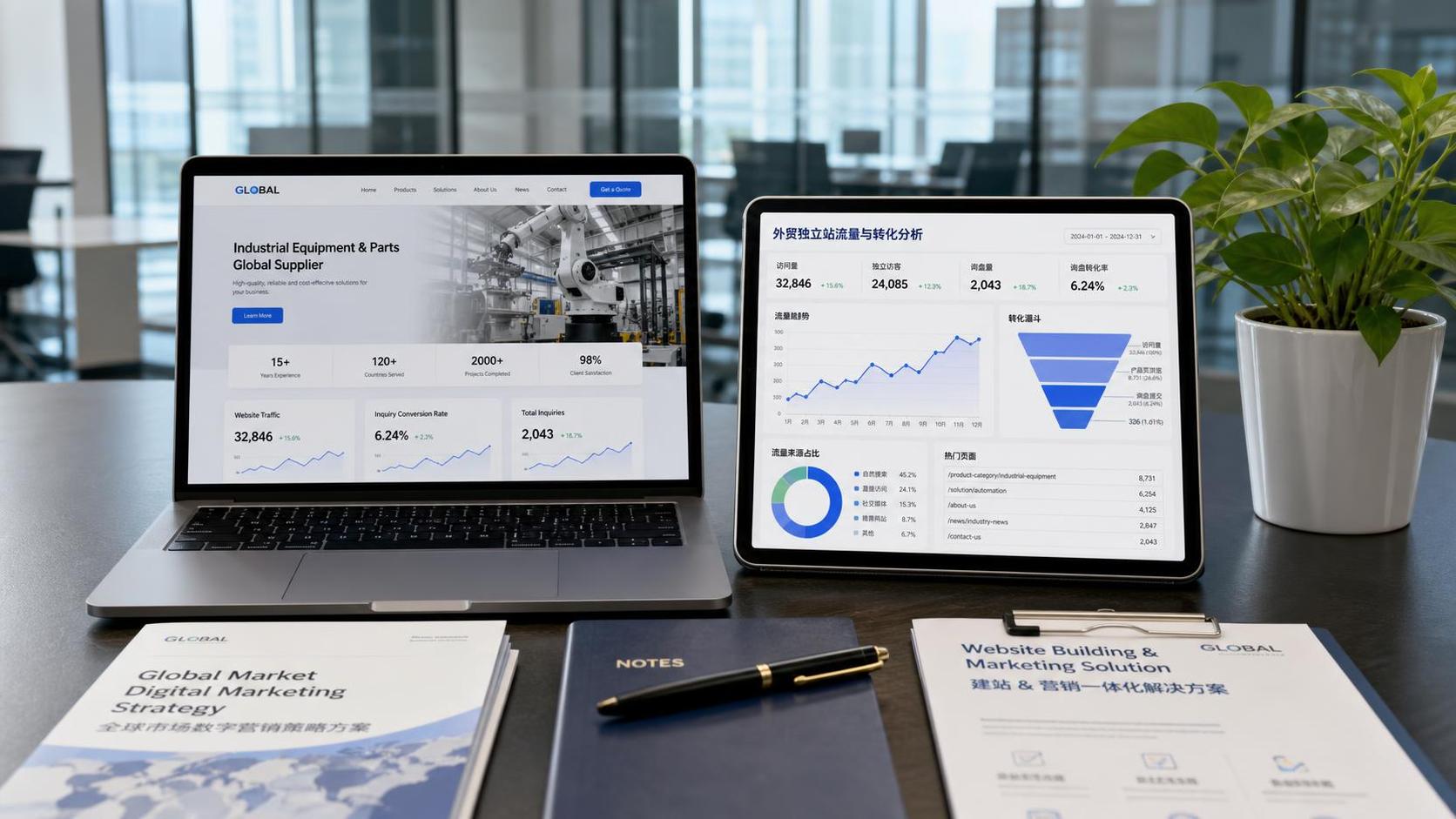
 Can Zhejiang foreign trade independent websites still be developed today? Look at changes in traffic and lead generation
 What New Signals Are Emerging in Enterprise Services SaaS Marketing Reports
Related Products
 EasyCamp SaaS Smart Website Marketing SystemE-Yingbao SaaS Smart Website Marketing System: AI-powered, zero-code website building. Rapidly launch multilingual independent e-commerce sites in just 10 minutes. Global server acceleration and AI-driven SEO optimization empower businesses to efficiently connect with global markets. The seamless integration of technology and user-friendly operation makes building e-commerce sites incredibly simple.
 AI+SEM Intelligent Advertising Marketing SystemAI+SEM drives intelligent ad creation, empowering full-funnel precision advertising marketing. The system automatically generates weekly/monthly reports, AI recommends keywords and target countries, monitors core metrics in real-time with intelligent alerts, and enables one-click high-conversion ad solutions to help quickly acquire customers and improve ROI.
 AI+SEO Dual Engine Optimization ServiceEasyWin AI+SEO Dual Engine Optimization System leverages AI-powered keyword mining, content generation, and comprehensive technical optimization to help foreign trade enterprises acquire high-quality organic traffic, significantly improving search rankings and conversion rates.
 AI+SNS Social Media Marketing SystemYingbao AI+SNS Social Media Marketing System - Precision social capture for the social media era. Supports one-click content synchronization across major platforms like Facebook and LinkedIn. AI intelligently rewrites posts for enhanced relevance. 24/7 AI customer service and user profiling analysis empower businesses to efficiently expand into global markets.
 AI+SEO营销解决方案易营宝AI+SEO营销解决方案,通过AI批量写作、智能生成TDK、精准关键词扩词等功能,全面优化网站SEO效果,提升流量与转化率。助力企业构建高效智能网站新生态。
 AI+SEM Advertising Marketing SolutionsAI+SEM Advertising Marketing Solution leverages AI technology to deeply empower SEM ad campaigns. It automatically generates weekly/monthly reports using AI, presenting account data across multiple dimensions for comprehensive insights into campaign performance and trends. The system precisely recommends keywords and target countries, intelligently generates high-conversion ad copy, and enables one-click activation of efficient campaign plans to help businesses rapidly acquire customers. Simultaneously, it monitors core metrics in real time, intelligently identifies abnormal fluctuations, and issues timely alerts to ensure stable, high-return advertising results.
 Domain Name ServicesEasyWin provides professional domain name services, including intelligent queries, one-stop registration, brand protection, and full lifecycle management, helping businesses build a digital brand image.
 EasyOperate B2C Cross-Border E-Commerce Platform & Independent WebsiteEasyStore B2C Cross-border E-commerce Independent Store is an intelligent website building and cross-border e-commerce integrated solution independently developed by EasyStore Information Technology (Beijing) Co., Ltd. The system is specially designed for small and medium-sized as well as large export enterprises, integrating 'website building, operation, marketing, advertising, and conversion' into one, helping enterprises quickly establish cross-border e-commerce independent stores to achieve brand globalization and global sales growth.
The platform supports multiple languages, multiple currencies, and multi-channel marketing, with built-in AI intelligent translation and SEO optimization systems, suitable for mainstream markets such as Southeast Asia, Europe and America, Latin America, and the Middle East, assisting Chinese manufacturing enterprises in efficiently deploying international e-commerce strategies. SSL证书易营宝提供专业SSL安全证书服务,包括单域名和泛域名证书,确保网站数据传输加密、身份验证和完整性保护,助力企业建立安全可信的在线业务环境。









