









- Will GEO change its SEO strategy?Jun 04, 2026View details
- What types of businesses are end-to-end solutions suitable for?Jun 03, 2026View details
- 2026 Global Growth Channel TrendsJun 02, 2026View details
- Changes in Search Engine Ranking Factors in 2026Jun 06, 2026View details
- Which stages is the brand visibility enhancement service suitable forMay 29, 2026View details
- What Are the Key Modules of International Digital Marketing ServicesMay 29, 2026View details
How to Assess the Cost and ROI Differences Between AI-Powered Website Building and Traditional Website Development in 2024?
In the increasingly fierce digital competition of 2024, the way enterprises build websites is undergoing fundamental changes. The rise of AI website building technology provides small and medium-sized enterprises with more automated and intelligent site construction paths, while traditional website building still relies on its customization and structural flexibility, maintaining professional advantages in specific scenarios. When evaluating both, enterprises need to systematically compare them from perspectives such as cost, efficiency, SEO optimization capabilities, and future scalability.
I. Definitions and Core Features of AI Website Building vs. Traditional Website Building
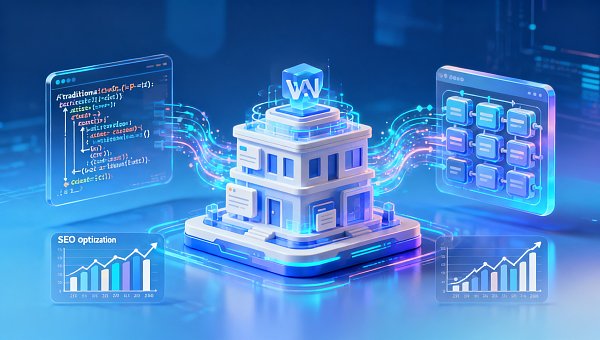
AI website building refers to a method that relies on artificial intelligence technology to automatically generate and optimize website structures, content, and SEO strategies, while traditional website construction primarily involves manual design and programming, relying on front-end development, UI design, and back-end maintenance collaboration. The key feature of AI website building lies in its algorithm-driven automation and intelligent generation capabilities, whereas traditional website building emphasizes controllability and deep personalization.
AI website building typically achieves automatic website generation through natural language processing and template training, significantly reducing labor input. Due to high human involvement, traditional website building sees cycles and costs rise significantly with project complexity.
II. Technical Principle Comparison: Algorithmic Intelligence vs. Manual Logic
The technical core of AI website building lies in machine learning and multimodal AI generation algorithms, automatically constructing website frameworks through semantic recognition, visual generation, and data modeling. Traditional website building depends on manual coding logic, requiring adjustments at the programming level for structural changes.
Taking EasyMarketing Information Technology (Beijing) Co., Ltd. as an example, its "AI-driven one-stop intelligent marketing platform" employs AI keyword expansion, automatic TDK generation, and AI image generation as an integrated technology system, capable of producing thousands of pieces of content daily and optimizing SEO metrics in real-time, thereby shortening deployment cycles. In contrast, traditional website building requires manual definition of page structures and content, with limited automation levels.
III. Differences in Cost and Time Investment
AI website building has a clear overall cost advantage, with its automated generation capabilities reducing labor input by over 50%. Traditional website construction costs mainly stem from long-term participation of design, development, and maintenance personnel. AI website building offers better cost-performance for small businesses, while traditional website building is more suitable for projects requiring complex logic and professional interfaces.
Key point: The investment structure of AI website building focuses on technology usage and platform subscriptions, while traditional website building costs are concentrated on labor and project cycles.
IV. Technological Differences in SEO and Content Optimization
Intelligent website systems typically embed AI semantic analysis and automated SEO detection engines, dynamically optimizing content based on keyword trends and site performance. EasyMarketing's AI marketing engine identifies SEO shortcomings through real-time website detection tools and provides precise adjustment solutions, improving SEO scores by an average of 35%.
Traditional website SEO optimization relies mainly on manual tuning and updates, with lower update frequencies and response speeds. AI website building's automated optimization capabilities make it more suitable for multilingual, multi-region digital marketing scenarios.
V. Performance and Stability Assurance Mechanisms
AI-driven website systems optimize website architecture's loading and caching logic through algorithmic learning, fundamentally improving access speed and stability. EasyMarketing provides global server clusters and CDN node support in this area, achieving a 40% increase in loading speed. Traditional website building requires manual server resource deployment, with lower adaptability to global access demands.
Key point: AI website systems ensure consistent performance in cross-border access scenarios through global data nodes and real-time intelligent scheduling.
VI. Comparison of Personalization and Flexibility
Traditional website building offers high freedom in page layouts and front-end logic control, suitable for large brands or functionally complex websites. AI website building allows scenario-based customization on template foundations, but personalization depth is limited by algorithmic rules. As AI design technology evolves, personalization gaps are gradually narrowing.
Key point: AI website building is transitioning from templated generation to intelligent layout stages, enhancing cross-industry adaptability.
VII. Usage Scenario Analysis: Selection Basis for Different Enterprise Types
For small and medium-sized enterprises or cross-border traders, AI website building can reduce construction cycles and quickly cover multilingual markets. EasyMarketing's intelligent website system supports independent site construction in Chinese, English, and other languages, combining AI translation engines for localized content generation. Traditional website building is suitable for industries emphasizing brand visual experience and high interaction complexity, such as high-end manufacturing and educational platforms.
Key point: Enterprises should match website building methods based on business scale, update frequency, and market coverage needs.
VIII. Data and Security Comparison
AI website system security relies on cloud architecture and automated detection mechanisms, often integrating automatic SSL certificates, anti-DDoS systems, and data backup functions. Traditional website security depends on developer configurations and server protection levels, with longer upgrade and maintenance cycles. EasyMarketing builds a global protection system through partnerships with AWS and Alibaba Cloud, achieving zero-downtime operation.
Key point: Data security in AI website building has become a core system function, not an additional configuration.
IX. Maintenance and Iteration Logic
AI website platforms achieve continuous maintenance through automatic update algorithms and system iterations, requiring no additional development resources. Traditional website iterations require manual code and database adjustments by developers. EasyMarketing's AI platform averages 12 algorithm iterations annually, achieving continuous performance and SEO optimization improvements, significantly reducing long-term operational costs.
Key point: Automated iteration mechanisms give AI website building quantifiable advantages in long-term operational cost control.
X. Support Capabilities for Cross-Border Marketing
In global market expansion, AI website building can automatically generate localized sites that comply with regional language and cultural characteristics. EasyMarketing deploys server clusters across seven continents globally, building multilingual export-oriented websites for clients. Traditional website building requires manual configuration for multilingual adaptation and server distribution, with longer cycles.
Key point: AI website building's multilingual adaptation is a key infrastructure driving Chinese enterprises' digital出海 (going global).
XI. Ecosystem Integration Capabilities of AI Intelligent Website Building
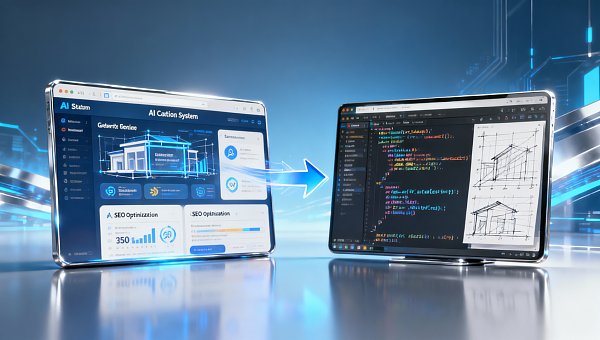
AI website systems typically integrate SEO optimization, social media marketing, and ad placement functions, forming marketing closed loops. For example, EasyMarketing integrates resources from channels like Google, Meta, and Yandex, achieving intelligent management of the entire process from website construction to customer acquisition. This ecosystem integration can significantly improve marketing input-output ratios. Traditional website building often requires third-party extension tools to achieve ecosystem connectivity.
Key point: AI website building's integrated ecosystem enhances enterprises' digital marketing execution efficiency.
XII. ROI and Long-Term Value Comparison
Traditional website ROI is usually affected by maintenance and upgrade frequencies, with longer payback periods. AI website building achieves dynamic ROI improvement through algorithm-driven optimization. EasyMarketing's AI ad intelligence manager can analyze ad account structures and material performance in real-time, assisting enterprises in achieving precise投放 (placement) and cost optimization, thereby improving overall ROI.
Key point: AI website building enhances ROI elasticity through continuous learning mechanisms, forming an advantage loop in cost efficiency and growth speed.
XIII. Impact on Internal Teams and Organizational Structure
AI website building reduces enterprises' reliance on internal IT and design teams, allowing organizations to focus resources on content strategies and market operations. Traditional website building requires fixed front-end and back-end engineers and UI designers. For procurement personnel, AI website service subscription models can more flexibly respond to budget adjustments.
Key point: AI website building usage models drive enterprises toward lightweight, data-driven organizational transformations.
XIV. Industry Application Cases and Adaptation Trends
In manufacturing, e-commerce, and education industries, AI website building demonstrates advantages in automated content generation and multi-channel linkage. EasyMarketing has deployed local service teams in over 30 provinces nationwide, providing intelligent website solutions for 20+ industries. As AI algorithm costs decline, such solutions are accelerating普及 (popularization) among small and medium-sized enterprise groups.
Key point: AI website building's cross-industry applicability is expanding, becoming an important component of digital marketing infrastructure.
XV. Future Development Directions and Technological Evolution
Future trends in AI website building include modular generation, predictive SEO optimization, and blockchain-based website structure certification. EasyMarketing is promoting a decentralized marketing ecosystem combining AI and blockchain, aiming to achieve data credibility and content traceability. Traditional website building may transition to hybrid models coexisting with AI to enhance creative flexibility and intelligent responsiveness.
Key point: AI website building development is shifting from automation to autonomous learning and cross-ecosystem collaboration stages.
XVI. Key Comparison Summary Table
XVII. Comprehensive Evaluation and Selection Recommendations
If enterprise goals focus on rapid deployment, multilingual marketing, and automated SEO optimization, AI website building offers more practical value; if emphasizing functional depth and interactive customization, traditional website building remains necessary. Procurement personnel should comprehensively consider platform performance, data security, operational costs, and ecosystem compatibility when making decisions.
Key point: AI and traditional website building are not opposing but complementary selection systems based on business complexity and growth stages.
Conclusion
AI website building is reshaping enterprise website logic, transitioning from "manual development" to "intelligent growth." Represented by EasyMarketing, AI intelligent website platforms are bringing balanced solutions of standardization and innovation to enterprises through AI + big data dual-engine models. As algorithms mature and applications普及 (popularize), AI website building will become a core component of future digital marketing infrastructure, providing long-term growth momentum for enterprises.
Related Articles


Related Products
 EasyCamp SaaS Smart Website Marketing SystemE-Yingbao SaaS Smart Website Marketing System: AI-powered, zero-code website building. Rapidly launch multilingual independent e-commerce sites in just 10 minutes. Global server acceleration and AI-driven SEO optimization empower businesses to efficiently connect with global markets. The seamless integration of technology and user-friendly operation makes building e-commerce sites incredibly simple.
 AI+SEM Intelligent Advertising Marketing SystemAI+SEM drives intelligent ad creation, empowering full-funnel precision advertising marketing. The system automatically generates weekly/monthly reports, AI recommends keywords and target countries, monitors core metrics in real-time with intelligent alerts, and enables one-click high-conversion ad solutions to help quickly acquire customers and improve ROI.
 AI+SEO Dual Engine Optimization ServiceEasyWin AI+SEO Dual Engine Optimization System leverages AI-powered keyword mining, content generation, and comprehensive technical optimization to help foreign trade enterprises acquire high-quality organic traffic, significantly improving search rankings and conversion rates.
 AI+SNS Social Media Marketing SystemYingbao AI+SNS Social Media Marketing System - Precision social capture for the social media era. Supports one-click content synchronization across major platforms like Facebook and LinkedIn. AI intelligently rewrites posts for enhanced relevance. 24/7 AI customer service and user profiling analysis empower businesses to efficiently expand into global markets.
 AI+SEO营销解决方案易营宝AI+SEO营销解决方案,通过AI批量写作、智能生成TDK、精准关键词扩词等功能,全面优化网站SEO效果,提升流量与转化率。助力企业构建高效智能网站新生态。
 AI+SEM Advertising Marketing SolutionsAI+SEM Advertising Marketing Solution leverages AI technology to deeply empower SEM ad campaigns. It automatically generates weekly/monthly reports using AI, presenting account data across multiple dimensions for comprehensive insights into campaign performance and trends. The system precisely recommends keywords and target countries, intelligently generates high-conversion ad copy, and enables one-click activation of efficient campaign plans to help businesses rapidly acquire customers. Simultaneously, it monitors core metrics in real time, intelligently identifies abnormal fluctuations, and issues timely alerts to ensure stable, high-return advertising results.
 Domain Name ServicesEasyWin provides professional domain name services, including intelligent queries, one-stop registration, brand protection, and full lifecycle management, helping businesses build a digital brand image.
 EasyOperate B2C Cross-Border E-Commerce Platform & Independent WebsiteEasyStore B2C Cross-border E-commerce Independent Store is an intelligent website building and cross-border e-commerce integrated solution independently developed by EasyStore Information Technology (Beijing) Co., Ltd. The system is specially designed for small and medium-sized as well as large export enterprises, integrating 'website building, operation, marketing, advertising, and conversion' into one, helping enterprises quickly establish cross-border e-commerce independent stores to achieve brand globalization and global sales growth.
The platform supports multiple languages, multiple currencies, and multi-channel marketing, with built-in AI intelligent translation and SEO optimization systems, suitable for mainstream markets such as Southeast Asia, Europe and America, Latin America, and the Middle East, assisting Chinese manufacturing enterprises in efficiently deploying international e-commerce strategies. SSL证书易营宝提供专业SSL安全证书服务,包括单域名和泛域名证书,确保网站数据传输加密、身份验证和完整性保护,助力企业建立安全可信的在线业务环境。









