









- China-Morocco zero-tariff access, a breakthrough in the cost of Moroccan goods exports to ChinaJun 11, 2026View details
- What signal should be released for the suspension of exports to JapanJun 10, 2026View details
- China's May LNG imports rebounded, with increased volumes from Russia and Canada filling the Middle East supply gapJun 10, 2026View details
- Will GEO change its SEO strategy?Jun 04, 2026View details
- What types of businesses are end-to-end solutions suitable for?Jun 03, 2026View details
- 2026 Global Growth Channel TrendsJun 02, 2026View details
- Changes in Search Engine Ranking Factors in 2026Jun 06, 2026View details
- Which stages is the brand visibility enhancement service suitable forMay 29, 2026View details
Is YouTube video marketing better for branding or lead generation
When many companies evaluate YouTube video marketing, the most common question is not “whether it can be done,” but rather “whether it is better suited for branding or for customer acquisition.” The direct conclusion is: YouTube is naturally stronger for brand building, but as long as the content structure, ad placement, and website conversion path are designed properly, it can also take on the task of customer acquisition. The issue is not the platform itself, but whether a company’s goals, budget, content capabilities, and back-end follow-up capacity are aligned.
For companies in the integrated website + marketing services industry, as well as for operators and management teams, what truly needs to be judged is: does your business currently need to expand awareness more, or does it need to steadily generate qualified leads more; can your video content build trust; can your official website and landing pages turn viewing traffic into inquiries; and can your SEO and advertising work together to amplify results. Only by clearly understanding these questions can YouTube video marketing avoid staying at the stage of “getting views but no results.”
Is YouTube video marketing ultimately more for branding, or can it also drive customer acquisition?
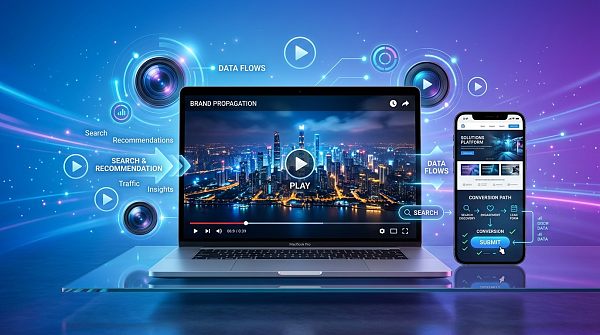
From the perspective of platform attributes, YouTube is first and foremost a “content-driven search + recommendation platform,” so it is highly suitable for brand education, awareness building, trust accumulation, and influencing decisions over the long term. Especially for complex products, cross-border business, B2B services, and solutions with relatively high explanation costs, video is better than text and images at conveying professionalism and is also more likely to make users remember the brand.
But this does not mean YouTube can only be used for branding. In fact, many companies have already combined YouTube advertising with content operations for lead generation, independent website conversions, inquiry growth, and channel partner recruitment. The difference lies in the fact that brand goals usually focus on exposure, watch time, growth in search volume, and improvement in branded keywords; customer acquisition goals place more emphasis on click-through rate, bounce rate, form submissions, inquiry conversions, and the final quality of closed deals.
Therefore, the correct answer is not an either-or choice, but phased use:
- New market expansion stage: more suitable to first focus on brand awareness and education
- Clear demand stage: more suitable for product comparison, case explanation, and solution videos
- Lead harvesting stage: more suitable to combine ad targeting, landing pages, and remarketing for customer acquisition
If the company itself has low brand awareness, a long customer decision-making cycle, and products that require explanation, then using YouTube to build the brand first and acquire customers later is often more realistic than forcing low-cost conversions from the very beginning.
What business decision-makers should care about most is not view count, but whether the conversion chain is complete
Many companies misjudge YouTube performance because the core reason is that they only look at front-end data and not the full chain. High view counts are not necessarily effective, and a large number of subscribers does not necessarily bring business opportunities. What really matters is whether the path from seeing the video, to understanding the product, to clicking through to the website, to submitting a form is smooth.
For business managers, when judging whether YouTube is worth investing in, it is recommended to focus on the following questions:
- Whether the goal is clear: is this round of promotion for brand exposure, or for direct customer acquisition
- Whether the content matches search intent: are users looking for solutions, watching reviews, or just casually browsing
- Whether the landing page can effectively receive traffic: whether website loading speed, page trustworthiness, and form design are up to standard
- Whether the data can be attributed: whether organic traffic, paid traffic, and remarketing conversions can be distinguished
- Whether the leads are valid: beyond the number of inquiries, whether there are real business opportunities and the possibility of follow-up deals
Especially in foreign trade, independent website, and multilingual business scenarios, if the interest traffic brought by video encounters problems after entering the official website, such as slow loading, unstable cross-border access, or lagging form submission, the customer acquisition effect will be severely diluted. For this type of business, front-end content marketing and back-end website experience must be optimized simultaneously. For example, for overseas access scenarios, you can improve first-screen speed, stability, and real customer access experience for foreign trade B2B website building through global CDN acceleration empowering foreign trade B2B website building, reducing traffic loss caused by “the page won’t open” or “submission is too slow.”
Under what circumstances is it more suitable to treat YouTube as a branding tool?
If a company is in any of the following situations, YouTube is more suitable for prioritizing brand-building tasks:
- The product is complex, and customers need more time to understand and compare
- The target market has high trust requirements for brands, and purchasing decisions are made cautiously
- The company has just entered overseas markets, and brand awareness is almost zero
- The industry education cost is high, and customers have many awareness gaps
- Distributors, agents, and end customers all need a unified communication of value points
At this time, the content direction should not focus only on hard-selling ads, but should be arranged around user search intent, such as:
- Popular science content on industry knowledge
- Explanations of product working principles
- Scenario-based solution explanations
- Customer cases and displays of actual results
- Answers to common questions and selection recommendations
The value of this type of content lies in first establishing the perception that “you are professional, trustworthy, and worth contacting further.” For end consumers, it can reduce anxiety in choosing; for distributors and agents, it can strengthen confidence in cooperation; for corporate procurement, quality control, and safety management personnel, it can help them understand risk points and evaluation standards more quickly.
Under what circumstances can YouTube directly take on the task of customer acquisition?
When a company has a relatively mature marketing foundation, YouTube can absolutely become an effective customer acquisition channel. This usually includes the following prerequisites:
- Product demand is relatively clear, and users are already searching for solutions themselves
- There are already clear landing pages, forms, and sales follow-up processes
- The company can continuously produce video content targeting decision-making questions
- It has the capability for ad placement, remarketing, and data analysis
- Official website SEO and video SEO can be coordinated strategically
At this point, it is more suitable to create the following types of videos:
- Product comparison videos: help users shorten selection time
- Case study videos: directly answer “have you done similar projects”
- Usage demonstration videos: lower the barrier to understanding and enhance trust
- FAQ videos: resolve users’ last-minute hesitation
- High-intent keyword videos: capture clearly defined search demand
For example, users may search “how to choose a certain type of marketing service,” “is independent website SEO effective,” or “how can a B2B official website increase overseas inquiries.” Behind such searches, there is often already strong commercial intent. If a company first answers these questions through video and then uses a clear CTA to guide users to the official website, book a consultation, or download a solution, it has the opportunity to turn YouTube from a “traffic platform” into a “lead entry point.”
If you want to balance both branding and customer acquisition at the same time, how should the strategy be designed?
The most effective approach is not to make every single video achieve all goals at once, but to build a layered content structure.
It can usually be divided into three layers:
- Top-of-funnel content: solves broad awareness issues, with the goal of exposure and trust building
- Mid-funnel content: solves comparison and evaluation issues, with the goal of shortening the decision-making cycle
- Bottom-of-funnel content: solves conversion barriers, with the goal of driving consultations, lead capture, and transactions
Specifically:
First layer, brand awareness content. For audiences who are not yet familiar with the company and products, emphasize industry insights, trend interpretation, and issue education.
Second layer, decision-support content. For audiences who have already recognized a problem and are looking for solutions, emphasize solutions, differentiated capabilities, and proof through case studies.
Third layer, conversion-driving content. For high-intent audiences, emphasize pricing logic, service processes, implementation details, after-sales support, and risk assurance.
At this point, YouTube advertising, SEO content optimization, and website SEO optimization solutions can work together: video is responsible for attracting and educating, search is responsible for continuously capturing demand, and the website is responsible for building trust and converting leads. For cross-border access scenarios, if website speed and stability are insufficient, even the best video traffic may be wasted, so website infrastructure optimization should not be overlooked.
When implementing execution, which details are most likely to affect the final results?
For users, operators, and marketing execution teams, the success or failure of YouTube video marketing often depends on the details, not just on creativity.
It is recommended to focus on the following aspects:
- Keyword topic selection: prioritize question-based, comparison-based, and solution-based keywords with clear demand
- Title and thumbnail: they should be searchable and also increase click intent
- First 30-second structure: quickly explain “what problem this video can help you solve”
- Content rhythm: reduce empty talk and get to the judgment criteria and actionable suggestions users care about as soon as possible
- Call to action: clearly tell users what to watch next, where to click, and how to inquire
- Landing page consistency: the content discussed in the video should remain consistent with the information on the website page
- Data review: do not only look at view count, but also watch completion rate, click-through rate, dwell time, and conversion rate
If a company serves decision-makers, after-sales maintenance personnel, distributors, and end consumers, it is recommended not to use one set of content for everyone, but to design content by role. This is because different people care about completely different issues: managers focus on return on investment, operators focus on implementation methods, quality control and safety personnel focus on risk and stability, and channel partners care more about cooperation space and brand endorsement.
How do you determine whether your company should currently prioritize branding or customer acquisition?
You can use a simple judgment method:
- If your brand awareness is low, customers do not understand you, and the decision-making cycle is long——prioritize branding
- If your market education has already been completed and your website conversion chain is mature——you can focus on customer acquisition
- If you want both greater exposure and more leads——adopt a combined approach of “brand content as the foundation + conversion content as the closing step”
For most companies, the biggest risk is not choosing the wrong platform, but using a single goal to define the entire YouTube channel. In reality, YouTube is most suitable for playing a medium-to-long chain role of “from awareness to trust, and then to conversion.” As long as content, advertising, SEO, and website follow-up work together, it can serve both as a brand asset accumulation tool and as a stable customer acquisition entry point.
Especially for foreign trade B2B official websites, multilingual sites, and independent website scenarios, whether overseas users brought by video marketing can convert smoothly often depends on whether the website access experience is stable enough. If a company is optimizing its cross-border marketing chain, it can also pay attention to capabilities such as global CDN acceleration empowering foreign trade B2B website building to reduce the impact of slow loading, high bounce rates, and submission failures on inquiry conversion.
In summary, YouTube video marketing is not an opposing choice between “branding” and “customer acquisition,” but a channel whose role needs to be configured according to the company’s stage, budget structure, content capabilities, and website follow-up capacity. When branding is done well, customer acquisition costs usually decrease; when the conversion chain is done well, brand traffic is also more likely to turn into business opportunities. What companies truly should do is not argue about which side YouTube leans toward more, but clarify goals, create the right content, capture traffic effectively, and make the conversion process work.
Related Articles



Related Products
 EasyCamp SaaS Smart Website Marketing SystemE-Yingbao SaaS Smart Website Marketing System: AI-powered, zero-code website building. Rapidly launch multilingual independent e-commerce sites in just 10 minutes. Global server acceleration and AI-driven SEO optimization empower businesses to efficiently connect with global markets. The seamless integration of technology and user-friendly operation makes building e-commerce sites incredibly simple.
 AI+SEM Intelligent Advertising Marketing SystemAI+SEM drives intelligent ad creation, empowering full-funnel precision advertising marketing. The system automatically generates weekly/monthly reports, AI recommends keywords and target countries, monitors core metrics in real-time with intelligent alerts, and enables one-click high-conversion ad solutions to help quickly acquire customers and improve ROI.
 AI+SEO Dual Engine Optimization ServiceEasyWin AI+SEO Dual Engine Optimization System leverages AI-powered keyword mining, content generation, and comprehensive technical optimization to help foreign trade enterprises acquire high-quality organic traffic, significantly improving search rankings and conversion rates.
 AI+SNS Social Media Marketing SystemYingbao AI+SNS Social Media Marketing System - Precision social capture for the social media era. Supports one-click content synchronization across major platforms like Facebook and LinkedIn. AI intelligently rewrites posts for enhanced relevance. 24/7 AI customer service and user profiling analysis empower businesses to efficiently expand into global markets.
 AI+SEO营销解决方案易营宝AI+SEO营销解决方案,通过AI批量写作、智能生成TDK、精准关键词扩词等功能,全面优化网站SEO效果,提升流量与转化率。助力企业构建高效智能网站新生态。
 AI+SEM Advertising Marketing SolutionsAI+SEM Advertising Marketing Solution leverages AI technology to deeply empower SEM ad campaigns. It automatically generates weekly/monthly reports using AI, presenting account data across multiple dimensions for comprehensive insights into campaign performance and trends. The system precisely recommends keywords and target countries, intelligently generates high-conversion ad copy, and enables one-click activation of efficient campaign plans to help businesses rapidly acquire customers. Simultaneously, it monitors core metrics in real time, intelligently identifies abnormal fluctuations, and issues timely alerts to ensure stable, high-return advertising results.
 Domain Name ServicesEasyWin provides professional domain name services, including intelligent queries, one-stop registration, brand protection, and full lifecycle management, helping businesses build a digital brand image.
 EasyOperate B2C Cross-Border E-Commerce Platform & Independent WebsiteEasyStore B2C Cross-border E-commerce Independent Store is an intelligent website building and cross-border e-commerce integrated solution independently developed by EasyStore Information Technology (Beijing) Co., Ltd. The system is specially designed for small and medium-sized as well as large export enterprises, integrating 'website building, operation, marketing, advertising, and conversion' into one, helping enterprises quickly establish cross-border e-commerce independent stores to achieve brand globalization and global sales growth.
The platform supports multiple languages, multiple currencies, and multi-channel marketing, with built-in AI intelligent translation and SEO optimization systems, suitable for mainstream markets such as Southeast Asia, Europe and America, Latin America, and the Middle East, assisting Chinese manufacturing enterprises in efficiently deploying international e-commerce strategies. SSL证书易营宝提供专业SSL安全证书服务,包括单域名和泛域名证书,确保网站数据传输加密、身份验证和完整性保护,助力企业建立安全可信的在线业务环境。









