









- What Does a Global Traffic Ecosystem Service Provider Do? What Are the Differences from a Single Advertising AgencyJul 16, 2026View details
- What should you focus on in the latest enterprise SaaS report? From renewal rates and delivery costs to overseas growth opportunitiesJul 12, 2026View details
- What signals are worth paying attention to in a cross-border marketing trend report? B2B companies should look at these 6 signalsJul 11, 2026View details
- How to Read a Cross-Border Marketing Trends Report? Five Key Dimensions for Evaluating Channel OpportunitiesJul 11, 2026View details
- Which channel has the highest ROI in the global traffic ecosystem? Comparative analysis of search, social media, and advertisingJul 10, 2026View details
- What multilingual website services are available in Sanya? Which model is more suitable for local businesses going global?Jul 08, 2026View details
- How to view the complete list of China SaaS companies in the top 100? Practical methods for screening website-building and marketing service providersJul 08, 2026View details
- How to view pricing in the global traffic ecosystem? Cost comparison of search, social media, and content channel advertisingJul 06, 2026View details
How to Do YouTube Video SEO Starting with the Title
To do YouTube video SEO well, the title is often the first step. A title that balances keywords, click-through rate, and user intent not only affects rankings, but also directly determines exposure and playback performance. This article will explain title optimization methods from a practical perspective.
For operators responsible for content uploads, channel operations, and overseas promotion on a daily basis, a title is not just a simple sentence, but a key node connecting search traffic, recommended traffic, and conversion paths. Especially in the integrated website and marketing service scenario, YouTube videos often take on 3 tasks: driving traffic to the official website, capturing inquiries, and building brand awareness.
Beijing E-Marketing Information Technology Co., Ltd. has long served global growth needs. Relying on artificial intelligence and big data capabilities, it connects smart website building, SEO optimization, social media marketing, and advertising placement. In such a full-chain operating system, YouTube title optimization is not an isolated action, but a prerequisite step for improving content distribution efficiency.
Why YouTube titles determine a video's first wave of traffic
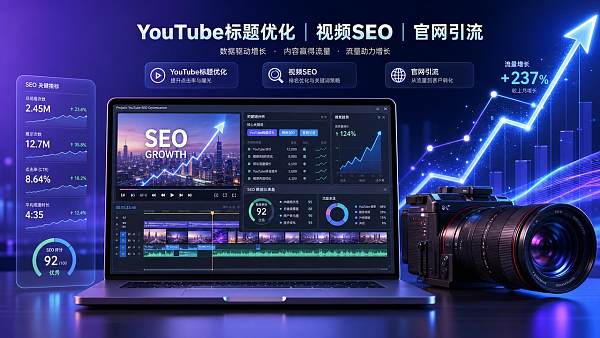
YouTube uses multiple signals such as titles, descriptions, tags, watch time, and click-through rate to understand a video's topic, and the title is usually the element first captured by the system and first seen by users. For most new videos, the first 24 hours to 72 hours after publishing is an important window for judging initial performance.
If the title does not clearly express the topic, the system will struggle to accurately match search intent; if the title only has keywords without appeal, users will not click. The 4 most common operational problems are: keywords placed in the wrong position, wording that is too broad, promises that are too exaggerated, and inconsistency with the thumbnail.
3 core metrics affected by the title
- Search relevance: whether the first half of the title contains the core topic keyword.
- Click-through rate: usually the first 40 characters determine whether users continue looking.
- Viewing expectations: whether the title accurately promises the content, affecting retention in the first 30 seconds.
This is especially true for B2B content. For example, for tutorial, case study, and product demo videos, users care more about “whether it can solve a problem quickly.” If the title is vaguely written as “Marketing Tips Sharing”, it is often not as effective as “How to Write YouTube SEO Titles in 2025: A 7-Step Practical Template” for gaining precise traffic.
Different traffic entry points have different requirements for titles
There are at least 3 common entry points for YouTube videos: search results pages, homepage recommendation feeds, and related video placements. Search entry points focus more on keyword clarity, recommendation entry points focus more on click appeal, and related video placements rely more on topic similarity. Therefore, a qualified title must satisfy at least 3 conditions at the same time: “recognizable, clickable, and expandable”.
The table below can help operators quickly judge what a title should prioritize under different content goals.
In actual execution, do not treat the title only as a copywriting issue, but rather as a traffic entry point matching issue. The closer the title is to the characteristics of the entry point, the easier it is to gain stable exposure within the first 1 week, which is especially critical for subsequent traffic to the official website and business opportunity acquisition.
Practical methods for YouTube title optimization: from keyword selection to final draft
A YouTube title that can generate search and clicks is usually not written in one go, but goes through 4 steps: keyword selection, intent judgment, structural combination, and live testing. For operators, it is recommended to prepare at least 3 alternative titles for each video, and then filter them based on the channel positioning.
Step 1: First determine 1 primary keyword and 2 semantic keywords
When using “YouTube” as the core keyword, it is not recommended to use it alone. Instead, expand it into more specific search expressions, such as “YouTube SEO”, “YouTube title optimization”, “YouTube video ranking”, and “YouTube operations tutorial”. The primary keyword is responsible for topic categorization, while the 2 semantic keywords supplement user intent.
If the video targets beginner operators, the keywords should lean toward tutorial-oriented terms; if it targets corporate marketing teams, the keywords can lean more toward growth-oriented and conversion-oriented terms. Usually, keeping a title between 28 and 65 characters is more reliable. If it is too short, it may be incomplete; if it is too long, it may be truncated on different devices.
4 title structures you can directly apply
- Keyword + action result: for example, “How to Write YouTube Titles, 5 Tips to Improve Search Clicks”
- Keyword + scenario audience: for example, “YouTube SEO Basics: How Operators Can Write High-CTR Video Titles”
- Keyword + numbered steps: for example, “YouTube Video Title Optimization: 7 Steps to Build a Search-Friendly Structure”
- Keyword + pitfall warning: for example, “Stop Writing YouTube Titles Like This, 3 Mistakes That Lower Exposure”
Step 2: Decide the tone of the title based on search intent
Even for YouTube, user intent may be completely different. Some people want to learn basic operations, some want to solve low-play issues, and some want to drive video traffic to their official website. The title must align with intent; otherwise, even if it ranks, the completion rate will still be low, which in turn affects subsequent recommendations.
The table below is suitable for pre-publication content checks, and is especially useful for unifying naming standards when website and marketing teams work together.
After judging intent, the tone of the title should also change accordingly. For beginner-oriented content, “how to do” feels more natural; for decision-oriented content, “how to improve” feels more valuable; for solution-oriented content, it is suitable to add information such as process, cycle, and cost, so users can more quickly judge whether it is worth clicking.
Step 3: Put keywords at the front, but do not leave only keywords
The first half of the title should preferably prioritize the core topic, especially within the first 10 to 20 characters. The reason is straightforward: search recognition is clearer, mobile display is more complete, and users can confirm relevance at a glance. But if the title is only a string of keywords, such as “YouTube SEO YouTube Title YouTube Optimization Tips”, it will instead reduce readability.
A more effective method is “keyword + value point”. The value point can be 1 result, 1 scenario, 1 set of numbers, or 1 common problem. For example, “YouTube Title Optimization: 6 Practical Methods for Operators to Improve Click-Through Rate” is more suitable than simple keyword stuffing for the dual goals of search and clicks.
Step 4: Observe for 7 days after publishing, and do not change titles frequently without purpose
Many teams see low plays and repeatedly change the title within 1 day, which is not helpful for identifying the source of the problem. A more reliable approach is to observe for at least 72 hours after publishing, fully evaluate 7 days of data, and then decide whether to make slight adjustments. Focus on 3 indicators: impression click-through rate, average watch time, and the proportion of search traffic sources.
If the click-through rate is lower than the channel's normal range, you can first adjust the appeal of the title; if the click-through rate is normal but watch time is low, it is more likely that the promise of the title is inconsistent with the content. Operationally, it is recommended to change only 1 variable at a time, for example changing only the number, only the result word, or only the opening structure, to facilitate review.
In integrated website and marketing scenarios, how titles serve conversions
For enterprises, YouTube is not just a playback platform, but also an external traffic entry point. If a video title only pursues views without considering website follow-up and business conversion, its ultimate value will be weakened. Especially in scenarios such as cross-border promotion, e-commerce campaigns, and content distribution, title strategy should be designed in sync with landing page strategy.
For example, during major e-commerce promotions or media content distribution stages, when videos suddenly gain higher plays, website bandwidth and traffic costs will also rise accordingly. At this time, content growth and infrastructure preparation need to be considered together. For teams with global business needs, resources such as website traffic packages are suitable for coordinating with video promotion rhythms, locking in traffic costs in advance and reducing the pressure of sudden visits.
Titles and landing pages must remain consistent
If the video title is about “how to improve YouTube organic traffic”, but the landing page directly promotes generalized services, the conversion rate is usually not high. A more reasonable approach is to make the keywords in the title, the core content of the video, and the topic of the website page form a consistent chain. At minimum, 3 points should be achieved: topic consistency, benefit-point consistency, and action-entry consistency.
- If the title emphasizes a tutorial, the landing page should provide a step list or solution introduction.
- If the title emphasizes a case study, the landing page should provide industry scenarios and execution paths.
- If the title emphasizes growth, the landing page should display quantifiable metrics and service processes.
2 risk points often overlooked by operators
Risk 1: The title overpromises, but the content delivery falls short
For example, frequently using terms such as “viral traffic”, “double growth”, and “guaranteed homepage ranking” may increase clicks in the short term, but will reduce viewing satisfaction. B2B service content is better suited to restrained, clear, and actionable wording, such as “3-step check”, “7-day observation”, and “4 common mistakes”, which makes it easier to build trust.
Risk 2: After traffic growth, website follow-up preparation is insufficient
When videos grow explosively, the official website, landing pages, and inquiry pages may all face higher concurrent traffic. If website access costs are uncontrollable and monitoring is not timely, the marketing chain will be slowed down. For teams that need to frequently distribute global content, they can plan resource packages, monitoring alerts, and automated procurement interfaces in advance based on campaign cycles, regional traffic fluctuations, and BI data analysis needs, to avoid amplified front-end traffic while back-end support drops offline.
Common issues and execution suggestions for YouTube title optimization
Title optimization seems simple, but the real difficulty lies in long-term stable execution. Below are concentrated answers to several questions operators encounter most often, so they can be directly applied in daily publishing workflows.
Should titles include years, numbers, and parentheses
Yes, but it depends on the content type. Tutorial update content and platform rule change content are suitable for adding a year, such as “2025”; step-based content is suitable for adding “5 methods” or “7 execution steps”; parentheses are suitable for supplementing scenarios, such as “for beginners” or “for B2B operations”. It is recommended not to stack more than 2 emphasis elements in 1 title, to avoid visual noise.
How long after changing a title should you look at the results
It is generally recommended to observe for 3 days to 7 days. If the video itself already has stable search traffic, changes should be made more cautiously to avoid damaging existing rankings. If search traffic is still low 14 days after publication, you can reassess whether the keywords are too broad, too competitive, or whether the content itself does not sufficiently match the search terms.
Should a channel unify its title style
It is recommended to unify about 70%. A consistent structure helps the system identify the boundaries of the channel's content and also helps users form recognition. But it is not recommended to copy templates 100% exactly, because videos on different topics and at different stages need different click triggers. In practice, you can fix the prefix logic while varying the value point in the second half of the sentence.
If the team is simultaneously operating the official website, video channels, and overseas promotion projects, title standards should also be incorporated into the content SOP, including at least 4 items: keyword selection rules, character count range, post-publication review cycle, and landing page mapping relationships. In this way, whether it is operated by one person or through multi-person collaboration, execution quality will be more stable.
When YouTube titles are done well, what they bring is not only ranking improvement, but also improved efficiency for the entire content customer acquisition chain. For operators, grasping these 4 core points—keyword placement, user intent, value expression, and data review—usually can significantly improve video exposure and click performance.
If you want to unify YouTube optimization with official website follow-up, SEO planning, social media distribution, and advertising placement, E-Marketing can provide solution support that is closer to execution based on your business stage. Whether it is content title standards, website follow-up optimization, or supporting website traffic package resource planning, everything can be customized according to your promotion rhythm. Contact us now to get a more suitable implementation solution for your team.
Related Articles
Related Products
 EasyCamp SaaS Smart Website Marketing SystemE-Yingbao SaaS Smart Website Marketing System: AI-powered, zero-code website building. Rapidly launch multilingual independent e-commerce sites in just 10 minutes. Global server acceleration and AI-driven SEO optimization empower businesses to efficiently connect with global markets. The seamless integration of technology and user-friendly operation makes building e-commerce sites incredibly simple.
 AI+SEM Intelligent Advertising Marketing SystemAI+SEM drives intelligent ad creation, empowering full-funnel precision advertising marketing. The system automatically generates weekly/monthly reports, AI recommends keywords and target countries, monitors core metrics in real-time with intelligent alerts, and enables one-click high-conversion ad solutions to help quickly acquire customers and improve ROI.
 AI+SEO Dual Engine Optimization ServiceEasyWin AI+SEO Dual Engine Optimization System leverages AI-powered keyword mining, content generation, and comprehensive technical optimization to help foreign trade enterprises acquire high-quality organic traffic, significantly improving search rankings and conversion rates.
 AI+SNS Social Media Marketing SystemYingbao AI+SNS Social Media Marketing System - Precision social capture for the social media era. Supports one-click content synchronization across major platforms like Facebook and LinkedIn. AI intelligently rewrites posts for enhanced relevance. 24/7 AI customer service and user profiling analysis empower businesses to efficiently expand into global markets.
 AI+SEO营销解决方案易营宝AI+SEO营销解决方案,通过AI批量写作、智能生成TDK、精准关键词扩词等功能,全面优化网站SEO效果,提升流量与转化率。助力企业构建高效智能网站新生态。
 AI+SEM Advertising Marketing SolutionsAI+SEM Advertising Marketing Solution leverages AI technology to deeply empower SEM ad campaigns. It automatically generates weekly/monthly reports using AI, presenting account data across multiple dimensions for comprehensive insights into campaign performance and trends. The system precisely recommends keywords and target countries, intelligently generates high-conversion ad copy, and enables one-click activation of efficient campaign plans to help businesses rapidly acquire customers. Simultaneously, it monitors core metrics in real time, intelligently identifies abnormal fluctuations, and issues timely alerts to ensure stable, high-return advertising results.
 Domain Name ServicesEasyWin provides professional domain name services, including intelligent queries, one-stop registration, brand protection, and full lifecycle management, helping businesses build a digital brand image.
 EasyOperate B2C Cross-Border E-Commerce Platform & Independent WebsiteEasyStore B2C Cross-border E-commerce Independent Store is an intelligent website building and cross-border e-commerce integrated solution independently developed by EasyStore Information Technology (Beijing) Co., Ltd. The system is specially designed for small and medium-sized as well as large export enterprises, integrating 'website building, operation, marketing, advertising, and conversion' into one, helping enterprises quickly establish cross-border e-commerce independent stores to achieve brand globalization and global sales growth.
The platform supports multiple languages, multiple currencies, and multi-channel marketing, with built-in AI intelligent translation and SEO optimization systems, suitable for mainstream markets such as Southeast Asia, Europe and America, Latin America, and the Middle East, assisting Chinese manufacturing enterprises in efficiently deploying international e-commerce strategies. SSL证书易营宝提供专业SSL安全证书服务,包括单域名和泛域名证书,确保网站数据传输加密、身份验证和完整性保护,助力企业建立安全可信的在线业务环境。









