









- Can Zhejiang foreign trade independent websites still be developed today? Look at changes in traffic and lead generationJul 28, 2026View details
- What New Signals Are Emerging in Enterprise Services SaaS Marketing ReportsJul 27, 2026View details
- What Does a Global Traffic Ecosystem Service Provider Do? What Are the Differences from a Single Advertising AgencyJul 16, 2026View details
- What should you focus on in the latest enterprise SaaS report? From renewal rates and delivery costs to overseas growth opportunitiesJul 12, 2026View details
- What signals are worth paying attention to in a cross-border marketing trend report? B2B companies should look at these 6 signalsJul 11, 2026View details
- How to Read a Cross-Border Marketing Trends Report? Five Key Dimensions for Evaluating Channel OpportunitiesJul 11, 2026View details
What compliance setups does a foreign trade website need? Privacy policy, Cookie, and data compliance explained in one article
What compliance settings does an export website need, and why can't it just put up a privacy policy page?
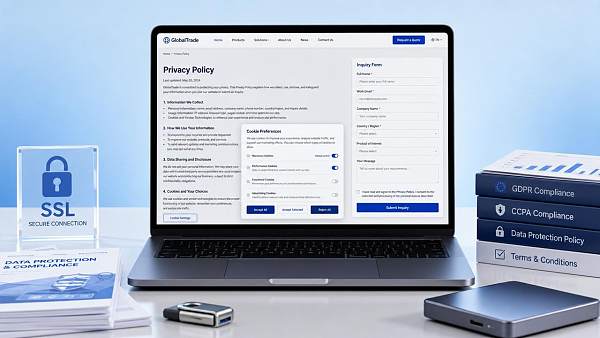
What compliance settings does an export website need? This question is often underestimated. Many websites focus on page design, ad campaigns, and SEO, while ignoring compliance details that also affect conversions.
The more realistic situation is that overseas visitors first judge whether a website is trustworthy before deciding whether to submit a form, accept a quote, or continue the conversation. Missing privacy notices, non-compliant Cookie pop-ups, and unclear form consent all directly lower trust.
For export businesses, compliance settings are not a “legal add-on” but part of the website’s basic infrastructure. Especially when targeting European, North American, and other markets, data collection, tracking analysis, and retargeting all need to be built on clear disclosure and traceable management.
If the website also carries multilingual display, ad landing pages, and inquiry collection functions, then the question of what compliance settings an export website needs cannot be answered by looking at a single page of text alone; it is necessary to examine whether the entire user journey forms a closed loop.
Which settings are considered “must-have items” and are best aligned before launch?
To start with the conclusion, common must-have items usually include a privacy policy, Cookie notice and preference mechanism, form consent statement, terms page, SSL certificate, data storage explanation, and necessary cross-border transfer notices.
What is most easily overlooked is not whether there is a page, but whether the page content corresponds to the real business. For example, if the website uses analytics code, ad pixels, and online chat tools, it cannot simply say “we value privacy” in a vague way.
- Privacy policy: explain what data is collected, for what purpose, how long it is retained, and how it can be deleted.
- Cookie settings: distinguish between necessary and marketing cookies, and allow visitors to make independent choices.
- Form consent: clearly inform users of the purpose of information use before inquiries, subscriptions, or material downloads.
- Secure transmission: deploy HTTPS and avoid transmitting form content in plain text.
- Third-party disclosure: if analytics, ads, or customer service systems are integrated, they should also be disclosed accordingly.
If the website serves a broad region, the multilingual content must also remain consistent. Inconsistent text versions will cause differences between the compliance terms and the actual pages, making later review and complaint handling very passive.
How should a Cookie pop-up be configured so it does not affect the experience or create pitfalls?
This is one of the most common points of controversy for export websites. Many websites do have a prompt, but only provide an “Accept” button, without reject or preference settings. This may seem convenient, but in practice the risk is higher.
A more robust approach is to classify Cookies into necessary, analytics, marketing, and other categories, and let users choose for themselves. Before consent is obtained, ad tracking and retargeting scripts should not be enabled by default.
For websites that rely on SEO and advertising to acquire customers, Cookie management must be considered together with technical deployment. Otherwise, there may be a situation where a pop-up appears on the front end, but tracking scripts have already been loaded in advance on the back end.
If the site has multilingual versions, attention must also be paid to the expression style of different regions. Tools like EasyYingbao AI Translation Center are even more valuable when synchronizing multilingual pages, because updates to terms, units of measure, and local expressions can be aligned together, reducing version mismatches.
What should be the focus when it comes to cross-border data and inquiry forms?
Export websites are often not just for display, but for continuously collecting names, emails, phone numbers, company names, and purchasing requirements. Once this information enters a CRM, email system, or advertising platform, it involves data flow and processing responsibilities.
When judging what compliance settings an export website needs, forms are the core entry point. Three things need to be confirmed in advance: whether collection is necessary, whether the explanation is clear, and where the data goes after submission.
If the website server, email system, and customer service tools are distributed in different countries, a cross-border transfer explanation must also be added. This is not about cramming legal jargon onto the page, but about letting visitors know the scope of data processing and the contact channel.
- Collect only the information needed to complete the business, and do not add fields arbitrarily.
- Explain the purpose near the submit button, such as for quotation, follow-up, or material delivery.
- Reserve contact channels for deletion, correction, and withdrawal of authorization.
- Clearly indicate whether third-party systems are involved in storage or automated processing.
In actual projects, website building, SEO, advertising, and data collection are often completed by different teams. Platforms like EasyYingbao, which have long focused on integrated smart website building and overseas marketing services, have an advantage in being able to plan traffic acquisition and compliance foundations together, rather than fixing loopholes after launch.
Is translating the terms enough for a multilingual website?
No, it is not enough. The most common problem with multilingual websites is not the lack of translation, but the lack of synchronization between different language versions. The homepage has updated form fields, while the Spanish page has not; the Cookie copy has been updated, while the German page is still using the old version. These are all high-frequency risks.
Therefore, when asking what compliance settings an export website needs, you should also factor in a “multilingual synchronization mechanism.” Especially in cross-border e-commerce, B2B export, and service export scenarios, terms management must be updated together with page content.
If a solution supports 249 languages, dynamic content synchronization, and human-machine collaborative editing, the maintenance burden will be much lower. The key is not just translating quickly, but ensuring consistent versions, stable terminology, and region-specific details that are adapted correctly.
How do you judge budget and implementation cycle, and which misunderstandings most easily increase rework?
In many projects, only design and promotion are budgeted at the beginning, with no time reserved for compliance configuration. As a result, after the website goes live, pages and scripts must be repeatedly adjusted because of ad account opening, client review, or legal verification.
The three most common misunderstandings are: treating compliance as a copywriting issue, treating Cookies as a pop-up issue, and treating data compliance as a server issue. In fact, all of these are directly related to the website architecture, marketing tools, and content management.
The implementation can be organized in this order:
- First review the pages, forms, tracking code, and third-party plugins.
- Then confirm the target market’s requirements for privacy, Cookies, and cross-border transmission.
- Finally, unify multilingual terms, front-end prompts, and back-end logging logic.
If the business scope is broad, it is recommended to evaluate website building, SEO, ad placement, and data governance within one project framework. This makes it easier to determine which settings are must-have items and which can be improved in stages.
How can you quickly determine whether your website’s compliance settings meet the standard?
You can start by checking backward from the visitor journey. When the homepage opens, is there a clear Cookie choice; when submitting a form, is the purpose explained; when entering the privacy policy page, does the content match the actual tools and data flow.
If there are obvious blank spots in the answer, it means the export website still has not been properly configured. Especially when preparing for long-term SEO, ad retargeting, and multi-market campaigns, the earlier this part is organized, the lower the later cost will be.
The final evaluation standard is actually very practical: can visitors understand it, can the system execute it, and can the team leave a trace. If these three points are done properly, the website will not only be more stable, but also more helpful in improving overseas trust and inquiry efficiency.
The next step is to first make a checklist, cross-check the privacy policy, Cookie management, form authorization, multilingual synchronization, and data flow. After confirming these basic items, then evaluate the promotion strategy; the efficiency will usually be higher.
Related Articles
 U.S. CPSC Updates Online Compliance Guidelines for Children's Products
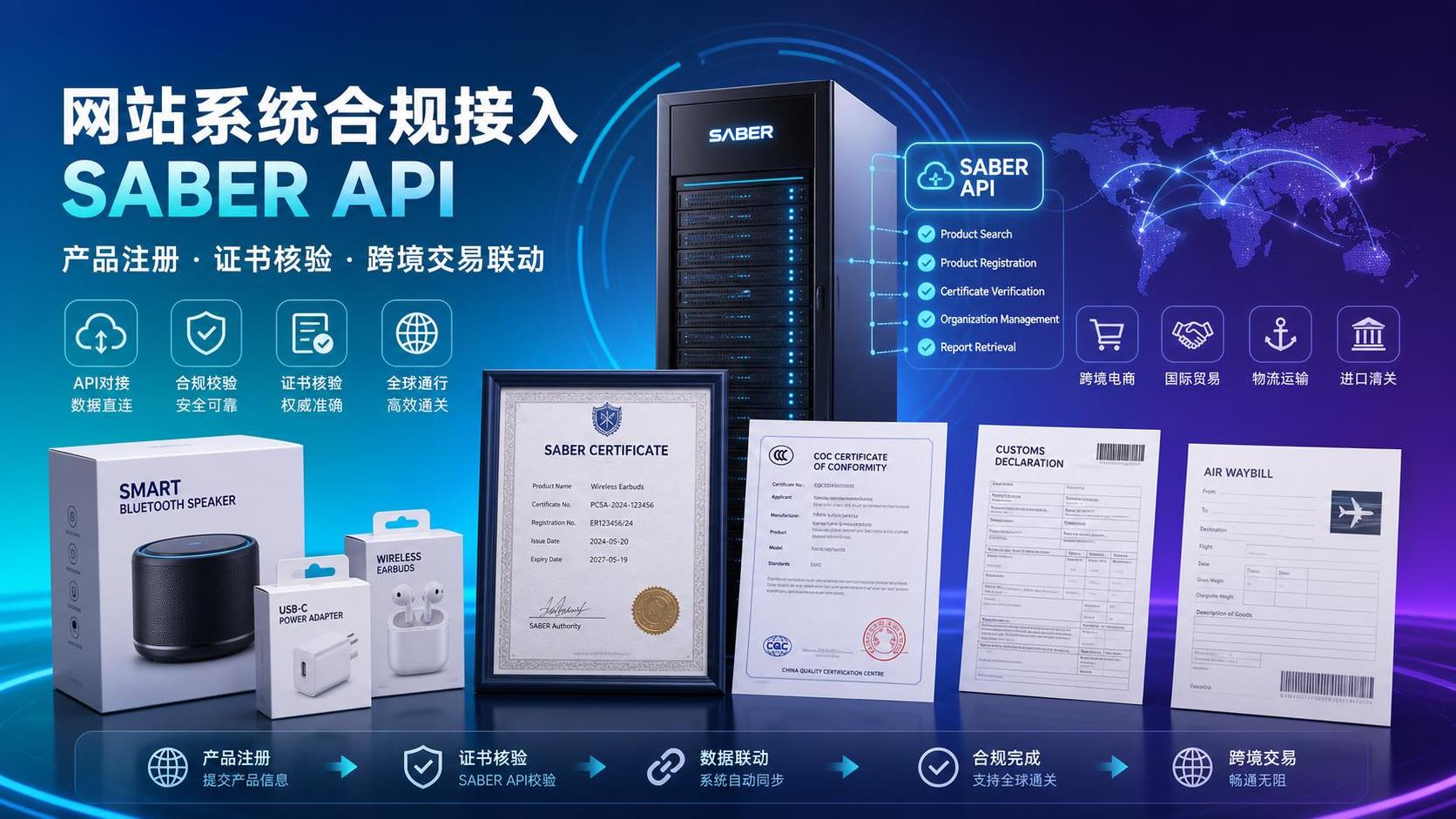
 Saudi Arabia's New SASO Regulations Take Effect: Standalone Websites for Electrical and Electronic Products Must Integrate with the SABER API
 FDA New Regulations Take Effect: Medical Device Independent Websites Must Integrate Real-Time U.S. Agent Verification


Related Products
 EasyCamp SaaS Smart Website Marketing SystemE-Yingbao SaaS Smart Website Marketing System: AI-powered, zero-code website building. Rapidly launch multilingual independent e-commerce sites in just 10 minutes. Global server acceleration and AI-driven SEO optimization empower businesses to efficiently connect with global markets. The seamless integration of technology and user-friendly operation makes building e-commerce sites incredibly simple.
 AI+SEM Intelligent Advertising Marketing SystemAI+SEM drives intelligent ad creation, empowering full-funnel precision advertising marketing. The system automatically generates weekly/monthly reports, AI recommends keywords and target countries, monitors core metrics in real-time with intelligent alerts, and enables one-click high-conversion ad solutions to help quickly acquire customers and improve ROI.
 AI+SEO Dual Engine Optimization ServiceEasyWin AI+SEO Dual Engine Optimization System leverages AI-powered keyword mining, content generation, and comprehensive technical optimization to help foreign trade enterprises acquire high-quality organic traffic, significantly improving search rankings and conversion rates.
 AI+SNS Social Media Marketing SystemYingbao AI+SNS Social Media Marketing System - Precision social capture for the social media era. Supports one-click content synchronization across major platforms like Facebook and LinkedIn. AI intelligently rewrites posts for enhanced relevance. 24/7 AI customer service and user profiling analysis empower businesses to efficiently expand into global markets.
 AI+SEO营销解决方案易营宝AI+SEO营销解决方案,通过AI批量写作、智能生成TDK、精准关键词扩词等功能,全面优化网站SEO效果,提升流量与转化率。助力企业构建高效智能网站新生态。
 AI+SEM Advertising Marketing SolutionsAI+SEM Advertising Marketing Solution leverages AI technology to deeply empower SEM ad campaigns. It automatically generates weekly/monthly reports using AI, presenting account data across multiple dimensions for comprehensive insights into campaign performance and trends. The system precisely recommends keywords and target countries, intelligently generates high-conversion ad copy, and enables one-click activation of efficient campaign plans to help businesses rapidly acquire customers. Simultaneously, it monitors core metrics in real time, intelligently identifies abnormal fluctuations, and issues timely alerts to ensure stable, high-return advertising results.
 Domain Name ServicesEasyWin provides professional domain name services, including intelligent queries, one-stop registration, brand protection, and full lifecycle management, helping businesses build a digital brand image.
 EasyOperate B2C Cross-Border E-Commerce Platform & Independent WebsiteEasyStore B2C Cross-border E-commerce Independent Store is an intelligent website building and cross-border e-commerce integrated solution independently developed by EasyStore Information Technology (Beijing) Co., Ltd. The system is specially designed for small and medium-sized as well as large export enterprises, integrating 'website building, operation, marketing, advertising, and conversion' into one, helping enterprises quickly establish cross-border e-commerce independent stores to achieve brand globalization and global sales growth.
The platform supports multiple languages, multiple currencies, and multi-channel marketing, with built-in AI intelligent translation and SEO optimization systems, suitable for mainstream markets such as Southeast Asia, Europe and America, Latin America, and the Middle East, assisting Chinese manufacturing enterprises in efficiently deploying international e-commerce strategies. SSL证书易营宝提供专业SSL安全证书服务,包括单域名和泛域名证书,确保网站数据传输加密、身份验证和完整性保护,助力企业建立安全可信的在线业务环境。









