









- What stages does the cross-border services ecosystem include? How do website building, promotion, payment, and compliance work togetherJun 22, 2026View details
- How will email marketing costs change in 2026Jun 22, 2026View details
- The China-US tariff arrangement has reached a preliminary consensus, and the trade association will be establishedJun 15, 2026View details
- Should overseas brand marketing start with ads or contentJun 21, 2026View details
- What determines B2C cross-border e-commerce website development costs? A breakdown of features, interfaces, and deployment methodsJun 17, 2026View details
- China-Morocco zero-tariff access, a breakthrough in the cost of Moroccan goods exports to ChinaJun 11, 2026View details
How to choose an SSL certificate? Understand the differences between DV, OV, and EV certificates at a glance
How to choose an SSL certificate: First understand the real problem the business needs to solve
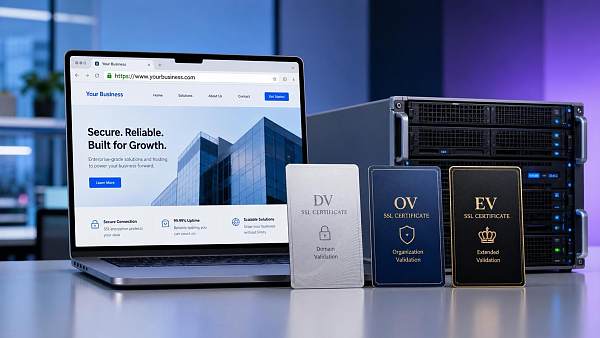
When choosing an SSL certificate, the issue on the surface looks like a price comparison, but in reality it is about choosing encryption strength, identity verification method, and business fit. Many companies only focus on the quote at the beginning, only to later realize that the certificate type directly affects website trust, launch efficiency, and ongoing maintenance costs.
From a purchasing decision perspective, the core of an SSL certificate is not that the more expensive it is, the better, nor that it only needs to be usable. Instead, it should be judged based on website positioning, lead generation goals, customer sources, and brand stage. This is especially true for foreign trade websites, brand independent sites, and ad landing pages, where certificate selection affects security prompts for visitors, form submission trust, and whether customers are willing to continue browsing.
This article uses a more straightforward approach to clearly explain the differences among DV, OV, and EV certificates in one go, helping companies quickly complete SSL certificate selection and avoid spending money without getting the solution that truly fits their needs.
What exactly is the difference between DV, OV, and EV certificates
The underlying encryption capabilities of the three types of SSL certificates are not fundamentally different. What really creates the gap is the depth of verification, issuance speed, and the level of trust shown to the outside world.
1. DV certificate: domain ownership verification, fastest deployment
A DV certificate only verifies whether you own the domain name; it does not review the company entity information. It is usually issued within a few minutes to a few hours, making it suitable for sites that need to go live quickly.
Its advantages are low cost, fast issuance, and a high degree of automation, making it suitable for test sites, content sites, blogs, general display websites, and budget-sensitive projects.
2. OV certificate: verifies company identity, more balanced trust
In addition to verifying the domain name, an OV certificate also checks company registration information, organizational authenticity, and application authorization. Issuance usually takes 1 to 3 business days.
For websites that need to present a formal corporate image, OV certificates are a better fit. Examples include foreign trade websites, manufacturing company sites, service company websites, and multilingual brand sites.
3. EV certificate: the strictest verification, stronger brand credibility
EV certificates require a more rigorous company review, including the legal entity, operating status, contact information, and application authorization. The issuance time is usually longer.
If a website handles high-value transactions, financial information submission, brand trust building, or important customer verification, the value of an EV certificate becomes much more apparent. It is better suited to business scenarios that emphasize authority and credibility in external communication.
How to choose an SSL certificate: Start with the website type and do the first round of screening
If a company has a website, store, ad landing pages, and overseas multilingual sites at the same time, an SSL certificate does not necessarily need to be purchased in only one type. A more practical approach is to configure it in layers based on site purpose.
- Display website: prioritize OV certificates, balancing brand image and cost.
- Short-term campaign page: DV certificates can be considered first, with fast deployment suitable for temporary launches.
- Cross-border store: OV certificates are recommended at minimum; if order values are high, EV certificates can be evaluated.
- Customer login backend: focus on encryption and ongoing management, and DV or OV can be used together.
- Brand headquarters website: if corporate strength needs to be emphasized, EV certificates can be considered further.
This also means that SSL certificate selection cannot be judged independently from website operating goals. For a foreign trade website used for lead generation, if it frequently handles inquiries, quotation requests, and material downloads, basic encryption alone is often not enough; customers care more about whether the company behind the site is real and trustworthy.
The four most common misconceptions during procurement
Many SSL certificate procurement issues are not technical problems, but judgment logic problems. The following misconceptions are the most likely to lead to rework later.
- Only look at the price, not the business outcome. Cheap does not necessarily save money, and insufficient trust later may affect conversion.
- Confusing encryption capability with identity verification. All three certificate types provide encryption, but the depth of verification differs.
- Ignoring renewal and deployment efficiency. Even a good certificate can create maintenance risks if the renewal process is too complicated.
- Applying one configuration to all sites. Security and trust requirements are not the same across different business scenarios.
In actual operations, website development and marketing conversion are often closely linked. If certificate configuration deviates from business goals, it may affect landing page conversion, SEO trust foundation, and overseas visitor experience. When companies build digital infrastructure, they also need to incorporate this kind of basic setup into the overall plan, following a mindset similar to an analysis of the impact of digital transformation on corporate resilience; many growth problems are often hidden in these seemingly basic decisions.
A table to help you quickly understand the differences among DV, OV, and EV certificates
If a one-sentence summary is needed, DV certificates are suitable for rapid activation, OV certificates are suitable for most corporate websites, and EV certificates are suitable for high-trust businesses. Most websites focused on long-term marketing and brand accumulation usually choose OV certificates as the more stable option.
For long-term operations, SSL certificate selection should also consider these three points
Beyond the basic differences among DV, OV, and EV, SSL certificate procurement should also take future maintenance into account. A truly mature decision is not only about whether it can be installed today, but also whether it will be easy to manage tomorrow.
1. Does it support multiple domains or wildcard certificates
If a company has multiple sub-sites, language sites, and business domains, planning the certificate type in advance can reduce repeated procurement and deployment workload.
2. Is the renewal process stable
Certificate expiration is not a minor issue. Once renewal is forgotten, browser warnings will directly affect visits and inquiries. When purchasing, confirm reminder mechanisms, deployment support, and emergency handling procedures.
3. Does it integrate with the website-building and marketing systems
For companies that need to do SEO, advertising, and overseas promotion for the long term, SSL certificates should not be purchased in isolation. They should ideally work together with the website-building system, CDN, form system, and site monitoring management, which can reduce technical downtime and is also more conducive to sustainable operations.
For example, when building an overseas independent site, many companies will plan certificates, security, indexing, and conversion together, which is more省事 than making scattered fixes later. If a company is currently sorting out its digital growth path, it can also take a look at an analysis of the impact of digital transformation on corporate resilience like this, to help unify internal planning.
Conclusion: The key to choosing an SSL certificate is matching the business trust level
Returning to the original question, how should an SSL certificate be chosen? In fact, it can be judged in a simple sequence: first look at the website purpose, then the customer trust requirements, and finally the budget and deployment cycle.
If you only need a quick launch, a DV certificate is usually enough; if the website carries brand presentation and lead generation tasks, an OV certificate is more balanced; if the business heavily relies on authority branding and high-trust transactions, an EV certificate is more worth the investment.
Choosing the right SSL certificate is not just about adding a small function, but about building the foundation for website security, customer trust, and future marketing results. If the certificate is considered within the overall website operations framework, the decision will be more stable, and the return on investment will be easier to see.
Related Articles
- Website Review Activity Guidelines has tightened the disclosure requirements for AI website building." class="listBoxHref" target="_self">
Website Review Activity Guidelines has tightened the disclosure requirements for AI website building." title="The release of the Website Review Activity Guidelines has tightened the disclosure requirements for AI website building." data-src="https://img.bjyyb.net/sites/94000/94397/1782346179928560938003017728.jpg" data-webp="https://img.bjyyb.net/sites/94000/94397/1782346179928560938003017728.webp"/>
The release of the Website Review Activity Guidelines has tightened the disclosure requirements for AI website building.  Shanghai Free Trade Zone launches a pilot RMB cross-border exchange
 EU low-value package tax exemption finalized, import declaration requirements upgraded
Related Products
 EasyCamp SaaS Smart Website Marketing SystemE-Yingbao SaaS Smart Website Marketing System: AI-powered, zero-code website building. Rapidly launch multilingual independent e-commerce sites in just 10 minutes. Global server acceleration and AI-driven SEO optimization empower businesses to efficiently connect with global markets. The seamless integration of technology and user-friendly operation makes building e-commerce sites incredibly simple.
 AI+SEM Intelligent Advertising Marketing SystemAI+SEM drives intelligent ad creation, empowering full-funnel precision advertising marketing. The system automatically generates weekly/monthly reports, AI recommends keywords and target countries, monitors core metrics in real-time with intelligent alerts, and enables one-click high-conversion ad solutions to help quickly acquire customers and improve ROI.
 AI+SEO Dual Engine Optimization ServiceEasyWin AI+SEO Dual Engine Optimization System leverages AI-powered keyword mining, content generation, and comprehensive technical optimization to help foreign trade enterprises acquire high-quality organic traffic, significantly improving search rankings and conversion rates.
 AI+SNS Social Media Marketing SystemYingbao AI+SNS Social Media Marketing System - Precision social capture for the social media era. Supports one-click content synchronization across major platforms like Facebook and LinkedIn. AI intelligently rewrites posts for enhanced relevance. 24/7 AI customer service and user profiling analysis empower businesses to efficiently expand into global markets.
 AI+SEO营销解决方案易营宝AI+SEO营销解决方案,通过AI批量写作、智能生成TDK、精准关键词扩词等功能,全面优化网站SEO效果,提升流量与转化率。助力企业构建高效智能网站新生态。
 AI+SEM Advertising Marketing SolutionsAI+SEM Advertising Marketing Solution leverages AI technology to deeply empower SEM ad campaigns. It automatically generates weekly/monthly reports using AI, presenting account data across multiple dimensions for comprehensive insights into campaign performance and trends. The system precisely recommends keywords and target countries, intelligently generates high-conversion ad copy, and enables one-click activation of efficient campaign plans to help businesses rapidly acquire customers. Simultaneously, it monitors core metrics in real time, intelligently identifies abnormal fluctuations, and issues timely alerts to ensure stable, high-return advertising results.
 Domain Name ServicesEasyWin provides professional domain name services, including intelligent queries, one-stop registration, brand protection, and full lifecycle management, helping businesses build a digital brand image.
 EasyOperate B2C Cross-Border E-Commerce Platform & Independent WebsiteEasyStore B2C Cross-border E-commerce Independent Store is an intelligent website building and cross-border e-commerce integrated solution independently developed by EasyStore Information Technology (Beijing) Co., Ltd. The system is specially designed for small and medium-sized as well as large export enterprises, integrating 'website building, operation, marketing, advertising, and conversion' into one, helping enterprises quickly establish cross-border e-commerce independent stores to achieve brand globalization and global sales growth.
The platform supports multiple languages, multiple currencies, and multi-channel marketing, with built-in AI intelligent translation and SEO optimization systems, suitable for mainstream markets such as Southeast Asia, Europe and America, Latin America, and the Middle East, assisting Chinese manufacturing enterprises in efficiently deploying international e-commerce strategies. SSL证书易营宝提供专业SSL安全证书服务,包括单域名和泛域名证书,确保网站数据传输加密、身份验证和完整性保护,助力企业建立安全可信的在线业务环境。









