









- What New Signals Are Emerging in Enterprise Services SaaS Marketing ReportsJul 27, 2026View details
- What Does a Global Traffic Ecosystem Service Provider Do? What Are the Differences from a Single Advertising AgencyJul 16, 2026View details
- What should you focus on in the latest enterprise SaaS report? From renewal rates and delivery costs to overseas growth opportunitiesJul 12, 2026View details
- What signals are worth paying attention to in a cross-border marketing trend report? B2B companies should look at these 6 signalsJul 11, 2026View details
- How to Read a Cross-Border Marketing Trends Report? Five Key Dimensions for Evaluating Channel OpportunitiesJul 11, 2026View details
- Which channel has the highest ROI in the global traffic ecosystem? Comparative analysis of search, social media, and advertisingJul 10, 2026View details
Improving conversion rates in the machinery industry, from lead segmentation to sales follow-up: how to do it
Improving conversion rates in the machinery industry, don't rush to scale traffic first
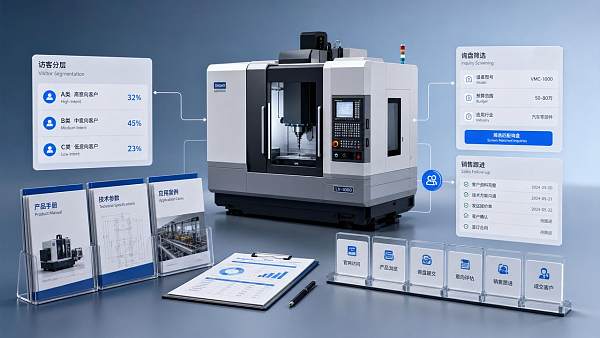
A common misconception in improving conversion rates in the machinery industry is to blame everything on insufficient traffic. In actual operations, many websites already have visits, but have not formed a stable stream of qualified leads. The reason is often not exposure itself, but rather loose visitor segmentation, weak page handoff, and misaligned follow-up rhythm between sales and marketing.
The decision cycle for machinery products is long, parameters are complex, and regional differences are obvious. Visitors to the same page may be looking for models, comparing solutions, checking delivery times, or simply conducting preliminary market research. If the website and marketing system do not identify these differences, subsequent follow-up is very likely to go off track.
In the integrated website+marketing service model, improving inquiry conversion is more like a continuous sequence of actions. First identify the quality of the lead, then judge the maturity of the demand, and finally arrange the appropriate sales response. Only when this process is refined can the improvement in conversion rates in the machinery industry truly deliver results.
The value of leads varies across different visit scenarios
Visitor sources for machinery independent websites are highly mixed. Visits from organic search usually come with clearer questions, such as dimensions, materials, certifications, and applicable working conditions. Visits from ad clicks are more affected by landing page messaging, and it is easy for strong interest to coexist with weak purchase intent. Social media traffic is more front-end awareness, and may not immediately generate high-quality inquiries.
Therefore, improving inquiry conversion in the machinery industry cannot be judged only by whether there are leads. It is also necessary to see what the lead saw before submitting, which stage they stopped at, and whether they repeatedly visited core pages. Platforms like Yibingbao, which integrate AI website building, SEO, advertising, and multi-channel customer acquisition, are valuable because they connect the access path and lead behavior, rather than simply delivering a display website.
If visitor segmentation is done well, sales actions will not be wasted
Many teams know segmentation is necessary, but in practice the method is too simple, separating only by country, channel, or whether a lead has been submitted. This approach is not sufficient for the machinery industry, because visitors from the same country may have very different intentions: one may be concerned about custom structures, another about standard parts pricing, and another may just be looking for substitute suppliers.
A more effective way to segment is to break leads into three dimensions: demand clarity, project urgency, and depth of technical communication. For example, whether the visitor has repeatedly viewed specification pages, whether they have entered case pages multiple times, whether they have downloaded a brochure, and whether they filled in application conditions in the form. These behavioral signals are closer to the real conversion probability than source alone.
If the site itself has multilingual pages, search optimization, and behavior tracking capabilities, segmentation will be more accurate. Through intelligent website building, AI+SEO/GEO optimization, and coordinated ad placement, Yibingbao can route traffic from different markets to more suitable pages, and then feed behavioral data back to the follow-up process. This is key to improving inquiry conversion in the machinery industry.
When segmenting leads, prioritize these signals
- Whether the visitor has viewed technical parameters, certifications, case studies, and delivery instructions, rather than just staying on the homepage.
- Whether the visitor asks questions with clear application conditions, such as load, precision, ambient temperature, or supporting equipment.
- Whether the visitor visits multiple times in a short period, indicating that internal evaluation has already started.
- Whether the visitor comes from a highly matched keyword page, since such leads usually are closer to the deal stage.
At the sales follow-up stage, the focus is not on fast replies, but on accurate replies
Improving inquiry conversion in the machinery industry often gets stuck at sales follow-up. On the surface, it looks like an untimely response, but in essence it is often that the first reply did not hit the real issue. For leads with clear parameters and lines, generic company introductions have limited effect; for leads still in the confirmation stage, quoting directly can easily lose initiative.
A more effective approach is to prepare different response frameworks according to lead type. For high-intent leads, first supplement the key technical points, then provide the solution path; for medium-intent leads, first confirm the usage scenario, certification requirements, and budget range; for low-maturity leads, gradually warm them up through case studies, content materials, and secondary touchpoints. This approach makes the sales rhythm more aligned with the decision process for machinery products.
Some teams separate operations data and sales data, resulting in websites that appear to have high traffic pages but do not bring high-quality conversations to sales. Once content, advertising, leads, and follow-up are connected, many judgments become much clearer. For example, some keywords bring large lead volume, but the demand is vague; in that case, advertising and page structure should be adjusted rather than simply increasing the budget.
Several common misjudgments are often more damaging to conversion than insufficient traffic
The first misjudgment is treating all inquiries as the same priority. Machinery product order value and project complexity vary greatly, and a unified reply template will bury truly high-quality leads. The second misjudgment is only looking at form submissions and ignoring browsing behavior. Many high-value leads write very little in the form, but their behavioral path has already revealed clear demand.
Another easily overlooked situation is the disconnect between website content and sales talk tracks. The page emphasizes application solutions, but the sales reply only sends product catalogs; the page highlights customization capabilities, but during follow-up there is no further question about working condition details. Such gaps between front-end and back-end information will directly weaken trust.
In internal management, some teams have already begun to pay attention to the linkage between lead quality, refund cycle, and input-output. Content like Enterprise Intelligent Finance Transformation: An Initial Exploration can also help explain how marketing data connects with operating metrics, avoiding the trap of only looking at inquiry volume while ignoring real conversion efficiency.
When it truly lands, the website, content, and follow-up rules usually need to be adjusted together
If the goal is to continuously improve inquiry conversion in the machinery industry, optimizing only one part is often not enough. A more stable approach is to sort out the whole chain from website handoff, keyword structure, page content, form fields, automatic distribution, and manual follow-up rules. Only then can front-end customer acquisition and back-end conversion form a closed loop.
Before implementation, three key points usually need to be confirmed. First, whether the website can carry search demands from different markets and product lines. Second, whether basic segmentation can be completed based on behavioral signals. Third, whether sales have corresponding first-response templates, question lists, and secondary follow-up rhythm. Missing any one of these will keep the improvement in inquiry conversion in the machinery industry at the surface level.
- Bind high-value pages with high-intent keywords to reduce invalid visits entering the core form.
- Add fields such as application scenario, procurement cycle, and technical requirements in the form, but do not make it too long.
- Create differentiated follow-up question banks for different product lines to avoid overly uniform replies.
- Organize certification, logistics, and after-sales materials by region to shorten cross-market communication time.
In the end, improving inquiry conversion in the machinery industry is not about making one action more aggressive, but about making visitor segmentation, demand judgment, and sales coordination more refined. First sort out the real visit scenarios, then compare the judgment basis of different leads, and finally establish executable follow-up standards. Improvements in conversion rates achieved this way are usually more stable than simply pursuing traffic, and also closer to long-term growth.
Related Articles

Related Products
 EasyCamp SaaS Smart Website Marketing SystemE-Yingbao SaaS Smart Website Marketing System: AI-powered, zero-code website building. Rapidly launch multilingual independent e-commerce sites in just 10 minutes. Global server acceleration and AI-driven SEO optimization empower businesses to efficiently connect with global markets. The seamless integration of technology and user-friendly operation makes building e-commerce sites incredibly simple.
 AI+SEM Intelligent Advertising Marketing SystemAI+SEM drives intelligent ad creation, empowering full-funnel precision advertising marketing. The system automatically generates weekly/monthly reports, AI recommends keywords and target countries, monitors core metrics in real-time with intelligent alerts, and enables one-click high-conversion ad solutions to help quickly acquire customers and improve ROI.
 AI+SEO Dual Engine Optimization ServiceEasyWin AI+SEO Dual Engine Optimization System leverages AI-powered keyword mining, content generation, and comprehensive technical optimization to help foreign trade enterprises acquire high-quality organic traffic, significantly improving search rankings and conversion rates.
 AI+SNS Social Media Marketing SystemYingbao AI+SNS Social Media Marketing System - Precision social capture for the social media era. Supports one-click content synchronization across major platforms like Facebook and LinkedIn. AI intelligently rewrites posts for enhanced relevance. 24/7 AI customer service and user profiling analysis empower businesses to efficiently expand into global markets.
 AI+SEO营销解决方案易营宝AI+SEO营销解决方案,通过AI批量写作、智能生成TDK、精准关键词扩词等功能,全面优化网站SEO效果,提升流量与转化率。助力企业构建高效智能网站新生态。
 AI+SEM Advertising Marketing SolutionsAI+SEM Advertising Marketing Solution leverages AI technology to deeply empower SEM ad campaigns. It automatically generates weekly/monthly reports using AI, presenting account data across multiple dimensions for comprehensive insights into campaign performance and trends. The system precisely recommends keywords and target countries, intelligently generates high-conversion ad copy, and enables one-click activation of efficient campaign plans to help businesses rapidly acquire customers. Simultaneously, it monitors core metrics in real time, intelligently identifies abnormal fluctuations, and issues timely alerts to ensure stable, high-return advertising results.
 Domain Name ServicesEasyWin provides professional domain name services, including intelligent queries, one-stop registration, brand protection, and full lifecycle management, helping businesses build a digital brand image.
 EasyOperate B2C Cross-Border E-Commerce Platform & Independent WebsiteEasyStore B2C Cross-border E-commerce Independent Store is an intelligent website building and cross-border e-commerce integrated solution independently developed by EasyStore Information Technology (Beijing) Co., Ltd. The system is specially designed for small and medium-sized as well as large export enterprises, integrating 'website building, operation, marketing, advertising, and conversion' into one, helping enterprises quickly establish cross-border e-commerce independent stores to achieve brand globalization and global sales growth.
The platform supports multiple languages, multiple currencies, and multi-channel marketing, with built-in AI intelligent translation and SEO optimization systems, suitable for mainstream markets such as Southeast Asia, Europe and America, Latin America, and the Middle East, assisting Chinese manufacturing enterprises in efficiently deploying international e-commerce strategies. SSL证书易营宝提供专业SSL安全证书服务,包括单域名和泛域名证书,确保网站数据传输加密、身份验证和完整性保护,助力企业建立安全可信的在线业务环境。









