









- What Does a Global Traffic Ecosystem Service Provider Do? What Are the Differences from a Single Advertising AgencyJul 16, 2026View details
- What should you focus on in the latest enterprise SaaS report? From renewal rates and delivery costs to overseas growth opportunitiesJul 12, 2026View details
- What signals are worth paying attention to in a cross-border marketing trend report? B2B companies should look at these 6 signalsJul 11, 2026View details
- How to Read a Cross-Border Marketing Trends Report? Five Key Dimensions for Evaluating Channel OpportunitiesJul 11, 2026View details
- Which channel has the highest ROI in the global traffic ecosystem? Comparative analysis of search, social media, and advertisingJul 10, 2026View details
- What multilingual website services are available in Sanya? Which model is more suitable for local businesses going global?Jul 08, 2026View details
Should brands prioritize SEO or paid advertising for overseas customer acquisition?
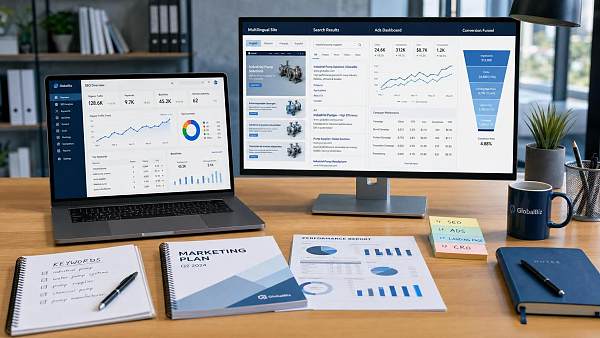
SEO or Paid Ads for Overseas Brand Lead Generation: A Decision Checklist for Executives
There is no standard answer to whether SEO or paid ads should come first for overseas brand lead generation. The key is not which one is “more advanced,” but whether you urgently need leads, whether you have a content and website foundation, whether your budget can absorb trial and error, and how long you plan to develop this business line. Many companies start by asking which advertising channel to use, when the real problems often occur earlier: poor website lead handling, unreasonable inquiry form design, English pages that read like product manuals, and a lack of differentiated search demand analysis by country. In such cases, SEO struggles to gain traction, while advertising can easily burn through the budget.
If you are currently deciding how to start generating overseas leads for your brand, the following checklist is more suitable for discussion in a meeting. It is not a theoretical ranking, but a set of decision points repeatedly encountered in actual projects.
Start with the objective: Do you need “leads immediately” or “lower traffic acquisition costs six months from now”?
This question looks simple, but it is actually the one most likely to be left ambiguous.
If a company is launching a new product, preparing to attend an overseas trade show, or must see inquiry growth within the quarter, advertising should usually come first. The reason is straightforward: Google Ads, social media advertising, and remarketing can generate data relatively quickly once the website and landing pages are ready, at least showing which countries, keywords, and audiences are clicking through.
However, if a brand has clearly committed to long-term international expansion, especially in high-value businesses such as B2B foreign trade, manufacturing, and customized products, relying solely on advertising tends to become increasingly difficult. Rising cost per click, more competitors, and traffic stopping as soon as an account is paused are all common situations. In this case, SEO is not merely “the icing on the cake”; it turns organic search into a cumulative asset.
- If quarterly KPIs are very tight, prioritize advertising to validate the market.
- If you want to gradually reduce customer acquisition costs, start SEO as early as possible, even if the initial pace is slower.
- The two approaches are not mutually exclusive. A truly mature approach is usually to use advertising to open the way and SEO to build the foundation.
Do not rush to choose a channel. First check whether your website can handle the traffic.
This is the most practical point. Many companies are not unable to buy traffic; they are unable to handle it.
You can first check the following: Is the page load speed noticeably slow? Can the site be browsed properly on mobile devices? Do product pages contain only specifications without application scenarios? Is the inquiry entry hidden too deeply? Do multilingual pages show obvious signs of machine translation? Does the website meet the basic requirements for indexing, such as a clear structure, standardized titles, and indexable pages?
If these problems have not been resolved, starting with SEO will extend the timeline; launching ads directly may also fail to produce a good conversion rate. For decision-makers, this is not a channel problem but a problem with the website’s ability to receive and convert traffic. The value of services such as Yiyingbao, which integrates smart website building, SEO optimization, and advertising, often lies here: rather than selling traffic separately, they first establish a foundation that is “promotable, indexable, and convertible.”
The judgment is simple: if your website is still merely a “showcase website,” do not worry yet about whether SEO or advertising should come first. First transform the site into a marketing-oriented landing-page system.
How you allocate the budget determines the priority.
When many management teams discuss overseas brand lead generation, they interpret the budget as whether the “total amount is sufficient.” In practice, the structure is more important.
Here is a practical rule of thumb: If a company can consistently invest in a testing budget every month, advertising can help it quickly understand the market; if the budget is prone to fluctuation, SEO is more suitable as a long-term investment. Advertising is vulnerable to pauses, while SEO is vulnerable to interrupted publishing, but their cost curves are completely different.
Consider the business type: priorities vary significantly by industry.
Not every international business is suited to the same approach.
For B2B foreign trade, industrial equipment, engineering materials, and OEM/ODM businesses, the purchasing cycle is long, and customers repeatedly search for, compare, and verify qualifications and case studies. In such scenarios, SEO is highly valuable because customers do not place an order after clicking an ad once. They research the company, solutions, and specific product terms, and may even search for “supplier + country” or “manufacturer + application scenario.” If your content does not appear in organic search, it will be difficult to make up for the gap later.
For cross-border retail, promotional independent websites, and short-term campaign pages, however, advertising is often more direct. This is especially true during the cold-start phase of a new product, when there is no accumulated search volume and branded search terms have not yet gained traction. Waiting for organic traffic through SEO can be relatively slow.
If you are taking a brand global, you can make the following distinction: SEO should carry more weight for high-value, slow-decision, information-intensive businesses; advertising usually takes priority for low-value, fast-paced businesses driven by strong promotions.
Do not overlook differences between target markets: North America and the Middle East cannot use the same content and advertising approach.
This point is often underestimated. When companies discuss overseas brand lead generation, they tend to treat “overseas” as a single market. In reality, search habits, language preferences, landing-page wording, and lead conversion methods may all differ across North America, Europe, Southeast Asia, Japan and South Korea, the Middle East, and Latin America.
For example, a multilingual website is not finished simply by copying an English page into several languages. The selling points that different markets focus on, the order in which certifications are presented, and payment and delivery information can all affect conversion. [To be verified] Some industries may also involve local compliance requirements, privacy notices, and cookie management. At a minimum, these issues should be reviewed by legal counsel or a local advisor before entering a new market.
Therefore, if a company is still in the early stage of its overseas expansion, it is advisable to select key markets and develop them in depth rather than launch campaigns in more than a dozen countries at once. The more scattered the effort, the thinner the SEO content will be and the harder it will be for the advertising learning phase to stabilize.
Use advertising to validate keywords and SEO to build lasting value around them—this is the more stable combination.
Many teams divide SEO and advertising into two opposing camps. In practice, the most effective approach is usually for the two to feed data to each other.
Advertising is suitable for initial validation: Which keywords really generate qualified inquiries? Which countries receive many clicks but convert poorly? Which types of pages have longer dwell times? Once this data is available, you can decide which product topic pages, industry solution pages, FAQ pages, and case-study pages should be prioritized for SEO. The advantage is that SEO does not start with a pile of keywords chosen arbitrarily.
Conversely, SEO can reduce the pressure on advertising. Once organic rankings improve, branded terms, defensive terms, and long-tail terms no longer need to rely entirely on paid search. The advertising budget can be concentrated on high-value keywords and key markets.
If a service provider can handle only one part of the process, ask one more question when making the decision: Who will complete the rest of the customer acquisition chain? This is especially important for integrated website and marketing services.
When choosing a service provider, the key is not whether it “can run ads,” but whether it can close the entire lead-generation loop.
What executives should really ask is not “How long will it take for your SEO to work?” or “How low can you make the cost per ad click?” These questions are too easily influenced by sales rhetoric.
The following questions are more valuable:
- Is the website system designed for overseas promotion, or was it converted from a standard showcase website?
- Can multilingual pages, technical SEO, content production, and advertising landing pages work together?
- Is there a way to clearly identify the sources of inquiries rather than only view traffic reports?
- Can it later support expansion into additional channels such as social media, short-form video, and AI search visibility optimization?
A platform-based solution such as Yiyingbao, which connects AI-powered smart website building, multilingual websites, SEO/GEO optimization, Google Ads, and Facebook advertising, is more suitable for companies that do not want their budgets split across multiple providers but do want continuous iteration. The reason is simple: the website is the front end, marketing data is the back end, and content and advertising connect the two. Once the work is divided among too many suppliers, problems can easily be passed from one party to another.
A practical decision rule to conclude
If you need one sentence to guide the decision, use this:
If the website foundation is weak and results are urgently needed, improve the site first and then use advertising for testing; if the website foundation is already sound and the business is intended for the long term, SEO must be planned as early as possible; when the budget and team allow, the most reliable approach is never an either-or choice, but to let advertising accelerate growth while SEO builds lasting value.
In overseas brand lead generation, the real difference is often not which channel you invest in, but who is first to integrate the website, content, advertising, and data attribution into one growth framework. Once this step is done correctly, many subsequent decisions become much easier.
Related Articles
Related Products
 EasyCamp SaaS Smart Website Marketing SystemE-Yingbao SaaS Smart Website Marketing System: AI-powered, zero-code website building. Rapidly launch multilingual independent e-commerce sites in just 10 minutes. Global server acceleration and AI-driven SEO optimization empower businesses to efficiently connect with global markets. The seamless integration of technology and user-friendly operation makes building e-commerce sites incredibly simple.
 AI+SEM Intelligent Advertising Marketing SystemAI+SEM drives intelligent ad creation, empowering full-funnel precision advertising marketing. The system automatically generates weekly/monthly reports, AI recommends keywords and target countries, monitors core metrics in real-time with intelligent alerts, and enables one-click high-conversion ad solutions to help quickly acquire customers and improve ROI.
 AI+SEO Dual Engine Optimization ServiceEasyWin AI+SEO Dual Engine Optimization System leverages AI-powered keyword mining, content generation, and comprehensive technical optimization to help foreign trade enterprises acquire high-quality organic traffic, significantly improving search rankings and conversion rates.
 AI+SNS Social Media Marketing SystemYingbao AI+SNS Social Media Marketing System - Precision social capture for the social media era. Supports one-click content synchronization across major platforms like Facebook and LinkedIn. AI intelligently rewrites posts for enhanced relevance. 24/7 AI customer service and user profiling analysis empower businesses to efficiently expand into global markets.
 AI+SEO营销解决方案易营宝AI+SEO营销解决方案,通过AI批量写作、智能生成TDK、精准关键词扩词等功能,全面优化网站SEO效果,提升流量与转化率。助力企业构建高效智能网站新生态。
 AI+SEM Advertising Marketing SolutionsAI+SEM Advertising Marketing Solution leverages AI technology to deeply empower SEM ad campaigns. It automatically generates weekly/monthly reports using AI, presenting account data across multiple dimensions for comprehensive insights into campaign performance and trends. The system precisely recommends keywords and target countries, intelligently generates high-conversion ad copy, and enables one-click activation of efficient campaign plans to help businesses rapidly acquire customers. Simultaneously, it monitors core metrics in real time, intelligently identifies abnormal fluctuations, and issues timely alerts to ensure stable, high-return advertising results.
 Domain Name ServicesEasyWin provides professional domain name services, including intelligent queries, one-stop registration, brand protection, and full lifecycle management, helping businesses build a digital brand image.
 EasyOperate B2C Cross-Border E-Commerce Platform & Independent WebsiteEasyStore B2C Cross-border E-commerce Independent Store is an intelligent website building and cross-border e-commerce integrated solution independently developed by EasyStore Information Technology (Beijing) Co., Ltd. The system is specially designed for small and medium-sized as well as large export enterprises, integrating 'website building, operation, marketing, advertising, and conversion' into one, helping enterprises quickly establish cross-border e-commerce independent stores to achieve brand globalization and global sales growth.
The platform supports multiple languages, multiple currencies, and multi-channel marketing, with built-in AI intelligent translation and SEO optimization systems, suitable for mainstream markets such as Southeast Asia, Europe and America, Latin America, and the Middle East, assisting Chinese manufacturing enterprises in efficiently deploying international e-commerce strategies. SSL证书易营宝提供专业SSL安全证书服务,包括单域名和泛域名证书,确保网站数据传输加密、身份验证和完整性保护,助力企业建立安全可信的在线业务环境。









