









- Is Brand Globalization Marketing Consulting Worth Buying? At What Stage Should Companies Bring It InJul 01, 2026View details
- Cross-Border Marketing Trend Research: Why More and More Companies Are Starting to Deploy AI Search and GEO OptimizationJun 30, 2026View details
- Cross-Border Marketing Trend Research: How Independent Sites, AI Content, and Short-Video Customer Acquisition Are ChangingJun 30, 2026View details
- How Can a Brand Updates Page Be Made More SEO-Friendly? Analysis of Update Frequency, Content Structure, and Internal Linking StrategyJun 28, 2026View details
- What stages does the cross-border services ecosystem include? How do website building, promotion, payment, and compliance work togetherJun 22, 2026View details
- How will email marketing costs change in 2026Jun 22, 2026View details
How to Compare Multilingual Product Page Development Solutions
When comparing solutions for building multilingual product pages, you should not look only at price. More importantly, you need to focus on SEO indexing, localized user experience, conversion paths, and operational efficiency after launch. Only by choosing the right solution can overseas traffic truly become inquiries and orders.
For foreign trade companies, manufacturing factories, cross-border sellers, and global brand teams, multilingual product pages are not simply about translating a few paragraphs of text. They are customer acquisition entry points for different markets. Whether a solution is worth purchasing often depends on 4 outcomes: whether it can be crawled by search engines, whether customers can understand it, whether it can drive inquiries, and whether it can be operated continuously at low cost in the later stage.
In a website + marketing service integration scenario, comparing multilingual product page building solutions requires a comprehensive assessment across 5 dimensions: website building system, page structure, content production, advertising collaboration, and data tracking. Especially when a company plans to cover more than 3 national markets, a wrong choice in the early stage will usually increase later rebuilding costs by 2 to 4 times.
Why Comparing Multilingual Product Page Building Solutions Should Not Be Based Only on Website Quotation
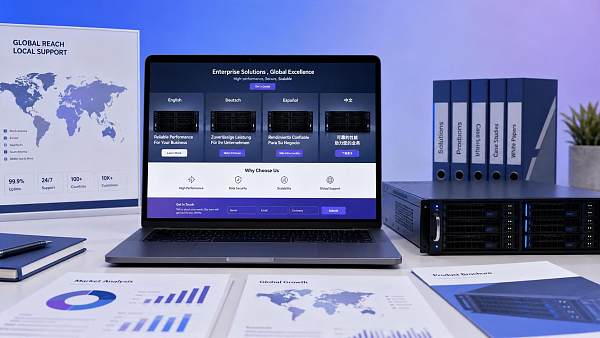
When many companies compare multilingual product page building solutions, their first reaction is to compare the cost per page, the number of languages, and the launch timeline. However, if a solution only solves the issue of “being able to go live” but not “being able to acquire customers,” then even the lowest initial cost may be pushed up in reverse within 6 months through additional SEO work, content rewriting, and tracking reconfiguration.
3 Common Problems with Low-Efficiency Solutions
The first type of problem is a disorganized language version structure. For example, different languages may share the same URL parameters, or only image translation is provided, making it difficult for search engines to identify the page topic, slowing down indexing, and even causing competition between the primary language and secondary languages. Usually, after 30 days online, the gap in page indexation rates becomes obvious.
The second type of problem is insufficient localization. This includes currencies, units, form fields, logistics descriptions, and certification expressions that do not match local habits. If a German product page still uses English-style titles and a Chinese-style selling point sequence, its bounce rate is often 10% to 25% higher than that of a localized page.
The third type of problem is a broken conversion chain. Many pages only have product specifications, without scenario descriptions, trust elements, or inquiry actions, so customers do not know what to do next after reading the page. For B2B product pages, there should be at least 1 primary conversion action and 2 auxiliary conversion entry points, such as a form, WhatsApp, email, or quotation button.
Core Dimensions Buyers Should Compare Most
The following table is suitable for preliminary screening when comparing multilingual product page building solutions. Instead of looking only at the quotation, it is better to first check whether the solution is truly usable for overseas customer acquisition.
From the perspective of purchasing decisions, what is truly worth investing in is not the “lowest-priced page,” but a “page system that can continuously bring effective traffic and inquiries over the next 12 months.” This is also the part most easily overlooked when comparing multilingual product page building solutions, yet it has the greatest impact on ROI.
Types of Companies Suitable for Prioritizing Solution Upgrades
- Global expansion companies planning to cover more than 3 language markets at the same time
- Manufacturing companies with more than 20 product SKUs that need to generate product pages in batches
- Teams that are already running Google Ads but have landing page conversion rates below 2%
- Foreign trade companies that want to balance long-term organic traffic with short-term inquiry growth
6 Metrics to Focus on When Comparing Multilingual Product Page Building Solutions
Whether the supplier provides SaaS website building, custom development, or marketing managed services, buyers can use 6 metrics to quickly judge the practicality of a solution. As long as 2 of these items are clearly missing, the later promotion results are usually unstable.
1. Indexing Friendliness
Product pages should at least have independent titles, descriptions, language paths, editable body text, and clear internal links. If a system cannot allow operations staff to adjust the basic tags of 20 to 50 product pages in batches within 1 day, the later SEO maintenance cost will be very high.
2. Localization Depth
Localization is not translating Chinese into a foreign language, but synchronously adjusting units, currencies, application scenarios, customer concerns, and calls to action. For example, North American customers pay more attention to certifications and delivery times, while European customers place greater emphasis on specifications, standards, and technical descriptions. At minimum, it should cover 4 levels: text, forms, buttons, and trust elements.
3. Page Conversion Structure
An efficient product page is usually composed of 6 to 8 modules, including core selling points, specification tables, application scenarios, delivery descriptions, FAQ, case studies or qualification statements, and CTA sections. If a page only has images and specifications but lacks answers to questions and contact guidance, the quality of inquiries will be significantly lower.
4. Content Production Efficiency
When a company has 50, 100, or even more SKUs, building pages manually one by one is very slow. A more suitable solution should support template reuse, AI-assisted writing, batch field calling, and multilingual content collaboration. In this way, the launch cycle for one language can be compressed from 2 to 3 weeks to 5 to 10 days.
5. Channel Collaboration Capability
Multilingual product pages should not only serve search traffic, but also be compatible with Google Ads, Facebook Ads, social media content redirects, and AI search entry points. If a page cannot be quickly copied into an advertising landing page, campaign page, or market-specific page, marketing collaboration efficiency will be limited.
6. Backend Maintenance and Data Tracking
When purchasing, you should also check whether the backend supports conversion event configuration, lead source identification, form field management, and multi-role collaboration. For companies with an annual update frequency of more than 12 times, backend usability directly affects operational labor costs and may even determine whether continuous optimization is possible.
How to Choose Different Building Models: Template-Based, Custom-Built, and Marketing-Integrated
When companies compare multilingual product page building solutions, the common building models can generally be divided into 3 categories. They differ significantly in launch speed, scalability, content control, and marketing adaptability, and the budgets and team maturity levels they suit are also different.
The following table is suitable for mid-stage evaluation, especially as a decision-making reference for companies preparing to build a multilingual official website, B2B inquiry website, or cross-border independent website.
If a company’s goal is only short-term display, a template-based model can be used as a starting point. If it is already clear that long-term overseas growth is required, a marketing-integrated model is more suitable. This is because it does not only deliver pages, but delivers a set of business infrastructure that can be promoted, indexed, and converted.
Why Separating Website and Marketing Is Often Inefficient
Many companies separately hire website building companies, translation teams, SEO service providers, and advertising agencies. On the surface, responsibilities seem clear, but in practice, problems can easily occur, such as page structures that are not suitable for advertising, translated content that is not conducive to search, and forms that cannot send data back. A single revision often requires coordination across 3 to 4 teams, which extends the cycle.
The advantage of website + marketing service integration is that keyword layout, landing page templates, conversion components, and data tracking points are reserved from the beginning of website building. In this way, whether doing Google SEO, advertising campaigns, or social media traffic acquisition later, frequent rework is not required.
How to Manage Implementation Processes and Risk Control When Launching Multilingual Product Pages
Choosing the right solution is only the first step. What truly affects results is the implementation process. A mature multilingual product page project can usually be divided into 5 stages, and each stage should have clear inputs, outputs, and acceptance points to avoid large-scale rework after launch.
Recommended 5-Step Implementation Process
- Confirm market and language priorities: first determine 1 to 3 core markets, then expand to secondary languages.
- Plan product page templates: standardize selling points, specifications, FAQ, inquiry components, and trust modules.
- Content production and localization processing: complete keyword mapping, page copywriting, and multilingual proofreading.
- Technical launch and tracking deployment: check URLs, redirects, forms, events, and search crawling paths.
- 30-day post-launch optimization: iterate based on indexing, clicks, dwell time, and inquiry data.
4 Easily Overlooked Risk Points
The Translation Is Correct, But the Sales Message Is Wrong
Correct language does not mean customers are willing to submit inquiries. B2B product pages need to highlight applications, delivery, customization capabilities, and service scope, rather than simply providing literal translation. Especially on pages for industrial products, machinery, and materials, scenario descriptions are often more important than adjectives.
The Page Is Indexed, But Has No Ranking Entry Point
If a product page does not build its content structure around core keywords, application keywords, and long-tail question keywords, it may still have no stable exposure even if it is indexed by search engines. It is recommended to plan at least 1 core keyword, 3 related keywords, and 2 question-based keywords for each key product.
There Is Traffic, But Conversion Actions Are Too Weak
Many pages place inquiry entry points too far down the page, or include too many form fields. For first-time visitors, it is recommended to place at least 3 CTAs: one above the fold, one in the middle of the body content, and one at the bottom. Keeping form fields to 4 to 6 items makes it easier to improve submission rates.
The Launch Is Complete, But the Operations Team Cannot Take Over
If the backend is complex, permissions are scattered, and the update process depends on developers, it will be difficult for companies to achieve weekly or monthly updates later. For teams with fast SKU growth, prioritizing a system that supports visual maintenance, batch copying, and unified field management can significantly reduce the long-term operation and maintenance burden.
A Collaboration Approach Suitable for Long-Term Growth
From the perspective of implementation results, website building, SEO, advertising, social media, and AI search visibility should ideally be planned simultaneously instead of being advanced separately in disconnected stages. An AI-driven enterprise-level SaaS intelligent website building and overseas marketing platform like 易营宝 is more suitable for companies that need multi-region deployment, multilingual operations, and multi-channel customer acquisition, because it places the website building system, content efficiency, and marketing execution within the same framework.
For companies that want to cover markets such as North America, Europe, Southeast Asia, Japan and South Korea, the Middle East, Russian-speaking regions, and Latin America, the value of an integrated solution is not just building a website, but helping teams continuously iterate product pages, expand market pages, and increase the proportion of qualified inquiries over the next 6 to 12 months.
A Decision Checklist Executives Can Use Directly When Choosing a Multilingual Product Page Building Solution
If you are comparing multilingual product page building solutions, you can use the following 4 questions for a quick assessment: whether it supports search indexing and multilingual management, whether it has localization and conversion structures, whether it facilitates later advertising collaboration, and whether it can establish a continuous optimization mechanism within 3 months. If any one of these cannot be answered, the solution requires further verification.
For most global expansion companies, what is truly valuable is not how many pages are delivered at one time, but whether these pages can support long-term inquiry growth, brand accumulation, and market expansion. Choosing a service provider with a technical foundation, content efficiency, and coordinated marketing execution capabilities is usually more suitable for long-term overseas business planning.
If you are evaluating a multilingual official website, foreign trade marketing website, cross-border independent website, or product landing page project, it is recommended to combine your company’s target markets, number of languages, SKU scale, and promotion plan to obtain a building path that better fits your business. Contact us now to get a customized solution and learn more about multilingual product page building and overseas marketing solutions suitable for your company.
Related Articles
 Brand global expansion marketing services How should an independent site coordinate? Link design from customer acquisition to data accumulation
 Why is inquiry conversion difficult in manufacturing?Identify drop-off points from the product page to the quotation process
 GCC enables the digital certificate of origin portal,independent websites must directly connect to SABER

Related Products
 EasyCamp SaaS Smart Website Marketing SystemE-Yingbao SaaS Smart Website Marketing System: AI-powered, zero-code website building. Rapidly launch multilingual independent e-commerce sites in just 10 minutes. Global server acceleration and AI-driven SEO optimization empower businesses to efficiently connect with global markets. The seamless integration of technology and user-friendly operation makes building e-commerce sites incredibly simple.
 AI+SEM Intelligent Advertising Marketing SystemAI+SEM drives intelligent ad creation, empowering full-funnel precision advertising marketing. The system automatically generates weekly/monthly reports, AI recommends keywords and target countries, monitors core metrics in real-time with intelligent alerts, and enables one-click high-conversion ad solutions to help quickly acquire customers and improve ROI.
 AI+SEO Dual Engine Optimization ServiceEasyWin AI+SEO Dual Engine Optimization System leverages AI-powered keyword mining, content generation, and comprehensive technical optimization to help foreign trade enterprises acquire high-quality organic traffic, significantly improving search rankings and conversion rates.
 AI+SNS Social Media Marketing SystemYingbao AI+SNS Social Media Marketing System - Precision social capture for the social media era. Supports one-click content synchronization across major platforms like Facebook and LinkedIn. AI intelligently rewrites posts for enhanced relevance. 24/7 AI customer service and user profiling analysis empower businesses to efficiently expand into global markets.
 AI+SEO营销解决方案易营宝AI+SEO营销解决方案,通过AI批量写作、智能生成TDK、精准关键词扩词等功能,全面优化网站SEO效果,提升流量与转化率。助力企业构建高效智能网站新生态。
 AI+SEM Advertising Marketing SolutionsAI+SEM Advertising Marketing Solution leverages AI technology to deeply empower SEM ad campaigns. It automatically generates weekly/monthly reports using AI, presenting account data across multiple dimensions for comprehensive insights into campaign performance and trends. The system precisely recommends keywords and target countries, intelligently generates high-conversion ad copy, and enables one-click activation of efficient campaign plans to help businesses rapidly acquire customers. Simultaneously, it monitors core metrics in real time, intelligently identifies abnormal fluctuations, and issues timely alerts to ensure stable, high-return advertising results.
 Domain Name ServicesEasyWin provides professional domain name services, including intelligent queries, one-stop registration, brand protection, and full lifecycle management, helping businesses build a digital brand image.
 EasyOperate B2C Cross-Border E-Commerce Platform & Independent WebsiteEasyStore B2C Cross-border E-commerce Independent Store is an intelligent website building and cross-border e-commerce integrated solution independently developed by EasyStore Information Technology (Beijing) Co., Ltd. The system is specially designed for small and medium-sized as well as large export enterprises, integrating 'website building, operation, marketing, advertising, and conversion' into one, helping enterprises quickly establish cross-border e-commerce independent stores to achieve brand globalization and global sales growth.
The platform supports multiple languages, multiple currencies, and multi-channel marketing, with built-in AI intelligent translation and SEO optimization systems, suitable for mainstream markets such as Southeast Asia, Europe and America, Latin America, and the Middle East, assisting Chinese manufacturing enterprises in efficiently deploying international e-commerce strategies. SSL证书易营宝提供专业SSL安全证书服务,包括单域名和泛域名证书,确保网站数据传输加密、身份验证和完整性保护,助力企业建立安全可信的在线业务环境。









