









- What Does a Global Traffic Ecosystem Service Provider Do? What Are the Differences from a Single Advertising AgencyJul 16, 2026View details
- What should you focus on in the latest enterprise SaaS report? From renewal rates and delivery costs to overseas growth opportunitiesJul 12, 2026View details
- What signals are worth paying attention to in a cross-border marketing trend report? B2B companies should look at these 6 signalsJul 11, 2026View details
- How to Read a Cross-Border Marketing Trends Report? Five Key Dimensions for Evaluating Channel OpportunitiesJul 11, 2026View details
- Which channel has the highest ROI in the global traffic ecosystem? Comparative analysis of search, social media, and advertisingJul 10, 2026View details
- What multilingual website services are available in Sanya? Which model is more suitable for local businesses going global?Jul 08, 2026View details
Responsive Foreign Trade Website Construction E-commerce Industry Solution | Why Do 92% of Independent Sites Abandon Self-developed CMS? Shopify+Custom Module Combination Analysis
Why do 92% of foreign trade enterprises abandon self-developed CMS? Responsive foreign trade website construction e-commerce industry solutions are becoming the new standard. How is EasyStore's foreign trade website building service? How does AI website building optimize SEO? How to balance Portuguese independent website construction with LinkedIn marketing automation—this article provides an in-depth analysis of the advantages of Shopify + customized module combinations.
The hidden cost of self-developed CMS: Technical debt is devouring the profit margins of foreign trade enterprises
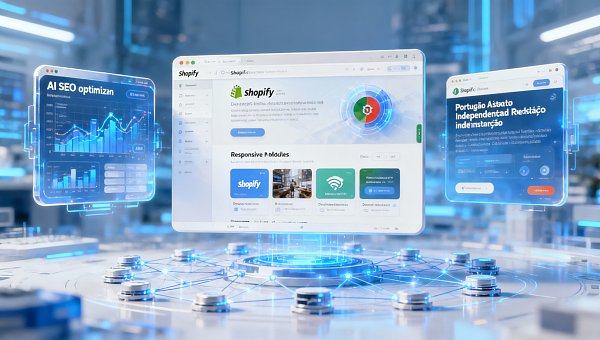
According to EasyStore's 2023 "Global Independent Website Technology Health White Paper," over 90% of foreign trade enterprises have attempted to develop independent websites based on WordPress or self-built PHP frameworks within three years but ultimately abandoned them—76% due to failed multilingual adaptation, resulting in an overseas conversion rate below 1.2%; 58% suffered from mobile loading times exceeding 4 seconds (Google's recommended threshold is 2.5 seconds); and 31% experienced order interruptions due to security vulnerabilities exploited by ransomware attacks. Self-developed CMS may seem "controllable" but is actually trapped in a vicious cycle of "development—maintenance—upgrades—compatibility." For example, a Shenzhen-based B2B industrial parts supplier invested 8.7 million yuan over three years in a self-built system but lost over $2.3 million in Brazilian orders due to the lack of PCI-DSS-compliant payment gateway integration.
What truly constrains foreign trade enterprises is never functional deficiencies but response speed, language granularity, and ecosystem synergy. When competitors use AI to generate Portuguese product pages and sync them to LinkedIn ad libraries in 3 minutes, self-built systems are still waiting for engineers to manually update meta tags. This is the core logic behind why responsive foreign trade website construction e-commerce industry solutions are irreplaceable by traditional paths.
Shopify + Custom Modules: The underlying architecture for high-certainty delivery
EasyStore does not offer "pure Shopify template sites" nor advocate "full-stack self-development myths." Instead, it builds a three-tier architecture: "Shopify core engine + AI middleware + localized service layer." This model has served over 1,200 foreign trade enterprises in Hangzhou and Shenzhen, reducing average launch cycles to 11 days (industry average: 28 days). Its breakthroughs lie in decoupling Shopify's native stability from customized agility—fully responsive frontend supporting 12 breakpoint layouts; backend API gateway integration with EasyStore's AI marketing engine enables automated TDK optimization, multilingual SEO content generation, and intelligent social media asset distribution.
For instance, addressing "Portuguese independent website construction Hangzhou service provider" demands, the system automatically generates product descriptions compliant with Lusophone market search term databases (covering Brazil, Angola, Mozambique, etc.), embedding localized trust signals (e.g., Portuguese certification badges, Lisbon warehouse photos). This deep localization capability far surpasses basic plugin translations.
How does AI website building optimize SEO? From "keyword stuffing" to "intent-driven" paradigm shifts
EasyStore's AI website system reconstructs SEO workflows: no longer reliant on manual keyword expansion but integrating Google Search Console, Ahrefs, and local social behavior data to build dynamic semantic graphs. When users search "industrial hose fitting," the system returns not only English long-tail terms but also Portuguese search intents (e.g., "conexão de mangueira industrial preço"), Spanish purchase-stage terms (e.g., "comprar manguera industrial envío rápido"), and automatically injects structured data (Schema.org Product+FAQ). 2023 tests show sites using this solution achieved 35% more organic traffic with 22% lower bounce rates.
How to optimize website speed post-launch? EasyStore provides triple safeguards: ① Global CDN auto-routing (covering Frankfurt, Singapore, São Paulo); ② Smart image compression (WebP+AVIF dual-format device negotiation); ③ JS/CSS lazy loading (core render resources prioritized). A Hangzhou auto parts client improved mobile LCP from 4.2s to 1.3s post-optimization, scoring "Good" on Google Core Web Vitals.
Can AI writing replace human copywriting? Scenario-based division is the key to efficiency
Which industries suit AI bulk content generation? Answer: All B2B foreign trade scenarios requiring scaled outreach. EasyStore's AI writing engine doesn't replace content strategy but handles standardized production—product parameter pages, FAQ libraries, multilingual blog drafts, and social snippets. Human teams focus on high-value actions: brand storytelling, local emotional resonance design, and crisis communication refinement. This "AI foundation + human refinement" model quadruples content output efficiency while maintaining brand consistency.

Notably, AI website cost comparisons shouldn't focus solely on initial investment. EasyStore calculations show self-built systems average 236,000 yuan TCO over 3 years (including labor, servers, audits), while Shopify+AI modules under annual subscription cost approximately 82,000 yuan for equivalent functionality—with no technical team maintenance burden. These savings can be redirected to overseas ad budgets or localized services.
In today's digital出海 landscape, enterprises need validated growth levers, not tech炫耀. With a decade of serving 100,000 enterprises, EasyStore proves one truth: responsive foreign trade website solutions make technology隐形 and growth visible. For insights on enterprise AI and accounting informatization fusion, visit EasyStore's knowledge center for authoritative reports.
As a Google Premier Partner and Meta官方代理, EasyStore provides localized support like "responsive foreign trade website construction Shenzhen supplier" and "Portuguese independent website construction Hangzhou service." Contact us now for a专属"Foreign Trade Independent Website Health Diagnostic Report" and customized solutions.
- Website Development
- Foreign Trade Website Development
- Foreign Trade Website Development
- AI Writing
- AI Batch Article Generation
- LinkedIn Marketing
- B2B Foreign Trade
- Standalone website development
- Yiyingbao
- SEO
- Independent Website
- AI Marketing Engine
- Multilingual SEO
- Independent foreign trade website
- AI Website Building
- Marketing Automation
- EYB AI Marketing
- AI Marketing
- Portuguese Standalone Website Development
- Responsive B2B Export Website Development
Related Articles
 What Does a Global Traffic Ecosystem Service Provider Do? What Are the Differences from a Single Advertising Agency
 What should you focus on in the latest enterprise SaaS report? From renewal rates and delivery costs to overseas growth opportunities
 What signals are worth paying attention to in a cross-border marketing trend report? B2B companies should look at these 6 signals
Related Products
 EasyCamp SaaS Smart Website Marketing SystemE-Yingbao SaaS Smart Website Marketing System: AI-powered, zero-code website building. Rapidly launch multilingual independent e-commerce sites in just 10 minutes. Global server acceleration and AI-driven SEO optimization empower businesses to efficiently connect with global markets. The seamless integration of technology and user-friendly operation makes building e-commerce sites incredibly simple.
 AI+SEM Intelligent Advertising Marketing SystemAI+SEM drives intelligent ad creation, empowering full-funnel precision advertising marketing. The system automatically generates weekly/monthly reports, AI recommends keywords and target countries, monitors core metrics in real-time with intelligent alerts, and enables one-click high-conversion ad solutions to help quickly acquire customers and improve ROI.
 AI+SEO Dual Engine Optimization ServiceEasyWin AI+SEO Dual Engine Optimization System leverages AI-powered keyword mining, content generation, and comprehensive technical optimization to help foreign trade enterprises acquire high-quality organic traffic, significantly improving search rankings and conversion rates.
 AI+SNS Social Media Marketing SystemYingbao AI+SNS Social Media Marketing System - Precision social capture for the social media era. Supports one-click content synchronization across major platforms like Facebook and LinkedIn. AI intelligently rewrites posts for enhanced relevance. 24/7 AI customer service and user profiling analysis empower businesses to efficiently expand into global markets.
 AI+SEO营销解决方案易营宝AI+SEO营销解决方案,通过AI批量写作、智能生成TDK、精准关键词扩词等功能,全面优化网站SEO效果,提升流量与转化率。助力企业构建高效智能网站新生态。
 AI+SEM Advertising Marketing SolutionsAI+SEM Advertising Marketing Solution leverages AI technology to deeply empower SEM ad campaigns. It automatically generates weekly/monthly reports using AI, presenting account data across multiple dimensions for comprehensive insights into campaign performance and trends. The system precisely recommends keywords and target countries, intelligently generates high-conversion ad copy, and enables one-click activation of efficient campaign plans to help businesses rapidly acquire customers. Simultaneously, it monitors core metrics in real time, intelligently identifies abnormal fluctuations, and issues timely alerts to ensure stable, high-return advertising results.
 Domain Name ServicesEasyWin provides professional domain name services, including intelligent queries, one-stop registration, brand protection, and full lifecycle management, helping businesses build a digital brand image.
 EasyOperate B2C Cross-Border E-Commerce Platform & Independent WebsiteEasyStore B2C Cross-border E-commerce Independent Store is an intelligent website building and cross-border e-commerce integrated solution independently developed by EasyStore Information Technology (Beijing) Co., Ltd. The system is specially designed for small and medium-sized as well as large export enterprises, integrating 'website building, operation, marketing, advertising, and conversion' into one, helping enterprises quickly establish cross-border e-commerce independent stores to achieve brand globalization and global sales growth.
The platform supports multiple languages, multiple currencies, and multi-channel marketing, with built-in AI intelligent translation and SEO optimization systems, suitable for mainstream markets such as Southeast Asia, Europe and America, Latin America, and the Middle East, assisting Chinese manufacturing enterprises in efficiently deploying international e-commerce strategies. SSL证书易营宝提供专业SSL安全证书服务,包括单域名和泛域名证书,确保网站数据传输加密、身份验证和完整性保护,助力企业建立安全可信的在线业务环境。









