









- Levanta’s Inaugural China Summit Held in Shenzhen, Focusing on AI and Cross-Border Brand GrowthOct 20, 2026View details
- The October Edition of the 2026 GGE Shenzhen Cross-Border E-Commerce Expo OpensOct 20, 2026View details
- Dongguan’s foreign trade imports and exports reached RMB 1.29 trillion in the first three quarters, a record high for the same periodOct 20, 2026View details
- Liaoning Holds Province-Wide Meeting to Advance Cross-Border E-Commerce, Emphasizing the Need to Explore Differentiated Development PathsOct 20, 2026View details
- Advanced Manufacturing Seizes Global Opportunities as Guangdong’s Q3 Foreign Trade Surpasses RMB 3 Trillion for the First TimeOct 20, 2026View details
- Can the average annual growth rate reflect real opportunities in overseas markets?Oct 07, 2026View details
How Logistics Equipment Export Websites Can Improve Overseas Inquiry Conversion and Product Selection Efficiency
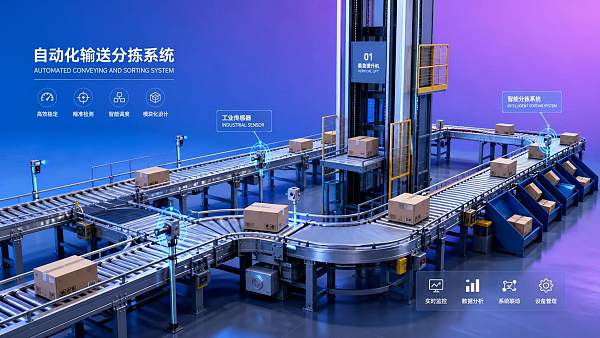
The first issue an export website for logistics equipment needs to address is not whether the pages look visually appealing, but whether overseas visitors can determine within a short time whether the equipment is suitable for their project. Products such as conveyors, sorting equipment, warehouse racking, lifts, and palletizing systems often involve material characteristics, throughput, site dimensions, interface methods, and subsequent maintenance conditions. If a website only displays complete machine images and general selling points, the resulting inquiries are likely to lack key information. Repeated specification confirmations then extend the quotation cycle and increase solution rework.
A more effective approach is to design the website as an upfront selection interface: first help visitors understand the product boundaries, then guide them to provide the necessary information that affects the solution. The inquiries obtained this way may not be the most numerous, but they are more likely to lead to technical discussions and the quotation process.
Product pages should first differentiate applicable operating conditions, then present equipment capabilities
Logistics equipment parameters cannot be presented separately from application conditions. For example, a high conveying speed does not automatically mean high throughput; carton spacing, material size variations, turning radius, accumulation requirements, and the operating pace of upstream and downstream equipment must also be considered. The rated load of a roller conveyor should also specify whether it is a uniformly distributed load or a concentrated load. For a pallet conveyor line, the pallet bottom structure, maximum eccentric load, entry and exit directions, and forklift transfer method should be clearly defined.
Therefore, the first screen of a product page should first explain what the equipment handles, at which stage it operates, and what layout conditions it is suitable for. Technical information should then be divided into “key specifications,” “optional configurations,” and “variables requiring project confirmation.” This is easier to understand than placing all data in a single parameter table, and it can reduce cases where standard models are assumed to directly cover special operating conditions.
A parameterized structure determines selection efficiency
A product page that supports export business communication should not mix different models within the same text. Maintainable fields should be established for model, load capacity range, effective width, conveying length, drive method, power requirements, frame material, surface treatment, and control method. Visitors can filter based on application requirements, while sales and technical teams can use consistent information, avoiding different versions of descriptions in product catalogs, webpages, and quotations.
Material and process information especially needs clearly defined boundaries. Powder-coated carbon steel, stainless steel, galvanized components, and aluminum profiles are suitable for different environments. Humid, low-temperature, dusty, food-contact, or mildly corrosive environments all affect protection ratings, bearing sealing, lubrication solutions, and fastener treatment. A website does not need to make conclusions directly for a project, but it should let visitors know which conditions will change the configuration. For belt conveying equipment, belt material, coefficient of friction, temperature resistance range, and cleaning method often provide more decision-making value than saying “high-quality belts are used.”
Complex systems can be presented using a “standard unit + project combination” approach. For example, inbound conveying, buffering, barcode scanning, sorting, and outbound connection can each be explained in terms of their functions and interfaces, followed by the possible process routes they can form. This both avoids packaging non-standard projects as fixed products and helps visitors understand which site data they need to provide.
Multilingual content is not merely completed translation; it is the preservation of technical meaning
A common issue with multilingual pages for logistics equipment is literal translation. Certain terms do not correspond to exactly the same equipment definitions in different markets, and there are also differences in specification units, drawing notation practices, and electrical expressions. Pages should standardize model naming, units of measurement, parameter fields, and document versions, avoiding one set of dimensions on the English page and another set of annotations in downloadable drawings.
Translations must retain the qualifiers needed for engineering judgment. For example, “maximum load” should specify the testing or operating conditions; “customizable” should be specific about length, width, drive, electrical control, or protection configurations, rather than becoming a general expression used to avoid specifications. For installation-related content, clearly state the equipment supply scope, on-site assembly method, foundation conditions, and whether space needs to be reserved for cables, air supply, network connections, or control cabinets. Language pages should share the same product data source, with only market messaging and case content adjusted by region, in order to reduce information drift.
Inquiry forms should capture variables that affect quotations
Providing only fields for name, email, and a message box usually results in vague requirements. Form fields should vary by product category: conveying projects can require material dimensions, individual item weight, target throughput, layout length, and turning requirements; warehousing projects can additionally include warehouse clear height, pallet dimensions, storage capacity, and inbound and outbound frequency; sorting projects need information on parcel range, number of destinations, identification method, and peak handling conditions.
Fields should not be presented in an excessively long list at once. Information determining preliminary feasibility can be collected first, followed by attachments for layout drawings, flowcharts, sample photos, or existing equipment documentation. For visitors who do not yet have precise data, range selections and a “to be confirmed” option can be provided to prevent them from abandoning submission because they cannot fill in a certain value. Inquiry entry points on the page should also be associated with the current product, so submitted information automatically includes the model, browsing language, and current page, reducing information loss during internal handover.
- Product detail pages are suitable for entry points such as “Get a Technical Solution” that relate to the current equipment, with the product name or model prefilled in the form.
- Before downloading specifications, company email and project stage can be requested, but basic parameters should not be completely hidden, otherwise early-stage selection will be hindered.
- For non-standard combinations, attachment uploads are more valuable than text-only messages, especially for site layouts, pallet drawings, and process flow documentation.
Match traffic entry points with landing page intent
Visitors searching for “pallet conveyor system” may need a single-machine replacement, an expansion of a complete line, or a project concept evaluation. If all traffic enters the homepage, visitors must find the related equipment, parameters, and inquiry entry points themselves, extending the conversion path. Building landing pages around specific equipment, application scenarios, and issues makes it easier to align search terms, page content, and submission actions.
Advertising pages and organic search pages should not be exact copies of each other. Advertising traffic needs a quick explanation of the scenarios handled, key specification ranges, and project materials that can be submitted; organic search pages can add operating principles, model differences, maintenance points, and links to related equipment to support a longer research process. Internal links should be based on process relationships, such as a roller conveyor line connecting to turning machines, vertical transfer units, and pallet storage systems, rather than simply stacking similar keywords.
Website data should be reviewed to identify “which pages generate effective technical documentation,” “which model pages have the most missing form items,” and “which sources end before quotation because operating conditions do not match.” These signals do not necessarily indicate traffic quality issues; they may also indicate that the page has not explained equipment boundaries in advance. By incorporating frequent questions from inquiries into parameter descriptions, form options, and downloadable materials, the website can gradually take on the role of upfront screening and communication. For a discussion of how digital processes affect organizational adaptability, refer to An Analysis of the Impact of Digital Transformation on Corporate Resilience.
When product data, language pages, inquiry fields, and subsequent quotation materials remain consistent, the website is no longer merely a display window. It can complete part of the operating-condition clarification in advance, shifting technical communication from “what is the equipment” to “how should it be configured,” and making overseas inquiries more likely to enter an executable selection process.
Related Articles



Related Products
 Yiyingbao SaaS Intelligent Website Building and Marketing SystemYiyingbao SaaS Intelligent Website Building and Marketing System, AI-powered no-code website building, rapid creation of multilingual B2B international websites in 10 minutes, global server acceleration, AI-powered SEO optimization, helping businesses connect efficiently with global markets. The perfect integration of technology and operation makes building an international trade website remarkably simple
 AI+SEM Intelligent Advertising Marketing SystemAI+SEM drives intelligent ad creation, empowering full-funnel precision advertising marketing. The system automatically generates weekly/monthly reports, AI recommends keywords and target countries, monitors core metrics in real-time with intelligent alerts, and enables one-click high-conversion ad solutions to help quickly acquire customers and improve ROI.
 AI+SEO Dual-Engine System Optimization ServicesYiyingbao’s AI+SEO dual-engine optimization system helps foreign trade enterprises acquire high-quality organic traffic through AI-powered keyword research, content generation, and comprehensive technical optimization, significantly improving search rankings and conversion rates.
 AI+SNS Social Media Marketing SystemYingbao AI+SNS Social Media Marketing System - Precision social capture for the social media era. Supports one-click content synchronization across major platforms like Facebook and LinkedIn. AI intelligently rewrites posts for enhanced relevance. 24/7 AI customer service and user profiling analysis empower businesses to efficiently expand into global markets.
 AI+SEO营销解决方案易营宝AI+SEO营销解决方案,通过AI批量写作、智能生成TDK、精准关键词扩词等功能,全面优化网站SEO效果,提升流量与转化率。助力企业构建高效智能网站新生态。
 AI+SEM Advertising Marketing SolutionsAI+SEM Advertising Marketing Solution leverages AI technology to deeply empower SEM ad campaigns. It automatically generates weekly/monthly reports using AI, presenting account data across multiple dimensions for comprehensive insights into campaign performance and trends. The system precisely recommends keywords and target countries, intelligently generates high-conversion ad copy, and enables one-click activation of efficient campaign plans to help businesses rapidly acquire customers. Simultaneously, it monitors core metrics in real time, intelligently identifies abnormal fluctuations, and issues timely alerts to ensure stable, high-return advertising results.
 Domain Name ServicesEasyWin provides professional domain name services, including intelligent queries, one-stop registration, brand protection, and full lifecycle management, helping businesses build a digital brand image.
 EasyOperate B2C Cross-Border E-Commerce Platform & Independent WebsiteEasyStore B2C Cross-border E-commerce Independent Store is an intelligent website building and cross-border e-commerce integrated solution independently developed by EasyStore Information Technology (Beijing) Co., Ltd. The system is specially designed for small and medium-sized as well as large export enterprises, integrating 'website building, operation, marketing, advertising, and conversion' into one, helping enterprises quickly establish cross-border e-commerce independent stores to achieve brand globalization and global sales growth.
The platform supports multiple languages, multiple currencies, and multi-channel marketing, with built-in AI intelligent translation and SEO optimization systems, suitable for mainstream markets such as Southeast Asia, Europe and America, Latin America, and the Middle East, assisting Chinese manufacturing enterprises in efficiently deploying international e-commerce strategies. SSL证书易营宝提供专业SSL安全证书服务,包括单域名和泛域名证书,确保网站数据传输加密、身份验证和完整性保护,助力企业建立安全可信的在线业务环境。









