









- Which customer acquisition channels will be affected by cross-border marketing trends in 2026?Sep 06, 2026View details
- Which homogenization risks should be considered in an analysis of the AI-powered website building industry?Aug 30, 2026View details
- How Will AI Marketing Trends 2026 Change Advertising Budget AllocationAug 28, 2026View details
- Is the EV SSL certificate market shrinking or upgrading? How should companies assess certificate procurement?Aug 11, 2026View details
- Why the old AMP SEO 2020 practices no longer work and what has changed in current optimization prioritiesAug 02, 2026View details
- How to Choose Topics for an Industry News Section to Attract More Organic Search TrafficJul 29, 2026View details
How to Build a Growth System for Overseas Brand Social Media Operations from Exposure to Inquiries
When many companies begin operating overseas social media, the first metrics they notice are follower counts, views, and engagement rates: a short video receives tens of thousands of views, a LinkedIn post gains many likes, and the team can easily conclude that “the account is gaining traction.” However, when the sales department asks how many qualified customers this traffic has generated, which markets are gaining momentum, and why leads have not entered the inquiry pool, a disconnect often emerges between operations and business teams.
Effective social media operations for global brand expansion are not about publishing content on more platforms. They involve building a growth system around the target customer's decision-making journey: “being seen—being understood—being trusted—being willing to act—ongoing follow-up.” For manufacturing companies, foreign trade B2B businesses, and cross-border brands, the value of social media lies not only in communication, but also in continuously delivering identifiable and nurturable business opportunities to independent websites, sales teams, and long-term brand assets.
First, clarify: exposure is not the end point, and inquiries are not the only outcome
Overseas customers rarely submit purchasing requirements immediately because of a single post, especially in fields with long decision cycles, such as equipment, components, industrial raw materials, and enterprise software. A procurement manager may first see an industry viewpoint on LinkedIn, then search for the brand on Google, visit the website to verify qualifications and product information, and subsequently download materials, book a meeting, or consult a local sales channel. Social media plays the role of initial outreach and trust acceleration in this process.
Therefore, management should not evaluate social media operations for global brand expansion solely by “follower growth,” but should establish tiered metrics: at the top, focus on effective reach in target markets, video completion rates, and audience profiles; in the middle, focus on website visits, content downloads, and retargeting audience accumulation; at the bottom, examine form submissions, WhatsApp or email inquiries, demo bookings, and qualified business opportunities confirmed by sales.
The purpose of this metric system is to distinguish where problems lie: whether content fails to attract the target audience, or landing pages fail to capture interest; whether lead quality is insufficient, or sales response is too slow. Attributing every issue to “social media not working” usually only causes companies to miss the links that truly need to be fixed.
Start with market selection, not with “what to post every day”
A common misconception among companies expanding overseas is to use the same English content for North America, Europe, the Middle East, Latin America, and Southeast Asia. A common language does not mean consistent needs. North American buyers may focus on delivery efficiency, certifications, and application innovation; European customers care more about compliance, sustainability, and long-term maintenance; Middle Eastern markets are often more sensitive to project service capabilities, relationship building, and response speed.
Before operations begin, companies should first create a “market—audience—scenario” map: which countries and regions they plan to prioritize; who influences purchasing in each market; in what situations they will pay attention to such products; and what concerns them most when selecting suppliers. B2B companies in particular need to differentiate between users, technical evaluators, procurement managers, and final decision-makers, because the content they need to see is not the same.
For example, content for engineers can discuss testing methods, parameter logic, and application details; content for procurement professionals is better suited to addressing production capacity, quality control, lead times, and after-sales mechanisms; brand decision-makers may be more concerned with supply stability, global service, and partnership risks. Content does not need to cover everything, but it must make key roles feel that “this company understands my problems.”
The content matrix should support progressive trust-building
Social media content should not focus only on product posters and promotional information. For Chinese brands in unfamiliar markets, users first need to establish basic awareness before they are willing to learn about products. A relatively reliable content mix usually includes the following four categories:
- Industry insight content: Evidence-based observations on trends, regulations, procurement changes, or technology paths, used to attract potential customers who are still in the research stage.
- Application proof content: Addressing the question, “Can you solve real problems?” through production processes, testing procedures, product application scenarios, and solution logic.
- Trust-building content: Showcasing teams, trade shows, factory management, service processes, cooperation methods, and frequently asked questions to reduce the unfamiliarity of cross-border collaboration.
- Call-to-action content: Directing suitable audiences to product pages, selection materials, sample request pages, consultation booking pages, or dedicated landing pages.
Among these, short videos are suitable for presenting equipment operation, manufacturing processes, before-and-after comparisons, and personal communication; LinkedIn is better suited to building professional viewpoints and B2B relationship networks; Facebook and Instagram can support brand stories, scenario displays, and retargeting; YouTube is suitable for building a searchable library of demonstrations and tutorial content. There is no need to cover every platform. The key is to identify channels where target customers are willing to stay and where subsequent visits can be generated.
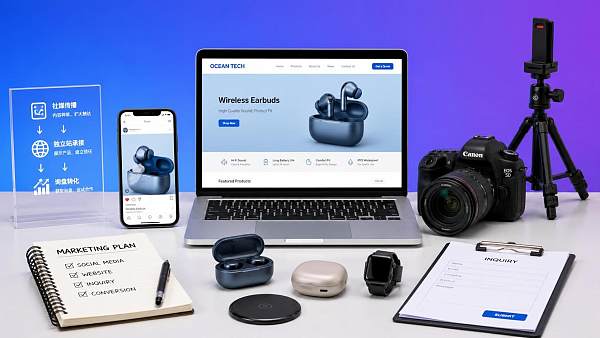
Give social media traffic somewhere to go: the independent website is the inquiry conversion hub
Even if a piece of content sparks interest, front-end investment can easily be wasted if users click through to a website with outdated information, slow loading speeds, and no clear action path. Social media profile links, post links, and advertising links should not point to the homepage arbitrarily, but should lead to corresponding landing pages based on the content topic.
For example, content published around an industry application can link to that industry's solutions page; a video explaining technical parameters can direct users to a product comparison page or material download page; content targeting regional distributors should lead to a cooperation policy and contact form page. The page should clearly explain who it serves, the value it provides, basic supporting materials, and the next action to take, avoiding the need for visitors to guess how to get in touch.
For inquiry-driven companies, more form fields are not necessarily better. At the initial contact stage, basic information such as name, business email, country or region, and type of requirement is usually sufficient. If customers are accustomed to using WhatsApp, online chat, or email, communication entry points aligned with local usage habits should also be provided. Automated emails after form submission, sales response time limits, and lead assignment rules are likewise part of the social media conversion system.
Connect content, advertising, and sales through data
Organic social media operations are suitable for building sustained awareness, but in priority markets, around trade show milestones, during new product launches, or when expanding into high-value customer segments, appropriately combining advertising on platforms such as Meta and LinkedIn can validate audience and content direction more quickly. The key is not to expand budgets blindly, but to first define the stage of advertising: whether it is for cold-start reach, retargeting people who have visited the website, or encouraging prospects who have downloaded materials to book a discussion.
It is recommended to set up trackable links for different campaigns and record user journeys through pixels, conversion events, and CRM source fields. At a minimum, managers should be able to see which types of content generate high-quality website visits, which countries have longer post-click dwell times, which ad groups generate leads recognized by sales, and how many interactions are required on average from first contact to inquiry.
Data is not intended to create complex reports, but to help teams make trade-offs. If a type of content has high engagement but generates almost no visits from target markets, it can be retained as brand material but should not consume too much customer acquisition budget; if a niche topic has limited traffic but generates consistent inquiries, it is worth expanding into dedicated pages, video series, and search advertising keywords.
Operating mechanisms matter more than “viral content”
Many companies see their social media projects stagnate not because their teams lack effort, but because they lack cross-departmental coordination. Marketing personnel do not understand the objections sales encounters on the front line, while sales cannot see the questions users repeatedly ask on social media; after content is published, no one tracks leads, making it naturally difficult to demonstrate the value of the investment.
A more suitable approach for long-term corporate execution is to establish monthly topic-planning meetings and a lead review mechanism. Sales provides frequently asked questions, customer case leads, and changes in regional demand, while marketing transforms them into content and landing pages; operations personnel regularly report on content performance, audience changes, and inquiry sources; management adjusts resources according to market priorities. The more deeply digital capabilities are integrated into business operations, the more room companies have to respond to external fluctuations. Further insights can also be gained from An Analysis of the Impact of Digital Transformation on Corporate Resilience.
For foreign trade enterprises and global brand expansion scenarios, Yiyingbao plans AI-powered website building, multilingual content development, SEO optimization, advertising, and overseas social media operations within the same growth chain. For companies seeking to move from “social media account management services” toward a “trackable customer acquisition system,” the value of this integrated approach lies in the fact that social media content no longer exists in isolation, but can work together with indexable independent website pages, retargeting audiences, and inquiry management.
Determine whether the system is heading in the right direction
A mature social media operations system for global brand expansion usually shows several signs: the share of audiences in target markets gradually increases; website traffic no longer depends solely on a single advertisement; users proactively ask about specifications, cooperation methods, or local delivery; sales can clearly identify the types of content from which leads originate; and content assets can be reused across websites, trade show emails, advertising materials, and customer follow-up.
The real challenge of overseas social media is not learning how to publish, but ensuring that every publication is connected to business objectives. When content positioning, website conversion, data tracking, and sales follow-up begin operating in the same direction, exposure can gradually accumulate into trust, and trust can have the opportunity to convert into genuine inquiries across geographic boundaries.
Related Articles

Related Products
 Yiyingbao SaaS Intelligent Website Building and Marketing SystemYiyingbao SaaS Intelligent Website Building and Marketing System, AI-powered no-code website building, rapid creation of multilingual B2B international websites in 10 minutes, global server acceleration, AI-powered SEO optimization, helping businesses connect efficiently with global markets. The perfect integration of technology and operation makes building an international trade website remarkably simple
 AI+SEM Intelligent Advertising Marketing SystemAI+SEM drives intelligent ad creation, empowering full-funnel precision advertising marketing. The system automatically generates weekly/monthly reports, AI recommends keywords and target countries, monitors core metrics in real-time with intelligent alerts, and enables one-click high-conversion ad solutions to help quickly acquire customers and improve ROI.
 AI+SEO Dual-Engine System Optimization ServicesYiyingbao’s AI+SEO dual-engine optimization system helps foreign trade enterprises acquire high-quality organic traffic through AI-powered keyword research, content generation, and comprehensive technical optimization, significantly improving search rankings and conversion rates.
 AI+SNS Social Media Marketing SystemYingbao AI+SNS Social Media Marketing System - Precision social capture for the social media era. Supports one-click content synchronization across major platforms like Facebook and LinkedIn. AI intelligently rewrites posts for enhanced relevance. 24/7 AI customer service and user profiling analysis empower businesses to efficiently expand into global markets.
 AI+SEO营销解决方案易营宝AI+SEO营销解决方案,通过AI批量写作、智能生成TDK、精准关键词扩词等功能,全面优化网站SEO效果,提升流量与转化率。助力企业构建高效智能网站新生态。
 AI+SEM Advertising Marketing SolutionsAI+SEM Advertising Marketing Solution leverages AI technology to deeply empower SEM ad campaigns. It automatically generates weekly/monthly reports using AI, presenting account data across multiple dimensions for comprehensive insights into campaign performance and trends. The system precisely recommends keywords and target countries, intelligently generates high-conversion ad copy, and enables one-click activation of efficient campaign plans to help businesses rapidly acquire customers. Simultaneously, it monitors core metrics in real time, intelligently identifies abnormal fluctuations, and issues timely alerts to ensure stable, high-return advertising results.
 Domain Name ServicesEasyWin provides professional domain name services, including intelligent queries, one-stop registration, brand protection, and full lifecycle management, helping businesses build a digital brand image.
 EasyOperate B2C Cross-Border E-Commerce Platform & Independent WebsiteEasyStore B2C Cross-border E-commerce Independent Store is an intelligent website building and cross-border e-commerce integrated solution independently developed by EasyStore Information Technology (Beijing) Co., Ltd. The system is specially designed for small and medium-sized as well as large export enterprises, integrating 'website building, operation, marketing, advertising, and conversion' into one, helping enterprises quickly establish cross-border e-commerce independent stores to achieve brand globalization and global sales growth.
The platform supports multiple languages, multiple currencies, and multi-channel marketing, with built-in AI intelligent translation and SEO optimization systems, suitable for mainstream markets such as Southeast Asia, Europe and America, Latin America, and the Middle East, assisting Chinese manufacturing enterprises in efficiently deploying international e-commerce strategies. SSL证书易营宝提供专业SSL安全证书服务,包括单域名和泛域名证书,确保网站数据传输加密、身份验证和完整性保护,助力企业建立安全可信的在线业务环境。









