









- Which customer acquisition channels will be affected by cross-border marketing trends in 2026?Sep 06, 2026View details
- Which homogenization risks should be considered in an analysis of the AI-powered website building industry?Aug 30, 2026View details
- How Will AI Marketing Trends 2026 Change Advertising Budget AllocationAug 28, 2026View details
- Is the EV SSL certificate market shrinking or upgrading? How should companies assess certificate procurement?Aug 11, 2026View details
- Why the old AMP SEO 2020 practices no longer work and what has changed in current optimization prioritiesAug 02, 2026View details
- How to Choose Topics for an Industry News Section to Attract More Organic Search TrafficJul 29, 2026View details
How to Assess Whether an Overseas Digital Marketing Outsourcing Service Provider Can Deliver Reliably
When evaluating outsourced overseas digital marketing services, many companies tend to focus first on pricing, case study screenshots, and whether results can be delivered quickly. However, what truly determines whether a project is worth signing is often not how attractive the proposal sounds, but whether the delivery process is transparent, data standards are consistent, and the results can be accumulated into the company's own long-term assets. For those responsible for vendor selection and decision-making, assessing whether a service provider is reliable essentially means determining whether the investment is buying short-term traffic or a sustainable overseas growth system.
Before looking at the results, first check whether the delivery scope is clearly defined
The most common problem with outsourced overseas marketing is not that the service provider does nothing, but that it does a lot that is difficult to verify. For example, website development, SEO, advertising, and social media operations may be handled by different teams. In the end, the business team receives a series of weekly reports saying that the website has gone live, keywords have been optimized, ads have been launched, and content has been published, yet no one can clearly explain why inquiries have not grown steadily.
This is when it becomes clear whether an integrated website and marketing service reflects genuine capability rather than merely being a sales pitch. Reliable outsourced overseas digital marketing services usually have clearly defined delivery boundaries: to what extent will the website be delivered, and does the scope include a multilingual structure, basic technical optimization, tracking implementation, and conversion tracking? Does SEO delivery refer only to the number of articles, or does it include page indexing, keyword planning, and technical fixes? Does advertising cover account setup and campaign operation only, or does it also include landing pages, conversion attribution, and creative testing? The less clearly defined the boundaries are, the higher the likelihood of disputes later.
If a service provider cannot clearly explain before contract signing what will and will not be done, who needs to cooperate, how long delivery will take, and how acceptance will be conducted, even the lowest quotation is not necessarily inexpensive.
Look at the data, not just whether the reports look good
Many outsourcing projects run into problems at the data level. Visits, clicks, and impressions may all increase, but if these figures cannot be linked to leads, inquiries, and sales opportunities, they are of little help for decision-making. Particularly in B2B overseas expansion, the truly valuable data is not simply traffic, but valid forms, phone inquiries, WhatsApp lead submissions, sample requests, quotation requests, and the countries, channels, and pages from which these conversions originate.
During a business evaluation, you can ask several specific questions directly: Who builds the data dashboard? Do the advertising platform, website analytics tools, and form system use accounts owned by the company? Can conversion tracking distinguish organic search, advertising, social media, and direct visits? If the website is redesigned, will historical data be interrupted? At this point, the differences in capability between service providers often become apparent.
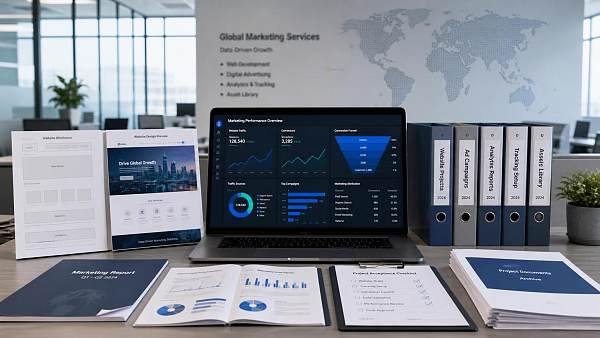
A reliable service provider will not simply provide a polished weekly report, but will also be willing to explain the underlying data logic clearly. Genuine delivery should be able to withstand detailed questions: Where does the traffic come from? Why is it increasing or declining? Which leads are invalid? Which markets deserve additional budget? Which activities are merely superficial busyness?
Whether business assets can be accumulated is the dividing line for evaluating outsourcing value
There is a practical standard for assessing whether outsourced overseas digital marketing services are reliable: what exactly does the company retain after the project ends?
If all that remains is temporary traffic generated during the advertising period, incomplete account access, an inaccessible website backend, and content assets held by the service provider, then even if the delivery appears effective, it is more like renting capabilities than building them. Conversely, if the website source code or backend access, domain management rights, advertising accounts, tracking implementation, content assets, keyword database, and landing page test results can all be transferred to the company, growth will not have to start from zero whether the company continues working with the same provider or changes teams.
This is why an increasing number of companies place greater emphasis on integrated solutions. A website is not an isolated project: it determines indexing, loading speed, conversion paths, and data collection. Marketing is not a collection of independent activities either; it relies on website structure, content organization, and audience journeys. For platform-based service providers such as Yiyingbao, which extends from intelligent website development to SEO, advertising, social media, and GEO, the value lies not in having many business lines, but in whether they connect front-end lead generation with back-end conversion, making the website promotable, indexable, and conversion-ready, rather than delivering an attractive overseas website that is difficult to operate.
Do not be misled by case studies; focus on the logic that can be replicated
Case studies are certainly important, but they should not be evaluated only by looking at the client list and screenshots of results. What is truly valuable for assessment is why the case succeeded and whether its methods apply to your business.
For example, a manufacturing B2B website and a cross-border retail independent site differ in their objectives, conversion cycles, content depth, and advertising strategies. User habits, language localization requirements, and channel priorities also differ between North America and the Middle East, Japan and South Korea, and Latin America. If a service provider can only demonstrate that it has served many industries but cannot clearly explain how to plan the information architecture of multilingual websites, how to allocate SEO and advertising budgets across different regions, or how the delivery priorities differ between inquiry-driven websites and e-commerce sites, its case studies have limited reference value.
A more reliable way to evaluate a provider is to see whether it can break down its methods: Which scenarios are suitable for building a website before launching advertising? Which are suitable for testing the market with advertising first? Which industries depend more on long-term content accumulation? Which product categories need to prioritize landing pages and creative testing? Being able to explain the methodology clearly is usually more persuasive than simply listing successful projects.
A truly professional team will proactively discuss risks and limitations
If a service provider promises that a website will definitely reach the first page quickly, that a low budget can cover the global market, or that inquiries will naturally arrive after the website is built, you should be cautious. Overseas marketing has never been a task that can achieve stable growth through a single action. Search demand, competition intensity, content review, advertising learning periods, and website fundamentals vary from country to country, and many results require time to validate.
Reliable teams often explain limitations at the outset. For example, a new domain generally needs time to observe indexing and crawl performance when conducting SEO. If a multilingual website uses machine translation, content quality and conversion performance require additional evaluation. If the landing page provides weak support for an advertising campaign, increasing the budget may instead amplify waste. If social media operations lack brand assets and a stable source of content, it is difficult to consistently produce effective content.
Proactively revealing these issues indicates that the provider is closer to a project-based service partner than a company simply selling packages.
When selecting a provider, ask questions at the execution level
Many purchasing mistakes occur because companies communicate only with sales representatives rather than with the people who will actually execute the project. During the business evaluation stage, it is advisable to request a more in-depth delivery discussion, focusing not on general concepts but on the process.
The discussion can focus on the following types of questions:
- Before the website goes live, will basic SEO settings, speed testing, mobile adaptation, and form testing be completed?
- Are multilingual pages planned independently, or are they simply copied and translated? Is there a localized content strategy for each market?
- Who is responsible for creatives, landing pages, audience testing, and negative keyword optimization in advertising campaigns, and how frequently are adjustments made?
- Does the monthly review only report results, or does it also provide recommendations for next-stage actions and budget decisions?
- If the company already has a CRM, customer service tools, or a sales system, can the provider cooperate in connecting the lead flow?
These questions may seem detailed, but they are highly effective for testing delivery maturity. Teams that have handled long-term projects usually provide specific answers rather than staying at the level of vague statements such as 'we will optimize' or 'we will continue to follow up.'
Why are more and more companies choosing integrated services?
For foreign trade companies, manufacturing factories, and cross-border brands, overseas marketing is increasingly unlike the past, when a website development company could build a site and an operations agency could run advertising campaigns, which could then simply be combined. Today's growth path is longer: website technical structure affects search performance and advertising quality scores, content affects organic traffic and visibility in AI search, social media affects brand awareness, and the data system determines whether subsequent reviews are effective.
Therefore, integration is not merely about reducing communication costs; more importantly, it reduces disconnection between activities. Yiyingbao has been focused on overseas digital marketing since 2013. Its core approach is to combine technical systems with localized services. Through its self-developed website development system, cross-border e-commerce system, AI advertising marketing system, and AI+SEO/GEO optimization system, it places website development, promotional lead generation, and ongoing operations within the same growth framework. For companies evaluating providers, the advantage of this model is that it makes it easier to align objectives and data standards, and to track whether each delivery step genuinely supports conversion.
What you should ultimately confirm is not whether it can be done, but how it will be accepted
When assessing whether outsourced overseas digital marketing services are delivered reliably, everything ultimately comes down to the acceptance mechanism. Without acceptance criteria, even the most professional proposal can easily become a matter of subjective interpretation. For a website project, examine page structure, loading performance, tracking implementation, and the complete form conversion loop. For SEO, examine whether technical fixes, content delivery, indexing progress, and keyword strategy form a coherent system. For advertising, examine account access, conversion tracking, testing logic, and how the budget is spent. For social media operations, examine the pace of content production, interaction quality, and whether the work serves the lead-generation objective.
If you are currently selecting a provider, consider shifting your focus one step beyond whether the quotation is cost-effective: Is the service provider willing to disclose its methods, provide access to data, deliver assets, and clearly explain why certain aspects cannot be guaranteed? A provider that can do these things is usually more trustworthy than one presenting an aggressive proposal. Whether it is ultimately suitable still depends on your target markets, budget cycle, internal cooperation capabilities, and growth stage. Define these conditions clearly first, and then evaluate service providers. Your choice will be more stable and you will be less likely to encounter avoidable problems.
Related Articles
 Why do SaaS cross-border e-commerce customer acquisition efforts often get stuck at demo booking?
 For an independent foreign trade website in Shanghai, is it better to focus first on inquiries or transactions?
 What parameters should a product selection guide include to reduce repeated communication with sales?



Related Products
 Yiyingbao SaaS Intelligent Website Building and Marketing SystemYiyingbao SaaS Intelligent Website Building and Marketing System, AI-powered no-code website building, rapid creation of multilingual B2B international websites in 10 minutes, global server acceleration, AI-powered SEO optimization, helping businesses connect efficiently with global markets. The perfect integration of technology and operation makes building an international trade website remarkably simple
 AI+SEM Intelligent Advertising Marketing SystemAI+SEM drives intelligent ad creation, empowering full-funnel precision advertising marketing. The system automatically generates weekly/monthly reports, AI recommends keywords and target countries, monitors core metrics in real-time with intelligent alerts, and enables one-click high-conversion ad solutions to help quickly acquire customers and improve ROI.
 AI+SEO Dual-Engine System Optimization ServicesYiyingbao’s AI+SEO dual-engine optimization system helps foreign trade enterprises acquire high-quality organic traffic through AI-powered keyword research, content generation, and comprehensive technical optimization, significantly improving search rankings and conversion rates.
 AI+SNS Social Media Marketing SystemYingbao AI+SNS Social Media Marketing System - Precision social capture for the social media era. Supports one-click content synchronization across major platforms like Facebook and LinkedIn. AI intelligently rewrites posts for enhanced relevance. 24/7 AI customer service and user profiling analysis empower businesses to efficiently expand into global markets.
 AI+SEO营销解决方案易营宝AI+SEO营销解决方案,通过AI批量写作、智能生成TDK、精准关键词扩词等功能,全面优化网站SEO效果,提升流量与转化率。助力企业构建高效智能网站新生态。
 AI+SEM Advertising Marketing SolutionsAI+SEM Advertising Marketing Solution leverages AI technology to deeply empower SEM ad campaigns. It automatically generates weekly/monthly reports using AI, presenting account data across multiple dimensions for comprehensive insights into campaign performance and trends. The system precisely recommends keywords and target countries, intelligently generates high-conversion ad copy, and enables one-click activation of efficient campaign plans to help businesses rapidly acquire customers. Simultaneously, it monitors core metrics in real time, intelligently identifies abnormal fluctuations, and issues timely alerts to ensure stable, high-return advertising results.
 Domain Name ServicesEasyWin provides professional domain name services, including intelligent queries, one-stop registration, brand protection, and full lifecycle management, helping businesses build a digital brand image.
 EasyOperate B2C Cross-Border E-Commerce Platform & Independent WebsiteEasyStore B2C Cross-border E-commerce Independent Store is an intelligent website building and cross-border e-commerce integrated solution independently developed by EasyStore Information Technology (Beijing) Co., Ltd. The system is specially designed for small and medium-sized as well as large export enterprises, integrating 'website building, operation, marketing, advertising, and conversion' into one, helping enterprises quickly establish cross-border e-commerce independent stores to achieve brand globalization and global sales growth.
The platform supports multiple languages, multiple currencies, and multi-channel marketing, with built-in AI intelligent translation and SEO optimization systems, suitable for mainstream markets such as Southeast Asia, Europe and America, Latin America, and the Middle East, assisting Chinese manufacturing enterprises in efficiently deploying international e-commerce strategies. SSL证书易营宝提供专业SSL安全证书服务,包括单域名和泛域名证书,确保网站数据传输加密、身份验证和完整性保护,助力企业建立安全可信的在线业务环境。









