









- Which customer acquisition channels will be affected by cross-border marketing trends in 2026?Sep 06, 2026View details
- Which homogenization risks should be considered in an analysis of the AI-powered website building industry?Aug 30, 2026View details
- How Will AI Marketing Trends 2026 Change Advertising Budget AllocationAug 28, 2026View details
- Is the EV SSL certificate market shrinking or upgrading? How should companies assess certificate procurement?Aug 11, 2026View details
- Why the old AMP SEO 2020 practices no longer work and what has changed in current optimization prioritiesAug 02, 2026View details
- How to Choose Topics for an Industry News Section to Attract More Organic Search TrafficJul 29, 2026View details
Which Aspects Account for the Main Costs of Building a B2B Export Website
When many companies prepare to build an overseas website, the first obstacle is often not whether to build one, but how much budget should actually be approved. On the surface, website development looks like a one-time purchase: find a service provider, create the pages, and launch the site. However, once the project enters the quotation and comparison stage, it is common to find significant differences among three quotations, with project descriptions covering different scopes. Some providers quote only for a template website, while others include multilingual support, content organization, basic optimization, and inquiry form logic. During the approval process, the most common issue is that all budgets are labeled as website development costs, while the actual spending falls into completely different ranges.
This is why, when discussing B2B overseas website development costs, it is not enough to focus only on homepage design fees or annual system fees. Budget overruns are often not caused by the website being “too expensive,” but by failing to identify in advance which stages will require spending. Once the project is underway, companies may discover that they still need to add content, language versions, inquiry functions, and basic SEO settings. As a result, a solution that initially appeared inexpensive may become more difficult to control.
Many budget discrepancies arise from treating website development as a purely design project
If a website is understood simply as a collection of pages, it is easy to assume that price differences should not be significant. However, a B2B overseas website is different from a standard showcase site. It is responsible for overseas presentation, search indexing, inquiry generation, and communicating brand credibility. If budget decisions focus only on the visual result while overlooking the underlying structure, content, and marketing coordination, the assessment is likely to be inaccurate.
There are two common misconceptions. The first is treating a low-cost template website as a complete delivery. The second is categorizing all expenses as “technical development.” In reality, the factors that truly influence B2B overseas website development costs often include preliminary planning, information architecture, multilingual content processing, functional details, pre-launch optimization, and future marketing capabilities. In other words, costs are not concentrated in one area but distributed across several easily overlooked stages.
First, break it down: costs typically go to these areas
1. Preliminary planning and structural organization
This is one of the areas that is most easily underestimated. For companies with extensive product lines, multiple target markets, and scattered internal materials, a website cannot be created simply by “starting the design.” The site’s objectives must first be clarified: should it focus more on brand presentation or inquiry generation? Should it launch in one language first, or support multiple languages from the beginning? Should product pages be organized by industry, application, model, or solution?
Although these tasks may not look like “development work,” they determine whether many subsequent stages will require rework. Without proper early planning, the design stage may involve repeated revisions, the content stage may require additional materials, and the functional stage may reveal unreasonable navigation or insufficient landing pages. Planning essentially helps reduce repeated investment later in the project. Therefore, even when it is not always charged as a clearly visible item, it still represents a genuine cost.
2. Visual design and page presentation
This is the most visible part and the one most often used for price comparisons. The costs are affected by whether the homepage, section pages, product detail pages, case study pages, contact pages, and other pages require custom design, as well as whether they need to accommodate different devices.
However, it is important to understand that design fees are not simply about whether a page “looks good.” For an overseas website, it is more important that information is easy to read, trust is established, and key content can be quickly assessed by overseas visitors. If a page merely piles up large images and slogans, spending more on design does not necessarily improve conversion. During approval, focus on whether the design supports business communication rather than simply pursuing visual complexity.
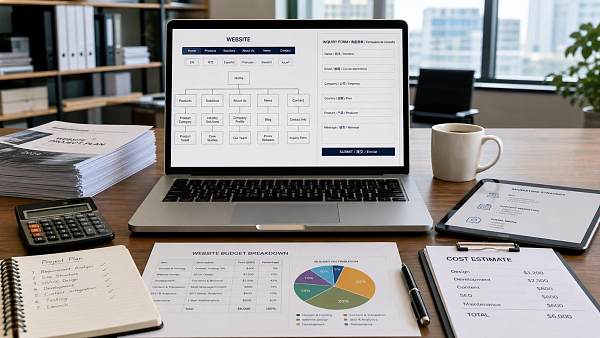
3. Functional development and system capabilities
This is often where major quotation differences actually arise. A basic product showcase website and a website with marketing capabilities are not equivalent in terms of functionality. For example, the development workload is affected by whether inquiry forms can distinguish product sources, whether the site supports language switching, whether new content can be added easily, whether pages comply with basic SEO requirements, and whether the site can support advertising landing pages.
If the company also plans to conduct Google SEO, Google Ads, or social media lead generation later, the website should ideally have stable content management, page expansion, and conversion-support capabilities from the outset. Otherwise, the money saved in the early stage may have to be paid again later through secondary development, migration and rebuilding, or limitations on marketing activities.
4. Content creation and multilingual processing
This is often the part of a project that causes the greatest delays and the most frequent budget increases. Many companies have materials in Chinese, but that does not mean they can be used directly on an overseas website. Adapting product introductions into language suitable for overseas visitors, standardizing industry terminology, organizing images and specifications, and determining whether multilingual pages require only translation or also localization adjustments all require time and labor.
If the materials are incomplete, service providers can usually only proceed with the framework first and make additions and revisions later. During approval, it is best to assess content work separately: does the quotation include copy organization, material entry, translation and proofreading, image processing, and page uploading? Unlike design, these tasks are not immediately visible, but they often account for a significant proportion of the total cost.
5. Basic optimization and launch preparation
A website being launched does not mean it will operate smoothly. Domain resolution, server environment, access speed, mobile responsiveness, basic SEO settings, form testing, and conversion tracking preparation are all part of the work before and after launch. If the supplier is only responsible for “building the site,” while no one within the company takes over these details, problems can easily emerge after launch.
This is particularly important for overseas websites. If the company plans to conduct organic search or advertising in the future, basic elements such as page titles, URL structure, sitemaps, image compression, and clean code should ideally be addressed during website development rather than after marketing begins. Otherwise, a common situation may occur: the website has been completed but cannot directly enter the marketing-use stage.
6. Ongoing maintenance and marketing coordination
During the approval process, many people treat website development as a one-time expense. In reality, the key question is whether ongoing investment will still be required after launch. If the website needs to update products, add languages, create campaign pages, or integrate advertising pages, maintenance capabilities are critical.
At this point, two types of costs should be distinguished. One is system or technical maintenance, and the other is marketing-related investment, such as SEO optimization, advertising landing page creation, and landing pages for social media lead generation. These costs do not necessarily all need to be included in the initial website development budget, but they should at least be anticipated during approval. Otherwise, the company may need to apply for another budget shortly after launch.
Why do some solutions look inexpensive but ultimately become harder to control?
Because low-cost solutions often cover only the parts that are easiest to present. For example, providing a template, creating several pages, and offering a basic backend may be considered complete delivery. The problem is that a website truly needed by a B2B business must do more than “open.” It must also demonstrate professionalism, handle inquiries, and support subsequent marketing activities.
If these needs are not considered in the initial solution, the company may later encounter several types of additional costs: adding languages, restructuring products, adding form logic, adapting the site for mobile devices, reconfiguring SEO settings, supplementing content pages, and rebuilding advertising landing pages. Each item may not seem significant on its own, but together they are often more difficult to control than making a complete plan from the beginning.
During approval, instead of asking only about the total price, ask these questions
When making a purchasing decision, asking “How much does it cost?” is far from sufficient. More valuable questions include “What is included in this price, and what is not?” For example, is the number of pages fixed? Does the quotation include planning and copywriting assistance? Does multilingual support involve machine translation, human editing, or only a language-switching function? Will it be easy to add pages later? Have the basic requirements for search and advertising been considered?
Another common consideration is whether the delivery scope is clearly defined. Many disputes that arise later are not because either party intentionally increases the price, but because both sides had different understandings of the scope of work from the outset. Confirming planning, design, development, content, launch, and maintenance separately is more effective than looking only at the total amount on the quotation.
If you want a more stable budget, website development and marketing should not be completely separated
This is particularly evident in overseas business scenarios. A website does not exist in isolation. It usually also needs to support search, advertising, social media, and even future work related to visibility in AI search. If the website development team does not understand subsequent marketing requirements, structural problems may be embedded in the site from the beginning. Conversely, if the marketing team takes over a website that is unfavorable for indexing and conversion, operating costs will also increase.
Therefore, many companies now prefer tools or service models that can handle website development, basic SEO settings, multilingual management, and advertising landing page coordination at the same time. An enterprise-level SaaS website builder with intelligent capabilities may not necessarily offer the “lowest price,” but its advantage lies in reducing repeated development and subsequent dismantling and modification, allowing website development and marketing to proceed according to the same logic. For companies that need to use their websites to acquire overseas customers over the long term, this approach is generally easier to manage from a budgeting perspective.
What should ultimately be approved is not merely the website cost, but an executable cost structure
Returning to the original question, which stages account for B2B overseas website development costs? The answer is usually not a single item. It is a combination of planning, design, functionality, content, launch preparation, and subsequent operational coordination. Which areas deserve greater investment and which can be controlled depends on the company’s current stage: whether it wants to launch quickly for initial validation or establish a solid foundation for long-term marketing from the beginning.
If you are reviewing quotations, consider first breaking “website development” into several clearly defined work items before comparing solutions. This makes it easier to determine which costs are necessary investments and which represent only superficial complexity. Budget control is never about simply forcing down the price. It is about avoiding repeated rebuilding, duplicate purchasing, and the need to add critical capabilities after launch. Before spending money on visible pages, first clarify how the website will be used in the future. The approval process will then be much less passive.
Related Articles
 Why do SaaS cross-border e-commerce customer acquisition efforts often get stuck at demo booking?
 For an independent foreign trade website in Shanghai, is it better to focus first on inquiries or transactions?
 What parameters should a product selection guide include to reduce repeated communication with sales?


Related Products
 Yiyingbao SaaS Intelligent Website Building and Marketing SystemYiyingbao SaaS Intelligent Website Building and Marketing System, AI-powered no-code website building, rapid creation of multilingual B2B international websites in 10 minutes, global server acceleration, AI-powered SEO optimization, helping businesses connect efficiently with global markets. The perfect integration of technology and operation makes building an international trade website remarkably simple
 AI+SEM Intelligent Advertising Marketing SystemAI+SEM drives intelligent ad creation, empowering full-funnel precision advertising marketing. The system automatically generates weekly/monthly reports, AI recommends keywords and target countries, monitors core metrics in real-time with intelligent alerts, and enables one-click high-conversion ad solutions to help quickly acquire customers and improve ROI.
 AI+SEO Dual-Engine System Optimization ServicesYiyingbao’s AI+SEO dual-engine optimization system helps foreign trade enterprises acquire high-quality organic traffic through AI-powered keyword research, content generation, and comprehensive technical optimization, significantly improving search rankings and conversion rates.
 AI+SNS Social Media Marketing SystemYingbao AI+SNS Social Media Marketing System - Precision social capture for the social media era. Supports one-click content synchronization across major platforms like Facebook and LinkedIn. AI intelligently rewrites posts for enhanced relevance. 24/7 AI customer service and user profiling analysis empower businesses to efficiently expand into global markets.
 AI+SEO营销解决方案易营宝AI+SEO营销解决方案,通过AI批量写作、智能生成TDK、精准关键词扩词等功能,全面优化网站SEO效果,提升流量与转化率。助力企业构建高效智能网站新生态。
 AI+SEM Advertising Marketing SolutionsAI+SEM Advertising Marketing Solution leverages AI technology to deeply empower SEM ad campaigns. It automatically generates weekly/monthly reports using AI, presenting account data across multiple dimensions for comprehensive insights into campaign performance and trends. The system precisely recommends keywords and target countries, intelligently generates high-conversion ad copy, and enables one-click activation of efficient campaign plans to help businesses rapidly acquire customers. Simultaneously, it monitors core metrics in real time, intelligently identifies abnormal fluctuations, and issues timely alerts to ensure stable, high-return advertising results.
 Domain Name ServicesEasyWin provides professional domain name services, including intelligent queries, one-stop registration, brand protection, and full lifecycle management, helping businesses build a digital brand image.
 EasyOperate B2C Cross-Border E-Commerce Platform & Independent WebsiteEasyStore B2C Cross-border E-commerce Independent Store is an intelligent website building and cross-border e-commerce integrated solution independently developed by EasyStore Information Technology (Beijing) Co., Ltd. The system is specially designed for small and medium-sized as well as large export enterprises, integrating 'website building, operation, marketing, advertising, and conversion' into one, helping enterprises quickly establish cross-border e-commerce independent stores to achieve brand globalization and global sales growth.
The platform supports multiple languages, multiple currencies, and multi-channel marketing, with built-in AI intelligent translation and SEO optimization systems, suitable for mainstream markets such as Southeast Asia, Europe and America, Latin America, and the Middle East, assisting Chinese manufacturing enterprises in efficiently deploying international e-commerce strategies. SSL证书易营宝提供专业SSL安全证书服务,包括单域名和泛域名证书,确保网站数据传输加密、身份验证和完整性保护,助力企业建立安全可信的在线业务环境。









