









- Can the average annual growth rate reflect real opportunities in overseas markets?Oct 07, 2026View details
- Which customer acquisition channels will be affected by cross-border marketing trends in 2026?Sep 06, 2026View details
- Which homogenization risks should be considered in an analysis of the AI-powered website building industry?Aug 30, 2026View details
- How Will AI Marketing Trends 2026 Change Advertising Budget AllocationAug 28, 2026View details
- Is the EV SSL certificate market shrinking or upgrading? How should companies assess certificate procurement?Aug 11, 2026View details
- Why the old AMP SEO 2020 practices no longer work and what has changed in current optimization prioritiesAug 02, 2026View details
How to Continuously Generate Traffic After Launching an Overseas Independent Website
Why Does Traffic Often Stall After an Overseas Independent Website Goes Live
Many companies focus most of their efforts on the website development stage: whether the pages look attractive, whether the English copy reads naturally, and whether all products have been uploaded. However, once the website goes live, the real problems begin. After an overseas independent website is completed, the challenge of continuously acquiring traffic is never simply about “being seen.” It is about making search engines, advertising systems, social platforms, and potential customers consistently willing to give you their attention.
This is why the data of many websites starts to stagnate one or two months after launch: organic traffic has not picked up, visitors disappear as soon as advertising stops, and social media posts generate no inquiries. The root cause is usually not that a particular action was missed, but that the website was not operated as a “sustainable customer acquisition system” from the beginning. The website is only the foundation; traffic growth depends on the coordination of subsequent content, channels, and conversion.
If one practical conclusion must be given, it is this: after launch, do not rush to pursue “all channels at once.” First build a traffic structure that is sustainable, reusable, and scalable. Otherwise, the more you do, the easier it is to become busy without achieving results.
FAQ 1: Where Should the First Batch of Traffic Come from After an Independent Website Goes Live?
For most foreign trade companies, manufacturing factories, and brands expanding overseas, the first batch of valuable traffic generally does not come from simply “waiting” for organic rankings. Instead, two approaches should run in parallel: one is using search or social media advertising for cold-start traffic, and the other is building a foundation through SEO content and on-site structure at the same time.
The reason is very practical. When a new website has just gone live, search engines are still evaluating the domain, content quality, and page relationships. It is difficult to gain stable exposure for highly competitive core keywords in a short period. If a company does not advertise at all during this stage, it may mistakenly think that the lack of visitors means there is a problem with the website. But if it relies only on advertising, it will soon find that customer acquisition costs are unstable, and that lead quality can fluctuate significantly when the landing page score drops slightly.
A more reliable approach is to let advertising validate the market and keyword directions, while SEO builds long-term assets. On-site content should focus on real purchasing questions, such as specifications, materials, application scenarios, delivery times, certification requirements, and solutions, rather than simply stacking product descriptions.
FAQ 2: Is SEO the First Thing to Do After Launch?
Yes, but SEO should not be understood as simply “publishing a few articles.” What often affects subsequent traffic is whether several fundamental actions are properly completed during the initial launch stage.
For example, is the website structure built according to market and product logic rather than named after internal company departments? Are multilingual pages independently crawlable and indexable instead of being switched by a simple machine translation function? Do product pages correspond to search intent instead of placing all parameters on a single page? Details such as page loading speed, mobile experience, and the inquiry form path also affect search performance and conversion results.
Many companies ask, “How can an overseas independent website continue to acquire traffic after it is completed?” In fact, the answer is already hidden in the website development stage: was the website built for promotion? For an integrated website and marketing service team, the value often lies precisely here. The work does not end when the website is delivered; it can continue from indexing, advertising, and content expansion to later data reviews. Platforms such as 易营宝, which have long specialized in intelligent website development and overseas marketing, are more likely to build websites that are promotable, indexable, and conversion-ready—not simply because they have more tools, but because they consider website development and traffic growth within the same framework.
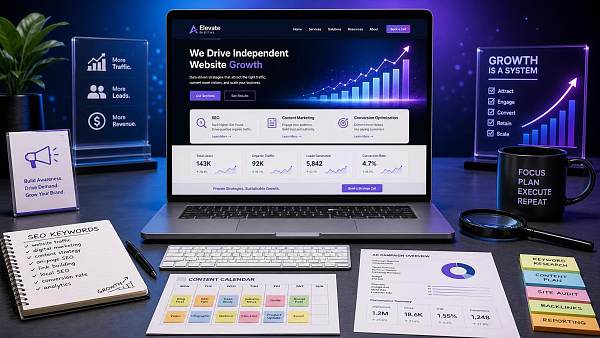
FAQ 3: What Should Content Marketing Cover to Actually Generate Traffic?
Let us start with a common misconception: many companies write content entirely from their own perspective, focusing on “who we are, what we offer, and how professional we are.” This type of content can have its place, but it usually does not generate much new search traffic. Content that continuously attracts visitors is more often built around the customer decision-making process.
For example, when B2B purchasing customers search, they may not begin with a brand keyword. They are more likely to search for questions such as “What applications is this type of product suitable for?”, “How should different materials be selected?”, “What should be considered when exporting to a certain market?”, or “How should MOQ and delivery time be evaluated?” If website content covers these questions, search traffic will be more solid and inquiry quality will generally be higher.
Content types do not need to be complicated, but they should have clear layers: product pages answer “What do you sell?”, industry pages answer “Who is it suitable for?”, educational articles answer “How should it be evaluated?”, and case or solution pages answer “Why choose you?” Even without existing customer cases, companies can write about application scenarios, selection logic, common mistakes, and pre-purchase checklists. Such content is easier for readers to save and more likely to be recognized by search systems as valuable information than empty promotional copy.
FAQ 4: Can Advertising Replace SEO?
No. However, at certain stages, advertising can indeed provide feedback more quickly than SEO. In particular, for new websites, newly launched products, and entry into new regional markets, Google Ads and social media advertising are better suited for testing audiences, pages, and pricing strategies.
The issue is that advertising is a channel based on immediate feedback. Its performance depends heavily on creatives, bids, audience groups, and landing-page relevance. It is suitable for amplification, but not as the sole foundation. Many companies obtain leads through advertising in the early stage, but their traffic stops once the budget is tightened later. This happens because they have not simultaneously accumulated organic search traffic, branded searches, and owned social media content.
A more practical way to evaluate advertising is to treat it as a data collection tool. Which keywords convert well? Which country has the greatest visit depth? Which page has the lowest bounce rate? These insights can in turn guide SEO topic selection, page redesign, and content expansion. An independent website that can operate successfully over the long term usually does not choose between advertising and SEO. Instead, it uses advertising to find direction and SEO to reduce long-term costs.
FAQ 5: Can Social Media Operations Be Put Off Until There Is Time?
If the goal is only to maintain a sense of presence, it can indeed be done gradually. But if you want an independent website to continue attracting new visitors, social media cannot consist only of product images. Especially in overseas markets, many users do not complete transactions directly on social media. Instead, they use social media to become familiar with a brand, verify its credibility, and return to it later.
More effective social media content is often not “company news,” but factory processes, product details, before-and-after comparisons, short video demonstrations, industry knowledge snippets, and topic content that links back to the independent website. B2B and B2C approaches are also different. B2B places greater emphasis on professionalism and ease of communication, while B2C relies more on visual presentation, user scenarios, and repurchase cycles. Channels should not be treated uniformly either. User habits differ significantly across markets such as North America, Europe, Southeast Asia, and the Middle East. This usually requires separate evaluation based on the target country and industry characteristics.
FAQ 6: Besides SEO, Advertising, and Social Media, What Other Traffic Sources Are Easily Overlooked?
There are several, and they are often why the growth of many websites becomes stuck.
One is multilingual content and localization. Translating a page is not the end of the process. Search terms, ways of expressing ideas, and product concerns differ across markets. Another is remarketing. Many visitors to independent websites do not convert on their first visit. Without email subscriptions, form tracking, and remarketing ads, traffic purchased in the early stage can be lost, which is a significant waste.
Another increasingly important direction in recent years is visibility in AI search and generative results. Some companies create a great deal of content, but because the content structure is disorganized, the information is incomplete, and the page semantics are unclear, it is difficult for them to be cited in new search scenarios. By incorporating AI+SEO and GEO into its overseas marketing process, 易营宝 follows a direction that is more aligned with current traffic changes: rather than focusing only on traditional rankings, it also considers content distribution opportunities beyond the search results page.
FAQ 7: How Can You Tell Whether Your Traffic Strategy Has Gone Off Track?
You can look at four signals.
If website traffic is growing but inquiries remain almost unchanged, the keywords are usually inaccurate or the landing page provides weak follow-through. If there are many ad clicks but visitors stay for only a short time, the promises in the creatives are often inconsistent with the page content. If many articles have been published but the rankings of core pages have not improved, the problem is probably not the quantity of content, but the topics and internal linking. If social media receives engagement but generates few website visits, the content and the independent website have not formed an effective traffic path.
To put it more directly, more traffic is not always better; traffic that is closer to a transaction-related need is more valuable. Especially for B2B websites, several hundred highly targeted visits can sometimes be more meaningful than tens of thousands of broad, untargeted visits.
FAQ 8: If the Team Is Small, What Should Be Prioritized?
The priorities can be kept simple: first organize the on-site foundation and conversion path, then create pages for high-intent keywords, use a small amount of advertising for validation, add more content, and then expand social media. Do not deploy too many channels at the beginning, and do not place the entire budget into a single advertising channel.
For many companies, the real challenge is not knowing that they need SEO, advertising, and social media, but not knowing how these actions should connect. The value of integrated website and marketing services lies precisely in reducing this fragmentation: the website development team understands indexing logic, the advertising team understands page conversion, the content team understands search questions, and the data team can identify whether a problem comes from the channel or the page. This gives traffic an opportunity to change from one-time acquisition into continuous accumulation.
Ultimately, the question of how to continue acquiring traffic after an overseas independent website goes live is not about creating a “good-looking website.” It is about building a growth system that can continuously answer market questions, address user needs, and keep improving. Going live is only the starting point. Every subsequent content update, advertising test, and page adjustment truly determines whether the website can continue operating successfully over the long term.
Related Articles

Related Products
 Yiyingbao SaaS Intelligent Website Building and Marketing SystemYiyingbao SaaS Intelligent Website Building and Marketing System, AI-powered no-code website building, rapid creation of multilingual B2B international websites in 10 minutes, global server acceleration, AI-powered SEO optimization, helping businesses connect efficiently with global markets. The perfect integration of technology and operation makes building an international trade website remarkably simple
 AI+SEM Intelligent Advertising Marketing SystemAI+SEM drives intelligent ad creation, empowering full-funnel precision advertising marketing. The system automatically generates weekly/monthly reports, AI recommends keywords and target countries, monitors core metrics in real-time with intelligent alerts, and enables one-click high-conversion ad solutions to help quickly acquire customers and improve ROI.
 AI+SEO Dual-Engine System Optimization ServicesYiyingbao’s AI+SEO dual-engine optimization system helps foreign trade enterprises acquire high-quality organic traffic through AI-powered keyword research, content generation, and comprehensive technical optimization, significantly improving search rankings and conversion rates.
 AI+SNS Social Media Marketing SystemYingbao AI+SNS Social Media Marketing System - Precision social capture for the social media era. Supports one-click content synchronization across major platforms like Facebook and LinkedIn. AI intelligently rewrites posts for enhanced relevance. 24/7 AI customer service and user profiling analysis empower businesses to efficiently expand into global markets.
 AI+SEO营销解决方案易营宝AI+SEO营销解决方案,通过AI批量写作、智能生成TDK、精准关键词扩词等功能,全面优化网站SEO效果,提升流量与转化率。助力企业构建高效智能网站新生态。
 AI+SEM Advertising Marketing SolutionsAI+SEM Advertising Marketing Solution leverages AI technology to deeply empower SEM ad campaigns. It automatically generates weekly/monthly reports using AI, presenting account data across multiple dimensions for comprehensive insights into campaign performance and trends. The system precisely recommends keywords and target countries, intelligently generates high-conversion ad copy, and enables one-click activation of efficient campaign plans to help businesses rapidly acquire customers. Simultaneously, it monitors core metrics in real time, intelligently identifies abnormal fluctuations, and issues timely alerts to ensure stable, high-return advertising results.
 Domain Name ServicesEasyWin provides professional domain name services, including intelligent queries, one-stop registration, brand protection, and full lifecycle management, helping businesses build a digital brand image.
 EasyOperate B2C Cross-Border E-Commerce Platform & Independent WebsiteEasyStore B2C Cross-border E-commerce Independent Store is an intelligent website building and cross-border e-commerce integrated solution independently developed by EasyStore Information Technology (Beijing) Co., Ltd. The system is specially designed for small and medium-sized as well as large export enterprises, integrating 'website building, operation, marketing, advertising, and conversion' into one, helping enterprises quickly establish cross-border e-commerce independent stores to achieve brand globalization and global sales growth.
The platform supports multiple languages, multiple currencies, and multi-channel marketing, with built-in AI intelligent translation and SEO optimization systems, suitable for mainstream markets such as Southeast Asia, Europe and America, Latin America, and the Middle East, assisting Chinese manufacturing enterprises in efficiently deploying international e-commerce strategies. SSL证书易营宝提供专业SSL安全证书服务,包括单域名和泛域名证书,确保网站数据传输加密、身份验证和完整性保护,助力企业建立安全可信的在线业务环境。









