









- Which customer acquisition channels will be affected by cross-border marketing trends in 2026?Sep 06, 2026View details
- Which homogenization risks should be considered in an analysis of the AI-powered website building industry?Aug 30, 2026View details
- How Will AI Marketing Trends 2026 Change Advertising Budget AllocationAug 28, 2026View details
- Is the EV SSL certificate market shrinking or upgrading? How should companies assess certificate procurement?Aug 11, 2026View details
- Why the old AMP SEO 2020 practices no longer work and what has changed in current optimization prioritiesAug 02, 2026View details
- How to Choose Topics for an Industry News Section to Attract More Organic Search TrafficJul 29, 2026View details
- Digital Marketing Shenzhen Market Insights: Why Are Companies Expanding Overseas Looking for Growth Teams in Shenzhen?Jul 31, 2026View details
- Can Zhejiang foreign trade independent websites still be developed today? Look at changes in traffic and lead generationJul 28, 2026View details
Where Do International Clients Come From? A Practical Guide for B2B Companies to Building Overseas Inquiry Channels
The sources of international customers are not mysterious: some are actively searching for suppliers, some are comparing existing options, and others may not yet have a clear purchasing action but repeatedly encounter a company through social content, industry discussions, or remarketing messages. The role of B2B overseas inquiry channels is to create entry points that can be found, understood, and contacted at these different stages, rather than simply equating traffic with customers.
Behind “clientes internacionales” there is often not a single country or a single purchasing habit. Some people directly search for product models, materials, and processing capabilities; some first verify whether a company can meet delivery schedules, quality inspection, or customization requirements; others already have drawings and are simply screening alternative suppliers that can communicate reliably. Therefore, overseas customer acquisition should first align channels with purchasing intent.
First distinguish: do inquiries come from search or outreach?
Search-driven customers arrive at a website with relatively clear questions. For example, they may search for the material, surface treatment, compatible equipment, or minimum order requirements for a certain part. The value of such visits lies in the fact that the need has already been expressed, but the page must provide information that matches the search terms. If a customer searching for custom metal parts first sees a generic company introduction, irrelevant products, or unrecognizable images, the visit can easily end.
Outreach-driven customers are more likely to come from advertising, social media content, exposure in industry media, or returning previous visitors. They may not submit an inquiry during their first interaction. Common actions include browsing capability pages, downloading specification materials, and reviewing the production process before leaving. If channel performance is judged only by whether a form has been submitted, campaigns or content that could have built trust may be stopped too early.
The two sources should share the same conversion website, but their landing pages should not be identical. Search landing pages need to quickly answer, “Can you make this?” Outreach landing pages need to supplement the answer to “Why is it worth learning more?” The former emphasizes product range, key parameters, and customization boundaries, while the latter can include factory capabilities, quality control, delivery processes, and frequently asked questions.
An independent website is the conversion layer for inquiry channels
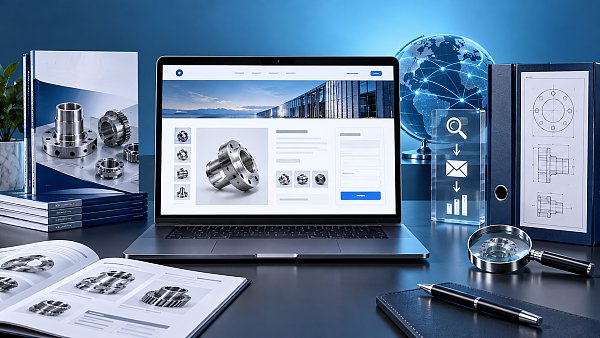
An independent website is not an online business card; it is a working interface that enables unfamiliar visitors to make decisions. A website used for overseas inquiries should at least allow customers to quickly identify what the product is, which scenarios it is suitable for, whether it can be customized according to drawings, and what information needs to be submitted next.
Product pages in particular cannot contain only names and a few images. For categories such as machinery, hardware, electronic components, and packaging materials, purchasing decisions usually depend on specific information: material grades or available materials, dimensional ranges, tolerances, surface treatments, applicable environments, sample arrangements, packaging methods, and factors affecting delivery lead times. When parameters are incomplete, customers can only send a broadly scoped inquiry email; when parameters are inaccurate, the result may be a large number of low-quality leads that cannot be quoted.
- Standard product pages should clearly present models, specification tables, operating conditions, and substitution relationships, making it easier for customers to compare options side by side.
- Non-standard custom product pages should explain the information required for quotation, such as drawings, quantity, materials, and process requirements, rather than fabricating fixed prices.
- Multilingual pages cannot rely on word-for-word translation alone. Units, industry terminology, application cases, and contact details must all align with the reading habits of the target market.
Website speed, mobile forms, and contact paths also affect conversion. Overseas visitors often view a page for the first time on mobile devices; too many form fields, invalid verification codes, unavailable attachment uploads, or no confirmation after submission can all cause genuine demand to be lost at the final step. Forms should collect the information necessary for quotation while retaining a free-text description field to avoid limiting complex requirements with rigid options.
Search channels should be structured around “questions that can lead to orders”
Organic search is suitable for building lasting visibility, but keyword selection should not focus only on broad, high-volume terms. Product terms may generate substantial traffic but may not correspond to needs that can be quoted; long-tail terms containing material, process, size, application, or customization intent may have lower traffic, but provide a clearer starting point for communication. For example, “industrial valves” and “corrosion-resistant valves for chemical media” reflect different search intent. The latter requires the page to clearly specify the media, pressure, sealing materials, and connection standards.
The role of content pages is not only to gain rankings. They should address details that customers repeatedly confirm before placing an order, such as differences between materials in humid environments, the effect of stamping and machining on tolerances, how ocean-shipping packaging prevents moisture, and which changes after sample confirmation will affect delivery lead times. There should be logical links between content pages and product pages, allowing visitors who have finished reading about a technical issue to continue to the corresponding product or inquiry page.
Paid search is suitable for validating markets and quickly covering high-intent terms, but ad keywords, landing pages, and form information must be connected in one coherent path. If an ad says “customized” but the landing page contains only an in-stock catalog, it will attract the wrong visitors; if an ad targets a particular application industry but the page lacks parameters or solution descriptions for that industry, the proportion of valid inquiries will also decline. At the beginning of a campaign, more attention should be paid to search term reports, time spent on pages, form completion, and inquiry content rather than click volume alone.
The value of social content lies in shortening the distance to trust
Social channels are better suited to presenting content that search result pages cannot fully convey, such as production equipment in operation, inspection steps, packaging details, engineers' explanations of drawing-related issues, and key stages in a product's journey from raw material to shipment. Content needs to be specific enough to be verified. Vaguely emphasizing “reliable quality” is less effective than showing inspection items, sampling locations, or the logic behind protective packaging.
Leads generated through social media are often at an earlier stage and cannot be measured using the same immediate conversion standards as search advertising. A more reasonable approach is to define the next step for the content: visit a relevant technical page, obtain specification materials, submit project requirements, or schedule a consultation. After visitors enter the website, follow-up content can be arranged based on the product categories they browsed, pages where they spent time, and whether they opened a form, rather than repeatedly sending the same promotional message to everyone.
Inquiry quality depends on whether the back end is traceable
The most easily overlooked part of channel development is the recording and response process after an inquiry is received. Leads from different countries should retain their source channel, first landing page, search term or ad group, product pages visited, submission time, and key requirements. Without this information, it is impossible to determine why a customer came after sales communication ends, or to discover that a certain channel is actually generating irrelevant needs.
It is also necessary to distinguish between “more forms” and “more opportunities.” An increase in inquiries may mean that the page has lowered the inquiry threshold, that the ad matching range is too broad, or that product information has become more complete and attracted customers who are genuinely ready to evaluate suppliers. Evaluation should review drawing completeness, specification clarity, whether the customer replied, whether the inquiry progressed to quotation, and subsequent communication, rather than merely accumulating submission counts.
Only by placing website development, multilingual content, search visibility, advertising tests, social outreach, and lead records within the same chain can you see the path customers take from their first visit to submitting requirements. When it comes to independent website conversion, channel coordination, and inquiry tracking, the website building, content management, and lead management capabilities covered by B2B Foreign Trade Solutions are suitable for organizing the connection points in this process.
More overseas inquiry channels are not necessarily better. First establish a closed loop for one product direction in one target market where it can be “found in search, understood, submitted, and followed up,” then replicate it to adjacent categories or regions. This is often more effective than launching many channels at once for identifying issues and building stable sources of international customers.
Related Articles



Related Products
 Yiyingbao SaaS Intelligent Website Building and Marketing SystemYiyingbao SaaS Intelligent Website Building and Marketing System, AI-powered no-code website building, rapid creation of multilingual B2B international websites in 10 minutes, global server acceleration, AI-powered SEO optimization, helping businesses connect efficiently with global markets. The perfect integration of technology and operation makes building an international trade website remarkably simple
 AI+SEM Intelligent Advertising Marketing SystemAI+SEM drives intelligent ad creation, empowering full-funnel precision advertising marketing. The system automatically generates weekly/monthly reports, AI recommends keywords and target countries, monitors core metrics in real-time with intelligent alerts, and enables one-click high-conversion ad solutions to help quickly acquire customers and improve ROI.
 AI+SEO Dual-Engine System Optimization ServicesYiyingbao’s AI+SEO dual-engine optimization system helps foreign trade enterprises acquire high-quality organic traffic through AI-powered keyword research, content generation, and comprehensive technical optimization, significantly improving search rankings and conversion rates.
 AI+SNS Social Media Marketing SystemYingbao AI+SNS Social Media Marketing System - Precision social capture for the social media era. Supports one-click content synchronization across major platforms like Facebook and LinkedIn. AI intelligently rewrites posts for enhanced relevance. 24/7 AI customer service and user profiling analysis empower businesses to efficiently expand into global markets.
 AI+SEO营销解决方案易营宝AI+SEO营销解决方案,通过AI批量写作、智能生成TDK、精准关键词扩词等功能,全面优化网站SEO效果,提升流量与转化率。助力企业构建高效智能网站新生态。
 AI+SEM Advertising Marketing SolutionsAI+SEM Advertising Marketing Solution leverages AI technology to deeply empower SEM ad campaigns. It automatically generates weekly/monthly reports using AI, presenting account data across multiple dimensions for comprehensive insights into campaign performance and trends. The system precisely recommends keywords and target countries, intelligently generates high-conversion ad copy, and enables one-click activation of efficient campaign plans to help businesses rapidly acquire customers. Simultaneously, it monitors core metrics in real time, intelligently identifies abnormal fluctuations, and issues timely alerts to ensure stable, high-return advertising results.
 Domain Name ServicesEasyWin provides professional domain name services, including intelligent queries, one-stop registration, brand protection, and full lifecycle management, helping businesses build a digital brand image.
 EasyOperate B2C Cross-Border E-Commerce Platform & Independent WebsiteEasyStore B2C Cross-border E-commerce Independent Store is an intelligent website building and cross-border e-commerce integrated solution independently developed by EasyStore Information Technology (Beijing) Co., Ltd. The system is specially designed for small and medium-sized as well as large export enterprises, integrating 'website building, operation, marketing, advertising, and conversion' into one, helping enterprises quickly establish cross-border e-commerce independent stores to achieve brand globalization and global sales growth.
The platform supports multiple languages, multiple currencies, and multi-channel marketing, with built-in AI intelligent translation and SEO optimization systems, suitable for mainstream markets such as Southeast Asia, Europe and America, Latin America, and the Middle East, assisting Chinese manufacturing enterprises in efficiently deploying international e-commerce strategies. SSL证书易营宝提供专业SSL安全证书服务,包括单域名和泛域名证书,确保网站数据传输加密、身份验证和完整性保护,助力企业建立安全可信的在线业务环境。









