









- Which customer acquisition channels will be affected by cross-border marketing trends in 2026?Sep 06, 2026View details
- Which homogenization risks should be considered in an analysis of the AI-powered website building industry?Aug 30, 2026View details
- How Will AI Marketing Trends 2026 Change Advertising Budget AllocationAug 28, 2026View details
- Is the EV SSL certificate market shrinking or upgrading? How should companies assess certificate procurement?Aug 11, 2026View details
- Why the old AMP SEO 2020 practices no longer work and what has changed in current optimization prioritiesAug 02, 2026View details
- How to Choose Topics for an Industry News Section to Attract More Organic Search TrafficJul 29, 2026View details
- Digital Marketing Shenzhen Market Insights: Why Are Companies Expanding Overseas Looking for Growth Teams in Shenzhen?Jul 31, 2026View details
- Can Zhejiang foreign trade independent websites still be developed today? Look at changes in traffic and lead generationJul 28, 2026View details
How to Determine Whether Inquiry Channels Are Effective for Lead Generation Through an Independent Foreign Trade Website
How to Determine Whether Inquiry Channels for Foreign Trade Lead Generation via an Independent Website Are Effective
The most common mistake in foreign trade lead generation through an independent website is to directly equate “the number of inquiries received” with “which channel is effective.” In actual operations, advertising may generate twenty inquiries, most of which could be irrelevant purchase requests, low-price comparisons, or inquiries from markets not covered; organic search may generate only three inquiries, yet all of them may come from customers in target industries, with clear purchasing roles and defined project timelines. For those responsible for budget evaluation, channel assessment cannot stop at traffic, form volume, or cost per lead. It needs to answer a more practical question: whether this investment consistently generates business opportunities worth further follow-up by the sales team.
Different customer acquisition channels naturally serve different roles. Google Ads is suitable for validating markets and capturing explicit demand; social media advertising is better at reaching potential customers who have not yet actively searched; SEO takes time to build up but may continuously generate high-intent visits; industry content, email, and social media operations are often used to build trust and enable repeated engagement. If the same “number of inquiries” standard is used to measure all channels, teams may prematurely discontinue sources with long-term value, while continuing to pay for traffic that appears active but is actually ineffective.
First Align on What Constitutes a Valid Inquiry
A valid inquiry does not need to equal an order from the outset, but it should at least contain assessable business information. In B2B foreign trade scenarios, it is recommended that sales, marketing, and management jointly define basic screening criteria: whether the customer’s country is within the served market, whether the company type and product application are a match, whether the contact has purchasing, technical, or decision-making influence, and whether demand quantity, specifications, certifications, delivery time, or project background can be further confirmed.
This definition should allow for tiers, rather than simply categorizing leads as “valid” or “invalid.” For example, form submissions can be classified as raw inquiries, initially qualified leads, sales-confirmed opportunities, and quotation opportunities. For businesses with longer sales cycles, such as non-standard equipment, industrial components, and customized materials, it is normal for inquiries not to convert in the same month. However, if the sales team still finds after repeated confirmation that the customer’s region, purchasing capability, and product requirements do not match, it should not be counted as a channel result.
When the Tracking Chain Is Broken, Channel Attribution Is Meaningless
The problem with many independent websites is not the lack of data, but that the data is not connected. Advertising platforms show conversions, and the website backend records forms, but sales follows up through email, instant messaging tools, or offline spreadsheets. As a result, it becomes impossible to know where customers came from or when they entered the quotation stage. Channel evaluation therefore degrades into “whose report looks better.”
A more reliable approach is to retain source information starting from the visit entry point, including organic search, paid search, social media content, social media advertising, external referrals, and direct visits; then associate landing pages, forms, phone clicks, instant communication buttons, and other actions with lead records. On the sales side, at minimum, add lead status, reasons for invalidity, estimated value range, and next actions. For multiple regions and multilingual websites, language versions and target markets should also be recorded to avoid evaluating inquiry quality from different markets together.
Attribution should also not place excessive faith in the “last click.” A customer may first see a brand on social media, then enter the website through a Google search and submit an inquiry several weeks later. The last click belongs to search, but that does not mean social media made no contribution. During actual reviews, first source, final conversion source, and key pages the customer interacted with can all be considered, in order to determine whether a channel is creating awareness, capturing demand, or merely receiving existing interest.
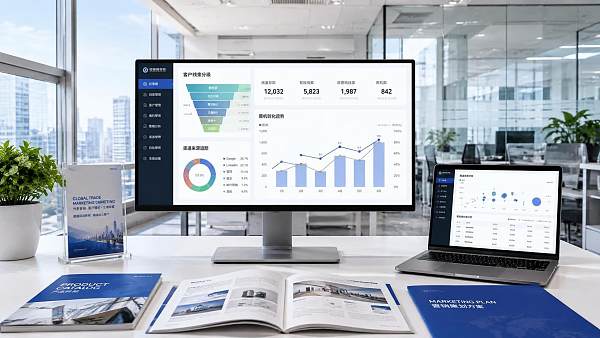
When Evaluating Channels, Do Not Look Only at Customer Acquisition Cost
Cost per inquiry can be considered, but it cannot serve as the sole basis for decision-making. If a low-cost channel continuously produces leads that cannot be contacted, have no purchasing demand, or are clearly mismatched, the sales handling cost is also high. Conversely, a high-cost channel may be more worthwhile to retain if it can lead to quotations, sampling, or technical reviews. A sequence of observation closer to the nature of the business is: whether traffic comes from target markets, whether visitors enter key pages such as product pages, case study pages, and technical document pages, whether they submit their information, and how many submissions pass the initial sales screening.
It is also important to note the interference caused by response speed. If inquiries from a channel are handled by different teams, or customers in certain time zones always submit information outside working hours, channel quality is likely to be lowered by follow-up efficiency. During reviews, reasons such as “no response,” “response too slow,” “incomplete information,” “product mismatch,” and “price mismatch” should be marked separately. Only by distinguishing channel issues, website issues, and sales process issues can optimization avoid going in the wrong direction.
Identify Where the Problem Lies Through Website Performance
When there are visits but few inquiries, it may not be necessary to immediately increase advertising spend. First check whether the landing page addresses the user’s original search intent: someone searching for a specific product model enters a generic brand homepage instead; a visitor from a certain country sees language, currency, and delivery information that do not correspond to their market; procurement personnel want to verify specifications, materials, applications, and certifications, but can only see promotional descriptions. In such cases, even highly accurate traffic will be lost on the website.
A foreign trade marketing website should enable customers to make decisions conveniently, rather than merely pursue visual effects. Product parameters, application limits, factory and quality information, delivery methods, downloadable materials, and inquiry entry points should all be organized around the customer’s decision-making path. Form fields also require a balance: too few fields make it difficult for sales to screen leads; too many fields raise the submission barrier. Usually, essential fields such as contact information, required product, quantity, or project description can be retained first, with sales supplementing details during subsequent communication.
The Value of Integrated Services Lies in Bringing Data Back to Decision-Making
When website development, SEO, advertising, and social media are executed by separate teams, a common problem is inconsistent objectives: the website development party focuses on going live, the advertising party focuses on clicks, the content party focuses on exposure, and sales only cares whether leads can be followed up. Integrated website and marketing services do not mean that a single channel must be used; rather, they mean that page development, content strategy, keyword packages for advertising, conversion tracking, and sales feedback should use the same set of business standards.
Since its establishment in 2013, Yingbao Information Technology (Beijing) Co., Ltd. has developed end-to-end service capabilities around intelligent website building, SEO optimization, social media marketing, and advertising. Its cloud-based intelligent website building, AI advertising marketing, and AI+SEO/GEO optimization systems for foreign trade enterprises are suitable for viewing multilingual websites, promotional pages, and lead data from different sources through a unified operational perspective. For enterprises expanding simultaneously in markets such as North America, Europe, Southeast Asia, and the Middle East, configurations should be differentiated for website languages, content topics, advertising regions, and lead screening criteria, rather than copying one page and one set of metrics across all regions.
To determine whether an independent website’s foreign trade customer acquisition channels are effective, it is recommended to first observe continuously for a period that matches the company’s own sales cycle, and then adjust the budget. Retain channels that consistently generate qualified leads and can enter the next sales stage; for sources with high traffic but poor quality, first examine targeting, search terms, messaging promises, and landing pages; for sources with few but high-quality leads, assess whether it is worthwhile to increase content and coverage. The truly useful conclusion is not “which channel is best,” but whether the company can clearly understand what role each type of channel plays in the customer acquisition process and where the next budget should be invested.
Related Articles
![]() The time is right for the chemical industry to go global! What are your products waiting for?
The time is right for the chemical industry to go global! What are your products waiting for?![]() For chemical companies looking to enter the Russian and Central Asian markets, taking this step is the right move—doubling orders is not difficult.
For chemical companies looking to enter the Russian and Central Asian markets, taking this step is the right move—doubling orders is not difficult.![]() Precision Customer Acquisition for Chemical Foreign Trade Starts with a Google Independent Website
Precision Customer Acquisition for Chemical Foreign Trade Starts with a Google Independent Website

Related Products
 Yiyingbao SaaS Intelligent Website Building and Marketing SystemYiyingbao SaaS Intelligent Website Building and Marketing System, AI-powered no-code website building, rapid creation of multilingual B2B international websites in 10 minutes, global server acceleration, AI-powered SEO optimization, helping businesses connect efficiently with global markets. The perfect integration of technology and operation makes building an international trade website remarkably simple
 AI+SEM Intelligent Advertising Marketing SystemAI+SEM drives intelligent ad creation, empowering full-funnel precision advertising marketing. The system automatically generates weekly/monthly reports, AI recommends keywords and target countries, monitors core metrics in real-time with intelligent alerts, and enables one-click high-conversion ad solutions to help quickly acquire customers and improve ROI.
 AI+SEO Dual-Engine System Optimization ServicesYiyingbao’s AI+SEO dual-engine optimization system helps foreign trade enterprises acquire high-quality organic traffic through AI-powered keyword research, content generation, and comprehensive technical optimization, significantly improving search rankings and conversion rates.
 AI+SNS Social Media Marketing SystemYingbao AI+SNS Social Media Marketing System - Precision social capture for the social media era. Supports one-click content synchronization across major platforms like Facebook and LinkedIn. AI intelligently rewrites posts for enhanced relevance. 24/7 AI customer service and user profiling analysis empower businesses to efficiently expand into global markets.
 AI+SEO营销解决方案易营宝AI+SEO营销解决方案,通过AI批量写作、智能生成TDK、精准关键词扩词等功能,全面优化网站SEO效果,提升流量与转化率。助力企业构建高效智能网站新生态。
 AI+SEM Advertising Marketing SolutionsAI+SEM Advertising Marketing Solution leverages AI technology to deeply empower SEM ad campaigns. It automatically generates weekly/monthly reports using AI, presenting account data across multiple dimensions for comprehensive insights into campaign performance and trends. The system precisely recommends keywords and target countries, intelligently generates high-conversion ad copy, and enables one-click activation of efficient campaign plans to help businesses rapidly acquire customers. Simultaneously, it monitors core metrics in real time, intelligently identifies abnormal fluctuations, and issues timely alerts to ensure stable, high-return advertising results.
 Domain Name ServicesEasyWin provides professional domain name services, including intelligent queries, one-stop registration, brand protection, and full lifecycle management, helping businesses build a digital brand image.
 EasyOperate B2C Cross-Border E-Commerce Platform & Independent WebsiteEasyStore B2C Cross-border E-commerce Independent Store is an intelligent website building and cross-border e-commerce integrated solution independently developed by EasyStore Information Technology (Beijing) Co., Ltd. The system is specially designed for small and medium-sized as well as large export enterprises, integrating 'website building, operation, marketing, advertising, and conversion' into one, helping enterprises quickly establish cross-border e-commerce independent stores to achieve brand globalization and global sales growth.
The platform supports multiple languages, multiple currencies, and multi-channel marketing, with built-in AI intelligent translation and SEO optimization systems, suitable for mainstream markets such as Southeast Asia, Europe and America, Latin America, and the Middle East, assisting Chinese manufacturing enterprises in efficiently deploying international e-commerce strategies. SSL证书易营宝提供专业SSL安全证书服务,包括单域名和泛域名证书,确保网站数据传输加密、身份验证和完整性保护,助力企业建立安全可信的在线业务环境。









