









- 21st Century Business Herald: AI and CTV Become Core Growth Engines for Digital Marketing in Overseas MarketsNov 18, 2026View details
- China Presents 25 Cooperation Outcomes in Areas Including Cross-Border E-Commerce During APECNov 18, 2026View details
- AI Products Drive Hong Kong Exports Up 64.9% in September, Fastest Growth in Over 40 YearsNov 17, 2026View details
- National Bureau of Statistics: Foreign trade grew rapidly in October, providing stable support for global tradeNov 17, 2026View details
- The U.S. has ended the $800 de minimis exemption for non-postal shipments; express courier packages must be formally declared.Nov 16, 2026View details
- ASEAN Signs Digital Economy Framework Agreement, Moving Toward Harmonized Cross-Border E-Commerce RulesNov 15, 2026View details
What are the common customer acquisition channels for businesses expanding overseas?
For businesses expanding overseas, more customer acquisition channels are not necessarily better. The right choice depends on how products are sold, purchasing habits in the target market, the sales cycle, and existing capacity to handle leads. For businesses that require inquiries, sample confirmation, and technical communication, websites and search traffic often serve to build trust and accumulate leads. For impulse purchases or standardized products, advertising, social content, and cross-border online stores offer shorter conversion paths. Choosing channels without considering landing pages, quotation response, and lead qualification can easily result in “traffic without qualified customers.”
Independent Website: The Infrastructure That Supports All Channels
An independent website is not a standalone customer acquisition channel, but it determines whether traffic from other channels can be effectively received. Search, advertising, social media content, and email outreach all ultimately require a clear page to explain products, applications, delivery capabilities, and next steps. For B2B businesses, product pages should not only list specifications; they should also present applicable scenarios, material or process differences, minimum order requirements, customization scope, packaging and shipping methods, and inquiry entry points. Buyers are often unable to assess supply capabilities upon first contact, and without such information, inquiries may remain at the price-comparison stage.
Multilingual pages should not be translated sentence by sentence directly. Different markets have different reading habits regarding measurement units, product names, lead-time expressions, and contact methods. For example, technical products need information such as model numbers, dimensions, surface treatments, and operating conditions to be organized according to commonly used local search methods; consumer product pages should place greater emphasis on usage results, style variations, delivery coverage, and return and exchange policies. If a language version has only a homepage without corresponding product pages, it creates a content gap for visitors arriving through ads and organic search.
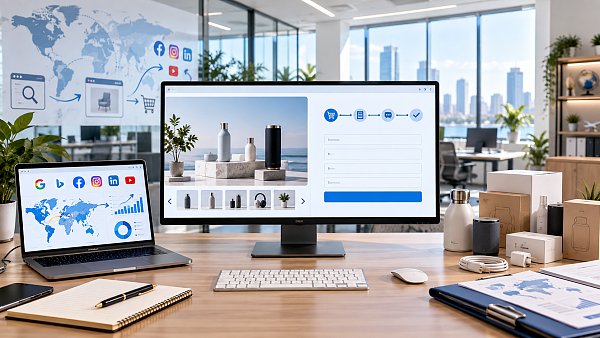
Organic Search Traffic: Suitable for Building Sustained Demand
Search engine optimization is suitable for products and services with clear search demand. When users search for terms such as “product name,” “application scenario,” “material comparison,” “supplier,” or “custom processing,” they are already in the information-gathering or procurement-screening stage. Compared with pursuing high search volume alone, it is more worthwhile to prioritize pages that reflect demand intensity: specific model pages, industry application pages, problem-solving pages, process description pages, and regional language pages.
The effectiveness of organic traffic depends on website structure, content completeness, page crawlability, and topical relevance. A common misjudgment is to continuously publish broad industry articles without improving core product pages, resulting in growing traffic but weak inquiry intent. Another issue is that multiple pages have highly repetitive descriptions, with only countries or keywords replaced, making it difficult for search engines to identify the independent value of each page. Content should focus on real differences, such as how selection criteria for the same product differ under high-temperature, humid, outdoor, food-contact, or high-frequency-use conditions, rather than repeatedly stuffing product names.
Paid Search Advertising: For Validating Demand and Securing High-Intent Entry Points
The advantage of paid search advertising is its fast launch and direct reach to people actively looking for products or services. It is particularly suitable for new product testing, peak-season promotion, entering new markets, or covering terms not yet reached by organic rankings. Its limitations are also obvious: clicks do not equal business opportunities, and budgets are often spent on broad terms, irrelevant regions, and visitors without purchasing capability.
Advertising accounts should be segmented by product category, country or region, language, and conversion action, rather than placing all terms in one ad group. For technically complex businesses with high order values, actions such as “get a quote,” “submit drawings,” and “request samples” can be tracked separately; standardized retail products should focus more on add-to-cart, checkout initiation, and completed payment. Looking only at click-through rates can easily lead to incorrect judgments about creative performance. A high click-through rate but low form-completion rate often indicates that the content promised in the ad copy does not match the landing-page information, or that visitors do not see the price range, lead time, specifications, and delivery information they care about after entering the page.
Social Media: Influencing Discovery, Trust, and Re-engagement
Social media is better suited to showcasing product usage processes, production details, installation demonstrations, packaging and shipment, industry knowledge, and brand stories. Its role for complex products does not always result in immediate inquiries; rather, it enables potential customers to form a basic understanding after repeated exposure. If short videos only show finished products, they may gain views but fail to explain what problems the product solves. Adding size references, installation steps, testing conditions, or before-and-after differences makes content more likely to filter for genuinely relevant visitors.
The roles of social media advertising and organic content should also be differentiated. Organic content is suitable for continually building creative assets and engagement signals, while advertising can expand the reach of validated content and re-engage people who have visited the website, viewed product pages, or submitted forms but have not continued communication. Excessive remarketing frequency can cause annoyance, while too low a frequency makes it difficult to form a lasting impression. It should be adjusted according to the sales cycle, product decision-making duration, and creative update pace.
Differences Between Channels Go Beyond Traffic Costs
Inquiry Channels and Email Outreach: Suitable for Long-Cycle, Highly Selective Businesses
For businesses with a high degree of customization and a need for repeated specification confirmation, industry directories, professional communities, trade show leads, and targeted emails remain valuable. The core of these methods is not sending volume, but list quality and whether the initial information is relevant. Email content should address specific issues the recipient may encounter in their industry and provide verifiable product information, such as available materials, processing scope, compatible equipment, or delivery documents. General introductions to company capabilities usually make it difficult to receive replies.
Email outreach should ideally correspond to website pages. When an email mentions an application or product line, the link should lead directly to the relevant page rather than the homepage. The speed of handling replies also affects the assessment of channel quality: if leads receive no follow-up for a long time during quotation, technical confirmation, or sample arrangement, even the best list may be mistakenly regarded as invalid traffic.
Connect the Conversion Chain Before Expanding Reach
To determine whether a channel is worth ongoing investment, it is necessary to distinguish at least four levels: visits, qualified leads, actionable opportunities, and actual transactions. A large number of form submissions may result from too few fields allowing spam leads to enter; declining visits combined with increasing qualified inquiries may also be a normal result of filtering out irrelevant traffic. Inquiry quality across different countries should not be compared by quantity alone, but also by language match, product fit, completeness of contact information, and subsequent responses.
A more prudent approach is to first identify one primary channel, then use an independent website for lead capture and tracking. When search demand is clear, first improve product pages and organic search pages; when rapid market validation is needed, use small-scale paid search to test keywords and landing pages; when products depend on visual presentation or usage scenarios, let social media content handle front-end outreach. As channels gradually increase, unified lead-source labels, form rules, and follow-up records should still be maintained; otherwise, it will be impossible to determine whether the budget has generated visits or customers who can be converted.
Related Articles
 Dongguan Opens a New Transit Logistics Route for Cross-Border E-Commerce Exports to Russia
 How Can You Identify Effective Traffic Sources When Reviewing Growth in Inquiries from Your Independent Website?
 How to Choose a Target Market for Your Cross-Border Ecommerce Store


Related Products
 Yiyingbao SaaS Intelligent Website Building and Marketing SystemYiyingbao SaaS Intelligent Website Building and Marketing System, AI-powered no-code website building, rapid creation of multilingual B2B international websites in 10 minutes, global server acceleration, AI-powered SEO optimization, helping businesses connect efficiently with global markets. The perfect integration of technology and operation makes building an international trade website remarkably simple
 AI+SEM Intelligent Advertising Marketing SystemAI+SEM drives intelligent ad creation, empowering full-funnel precision advertising marketing. The system automatically generates weekly/monthly reports, AI recommends keywords and target countries, monitors core metrics in real-time with intelligent alerts, and enables one-click high-conversion ad solutions to help quickly acquire customers and improve ROI.
 AI+SEO Dual-Engine System Optimization ServicesYiyingbao’s AI+SEO dual-engine optimization system helps foreign trade enterprises acquire high-quality organic traffic through AI-powered keyword research, content generation, and comprehensive technical optimization, significantly improving search rankings and conversion rates.
 AI+SNS Social Media Marketing SystemYingbao AI+SNS Social Media Marketing System - Precision social capture for the social media era. Supports one-click content synchronization across major platforms like Facebook and LinkedIn. AI intelligently rewrites posts for enhanced relevance. 24/7 AI customer service and user profiling analysis empower businesses to efficiently expand into global markets.
 AI+SEO营销解决方案易营宝AI+SEO营销解决方案,通过AI批量写作、智能生成TDK、精准关键词扩词等功能,全面优化网站SEO效果,提升流量与转化率。助力企业构建高效智能网站新生态。
 AI+SEM Advertising Marketing SolutionsAI+SEM Advertising Marketing Solution leverages AI technology to deeply empower SEM ad campaigns. It automatically generates weekly/monthly reports using AI, presenting account data across multiple dimensions for comprehensive insights into campaign performance and trends. The system precisely recommends keywords and target countries, intelligently generates high-conversion ad copy, and enables one-click activation of efficient campaign plans to help businesses rapidly acquire customers. Simultaneously, it monitors core metrics in real time, intelligently identifies abnormal fluctuations, and issues timely alerts to ensure stable, high-return advertising results.
 Domain Name ServicesEasyWin provides professional domain name services, including intelligent queries, one-stop registration, brand protection, and full lifecycle management, helping businesses build a digital brand image.
 EasyOperate B2C Cross-Border E-Commerce Platform & Independent WebsiteEasyStore B2C Cross-border E-commerce Independent Store is an intelligent website building and cross-border e-commerce integrated solution independently developed by EasyStore Information Technology (Beijing) Co., Ltd. The system is specially designed for small and medium-sized as well as large export enterprises, integrating 'website building, operation, marketing, advertising, and conversion' into one, helping enterprises quickly establish cross-border e-commerce independent stores to achieve brand globalization and global sales growth.
The platform supports multiple languages, multiple currencies, and multi-channel marketing, with built-in AI intelligent translation and SEO optimization systems, suitable for mainstream markets such as Southeast Asia, Europe and America, Latin America, and the Middle East, assisting Chinese manufacturing enterprises in efficiently deploying international e-commerce strategies. SSL证书易营宝提供专业SSL安全证书服务,包括单域名和泛域名证书,确保网站数据传输加密、身份验证和完整性保护,助力企业建立安全可信的在线业务环境。









