









- Which customer acquisition channels will be affected by cross-border marketing trends in 2026?Sep 06, 2026View details
- Which homogenization risks should be considered in an analysis of the AI-powered website building industry?Aug 30, 2026View details
- How Will AI Marketing Trends 2026 Change Advertising Budget AllocationAug 28, 2026View details
- Is the EV SSL certificate market shrinking or upgrading? How should companies assess certificate procurement?Aug 11, 2026View details
- Why the old AMP SEO 2020 practices no longer work and what has changed in current optimization prioritiesAug 02, 2026View details
- How to Choose Topics for an Industry News Section to Attract More Organic Search TrafficJul 29, 2026View details
- Digital Marketing Shenzhen Market Insights: Why Are Companies Expanding Overseas Looking for Growth Teams in Shenzhen?Jul 31, 2026View details
- Can Zhejiang foreign trade independent websites still be developed today? Look at changes in traffic and lead generationJul 28, 2026View details
How to Market Chinese SaaS? Key Steps from Localized Lead Generation to Overseas Conversion
How to Do Chinese SaaS Marketing: Key Steps from Localized Customer Acquisition to Overseas Conversion
When it comes to building Chinese SaaS marketing, the most common pitfall is not insufficient traffic, but a broken conversion chain. Many companies build an English-language website first and then launch several advertising campaigns. Although the traffic volume may look considerable, few inquiries are generated, or the inquiries fail to progress. The problem usually does not lie in one particular action, but in the fact that the website, content, channels, and sales follow-up are not connected according to the decision-making path of overseas users. For businesses integrating website development and marketing services, what truly determines results is whether they can turn “being seen” into “being understood,” and then turn “being understood” into “a willingness to communicate.”
This issue manifests differently in foreign trade companies, manufacturing factories, cross-border sellers, and global brand expansion projects. In B2B manufacturing, for example, customers typically do not leave a lead simply because the homepage looks attractive. They care more about delivery capabilities, application experience, response speed, and whether they can understand what type of problem you solve. A B2C brand website follows a different logic: users spend less time on the site, so the page must build trust more quickly, while payment, logistics, and return policies will emerge as conversion barriers earlier. Therefore, Chinese SaaS marketing is not simply a matter of translating a Chinese marketing approach into another language. It first requires an assessment of the target market and business model, followed by decisions about site structure, content strategy, and advertising cadence.
Before Rushing to Drive Traffic, Make Sure Your Website Can Support Overseas Users’ Decision-Making Logic
Many projects begin by asking whether their budget should be invested in Google or social media. This order is often reversed. In overseas customer acquisition, the official website is not a brochure; it is the first round of screening before a deal. This is especially true for multilingual websites. If Chinese pages are merely translated directly, the common results are mismatched keywords, a confusing information hierarchy, and low form conversion rates. Users see “what you want to say,” rather than “what they are looking for.”
A more reliable approach is to divide the site according to the tasks of target customers. For B2B inquiry generation, the homepage does not need to be overloaded with brand stories. Instead, it should quickly explain product applications, delivery scope, service regions, and contact options. For a cross-border e-commerce store, the core pages are usually not the About Us page, but category pages, product detail pages, reviews, payment information, and logistics information. A landing page for overseas advertising should not directly copy the website navigation either, because a landing page is responsible for one-time persuasion and therefore needs to present more focused information.
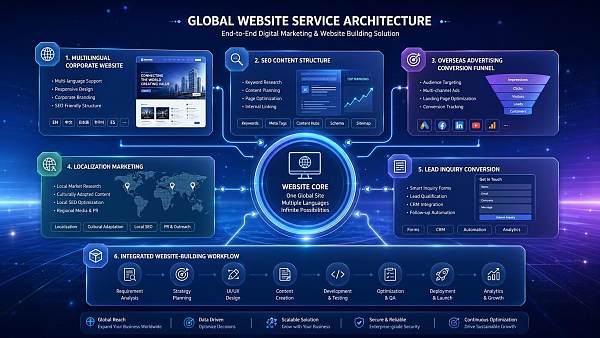
For an AI-driven intelligent website-building and overseas marketing platform such as 易营宝, the value lies not only in building websites faster, but also in considering “indexability, promotability, and convertibility” within one system. For companies that need to cover regions such as North America, Europe, and Southeast Asia at the same time, multilingual structure, page loading, form configuration, and search-crawler friendliness will all directly affect subsequent SEO, ad quality scores, and user engagement. No matter how attractive a website looks, if its technical foundation is not conducive to indexing, subsequent content and advertising efforts will become costly remedial work.
Localization Is Not Translation; It Means Addressing Trust Barriers in Different Markets
Many teams understand localization as language localization, but that is far from sufficient. When overseas users evaluate a Chinese SaaS service provider, they often look at three things first: whether you understand local business communication, whether you can deliver reliably, and whether communicating with you will involve excessive costs. Localization includes, at a minimum, content messaging, on-page evidence, contact information, response methods across time zones, and even button copy and form-field length.
For example, the North American market is more accustomed to direct and clear expressions of value. Pages should avoid unnecessary detours and empty slogans, while providing more information about service boundaries and execution methods. Some European markets are more sensitive to compliance and data processing, so website privacy notices, Cookie prompts, and form authorization logic cannot be handled casually. Users in Japan and South Korea often place greater emphasis on page organization, completeness of detail, and whether the company background is presented rigorously enough. These differences cannot be resolved automatically by translation software; they must be addressed together through website development, copywriting, and marketing activities.
When preparing overseas content, some companies also refer to research frameworks related to management and organizational development, such as research on business administration in the context of digital transformation, to help align internal understanding of organizational change, marketing digitalization, and business collaboration. Such materials cannot directly replace market activities, but when overseas projects are promoted across departments, they can help reduce the disconnect between “marketing wants leads,” “sales only wants highly qualified leads,” and “technology only cares about going live.”
Build Content Around Inquiry Questions, Not Around the Company Introduction
The most common misjudgment in SEO is to treat content as publishing news and writing company updates. For Chinese SaaS marketing, the content that can consistently generate search traffic usually comes from questions customers repeatedly ask before making a purchase. Examples include: “Which language versions do you support?”, “How do you get a standalone website indexed by Google?”, “How should advertising and organic search work together?”, and “How are B2B corporate websites structurally different from B2C online stores?” These questions correspond to clear search intent and are also the easiest way to build trust before conversion.
Content strategy should not focus only on keyword popularity; it should also consider whether the company has the ability to answer. Content without the support of project experience can easily become empty, no matter how long it is. By contrast, clearly explaining website development cycles, common indexing obstacles, multilingual maintenance costs, and the boundaries between advertising and SEO based on actual delivery processes—even without exaggerated data—makes it easier for potential customers to recognize the company as someone who understands practical problems. This is why many companies later bring technical teams, customer service teams, and even sales teams into content co-creation: they know better where customers hesitate.
If the business covers intelligent website development, SEO, social media operations, advertising, and improved visibility in AI search, these areas cannot be written independently. When users enter from search, they do not see your departmental division of labor; they see an entire solution path. If front-end content only discusses traffic acquisition without explaining website conversion, only discusses SEO without explaining form conversion, or only discusses social media without explaining landing-page consistency, the traffic will ultimately be sent to a situation where the problem cannot be clearly explained.
The Real Challenge in Advertising Is Not Opening Accounts, but Knowing Which Channel to Use at Each Stage
Many companies treat advertising as a shortcut to “get leads immediately,” but find during execution that costs are difficult to stabilize. The reason is that channels play different roles at different stages. In the early stage after a new website goes live, SEO foundations are weak, and advertising can indeed validate market feedback more quickly. However, the landing page must be clear and the conversion action explicit; otherwise, the company is simply paying for bounces. Once the site has sustainable indexing capabilities, SEO is not only a customer acquisition channel but also a tool for filtering long-term demand. Social media operations function more like an intermediate layer, gradually bringing people unfamiliar with the brand to a state of familiarity in which they can convert.
For B2B projects, advertising keyword selection requires particular restraint. Many high-traffic terms appear attractive but have weak purchasing intent. Some longer and more specific application terms may have lower volume but be closer to real customers. In manufacturing and factory-based businesses, it is common for the number of leads not to be particularly high, but when incoming users have sufficiently specific questions, the efficiency of downstream conversion is often higher. It is important to look beyond cost per click and also consider lead quality, sales follow-up cycles, and the likelihood that inquiries can be converted into deals.
If a project runs Google Ads, Facebook Ads, and SEO at the same time, it is advisable to unify the definition of conversion from the beginning. It must first be clarified whether phone calls, forms, WhatsApp, emails, or material downloads count as valid conversions. Otherwise, every channel may look successful in the monthly report, while sales does not know which leads to follow up on. This type of problem is especially common in multi-market operations because contact preferences vary greatly by region, and the same page path may not suit every country.
Do Not Overlook Offline Factors in “Overseas Conversion”
Many people understand conversion as clicking a button on a page. For global expansion businesses, however, the factors that truly affect deal closure are half online and half offline. Response time, quotation templates, demonstration processes, sales communication in English, and contract progression methods can all affect front-end marketing results in return. This is particularly true for SaaS or service-based projects. Users are not buying a static product; they are assessing whether you can work with them over the long term. No matter how complete the website is, if nobody responds for two or three days after a form is submitted, the previous content-building efforts will largely be wasted.
This is also why some companies place website development, SEO, advertising, and sales follow-up within the same operating framework when conducting overseas digital marketing. 易营宝 has long focused on intelligent website development, multilingual websites, foreign trade marketing websites, cross-border e-commerce stores, and AI+SEO/GEO optimization. In essence, it solves this very problem: rather than maximizing a single channel, it enables search, advertising, social media, and the website to work together along the same conversion chain. For companies with rapid annual growth and dispersed target markets, this integrated approach is easier to control than outsourcing individual functions and also makes it easier to review where problems occur.
Another frequently overlooked factor is the change in visibility brought about by AI search. Many overseas users no longer rely entirely on traditional search results and may conduct an initial screening directly in generative search environments. If a company only builds traditional pages without structured content, clear service descriptions, and consistent updates, it may later encounter a situation in which “the website exists but is not easily mentioned” in AI search scenarios. GEO, or generative engine optimization, may not produce clicks immediately like advertising in the short term, but it can no longer be completely ignored for long-term brand visibility.
To Determine Whether a Solution Is Suitable, Start by Looking at These Practical Conditions
If a company is evaluating whether its overseas marketing system needs to be rebuilt, it can first consider several practical questions. Does the website support ongoing expansion, or does every language version require redevelopment? Does the existing content answer the questions customers genuinely search for? Is the information on the advertising landing page consistent with that on the official website? Once inquiries arrive, does the internal team have a clear distribution and follow-up mechanism? Are different markets using the same communication methods even though those methods may not be suitable for all of them? If two or three of these areas remain problematic over the long term, increasing the front-end budget will still make it difficult to achieve stable growth at the back end.
Some teams ask whether they should build a brand website or an inquiry-generation website first, or whether they should start with SEO or advertising. There is no universal answer. The key factors are the stage of the business and available resources. If the product is complex, the average order value is high, and the sales cycle is long, the website and content foundation should usually be strengthened first. If the company is preparing to test a new market, advertising can come first, but its scope should preferably be controlled and used to validate keywords and page messaging. If there has already been some accumulation of traffic, investment in SEO, content, and AI search visibility will be more worthwhile. The sequence depends on the weakest link at present, not on which method sounds newer.
Ultimately, the difficulty of Chinese SaaS marketing lies not in the tools, but in making judgments. Different countries, business models, and levels of team maturity have different requirements for website structure, content localization, advertising channels, and sales follow-up. Aligning the target market, the role of the website, the customer acquisition method, and the conversion action one by one before scaling is generally more stable than deploying everything on a large scale from the start. When necessary, companies can also draw on research perspectives such as research on business administration in the context of digital transformation to clarify internal collaboration logic before advancing external growth initiatives, thereby reducing the cost of repeated communication during subsequent execution.
Related Articles



Related Products
 Yiyingbao SaaS Intelligent Website Building and Marketing SystemYiyingbao SaaS Intelligent Website Building and Marketing System, AI-powered no-code website building, rapid creation of multilingual B2B international websites in 10 minutes, global server acceleration, AI-powered SEO optimization, helping businesses connect efficiently with global markets. The perfect integration of technology and operation makes building an international trade website remarkably simple
 AI+SEM Intelligent Advertising Marketing SystemAI+SEM drives intelligent ad creation, empowering full-funnel precision advertising marketing. The system automatically generates weekly/monthly reports, AI recommends keywords and target countries, monitors core metrics in real-time with intelligent alerts, and enables one-click high-conversion ad solutions to help quickly acquire customers and improve ROI.
 AI+SEO Dual-Engine System Optimization ServicesYiyingbao’s AI+SEO dual-engine optimization system helps foreign trade enterprises acquire high-quality organic traffic through AI-powered keyword research, content generation, and comprehensive technical optimization, significantly improving search rankings and conversion rates.
 AI+SNS Social Media Marketing SystemYingbao AI+SNS Social Media Marketing System - Precision social capture for the social media era. Supports one-click content synchronization across major platforms like Facebook and LinkedIn. AI intelligently rewrites posts for enhanced relevance. 24/7 AI customer service and user profiling analysis empower businesses to efficiently expand into global markets.
 AI+SEO营销解决方案易营宝AI+SEO营销解决方案,通过AI批量写作、智能生成TDK、精准关键词扩词等功能,全面优化网站SEO效果,提升流量与转化率。助力企业构建高效智能网站新生态。
 AI+SEM Advertising Marketing SolutionsAI+SEM Advertising Marketing Solution leverages AI technology to deeply empower SEM ad campaigns. It automatically generates weekly/monthly reports using AI, presenting account data across multiple dimensions for comprehensive insights into campaign performance and trends. The system precisely recommends keywords and target countries, intelligently generates high-conversion ad copy, and enables one-click activation of efficient campaign plans to help businesses rapidly acquire customers. Simultaneously, it monitors core metrics in real time, intelligently identifies abnormal fluctuations, and issues timely alerts to ensure stable, high-return advertising results.
 Domain Name ServicesEasyWin provides professional domain name services, including intelligent queries, one-stop registration, brand protection, and full lifecycle management, helping businesses build a digital brand image.
 EasyOperate B2C Cross-Border E-Commerce Platform & Independent WebsiteEasyStore B2C Cross-border E-commerce Independent Store is an intelligent website building and cross-border e-commerce integrated solution independently developed by EasyStore Information Technology (Beijing) Co., Ltd. The system is specially designed for small and medium-sized as well as large export enterprises, integrating 'website building, operation, marketing, advertising, and conversion' into one, helping enterprises quickly establish cross-border e-commerce independent stores to achieve brand globalization and global sales growth.
The platform supports multiple languages, multiple currencies, and multi-channel marketing, with built-in AI intelligent translation and SEO optimization systems, suitable for mainstream markets such as Southeast Asia, Europe and America, Latin America, and the Middle East, assisting Chinese manufacturing enterprises in efficiently deploying international e-commerce strategies. SSL证书易营宝提供专业SSL安全证书服务,包括单域名和泛域名证书,确保网站数据传输加密、身份验证和完整性保护,助力企业建立安全可信的在线业务环境。









