









- Which customer acquisition channels will be affected by cross-border marketing trends in 2026?Sep 06, 2026View details
- Which homogenization risks should be considered in an analysis of the AI-powered website building industry?Aug 30, 2026View details
- How Will AI Marketing Trends 2026 Change Advertising Budget AllocationAug 28, 2026View details
- Is the EV SSL certificate market shrinking or upgrading? How should companies assess certificate procurement?Aug 11, 2026View details
- Why the old AMP SEO 2020 practices no longer work and what has changed in current optimization prioritiesAug 02, 2026View details
- How to Choose Topics for an Industry News Section to Attract More Organic Search TrafficJul 29, 2026View details
- Digital Marketing Shenzhen Market Insights: Why Are Companies Expanding Overseas Looking for Growth Teams in Shenzhen?Jul 31, 2026View details
- Can Zhejiang foreign trade independent websites still be developed today? Look at changes in traffic and lead generationJul 28, 2026View details
How to Build a B2C Independent Website for Brand Expansion Overseas? A Website-Building and Advertising Strategy for Emerging Brands
Why Should B2C Independent Site Development for Brand Going Global Start with “Growth”
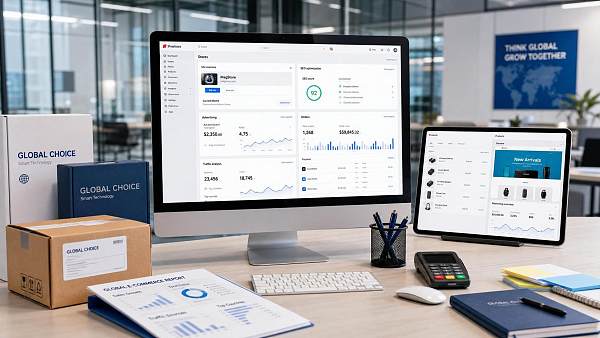
How should B2C independent site development for brand going global be done? Many new brands initially focus on whether the page looks good and whether the functions are complete, but what truly determines the result is often not the website itself, but whether the website can capture traffic, communicate value clearly, and complete conversions.
From recent changes, overseas traffic acquisition is becoming more and more expensive, and platform rules are also becoming less stable. This also means that B2C independent site development cannot only look at website-building efficiency; it must also consider subsequent advertising, SEO layout, content accumulation, and user asset retention capabilities.
For new brands, brand going global is not suitable for doing everything big at the very beginning. A more realistic path is to first focus on one core market, one main product category, and one clear conversion path, then connect the website, content, and promotion rhythm, and gradually replicate.
In simple terms, the goal of B2C independent site development is not “launching,” but “acquiring customers.” The key to brand going global is not a one-time exposure, but continuously turning unfamiliar traffic into buyers, and then turning first-time buyers into repeat buyers.
For New Brands Doing B2C Independent Site Development, First Clarify These Four Things
In actual business, many brand going global projects progress slowly, not because the team is not working hard, but because the early judgment is too vague. Before starting B2C independent site development, at least the following four questions must be clarified first.
1. Who to Sell To
First define the core country, age group, spending power, purchase motivation, and common concerns. If the target audience for brand going global is defined too broadly, advertising costs will rise significantly and page messaging will easily lose focus.
2. What Drives the Transaction
New brands should not assume that users will place orders because of a “brand story.” In most cases, users first look at function, price, reviews, logistics, return and exchange policies, and payment security. B2C independent site development must place these trust signals first.
3. What Path Converts
Some product categories are suitable for ad-driven direct product pages, while others are more suitable for first using content pages to educate users before entering detail pages. Brand going global is not suitable for all products to “click an ad and place an order”; the path design should vary by product category.
4. How to Continuously Optimize on the Backend
After the independent site goes live, you must be able to clearly see visitor sources, page dwell time, add-to-cart rate, abandonment rate, and order conversion rate. Without data feedback, B2C independent site development will remain at the stage of “having built a site,” and it will be difficult to truly drive brand going global growth.
The Framework of B2C Independent Site Development Suitable for New Brands
An effective B2C independent site development solution is not about complexity, but completeness. The site should at least simultaneously satisfy the four goals of display, indexing, promotion, and conversion.
- The homepage highlights brand positioning, featured products, and core benefits
- Product pages clearly present selling points, specifications, scenarios, reviews, and FAQs
- Category pages facilitate search, while balancing user browsing and search engine indexing
- Content pages support long-tail search and supplement the organic traffic for brand going global
- The checkout page simplifies steps to reduce drop-off and abandonment
A more obvious signal is that when doing brand going global now, the website can no longer just “be accessible.” It must also support multiple languages, multiple currencies, and multi-device adaptation, while taking into account page loading speed, SEO structure, and ad tracking deployment.
Platforms like 易营宝, an integrated website + marketing service platform, are valuable because they connect AI intelligent website building, multilingual deployment, cross-border e-commerce stores, SEO optimization, and advertising into one complete chain, reducing the losses new brands face in system selection, technical coordination, and operational execution.
For projects just getting started, this integrated approach is more practical. Because the biggest fear in brand going global is not a slow start, but having every link dispersed, causing traffic to come in while the website cannot handle it.
For Brand Going Global, It Is Not Recommended to Go Too Big at the Start with Advertising
A common mistake for new brands doing brand going global is opening too many countries, too many channels, and too many ad campaigns at the same time, which quickly disperses the budget, makes the data unclear, and creates more and more confusion in the optimization direction.
A more suitable approach for new brands is to first establish a “small closed loop,” and then gradually scale up. A workable rhythm can refer to the following three steps.
- First select 1 to 2 key markets to concentrate on validating demand and conversion cost.
- Then select 1 to 2 main channels, such as Google ads combined with Facebook ads.
- Finally focus on best-selling items or core products, and continuously test materials, landing pages, and incentive mechanisms.
If the product has clear search demand, B2C independent site development should consider the coordination of Google SEO and search ads in advance; if the product is more visually driven or impulse-driven, it is more suitable for social media ads, short-video materials, and retargeting strategies.
This is also why brand going global cannot separate website building from advertising. Page structure, copywriting, trust elements, and call-to-action buttons all directly affect ad conversion results.
The Most Easily Overlooked Conversion Details in B2C Independent Site Development
Many brand going global projects have plenty of traffic, but orders never come through. The problem is usually not the traffic itself, but that the conversion details have not been polished enough.
- The homepage does not clearly communicate product value, and users cannot understand the selling points within a few seconds
- Product page information is incomplete, lacking reviews, scenarios, and comparisons
- Payment methods do not match local habits, affecting order confidence
- Logistics timelines and return policies are not transparent, causing users to give up at the last minute
- Mobile experience is poor, loading is slow, and buttons are not obvious
When B2C independent site development is done well, it essentially keeps reducing the user’s decision-making cost. Every fewer doubt, every shorter step in the path, pushes brand going global conversion efficiency a little further forward.
If it is further combined with an AI advertising marketing system, an SEO/GEO optimization system, and social media content operations, the website is no longer just a static display page, but a growth base that can continuously accumulate search visibility, advertising data, and user assets.
For New Brands Doing Brand Going Global, How Can You Avoid Detours
If you want B2C independent site development to show results faster, you can first stick to a few basic principles. They may seem ordinary, but they are often what determine the outcome.
First, focus before expansion. Do not rush to make many markets; first build a template market that can continuously acquire customers.
Second, validate before scaling. Ads, materials, pages, and quotations should all be validated through data, not by experience alone.
Third, build the foundation before chasing hot trends. Brand going global is not finished by one wave of traffic; SEO content, social media accumulation, and repeat purchase mechanisms must be built in sync.
Fourth, choose the right service system. A platform like 易营宝, an AI-driven enterprise SaaS intelligent website building and overseas marketing platform, can coordinate website building, SEO, ads, social media, and AI search visibility optimization, and is more suitable for brands that hope to operate overseas markets for the long term.
Back to the original question, how should B2C independent site development for brand going global be done? The answer is actually very clear: first find the product-market fit, then build a convertible website, and then use an appropriate promotion strategy to keep scaling. Connecting these three steps well makes a new brand going global more likely to move steadily and go farther.
Related Articles


Related Products
 Yiyingbao SaaS Intelligent Website Building and Marketing SystemYiyingbao SaaS Intelligent Website Building and Marketing System, AI-powered no-code website building, rapid creation of multilingual B2B international websites in 10 minutes, global server acceleration, AI-powered SEO optimization, helping businesses connect efficiently with global markets. The perfect integration of technology and operation makes building an international trade website remarkably simple
 AI+SEM Intelligent Advertising Marketing SystemAI+SEM drives intelligent ad creation, empowering full-funnel precision advertising marketing. The system automatically generates weekly/monthly reports, AI recommends keywords and target countries, monitors core metrics in real-time with intelligent alerts, and enables one-click high-conversion ad solutions to help quickly acquire customers and improve ROI.
 AI+SEO Dual-Engine System Optimization ServicesYiyingbao’s AI+SEO dual-engine optimization system helps foreign trade enterprises acquire high-quality organic traffic through AI-powered keyword research, content generation, and comprehensive technical optimization, significantly improving search rankings and conversion rates.
 AI+SNS Social Media Marketing SystemYingbao AI+SNS Social Media Marketing System - Precision social capture for the social media era. Supports one-click content synchronization across major platforms like Facebook and LinkedIn. AI intelligently rewrites posts for enhanced relevance. 24/7 AI customer service and user profiling analysis empower businesses to efficiently expand into global markets.
 AI+SEO营销解决方案易营宝AI+SEO营销解决方案,通过AI批量写作、智能生成TDK、精准关键词扩词等功能,全面优化网站SEO效果,提升流量与转化率。助力企业构建高效智能网站新生态。
 AI+SEM Advertising Marketing SolutionsAI+SEM Advertising Marketing Solution leverages AI technology to deeply empower SEM ad campaigns. It automatically generates weekly/monthly reports using AI, presenting account data across multiple dimensions for comprehensive insights into campaign performance and trends. The system precisely recommends keywords and target countries, intelligently generates high-conversion ad copy, and enables one-click activation of efficient campaign plans to help businesses rapidly acquire customers. Simultaneously, it monitors core metrics in real time, intelligently identifies abnormal fluctuations, and issues timely alerts to ensure stable, high-return advertising results.
 Domain Name ServicesEasyWin provides professional domain name services, including intelligent queries, one-stop registration, brand protection, and full lifecycle management, helping businesses build a digital brand image.
 EasyOperate B2C Cross-Border E-Commerce Platform & Independent WebsiteEasyStore B2C Cross-border E-commerce Independent Store is an intelligent website building and cross-border e-commerce integrated solution independently developed by EasyStore Information Technology (Beijing) Co., Ltd. The system is specially designed for small and medium-sized as well as large export enterprises, integrating 'website building, operation, marketing, advertising, and conversion' into one, helping enterprises quickly establish cross-border e-commerce independent stores to achieve brand globalization and global sales growth.
The platform supports multiple languages, multiple currencies, and multi-channel marketing, with built-in AI intelligent translation and SEO optimization systems, suitable for mainstream markets such as Southeast Asia, Europe and America, Latin America, and the Middle East, assisting Chinese manufacturing enterprises in efficiently deploying international e-commerce strategies. SSL证书易营宝提供专业SSL安全证书服务,包括单域名和泛域名证书,确保网站数据传输加密、身份验证和完整性保护,助力企业建立安全可信的在线业务环境。









