









- Is the EV SSL certificate market shrinking or upgrading? How should companies assess certificate procurement?Aug 11, 2026View details
- Why the old AMP SEO 2020 practices no longer work and what has changed in current optimization prioritiesAug 02, 2026View details
- How to Choose Topics for an Industry News Section to Attract More Organic Search TrafficJul 29, 2026View details
- Digital Marketing Shenzhen Market Insights: Why Are Companies Expanding Overseas Looking for Growth Teams in Shenzhen?Jul 31, 2026View details
- Can Zhejiang foreign trade independent websites still be developed today? Look at changes in traffic and lead generationJul 28, 2026View details
- What New Signals Are Emerging in Enterprise Services SaaS Marketing ReportsJul 27, 2026View details
From Layout to Components: RTL Web Design Best Practices Checklist
In multilingual globalization projects, rtl web design best practices are not merely a matter of interface adaptation; they also affect usability, brand consistency, and conversion efficiency. This article outlines a practical design standards checklist covering layout, components, and development details.
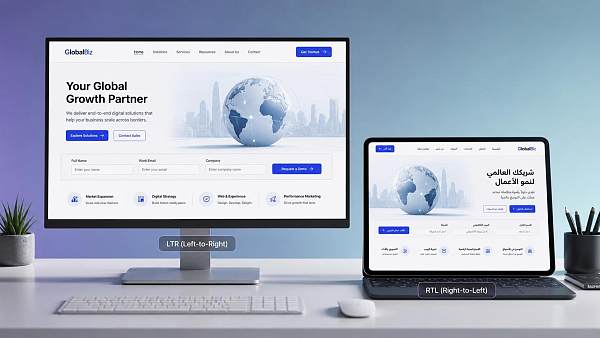
Many teams treat RTL (Right-to-Left) as simply “mirroring the page,” which is often where problems begin. In RTL language environments such as Arabic and Hebrew, users’ visual scanning paths, interaction expectations, and understanding of forms are not entirely the same as those on LTR (Left-to-Right) websites. For technical evaluators, the real question is not whether RTL can be implemented, but whether the existing design system, front-end architecture, component library, and deployment pipeline support long-term, cost-efficient, and maintainable RTL delivery.
RTL Is Not About Flipping the Page, but Rebuilding Directional Semantics
The primary issue in an RTL project is not styling, but the level at which “direction” is defined within the system. At least three layers of a website are affected: document direction, component direction, and content direction.
Document direction is usually controlled through dir="rtl". This is an important foundation for how browsers parse text flow, scrollbars, cursor movement, and default alignment behavior. If a team continues to rely heavily on physical properties such as margin-left, padding-right, and text-align:left, maintenance costs will rise rapidly once the direction changes. A more robust approach is to use CSS logical properties wherever possible, such as margin-inline-start, padding-inline-end, and text-align:start, replacing “left and right” with “start and end.”
Although this may seem basic, it is in practice one of the areas that causes the most rework in multilingual websites at later stages. Direction is not a minor page-level adjustment; it is a foundational constraint that must be standardized across design tokens, component APIs, and front-end styling guidelines.
Layout Standards Determine the Amount of Subsequent Rework
At the layout level, the areas most likely to cause RTL errors are not the main content sections, but the “edge areas”: navigation bars, sidebars, filters, step indicators, breadcrumbs, card information streams, and mixed image-and-text modules.
A practical rule is that any structure whose meaning depends on reading order must be revalidated rather than mechanically mirrored.
- Main navigation: Top-level menus should generally expand from the right, but whether the brand logo must also be moved to the right should be determined according to brand guidelines and user perception testing; a one-size-fits-all approach is not advisable.
- Sidebar: Filters and directory navigation are generally more suitable on the right in RTL layouts. However, if a system has already established a fixed workflow—for example, if B2B parameter filtering has long been placed on the left—migration should first be validated to ensure that it does not disrupt established usage habits.
- Grid system: CSS Grid and Flex layouts do not behave exactly the same way under RTL, especially when
row-reverseandcolumn-reverseare overused. The visual order may become disconnected from the DOM order, affecting accessibility and how search engines interpret the content. - Tables: Whether data columns should be mirrored depends on the business semantics. For example, in product parameter tables, SKU lists, and financial reports, the first column often carries the primary index and should not be blindly flipped merely because of the language direction.
This is also a common misunderstanding in technical evaluations: visual design teams may require everything to be reversed, but data-intensive modules in business systems are not always suitable for a complete RTL mirror. Directional adaptation should distinguish between “content-consumption pages” and “task-oriented pages.”
The Component Layer Shows the Most Obvious Differences in RTL Quality
If the layout layer affects visual perception, the component layer directly affects usability. Whether a website truly complies with rtl web design best practices is often determined not by its homepage, but by whether its detailed components can operate reliably.
Buttons and icons are typical examples. Arrow buttons, pagination controls, carousel navigation, back icons, download prompts, and expand/collapse icons all involve directional semantics. Not every arrow should be flipped: arrows representing “forward/back” generally need to follow the reading direction, while icons representing “play,” “upload,” or “external link” may not require any adjustment.
Forms are another module that is often underestimated in RTL projects. Text alignment in input fields, placeholder positioning, the presentation of LTR content such as telephone numbers and email addresses, the position of validation messages, dropdown expansion direction, and the month-view order in date pickers all need to be checked individually. Especially in B2B foreign trade scenarios, users often enter Arabic company names, English email addresses, international telephone numbers, and numeric amounts together. If this bidirectional text (BiDi text) is not handled properly, the interface will appear noticeably disordered.
Breadcrumbs and step indicators should not be mirrored directly either. If a step flow represents the sequence of a business process, logical readability should be preserved; if it is purely visual navigation, it can be displayed according to the RTL direction. In other words, whether a component should be flipped should be determined by semantics, not styling.
Text, Numbers, and Bidirectional Typography Are Easily Overlooked Technical Details
One of the most challenging issues in RTL projects is that text direction and content type do not always correspond. Embedding English brand names, URLs, SKUs, model numbers, and monetary figures in Arabic sentences is common on cross-border websites. In such cases, relying solely on page-level dir="rtl" is usually insufficient.
Several types of content require particular attention:
- Email addresses, URLs, and product codes: These should generally remain LTR and can be handled with a local
dir="ltr"setting or with tags such asbdiandbdo. - Numbers and units: For example, “20 kg,” “500 ml,” and “2025/06/01” may appear visually fragmented in an RTL text environment and should be tested together with the selected fonts and typography rules.
- Punctuation placement: Parentheses, slashes, colons, and percentage signs frequently display abnormally in bidirectional text, especially in product specifications and quotation information.
- Font adaptation: Arabic fonts are highly sensitive to font weight, line height, ligatures, and the vertical space of glyphs. If the font-size and line-height system of an English website is reused without adjustment, reading density is often too high.
These issues will not be fully exposed in static design mockups. They must be tested with real content, real translations, and real devices. Many projects go live with pages that “look almost right,” yet customers continually encounter errors when filling out forms. The root cause is often bidirectional text handling.
For Front-End Implementation, Prioritize “One Codebase Running in Both Directions”
From an engineering perspective, the biggest mistake in RTL implementation is maintaining two independent front ends. Although this may seem convenient in the short term, it inevitably increases style drift, inconsistencies between component versions, and delays in synchronizing defect fixes over time.
A more appropriate technical approach generally includes three layers:
- Design layer: Define direction-aware tokens in the design system, including spacing, alignment, icon direction, and border-radius priorities.
- Component layer: Components should detect direction through context or global configuration rather than using conditional logic in business pages.
- Styling layer: Prioritize logical properties and switchable theme mechanisms; where necessary, use build tools to generate RTL styles instead of manually writing overrides.
If a project uses React, Vue, or a mainstream UI framework, the technical evaluation should focus on three points: whether the component library natively supports RTL; whether third-party plugins support it; and whether the existing styles contain extensive hard-coded left/right directions. The third point is usually what most directly affects project timelines and costs.
In addition, third-party modules such as carousels, charts, maps, rich-text editors, and file uploaders require separate validation. Many libraries claim to support RTL but only handle basic text alignment, without addressing drag direction, animation direction, or keyboard navigation order.
Do Not Leave Accessibility and Performance Until the End
RTL adaptation is often treated as visual localization work, but for cross-border projects it also affects performance and accessibility.
Screen readers rely on correct language and direction declarations to interpret content order. If keyboard navigation order is inconsistent with the visual order, operational efficiency will decline significantly. An incorrect DOM order may also cause search engines to misunderstand the page structure. For technical teams, this means RTL is not merely a CSS task, but a comprehensive issue involving HTML semantics, accessibility, and rendering strategies.
At the performance level, multilingual websites targeting markets such as the Middle East and North Africa often carry large images, videos, catalog PDFs, inquiry forms, and advertising landing pages at the same time. If an RTL website also supports multiple languages and regional distribution, its deployment architecture will directly affect the actual user experience. Some teams complete RTL adaptation at the front-end layer but overlook overseas access routes. As a result, the page direction is correct, but the initial loading is slow and form submissions are delayed, so conversions still suffer.
In such projects, server nodes, edge acceleration, and protocol support are not independent issues. For example, Yingyingbao Global Server Deployment, which supports multilingual independent-site deployment and provides global nodes and intelligent routing capabilities, is more suitable for foreign trade websites that need to balance stable access in the Middle East, HTTPS secure transmission, and high-concurrency form submissions. Especially when page resources are heavy and advertising traffic is concentrated, network-layer optimization often improves the real user experience more effectively than front-end fine-tuning alone.
If Testing Standards Are Not Detailed Enough, RTL Will Inevitably Have “Hidden Bugs” After Launch
The hardest part of RTL pages is that “everything looks fine, but problems appear during use.” Therefore, testing should not be limited to visual inspections; a scenario-based checklist should be established.
At a minimum, the following dimensions should be covered:
- Content testing: Real Arabic/Hebrew copy, mixed with English brand names, links, numbers, currencies, and dates.
- Interaction testing: Dropdowns, pagination, carousels, drawers, pop-ups, date pickers, uploading, and copying operations.
- Device testing: Mobile-first testing, especially input method switching, soft-keyboard obstruction, and portrait/landscape changes.
- Regression testing: Simultaneous regression testing in both LTR and RTL to avoid fixing one direction while breaking the other.
- Accessibility testing: Focus order, screen-reader reading order, and the completeness of semantic tags.
If the project covers both advertising and SEO scenarios, landing-page loading tests and crawler verification should also be added. Some RTL websites use additional scripts to dynamically flip the layout for convenience, and such implementations may affect rendering stability and crawling efficiency.
What Should You Really Ask Suppliers During a Technical Evaluation?
For technical evaluators, determining whether a team truly has RTL delivery capabilities is not about whether it has built an Arabic website, but whether its approach is engineering-based.
Several key questions are more valuable than screenshots of previous projects:
- Does a single codebase support both directions, or are two themes or even two sets of pages maintained?
- Does the design system use logical properties and direction-aware components?
- What is the scope of RTL support for third-party components, and are there any known limitations?
- Are there dedicated testing standards for bidirectional text, forms, dates, numbers, and icon direction?
- Does overseas deployment take access quality, security protection, and compliance requirements in the target region into account, such as GDPR and CCPA?
If these questions cannot be answered, the project will most likely deliver RTL that is merely “presentable,” rather than RTL that is “operational.”
A mature set of rtl web design best practices is essentially not a set of design-style recommendations, but a coordinated standard spanning design, front-end development, testing, and deployment. An experienced team will move directional semantics forward into the design system, component consistency forward into development standards, and real user experience forward into the deployment architecture. For companies expanding overseas, only by reaching this level can RTL become more than an add-on for language coverage and instead serve as a fundamental capability for entering the target market.
Related Articles

Related Products
 Yiyingbao SaaS Intelligent Website Building and Marketing SystemYiyingbao SaaS Intelligent Website Building and Marketing System, AI-powered no-code website building, rapid creation of multilingual B2B international websites in 10 minutes, global server acceleration, AI-powered SEO optimization, helping businesses connect efficiently with global markets. The perfect integration of technology and operation makes building an international trade website remarkably simple
 AI+SEM Intelligent Advertising Marketing SystemAI+SEM drives intelligent ad creation, empowering full-funnel precision advertising marketing. The system automatically generates weekly/monthly reports, AI recommends keywords and target countries, monitors core metrics in real-time with intelligent alerts, and enables one-click high-conversion ad solutions to help quickly acquire customers and improve ROI.
 AI+SEO Dual-Engine System Optimization ServicesYiyingbao’s AI+SEO dual-engine optimization system helps foreign trade enterprises acquire high-quality organic traffic through AI-powered keyword research, content generation, and comprehensive technical optimization, significantly improving search rankings and conversion rates.
 AI+SNS Social Media Marketing SystemYingbao AI+SNS Social Media Marketing System - Precision social capture for the social media era. Supports one-click content synchronization across major platforms like Facebook and LinkedIn. AI intelligently rewrites posts for enhanced relevance. 24/7 AI customer service and user profiling analysis empower businesses to efficiently expand into global markets.
 AI+SEO营销解决方案易营宝AI+SEO营销解决方案,通过AI批量写作、智能生成TDK、精准关键词扩词等功能,全面优化网站SEO效果,提升流量与转化率。助力企业构建高效智能网站新生态。
 AI+SEM Advertising Marketing SolutionsAI+SEM Advertising Marketing Solution leverages AI technology to deeply empower SEM ad campaigns. It automatically generates weekly/monthly reports using AI, presenting account data across multiple dimensions for comprehensive insights into campaign performance and trends. The system precisely recommends keywords and target countries, intelligently generates high-conversion ad copy, and enables one-click activation of efficient campaign plans to help businesses rapidly acquire customers. Simultaneously, it monitors core metrics in real time, intelligently identifies abnormal fluctuations, and issues timely alerts to ensure stable, high-return advertising results.
 Domain Name ServicesEasyWin provides professional domain name services, including intelligent queries, one-stop registration, brand protection, and full lifecycle management, helping businesses build a digital brand image.
 EasyOperate B2C Cross-Border E-Commerce Platform & Independent WebsiteEasyStore B2C Cross-border E-commerce Independent Store is an intelligent website building and cross-border e-commerce integrated solution independently developed by EasyStore Information Technology (Beijing) Co., Ltd. The system is specially designed for small and medium-sized as well as large export enterprises, integrating 'website building, operation, marketing, advertising, and conversion' into one, helping enterprises quickly establish cross-border e-commerce independent stores to achieve brand globalization and global sales growth.
The platform supports multiple languages, multiple currencies, and multi-channel marketing, with built-in AI intelligent translation and SEO optimization systems, suitable for mainstream markets such as Southeast Asia, Europe and America, Latin America, and the Middle East, assisting Chinese manufacturing enterprises in efficiently deploying international e-commerce strategies. SSL证书易营宝提供专业SSL安全证书服务,包括单域名和泛域名证书,确保网站数据传输加密、身份验证和完整性保护,助力企业建立安全可信的在线业务环境。









