









- Eight Departments, Including the Ministry of Commerce, Issue the 15th Five-Year Plan for the Development of Trade in ServicesNov 27, 2026View details
- General Administration of Customs Issues New Rules on Import and Export Cosmetic Labeling, Effective December 1Nov 26, 2026View details
- U.S. to Announce Section 301 Investigation Findings on 16 Economies, Potentially Proposing New TariffsNov 26, 2026View details
- Hapag-Lloyd’s $4.2 billion acquisition of ZIM faces a closing delay; ZIM reports third-quarter net profit of $830 millionNov 24, 2026View details
- SCFI falls for a third straight week to 3,503.78 points, with blank sailings on trans-Pacific routes rising to 10Nov 24, 2026View details
- Lazada 11.11 Mega Sale: LazMall Contributes Nearly Two-Thirds of GMVNov 23, 2026View details
How Can Multilingual Field Mapping Prevent Content Synchronization Errors?

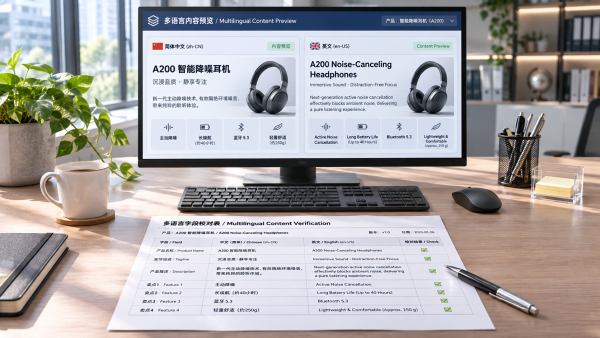
How can you ensure that multilingual field mapping keeps content in sync without errors? The key is to standardize field definitions, language identifiers, and validation rules so the system can clearly determine which entity each piece of content belongs to, which language it is in, and which fields can be updated. For technical evaluators, the focus is not only on whether translations can be imported, but also on whether the target website can maintain data consistency during repeated synchronization, concurrent edits, and retries after errors.
First, identify what needs to be synchronized: entities, languages, and fields
Multilingual websites commonly use one of two data structures: either all language-specific fields are stored in a single content record, or each language is stored as a separate record. Whichever approach is used, synchronization should locate the target using the content entity ID, language identifier, and field key, rather than relying on page names or display order.
For example, the Chinese and English names of the same product should be linked to the same product ID but marked separately as “zh-CN” and “en-US.” A product name can vary by language, while a product SKU is usually a shared field. If shared fields are treated as translation fields, updating the English content could inadvertently change product information across the entire site.
- Keep field keys stable: Use fixed internal identifiers to map fields and avoid synchronization failures caused by changes to their display names in the back end.
- Standardize language identifiers: Use agreed-upon language tags, such as “en-US” and “en-GB,” and validate them according to BCP 47. Do not use display values such as “English” or “EN” as unique identifiers.
- Define field ownership: Distinguish multilingual fields, fields shared across languages, and site-specific fields, and define update permissions for each category.
- Separate content from publication status: A saved translation is not necessarily reviewed or published. The synchronization interface should handle content, review status, and publication status separately.
How can you ensure that multilingual field mapping keeps content in sync without errors? Establish a mapping contract
A mapping contract is a set of rules that both the source and target systems follow. In addition to field mappings, it should specify data types, required-field conditions, transformation methods, and error handling. During technical evaluation, you can request the field list and API documentation, then validate them using real but anonymized data.
Mapping rules also need version control. When fields are renamed, split, or deprecated, record the effective date and compatibility strategy; also specify which version tasks created before the transition should use. Otherwise, even if both systems’ APIs are working, historical tasks may still write data to the wrong fields.
From validation to write operations: Design a synchronization process that supports retries
The synchronization process should surface errors as early as possible and provide a clear recovery path for failed tasks. The following steps apply to data exchanges between website content management systems and translation platforms or product systems:
- Identify the target record: Find the content using the entity ID and language tag. If the target does not exist, create a draft or add the task to an exception queue as agreed; do not guess which page it corresponds to.
- Validate the structure: Check that fields exist, data types match, and the language is supported. Validate required fields, length limits, and link formats. If validation fails, return an error that identifies the relevant field.
- Apply transformation rules: Standardize date, numeric, and rich-text formats. Handle translation fields separately from shared fields to prevent transformation logic from affecting non-translation data such as SKUs and prices.
- Detect version conflicts: Include the source and target versions, and check whether the target content has changed before writing. If a conflict occurs, pause the overwrite and resolve it according to defined rules or through manual review.
- Record and verify the results: Save the task ID, entity ID, language, field, version, and processing result. After a successful write, verify the target value and status; failed items should be retryable individually.
Retries must account for idempotency: if the same task is sent repeatedly because of a network timeout, it should not create duplicate pages or trigger publication multiple times. Use a stable task identifier for deduplication, while retaining traceable processing results. For operations such as deletion, clearing, and publication, specify the instructions and permissions explicitly; do not infer them from a missing field alone.
How to handle missing translations, fallbacks, and conflicts with manual edits
Missing translations can represent different states: translation not submitted, translation in progress, reviewed, or intentionally left blank. Record these states separately. When displaying a page, you can fall back to a predefined language—for example, display English when French is unavailable—but retain the “language actually displayed” information to avoid mistaking fallback text for a completed French translation.
It is also important to distinguish between display fallback and write fallback. The former temporarily selects available content when reading; the latter writes the default language into the target-language field, potentially concealing an untranslated item later. Whether write fallback is allowed should be explicitly determined by business rules, and the source should be identified.
If an operations team member edits a translation on the target site and the source system subsequently pushes an older version, a simple “last write wins” approach can easily overwrite the edit. A safer approach is to use version numbers or timestamps together with conditional updates: if the target version differs from the version read by the synchronization task, record the conflict and provide a diff. Write the update only after the handling rules have been confirmed.
Which edge cases should be tested during acceptance testing?
Technology selection should not be based solely on whether typical examples synchronize successfully. Prepare test content that includes shared fields, rich text, media references, and multiple regional languages. Test operations such as creation, updates, clearing, and publication, and check how the content actually appears on the target site.
- Verify language isolation: When only “en-US” is updated, check that “en-GB” and other languages retain their original values.
- Verify empty-value semantics: Test a field that is omitted, one submitted as an empty string, and one explicitly cleared. Confirm that each result matches the contract.
- Verify error recovery: Simulate timeouts, duplicate submissions, and validation failures for some fields. Check whether duplicate records are created and whether failed items can be retried.
- Verify concurrent-edit conflicts: Manually edit target content during synchronization and confirm that the system detects the version change and retains a record of how it was handled.
- Verify mapping changes: Change the mapping version for test fields and check that old tasks, historical content, and new tasks are handled as agreed.
Frequently asked questions
Do all languages need to have the same fields?
Not necessarily. The field structure can be standardized, but required-field rules, content length limits, and regional display requirements may differ. The contract should specify which fields are required across languages, which may be omitted, and whether content can be published when a field is missing.
Does successful synchronization mean the page content is correct?
Not necessarily. API success usually means only that the request was accepted or the data was written. You should also verify the language, field values, review and publication status, and page rendering. Sample reviews and alerts for key fields can help identify silent mapping errors early.
Related Articles
 How Can Multilingual Field Mapping Prevent Content Synchronization Errors?
 How can multinational enterprises manage publishing permissions across websites in different regions?
 How to Set Up 301 Redirects During a Website Migration?


Related Products
 Yiyingbao SaaS Intelligent Website Building and Marketing SystemYiyingbao SaaS Intelligent Website Building and Marketing System, AI-powered no-code website building, rapid creation of multilingual B2B international websites in 10 minutes, global server acceleration, AI-powered SEO optimization, helping businesses connect efficiently with global markets. The perfect integration of technology and operation makes building an international trade website remarkably simple
 AI+SEM Intelligent Advertising Marketing SystemAI+SEM drives intelligent ad creation, empowering full-funnel precision advertising marketing. The system automatically generates weekly/monthly reports, AI recommends keywords and target countries, monitors core metrics in real-time with intelligent alerts, and enables one-click high-conversion ad solutions to help quickly acquire customers and improve ROI.
 AI+SEO Dual-Engine System Optimization ServicesYiyingbao’s AI+SEO dual-engine optimization system helps foreign trade enterprises acquire high-quality organic traffic through AI-powered keyword research, content generation, and comprehensive technical optimization, significantly improving search rankings and conversion rates.
 AI+SNS Social Media Marketing SystemYingbao AI+SNS Social Media Marketing System - Precision social capture for the social media era. Supports one-click content synchronization across major platforms like Facebook and LinkedIn. AI intelligently rewrites posts for enhanced relevance. 24/7 AI customer service and user profiling analysis empower businesses to efficiently expand into global markets.
 AI+SEO营销解决方案易营宝AI+SEO营销解决方案,通过AI批量写作、智能生成TDK、精准关键词扩词等功能,全面优化网站SEO效果,提升流量与转化率。助力企业构建高效智能网站新生态。
 AI+SEM Advertising Marketing SolutionsAI+SEM Advertising Marketing Solution leverages AI technology to deeply empower SEM ad campaigns. It automatically generates weekly/monthly reports using AI, presenting account data across multiple dimensions for comprehensive insights into campaign performance and trends. The system precisely recommends keywords and target countries, intelligently generates high-conversion ad copy, and enables one-click activation of efficient campaign plans to help businesses rapidly acquire customers. Simultaneously, it monitors core metrics in real time, intelligently identifies abnormal fluctuations, and issues timely alerts to ensure stable, high-return advertising results.
 Domain Name ServicesEasyWin provides professional domain name services, including intelligent queries, one-stop registration, brand protection, and full lifecycle management, helping businesses build a digital brand image.
 EasyOperate B2C Cross-Border E-Commerce Platform & Independent WebsiteEasyStore B2C Cross-border E-commerce Independent Store is an intelligent website building and cross-border e-commerce integrated solution independently developed by EasyStore Information Technology (Beijing) Co., Ltd. The system is specially designed for small and medium-sized as well as large export enterprises, integrating 'website building, operation, marketing, advertising, and conversion' into one, helping enterprises quickly establish cross-border e-commerce independent stores to achieve brand globalization and global sales growth.
The platform supports multiple languages, multiple currencies, and multi-channel marketing, with built-in AI intelligent translation and SEO optimization systems, suitable for mainstream markets such as Southeast Asia, Europe and America, Latin America, and the Middle East, assisting Chinese manufacturing enterprises in efficiently deploying international e-commerce strategies. SSL证书易营宝提供专业SSL安全证书服务,包括单域名和泛域名证书,确保网站数据传输加密、身份验证和完整性保护,助力企业建立安全可信的在线业务环境。









