









- Eight Departments, Including the Ministry of Commerce, Issue the 15th Five-Year Plan for the Development of Trade in ServicesNov 27, 2026View details
- General Administration of Customs Issues New Rules on Import and Export Cosmetic Labeling, Effective December 1Nov 26, 2026View details
- U.S. to Announce Section 301 Investigation Findings on 16 Economies, Potentially Proposing New TariffsNov 26, 2026View details
- Hapag-Lloyd’s $4.2 billion acquisition of ZIM faces a closing delay; ZIM reports third-quarter net profit of $830 millionNov 24, 2026View details
- SCFI falls for a third straight week to 3,503.78 points, with blank sailings on trans-Pacific routes rising to 10Nov 24, 2026View details
- Lazada 11.11 Mega Sale: LazMall Contributes Nearly Two-Thirds of GMVNov 23, 2026View details
How to Review Pages in Each Language After Building a Multilingual Website in Zhongshan
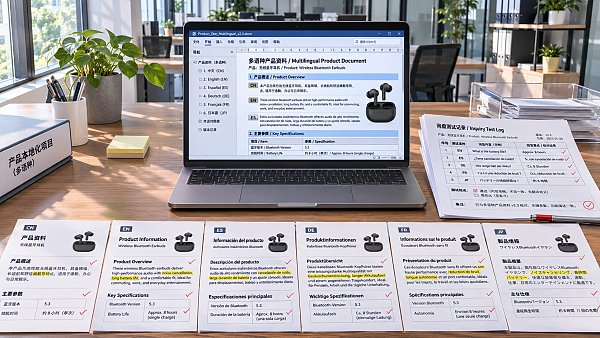
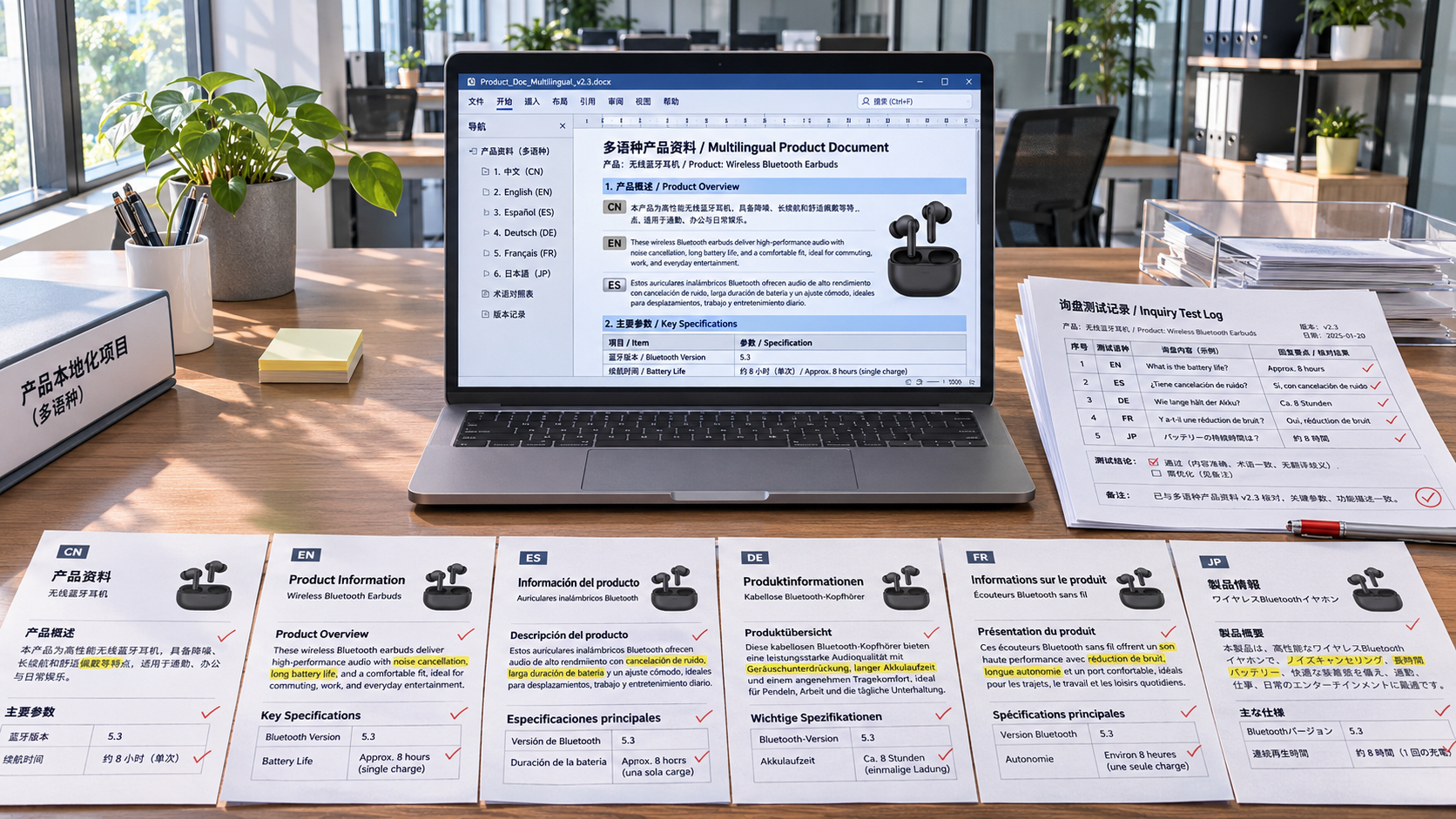
How to Review Each Language Version of a Multilingual Website in Zhongshan
Once a multilingual website in Zhongshan has been completed, how should you review each language version? Project managers can check translation accuracy, page functionality, search optimization, and conversion paths one by one. The goal of acceptance testing is not simply to confirm that “the pages open,” but to find out whether overseas customers can understand the products, find the right pages, and submit inquiries smoothly.
One of the most common issues with multilingual projects is that the English version has been updated while other language versions still contain outdated specifications. Another is that the page text has been translated, but the images, forms, and search result titles remain in another language. Identifying these discrepancies before delivery is much easier than fixing them page by page after launch.
Define the Scope of Acceptance Testing First—Don’t Just Check the Homepage
Ask the website developer to provide a list matching pages to languages, indicating which languages are available for the homepage, product categories, product details, application scenarios, contact page, forms, and policy pages. For pages that are not scheduled for translation, clarify in advance whether they will remain in the original language, redirect to the corresponding page, or remain unavailable for now. This prevents missing pages from being mistaken for items outside the agreed scope during acceptance testing.
Manufacturers with many pages can use a “full review of key pages and sampling of pages with the same template” approach: review the homepage, core products, and inquiry pages in every language one by one, and sample regular product pages that use the same template by product category. If sampling reveals common issues such as mismatched specifications or mixed languages, expand the review rather than fixing only the page at hand.
The testing environment should also be clearly defined. A staging site can help identify content and functionality issues in advance, but the production domain, form recipients, analytics tags, and search accessibility should be checked again after launch.
Translation Review: Product Information Matters More Than Smooth-Sounding Sentences
For products such as lighting, home appliances, and hardware, project managers should involve reviewers familiar with both the products and the target market. Focus on checking model numbers, materials, specifications, units, applicable uses, and delivery terms—not just whether the wording reads smoothly. Machine translation can help produce a first draft, but professional terminology, negative conditions, and text embedded in images should not be left entirely to automated judgment.
For example, if a product comes in different voltage options or installation configurations, each language version must match the corresponding product documentation. Certification information that has not yet been confirmed for a particular market should not be displayed simply because the translation was based on another version. For statements about certifications, warranties, and applicable regions, the company should provide verifiable information before deciding how to present them.
Also check the header navigation, buttons, pop-ups, breadcrumbs, image captions, and download file names. These elements are often excluded from the main body translation, yet they directly affect the user experience. Longer translations may push text out of buttons or obscure content. Pages read from right to left, such as Arabic, also require separate checks of text direction, icon placement, and form layout; verifying only that the text has been translated is not enough.
Test the Customer Journey Instead of Reviewing Screenshots Page by Page
Have reviewers simulate a real visit: start on the homepage in the target language, go to a product category, open a detail page, download a document, and then submit an inquiry. Switch languages along the way and check whether the corresponding version of the same product opens. If no page is available in that language, provide at least a clear notice or an agreed-upon alternative destination, so customers are not suddenly sent back to the homepage without knowing why.
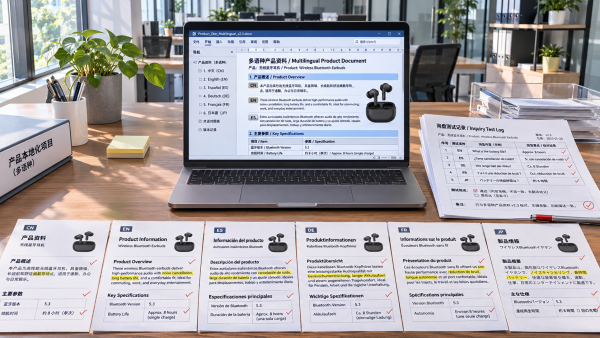
Forms deserve a thorough test. Enter a name, company, email address, and inquiry in different languages, and confirm that required-field prompts are understandable, a success message appears after submission, the information actually reaches the backend or designated email address, the text is not garbled, and the attachment function works as agreed. Seeing “Submission successful” does not mean the sales team has received the inquiry; also confirm that configuration issues will not send the email to spam or to an address belonging to a former employee.
Don’t check only the homepage on mobile. Test product specification tables, language-switching menus, contact information, and submission buttons on a phone. Pages with many images or videos should also be tested for loading performance on commonly used devices and network connections. If a key button is obscured by a floating element, the site should not be accepted as-is, even if the design looks attractive.
Check Search Access: Pages Must Be Accessible, Recognizable, and Linked to the Correct Version
Each language version should have a clear, stable URL and be accessible through internal links. Check that each page title and description match the page language and product content, rather than using the same copy across all languages. Also verify that canonical URLs point to the intended pages and that crawling or indexing has not been inadvertently blocked.
If the project uses hreflang tags for language or regional versions, check that the code, corresponding URLs, and reciprocal references are correct. Pay particular attention to broken URLs, incorrect region codes, and pages whose content does not match the language specified in the tags. The sitemap should also match the pages actually available. Whether and when search engines ultimately index or display pages cannot be guaranteed by the website developer alone as an acceptance criterion. A more practical approach is to confirm that the technical configuration is in place and the conditions for submission have been met.
If advertising or social media promotion is planned, also check the landing pages for each channel: can visitors find the advertised products on the page, is the language consistent, and are the inquiry or purchase buttons easy to spot? When the website and marketing are reviewed separately, these cross-functional issues are often missed.
Record Issues as Deliverables That Can Be Retested
An issue list should not simply say “translation issue” or “page needs optimization.” Record the page URL, language, device, steps taken, actual result, and expected result. Add screenshots if necessary, and assign an owner and retest date. Issues such as incorrect specifications, forms that fail to deliver, or inaccessible pages should be prioritized. Individual wording or non-critical visual details can be assigned a revision deadline agreed upon with the developer.
At handover, also confirm backend access, domain and DNS management, how content in each language can be updated, and permissions to view and export inquiry data. For platforms such as 易营宝 that provide website development, search optimization, and overseas marketing services, acceptance testing should also clearly define the access rights, analytics, and landing page responsibilities required for subsequent promotion. The fact that service components are connected is no reason to skip written confirmation.
Before signing off, keep a page list and a list of outstanding items confirmed by both parties. After launch, retest the inquiry flow using the production URLs and assign an owner for updating product information in every language. Website delivery is only the starting point; keeping product specification changes in sync across all languages is what helps prevent incorrect information from recurring.
Related Articles
Related Products
 Yiyingbao SaaS Intelligent Website Building and Marketing SystemYiyingbao SaaS Intelligent Website Building and Marketing System, AI-powered no-code website building, rapid creation of multilingual B2B international websites in 10 minutes, global server acceleration, AI-powered SEO optimization, helping businesses connect efficiently with global markets. The perfect integration of technology and operation makes building an international trade website remarkably simple
 AI+SEM Intelligent Advertising Marketing SystemAI+SEM drives intelligent ad creation, empowering full-funnel precision advertising marketing. The system automatically generates weekly/monthly reports, AI recommends keywords and target countries, monitors core metrics in real-time with intelligent alerts, and enables one-click high-conversion ad solutions to help quickly acquire customers and improve ROI.
 AI+SEO Dual-Engine System Optimization ServicesYiyingbao’s AI+SEO dual-engine optimization system helps foreign trade enterprises acquire high-quality organic traffic through AI-powered keyword research, content generation, and comprehensive technical optimization, significantly improving search rankings and conversion rates.
 AI+SNS Social Media Marketing SystemYingbao AI+SNS Social Media Marketing System - Precision social capture for the social media era. Supports one-click content synchronization across major platforms like Facebook and LinkedIn. AI intelligently rewrites posts for enhanced relevance. 24/7 AI customer service and user profiling analysis empower businesses to efficiently expand into global markets.
 AI+SEO营销解决方案易营宝AI+SEO营销解决方案,通过AI批量写作、智能生成TDK、精准关键词扩词等功能,全面优化网站SEO效果,提升流量与转化率。助力企业构建高效智能网站新生态。
 AI+SEM Advertising Marketing SolutionsAI+SEM Advertising Marketing Solution leverages AI technology to deeply empower SEM ad campaigns. It automatically generates weekly/monthly reports using AI, presenting account data across multiple dimensions for comprehensive insights into campaign performance and trends. The system precisely recommends keywords and target countries, intelligently generates high-conversion ad copy, and enables one-click activation of efficient campaign plans to help businesses rapidly acquire customers. Simultaneously, it monitors core metrics in real time, intelligently identifies abnormal fluctuations, and issues timely alerts to ensure stable, high-return advertising results.
 Domain Name ServicesEasyWin provides professional domain name services, including intelligent queries, one-stop registration, brand protection, and full lifecycle management, helping businesses build a digital brand image.
 EasyOperate B2C Cross-Border E-Commerce Platform & Independent WebsiteEasyStore B2C Cross-border E-commerce Independent Store is an intelligent website building and cross-border e-commerce integrated solution independently developed by EasyStore Information Technology (Beijing) Co., Ltd. The system is specially designed for small and medium-sized as well as large export enterprises, integrating 'website building, operation, marketing, advertising, and conversion' into one, helping enterprises quickly establish cross-border e-commerce independent stores to achieve brand globalization and global sales growth.
The platform supports multiple languages, multiple currencies, and multi-channel marketing, with built-in AI intelligent translation and SEO optimization systems, suitable for mainstream markets such as Southeast Asia, Europe and America, Latin America, and the Middle East, assisting Chinese manufacturing enterprises in efficiently deploying international e-commerce strategies. SSL证书易营宝提供专业SSL安全证书服务,包括单域名和泛域名证书,确保网站数据传输加密、身份验证和完整性保护,助力企业建立安全可信的在线业务环境。









