









- Which customer acquisition channels will be affected by cross-border marketing trends in 2026?Sep 06, 2026View details
- Which homogenization risks should be considered in an analysis of the AI-powered website building industry?Aug 30, 2026View details
- How Will AI Marketing Trends 2026 Change Advertising Budget AllocationAug 28, 2026View details
- Is the EV SSL certificate market shrinking or upgrading? How should companies assess certificate procurement?Aug 11, 2026View details
- Why the old AMP SEO 2020 practices no longer work and what has changed in current optimization prioritiesAug 02, 2026View details
- How to Choose Topics for an Industry News Section to Attract More Organic Search TrafficJul 29, 2026View details
How to Choose Website Translation and Localization Services: How to Assess Pricing, Delivery, and Quality
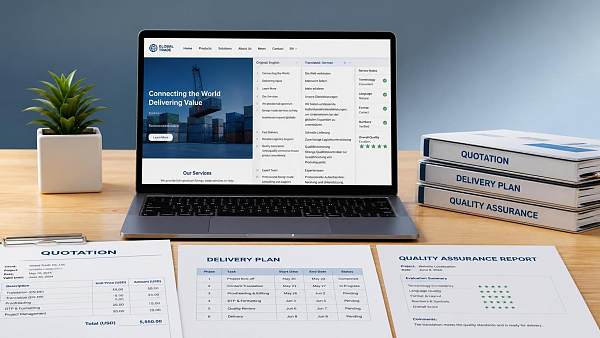
When purchasing website translation and localization services, the core is not "whether it looks like a translation," but whether it can be delivered on time, whether it fits the business, and whether it can bring real inquiries and conversions. For procurement personnel, a low price does not necessarily save money; rework, delays, and inaccurate expression are the real costs.
First, determine what you are actually buying
Users searching for "how to choose website translation and localization services" are usually not looking to understand the concept of translation, but rather seeking a set of actionable procurement evaluation criteria. The real core intent is to compare the differences between service providers in terms of language quality, industry understanding, delivery efficiency, and subsequent conversion effectiveness.
This type of target reader cares most about three things: whether the quotation is reasonable, whether it can be delivered stably according to project milestones, and whether the content, once live, will affect overseas customers' understanding and willingness to inquire. Especially for companies engaged in foreign trade, manufacturing, and cross-border e-commerce, the website language is just the entry point; whether it can bring business results is the key.
Therefore, when evaluating service providers, you should not only look at "how many languages are supported," but also whether they understand the product structure of your industry, the expression habits of the target market, and whether the website requires right-to-left layout, multilingual SEO, advertising landing page adaptation, and other practical issues. The Arabic market is a typical example; simple literal translation is often insufficient.
How to evaluate quotations without losing out
The quotation for website translation and localization services is usually determined by the language pair, word count, number of pages, technical modifications, and whether it includes localization proofreading. When procuring, you must first confirm the quotation basis—whether it is charged by source language word count, target language word count, or per page. Otherwise, prices from different suppliers cannot be compared horizontally.
Common problems with low-cost solutions fall into three categories: only performing mechanical translation without handling industry terminology; only delivering text without being responsible for website structure adaptation; and only promising a first draft without including revisions and launch assistance. What you should really ask is whether the quotation includes a terminology glossary, style consistency, keyword optimization, image and text replacement suggestions, and multiple rounds of revision.
If the project targets the Middle East market, you also need to check whether it involves technical items such as right-to-left layout, Arabic font compatibility, domain and language directory configuration, and SSL certificate selection. Services like Arabic Industry Website Construction and Marketing Solutions often consider localization translation, site structure, and marketing configuration together, making it easier for procurement to see the total investment.
How to judge if delivery efficiency is reliable
Delivery efficiency is not simply about "how many days to produce a draft," but whether the project can be closed in stages. A qualified service provider should be able to clearly explain: whether there is a requirements confirmation phase, whether there is terminology review during translation, whether there is native-speaker polishing before delivery, and whether there is final support for pre-launch inspection and revisions.
For procurement, the most valuable thing is predictability. For example, if you have milestones like a new site launch, ad campaigns, or trade show promotions, you must confirm whether the service provider can prioritize pages accordingly—starting with the homepage, product pages, and conversion pages—rather than progressing evenly by document order, which could delay the launch of core pages.
You should also check whether the service provider has technical collaboration capabilities. Website translation and localization is not purely copywriting work; many issues fall on front-end layout, menu length, form fields, image text, and mobile display. Whether these details can be handled simultaneously directly determines whether there will be repeated rework after delivery.
Quality assessment: Don't just look at grammar
When judging quality, you should not only look at whether the sentences are smooth. More importantly, it depends on whether the content conforms to the expression habits of the target market, accurately conveys the brand positioning, and is consistent with the product selling points. For procurement personnel, truly qualified quality means "the customer can understand it, is willing to continue reading, and is willing to contact you."
You can evaluate from four dimensions: whether the terminology is unified and consistent with industry usage; whether the tone aligns with local reading habits; whether the original website's sales focus is preserved; and whether it is helpful for SEO. Especially titles, buttons, product parameters, FAQs, and landing page copy are most prone to losing conversions due to literal translation.
If the service provider can provide a terminology database, bilingual comparison drafts, native-speaker review records, and revision marks, it usually indicates more complete quality control. For the Middle East, special attention should be paid to Arabic reading direction, date formats, contact information writing, and whether local social media entry points are natural—these are details that are often overlooked but greatly affect professionalism.
Five questions to ask during procurement
First, are there cases in the same industry, preferably similar to your foreign trade or manufacturing sector? Second, is a sample test provided, allowing you to decide after seeing the homepage or core product page? Third, are the revision rounds and response time clearly defined to avoid disputes later? Fourth, can it coordinate with SEO keyword layout, not just translate text? Fifth, does it support post-launch maintenance and updates?
If your target market is the Middle East, it is recommended to additionally confirm whether there is Arabic keyword research, Google Ads localization suggestions, and social media traffic strategies. Because many companies only realize after purchasing translation that although the content is readable, it cannot be found in search, ads cannot capture it, and the pages do not convert—indicating that the procurement criteria itself were off.
What kind of service provider is suitable
What is suitable for enterprise procurement is not necessarily the team with the cheapest language services, but the service provider that can connect translation, localization, website building, and marketing. Especially for companies building overseas independent sites, content launch is just the beginning; subsequent considerations include search engine indexing, ad landing page matching, social media traffic reception, and long-term maintenance.
For companies looking to quickly enter the Middle East market, it is best to choose a solution that understands both website translation and localization and Arabic site structure and marketing strategies. This can reduce multi-vendor collaboration costs and avoid situations where the translation company only handles text, the website building company only handles pages, and the marketing team has to rewrite the copy again.
How to conclude
The safest way to evaluate website translation and localization services is: first, look at industry understanding; second, look at delivery capability; and finally, look at the business results after launch. The quotation is just the starting point; what is truly worth buying is a solution that can translate content accurately, quickly, thoroughly, and in a way that serves conversion.
If your target market is clearly the Middle East, and it involves Arabic website construction, right-to-left layout, ad campaigns, and subsequent maintenance, then you should not treat it as a pure translation project. Choosing a supplier based on business results is usually closer to the real procurement value than choosing based on unit price.
Related Articles

Related Products
 Yiyingbao SaaS Intelligent Website Building and Marketing SystemYiyingbao SaaS Intelligent Website Building and Marketing System, AI-powered no-code website building, rapid creation of multilingual B2B international websites in 10 minutes, global server acceleration, AI-powered SEO optimization, helping businesses connect efficiently with global markets. The perfect integration of technology and operation makes building an international trade website remarkably simple
 AI+SEM Intelligent Advertising Marketing SystemAI+SEM drives intelligent ad creation, empowering full-funnel precision advertising marketing. The system automatically generates weekly/monthly reports, AI recommends keywords and target countries, monitors core metrics in real-time with intelligent alerts, and enables one-click high-conversion ad solutions to help quickly acquire customers and improve ROI.
 AI+SEO Dual-Engine System Optimization ServicesYiyingbao’s AI+SEO dual-engine optimization system helps foreign trade enterprises acquire high-quality organic traffic through AI-powered keyword research, content generation, and comprehensive technical optimization, significantly improving search rankings and conversion rates.
 AI+SNS Social Media Marketing SystemYingbao AI+SNS Social Media Marketing System - Precision social capture for the social media era. Supports one-click content synchronization across major platforms like Facebook and LinkedIn. AI intelligently rewrites posts for enhanced relevance. 24/7 AI customer service and user profiling analysis empower businesses to efficiently expand into global markets.
 AI+SEO营销解决方案易营宝AI+SEO营销解决方案,通过AI批量写作、智能生成TDK、精准关键词扩词等功能,全面优化网站SEO效果,提升流量与转化率。助力企业构建高效智能网站新生态。
 AI+SEM Advertising Marketing SolutionsAI+SEM Advertising Marketing Solution leverages AI technology to deeply empower SEM ad campaigns. It automatically generates weekly/monthly reports using AI, presenting account data across multiple dimensions for comprehensive insights into campaign performance and trends. The system precisely recommends keywords and target countries, intelligently generates high-conversion ad copy, and enables one-click activation of efficient campaign plans to help businesses rapidly acquire customers. Simultaneously, it monitors core metrics in real time, intelligently identifies abnormal fluctuations, and issues timely alerts to ensure stable, high-return advertising results.
 Domain Name ServicesEasyWin provides professional domain name services, including intelligent queries, one-stop registration, brand protection, and full lifecycle management, helping businesses build a digital brand image.
 EasyOperate B2C Cross-Border E-Commerce Platform & Independent WebsiteEasyStore B2C Cross-border E-commerce Independent Store is an intelligent website building and cross-border e-commerce integrated solution independently developed by EasyStore Information Technology (Beijing) Co., Ltd. The system is specially designed for small and medium-sized as well as large export enterprises, integrating 'website building, operation, marketing, advertising, and conversion' into one, helping enterprises quickly establish cross-border e-commerce independent stores to achieve brand globalization and global sales growth.
The platform supports multiple languages, multiple currencies, and multi-channel marketing, with built-in AI intelligent translation and SEO optimization systems, suitable for mainstream markets such as Southeast Asia, Europe and America, Latin America, and the Middle East, assisting Chinese manufacturing enterprises in efficiently deploying international e-commerce strategies. SSL证书易营宝提供专业SSL安全证书服务,包括单域名和泛域名证书,确保网站数据传输加密、身份验证和完整性保护,助力企业建立安全可信的在线业务环境。









