









- Which customer acquisition channels will be affected by cross-border marketing trends in 2026?Sep 06, 2026View details
- Which homogenization risks should be considered in an analysis of the AI-powered website building industry?Aug 30, 2026View details
- How Will AI Marketing Trends 2026 Change Advertising Budget AllocationAug 28, 2026View details
- Is the EV SSL certificate market shrinking or upgrading? How should companies assess certificate procurement?Aug 11, 2026View details
- Why the old AMP SEO 2020 practices no longer work and what has changed in current optimization prioritiesAug 02, 2026View details
- How to Choose Topics for an Industry News Section to Attract More Organic Search TrafficJul 29, 2026View details
For a foreign trade website agency model, is annual payment or project-based settlement more suitable?
There is no inherently superior pricing model for foreign trade website agency services. Annual payment addresses the need for “continuous availability, ongoing maintenance, and continual optimization,” while project-based settlement addresses the need for “clearly defined scope, phased delivery, and transparent cost boundaries.” The key procurement consideration is not the total price stated in the quotation, but which service items are one-time deliverables and which require long-term investment to produce results.
If a company only needs to complete a corporate website, multilingual product display, or a short-term campaign landing page, and can independently maintain content, handle leads, and manage technical accounts internally, project-based settlement is usually easier for controlling procurement costs. If the website also serves functions such as Google SEO, advertising landing page iteration, inquiry tracking, content updates, and technical maintenance, a purely project-based arrangement can leave follow-up work unaddressed. Annual cooperation or a combination of “project implementation + annual service” is more consistent with actual business operations.
First distinguish between “website launch” and “customer acquisition through the website”
In foreign trade website procurement, the most common confusion is between website development delivery and marketing operations. The former usually has a relatively clear endpoint: once domain name resolution, page design, product data import, multilingual configuration, form testing, and basic traffic analytics deployment are completed, the project can be accepted. The latter has no one-time completion point. Search engine indexing, page content additions, keyword strategy revisions, advertising landing page testing, and conversion path adjustments all need to continue after the website goes live.
Therefore, a provider's inclusion of website development, SEO, advertising, or social media services in the same proposal does not automatically mean that all such work is suitable for one settlement method. A more reasonable approach is to divide services into work packages of different types:
- One-time work: information architecture, visual design, front-end and back-end development, initial product import, basic multilingual pages, and go-live configuration;
- Ongoing work: server and system maintenance, security updates, backups, content updates, technical support, search optimization, and advertising account operations;
- On-demand work: additional languages, new product lines, CRM or ERP integration, feature development, website migration, and emergency fault handling.
Only when one-time work accounts for the main portion does a project-based model truly provide price comparability. If ongoing operational work is bundled into a “website development project,” providers can often only rebalance costs through service depth, response scope, or subsequent renewal fees, while purchasers will also find it difficult to accurately determine delivery boundaries.
The value of annual payment depends on whether annual services can be verified
Annual payment is common for SaaS website-building platforms, managed website services, and outsourced website marketing operations. Its advantage is not a “longer payment cycle,” but the integration of system usage rights, basic technical operations and maintenance, and continuous services into the same cooperation arrangement. For websites that require frequent product updates, page adjustments, ongoing advertising integration, or continuous improvement of organic search performance, this model can reduce the cost of requesting new quotations, scheduling, and signing supplementary agreements for every change.
However, annual contracts also present typical procurement risks: service descriptions may remain vague, such as “continuous optimization,” “professional maintenance,” and “regular updates,” without specifying workload, response time limits, or deliverable formats. In such cases, the annual fee may cover only platform accounts, basic server resources, and limited ticket support, and does not necessarily include content production, SEO execution, or day-to-day advertising account management.
Before signing an annual service agreement, it is necessary to confirm separately what is “available for use” and what involves “someone continuously performing work.” The former includes the website backend, templates, hosting resources, SSL certificates, basic backups, and system upgrades; the latter should clearly specify monthly or quarterly service lists, such as the number of page revisions, quantity of product uploads, technical support channels, fault response levels, scope of optimized pages, and frequency of data reviews. For services such as SEO and advertising, where results are jointly affected by the market, content quality, and budget, execution activities and reporting criteria should be confirmed rather than requiring an inquiry volume or ranking outcome that cannot be guaranteed independently of external variables.
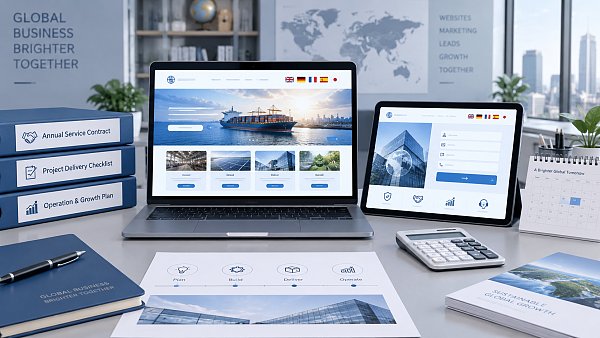
The ownership of assets under an annual model should also be verified carefully. The registrant of the domain name, website source files or exported data, copyrights for images and copy, analytics tool accounts, Google Ads accounts, and management permissions for pixels and conversion events should not be determined solely based on verbal statements. Platform-based products may not need to deliver all underlying source code, but they should at least explain how website data can be exported after contract termination, how the domain name can be transferred, how historical content and leads can be retained, and whether migration incurs additional fees.
Project-based settlement does not mean low one-time costs
The advantage of the project-based model is that scope, timeline, and acceptance criteria are relatively easy to define clearly. Purchasers can compare quotations from different providers based on the number of pages, number of languages, volume of product information, functional modules, interface complexity, and go-live time, and can also incorporate development costs into a clearly defined project budget.
The issue is that foreign trade websites often reveal actual requirements only after launch. Overseas customers may follow different access paths than expected, requiring changes to navigation, form fields, or inquiry assignment methods; new products entering the market may require additional landing pages; after advertising begins, existing pages may not be suitable for receiving traffic; and multilingual content may need to be supplemented rather than simply translated. If these changes are not included in the original contract, they will become secondary development or per-service costs.
When a project quotation is particularly low, purchasers should not focus only on the homepage design result, but should check whether the quotation excludes key work: multi-device adaptation, on-site search, basic technical SEO, form email configuration, 404 pages and redirects, image compression, traffic analytics, Cookie notices, website backups, and the post-launch defect correction period. Some project contracts cover only “completion of page production,” but do not cover compatibility handling in real environments or subsequent maintenance. While this may appear to save the initial budget, the lifecycle cost may be higher.
Situations better suited to a project-based model
When website requirements are stable, launch objectives are clear, and internal content and technical management capabilities are in place, project-based settlement offers greater advantages. For example, a company may already have a mature corporate website system and only need to build an English website for a particular product line; it may already have an independent advertising agency or SEO team, with the website provider responsible only for development; or a group may have strict requirements for supplier qualification, acceptance, and payment milestones, requiring work to be divided into auditable milestones.
Such projects should avoid describing requirements as abstract “internationalized design” or a “marketing website.” Procurement documents need to specify verifiable items: the number of pages and templates, implementation methods for language versions, product filtering logic, form fields, email notification rules, backend role permissions, third-party tool interfaces, browser and mobile compatibility scope, and the post-launch defect correction period. Elements with uncertain requirements should not be treated as if a fixed total price were possible; instead, a change mechanism and daily labor rates should be listed separately.
Situations better suited to annual cooperation
When a company treats its independent website as a long-term customer acquisition channel, and website content, traffic sources, and conversion pages require continual adjustment, annual services are generally smoother. This is particularly true in scenarios involving numerous product SKUs, multiple export markets, frequent language updates, or integration between the website and Google SEO, Google Ads, and social media landing pages, where a disconnect between development and operations significantly increases collaboration costs.
Annual cooperation is also suitable for companies without dedicated website administrators. The premise is not to outsource all work, but to establish the necessary collaboration mechanism: the company must still designate persons responsible for product information, pricing policies, certification documents, and lead follow-up; the provider is responsible for turning this information into pages, technical configurations, or promotional actions. If the company cannot provide accurate information in a timely manner, annual fee services cannot replace business decisions themselves.
For websites using AI website-building or SaaS platforms, annual fees often also include ongoing platform iteration, hosted environments, and basic technical support. This model is suitable for businesses that prioritize launch efficiency and backend ease of use, but purchasers should clearly understand template customization capabilities, boundaries of custom functionality, page performance control methods, and future data availability when migrating away from the platform. Platform convenience and vendor lock-in risk are not contradictory; both need to be assessed at the same time.
In practice, a hybrid settlement model is more prudent
Many foreign trade websites are not suited to an either-or choice between “annual payment” and “project-based models.” A common and more manageable approach is to accept the initial construction phase as a project, sign an annual agreement for website operation, technical maintenance, and continuous optimization, and settle separately through change orders for new functions, interface development, or work exceeding the agreed workload.
The core of this arrangement is to avoid two extremes: first, forcing all work into a fixed project total price, resulting in no one providing ongoing maintenance after delivery; second, including all vaguely scoped development work in the annual fee, weakening acceptance criteria. The contract should at least list separately the construction fee, platform or hosting fee, maintenance fee, content service fee, promotional operations fee, and advertising media fee. Advertising spend should be listed separately from agency service fees, and the account top-up process, invoicing entity, balance ownership, and account management permissions should also be clear.
When comparing quotations, first standardize the cost basis
Quotations under different foreign trade website agency models are difficult to compare directly because some providers quote an all-inclusive first-year price, some quote only development fees, and some charge separately for templates, hosting, maintenance, and optimization. Procurement decisions should extend the comparison period to at least one complete operating year and list all unavoidable cost items: initial construction, domain names and servers, system licensing, maintenance renewals, content updates, feature iteration, data tools, outsourced promotional operations, and potential migration costs.
More importantly, “annual service fees” should not be simply regarded as recurring expenses, nor should “total project price” be regarded as the full cost. If the former covers stable operations and maintenance and effective ongoing work, it may reduce subsequent fragmented procurement; even if the latter is paid in full as a one-time payment, operating, modification, and promotion costs will still arise. What should truly be compared is which contract can support the website's continued use with clearer responsibility boundaries under established business objectives, rather than which payment method appears cheaper on the day the contract is signed.
Ultimately, foreign trade website agency procurement should focus on three matters: whether website assets are within the company's controllable scope, whether the service scope can be accepted and verified, and who is responsible for ongoing operations after the website is launched. When boundaries are clear, both annual and project-based models can work; when boundaries are vague, any low-price solution may amplify costs during subsequent changes, renewals, and migration.
Related Articles


Related Products
 Yiyingbao SaaS Intelligent Website Building and Marketing SystemYiyingbao SaaS Intelligent Website Building and Marketing System, AI-powered no-code website building, rapid creation of multilingual B2B international websites in 10 minutes, global server acceleration, AI-powered SEO optimization, helping businesses connect efficiently with global markets. The perfect integration of technology and operation makes building an international trade website remarkably simple
 AI+SEM Intelligent Advertising Marketing SystemAI+SEM drives intelligent ad creation, empowering full-funnel precision advertising marketing. The system automatically generates weekly/monthly reports, AI recommends keywords and target countries, monitors core metrics in real-time with intelligent alerts, and enables one-click high-conversion ad solutions to help quickly acquire customers and improve ROI.
 AI+SEO Dual-Engine System Optimization ServicesYiyingbao’s AI+SEO dual-engine optimization system helps foreign trade enterprises acquire high-quality organic traffic through AI-powered keyword research, content generation, and comprehensive technical optimization, significantly improving search rankings and conversion rates.
 AI+SNS Social Media Marketing SystemYingbao AI+SNS Social Media Marketing System - Precision social capture for the social media era. Supports one-click content synchronization across major platforms like Facebook and LinkedIn. AI intelligently rewrites posts for enhanced relevance. 24/7 AI customer service and user profiling analysis empower businesses to efficiently expand into global markets.
 AI+SEO营销解决方案易营宝AI+SEO营销解决方案,通过AI批量写作、智能生成TDK、精准关键词扩词等功能,全面优化网站SEO效果,提升流量与转化率。助力企业构建高效智能网站新生态。
 AI+SEM Advertising Marketing SolutionsAI+SEM Advertising Marketing Solution leverages AI technology to deeply empower SEM ad campaigns. It automatically generates weekly/monthly reports using AI, presenting account data across multiple dimensions for comprehensive insights into campaign performance and trends. The system precisely recommends keywords and target countries, intelligently generates high-conversion ad copy, and enables one-click activation of efficient campaign plans to help businesses rapidly acquire customers. Simultaneously, it monitors core metrics in real time, intelligently identifies abnormal fluctuations, and issues timely alerts to ensure stable, high-return advertising results.
 Domain Name ServicesEasyWin provides professional domain name services, including intelligent queries, one-stop registration, brand protection, and full lifecycle management, helping businesses build a digital brand image.
 EasyOperate B2C Cross-Border E-Commerce Platform & Independent WebsiteEasyStore B2C Cross-border E-commerce Independent Store is an intelligent website building and cross-border e-commerce integrated solution independently developed by EasyStore Information Technology (Beijing) Co., Ltd. The system is specially designed for small and medium-sized as well as large export enterprises, integrating 'website building, operation, marketing, advertising, and conversion' into one, helping enterprises quickly establish cross-border e-commerce independent stores to achieve brand globalization and global sales growth.
The platform supports multiple languages, multiple currencies, and multi-channel marketing, with built-in AI intelligent translation and SEO optimization systems, suitable for mainstream markets such as Southeast Asia, Europe and America, Latin America, and the Middle East, assisting Chinese manufacturing enterprises in efficiently deploying international e-commerce strategies. SSL证书易营宝提供专业SSL安全证书服务,包括单域名和泛域名证书,确保网站数据传输加密、身份验证和完整性保护,助力企业建立安全可信的在线业务环境。









