









- Can the average annual growth rate reflect real opportunities in overseas markets?Oct 07, 2026View details
- Which customer acquisition channels will be affected by cross-border marketing trends in 2026?Sep 06, 2026View details
- Which homogenization risks should be considered in an analysis of the AI-powered website building industry?Aug 30, 2026View details
- How Will AI Marketing Trends 2026 Change Advertising Budget AllocationAug 28, 2026View details
- Is the EV SSL certificate market shrinking or upgrading? How should companies assess certificate procurement?Aug 11, 2026View details
- Why the old AMP SEO 2020 practices no longer work and what has changed in current optimization prioritiesAug 02, 2026View details
How to Evaluate an Integrated SEO and SEM Agency? Focus on Strategy, Execution, and Data Transparency
When choosing an SEO and SEM agency, the real challenge is not finding a provider that “does SEO and advertising,” but determining whether it can connect website development, content, organic search, paid campaigns, and sales leads into a sustainably operating system. This is especially relevant for export manufacturers, cross-border brands, and B2B service providers: Google rankings, ad clicks, and inquiry volume are not the same outcome. Traffic does not necessarily mean qualified prospects; inquiries do not necessarily mean the sales team can handle them.
If procurement only compares quotations side by side, it is easy to fall into two extremes: one provider promises rankings for a large number of keywords but does not explain whether those keywords have purchase intent; another presents impressive ad-click data but cannot clearly explain which country, product page, or audience the spend ultimately reached. When evaluating an integrated SEO and SEM agency, the key is whether its strategy fits the business, its execution is practical, and its data is sufficiently transparent.
First determine whether they understand “traffic” or your conversion path
A common misconception in overseas customer acquisition projects is to split SEO and SEM into two unrelated task lists: the SEO team writes articles and builds pages; the advertising team purchases keywords and adjusts bids; while the website is maintained by a third party. Each item may appear to deliver results, but in practice, ads may lead to the homepage, SEO content may have no inquiry entry point, and form leads may not be traceable to their sources. With this type of cooperation, even if short-term data improves, it is difficult to determine whether the spending is worthwhile.
A more reliable SEO and SEM agency will first ask several specific questions: What are the gross margins and delivery boundaries of the main products? Is the target market North America, Europe, or the Middle East? Do customers search for suppliers by model number, application scenario, or pain point? What qualifies as a valid inquiry according to the sales team? If an agency only asks about budget, industry, and the number of keywords during the requirements discussion, its subsequent strategy will most likely be rather broad.
For example, the search journey for industrial equipment exporters is usually long. Customers may first search for process solutions or equipment types, then compare technical specifications, certification documents, delivery times, and supply capacity. In this case, SEO content cannot consist only of product-name pages, and SEM should not place all of the budget on the broadest industry terms. Instead, advertising can first test high-intent model keywords, purchase-oriented long-tail keywords, and remarketing audiences, while SEO gradually fills in application pages, technical documentation pages, FAQs, and country- or language-version pages. The two channels become increasingly precise only when they share search-term data.
When evaluating strategy, focus on “trade-offs,” not on how thick the proposal is
A valuable integrated plan should clearly explain what to do first, what to defer, and why priorities are arranged this way. When a new site has a weak foundation, building a large number of backlinks or launching dozens of languages at once is often less effective than first resolving indexing, speed, site structure, core landing pages, and conversion forms. If the product range is complex, it may not be appropriate to allocate resources evenly. Priority should be given to categories with clearer demand, stable supply, and more complete page materials for validation.
Buyers can ask service providers to submit a discussable preliminary roadmap, but there is no need to place blind faith in commitments that “guarantee a certain number of rankings” every month. More importantly, check how keywords are segmented; what roles organic search and advertising respectively play; which pages are used for customer acquisition and which are used to build trust; and whether language, currency, logistics, and compliance information need to be localized for different countries. A technical procurement page for German-speaking markets and a distributor recruitment page for Southeast Asia clearly cannot simply be machine-translated and published as copies.
Some projects also require assessment of more specialized content topics. For example, for companies related to environmental protection equipment, energy-saving technologies, or green investment, content teams seeking to cover industry background and funding logic should not merely pile up popular “environmental protection” keywords. They may refer to materials such as investment research on environmental industry funds within the energy conservation and environmental protection sector to organize the industry context, and then have the company confirm the factual boundaries. The value of professional content lies in helping potential customers understand the procurement context, not in rewriting research reports into marketing slogans.
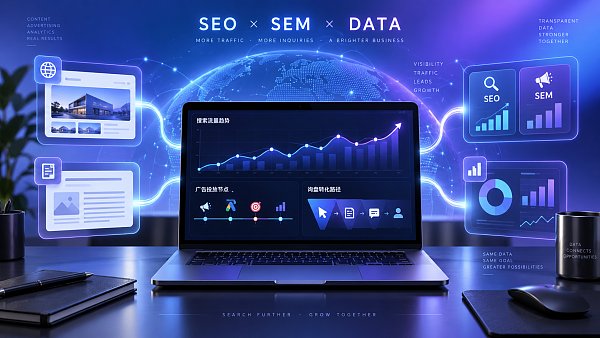
Execution capability is reflected in details such as website development and landing pages
Whether SEO and SEM integration can operate effectively, the website is usually the most underestimated element. Many companies already have corporate websites, but page changes must wait in line, adding multilingual versions is difficult, and advertising landing pages cannot be configured independently. As a result, campaign teams can only direct traffic to mismatched pages. If an agency does not have website development or technical coordination capabilities, it should at least clearly list the items, interfaces, and timelines requiring cooperation from the client's IT team, rather than broadly attributing “website issues” to the client.
When assessing the execution team, you can directly review three items: a sample page that has been optimized, an ad account optimization record, and a monthly review report. For the page sample, examine whether the information architecture, title, and body content align with search intent, whether inquiry buttons are clear, and whether technical documents are easy to obtain. For account records, check whether negative keywords, geographic and device adjustments, search-term cleanup, and creative testing are continuously carried out. For review reports, see whether issues lead to next-step actions, rather than consisting only of screenshots of impressions, clicks, and rankings.
Since its establishment in 2013, Yiyingbao Information Technology (Beijing) Co., Ltd. has provided integrated services for intelligent website development, SEO optimization, advertising campaigns, and social media marketing, covering multilingual websites, cross-border online stores, and overseas marketing scenarios. For companies that need to handle website development and promotion at the same time, the significance of this type of integrated platform is not only to reduce the number of suppliers, but also to enable website pages, advertising landing pages, and search optimization to be adjusted within the same operating rhythm. Of course, during procurement, it is still necessary to confirm who is actually responsible for strategy, content, technology, and account operations, and avoid equating “platform capabilities” with “project delivery capabilities.”
Data transparency determines whether cooperation can continue
Advertising account ownership is an issue that must be clarified before signing a contract. A more prudent approach is for the company to retain administrator access to advertising accounts, website analytics tools, search management tools, and key data assets, while the agency operates under authorization. This ensures that even if the service team is replaced in the future, historical campaign data, conversion events, and search performance will not be lost along with it.
Transparency does not mean sending dozens of pages of reports every week; it means being able to answer the questions management truly cares about: Which markets and pages did this month's budget primarily target? Which topics drove organic traffic growth? Where did inquiries through forms, WhatsApp, phone calls, or email come from? Why have invalid leads increased? Has sales feedback been incorporated into keyword and advertising strategies? If a company does not yet have a CRM, it should at least establish lead registration rules. Otherwise, “conversion” remains limited to form submissions, making it impossible to judge subsequent quality.
A low quotation does not necessarily mean a low total cost
When comparing quotations, service fees, advertising media costs, content production, translation and localization, website development, data tracking, and third-party tools should be reviewed separately. Some low-price plans exclude core work, requiring additional payment for each added landing page, language, or conversion event; other plans use fixed content templates across all industries, apparently saving budget but actually affecting page quality and communication efficiency.
A more practical selection method is to first set a validation period and clear phased objectives: in the early stage, establish the data chain, core pages, and keyword direction; in the middle stage, expand content based on advertising search terms and inquiry feedback; then decide whether to expand country sites, budget, and social media coordination. Whether an agency is suitable depends not only on its first proposal, but also on whether it is willing to clearly explain uncertainties and can make timely adjustments when data deviates.
Ultimately, a good SEO and SEM partnership is not about “outsourcing promotion,” but about enabling companies to retain their judgment over markets, data, and customer feedback. Service providers that can clearly explain strategy, execute thoroughly, and return data to the company are usually more worthy of entering the next round of evaluation than teams that promise more keywords and more clicks on their quotations.
Related Articles



Related Products
 Yiyingbao SaaS Intelligent Website Building and Marketing SystemYiyingbao SaaS Intelligent Website Building and Marketing System, AI-powered no-code website building, rapid creation of multilingual B2B international websites in 10 minutes, global server acceleration, AI-powered SEO optimization, helping businesses connect efficiently with global markets. The perfect integration of technology and operation makes building an international trade website remarkably simple
 AI+SEM Intelligent Advertising Marketing SystemAI+SEM drives intelligent ad creation, empowering full-funnel precision advertising marketing. The system automatically generates weekly/monthly reports, AI recommends keywords and target countries, monitors core metrics in real-time with intelligent alerts, and enables one-click high-conversion ad solutions to help quickly acquire customers and improve ROI.
 AI+SEO Dual-Engine System Optimization ServicesYiyingbao’s AI+SEO dual-engine optimization system helps foreign trade enterprises acquire high-quality organic traffic through AI-powered keyword research, content generation, and comprehensive technical optimization, significantly improving search rankings and conversion rates.
 AI+SNS Social Media Marketing SystemYingbao AI+SNS Social Media Marketing System - Precision social capture for the social media era. Supports one-click content synchronization across major platforms like Facebook and LinkedIn. AI intelligently rewrites posts for enhanced relevance. 24/7 AI customer service and user profiling analysis empower businesses to efficiently expand into global markets.
 AI+SEO营销解决方案易营宝AI+SEO营销解决方案,通过AI批量写作、智能生成TDK、精准关键词扩词等功能,全面优化网站SEO效果,提升流量与转化率。助力企业构建高效智能网站新生态。
 AI+SEM Advertising Marketing SolutionsAI+SEM Advertising Marketing Solution leverages AI technology to deeply empower SEM ad campaigns. It automatically generates weekly/monthly reports using AI, presenting account data across multiple dimensions for comprehensive insights into campaign performance and trends. The system precisely recommends keywords and target countries, intelligently generates high-conversion ad copy, and enables one-click activation of efficient campaign plans to help businesses rapidly acquire customers. Simultaneously, it monitors core metrics in real time, intelligently identifies abnormal fluctuations, and issues timely alerts to ensure stable, high-return advertising results.
 Domain Name ServicesEasyWin provides professional domain name services, including intelligent queries, one-stop registration, brand protection, and full lifecycle management, helping businesses build a digital brand image.
 EasyOperate B2C Cross-Border E-Commerce Platform & Independent WebsiteEasyStore B2C Cross-border E-commerce Independent Store is an intelligent website building and cross-border e-commerce integrated solution independently developed by EasyStore Information Technology (Beijing) Co., Ltd. The system is specially designed for small and medium-sized as well as large export enterprises, integrating 'website building, operation, marketing, advertising, and conversion' into one, helping enterprises quickly establish cross-border e-commerce independent stores to achieve brand globalization and global sales growth.
The platform supports multiple languages, multiple currencies, and multi-channel marketing, with built-in AI intelligent translation and SEO optimization systems, suitable for mainstream markets such as Southeast Asia, Europe and America, Latin America, and the Middle East, assisting Chinese manufacturing enterprises in efficiently deploying international e-commerce strategies. SSL证书易营宝提供专业SSL安全证书服务,包括单域名和泛域名证书,确保网站数据传输加密、身份验证和完整性保护,助力企业建立安全可信的在线业务环境。









