









- Hapag-Lloyd’s $4.2 billion acquisition of ZIM faces a closing delay; ZIM reports third-quarter net profit of $830 millionNov 24, 2026View details
- SCFI falls for a third straight week to 3,503.78 points, with blank sailings on trans-Pacific routes rising to 10Nov 24, 2026View details
- Lazada 11.11 Mega Sale: LazMall Contributes Nearly Two-Thirds of GMVNov 23, 2026View details
- Shein’s European Revenue Falls 16% as Tighter Rules on Low-Value Direct Shipments Take EffectNov 23, 2026View details
- EU Low-Value Parcel Rules Impact Cargo Flows: Air Freight Volume from China to Europe Down 17% in OctoberNov 23, 2026View details
- Indonesia and the EU Sign Comprehensive Economic Partnership Agreement, 90.4% of Tariff Lines to Become Duty-Free ImmediatelyNov 23, 2026View details
How should global enterprises evaluate multi-site management capabilities when choosing a CMS?
How Should Global Enterprises Evaluate Multi-Site Management Capabilities When Choosing a CMS?
When evaluating a CMS for global enterprises, multi-site management capabilities are essential. Technical teams should focus on centralized control, multilingual support, permission separation, and system scalability to ensure efficient global operations. More importantly, can the system let headquarters set the rules while giving regional teams the autonomy they need?
Multi-site management is about more than “using one backend to build multiple websites.” When a company operates a brand website, regional sites, and advertising landing pages at the same time, product information may need to be shared, while prices and contact details vary by market. If every product specification update from headquarters has to be copied site by site, or a single template change causes pages across all regions to break, the more sites there are, the harder it becomes to control maintenance costs.
First, Determine What Sites Can Share and What They Can Manage Independently
When evaluating a system, assess content, templates, and settings separately. Product specifications and brand assets are suitable for centralized management, while regional contact details, form fields, and promotional information may need to be managed separately for each site. Technical teams can ask the vendor to demonstrate what happens after headquarters updates a product detail: which sites update automatically, which fields can be overridden locally, and whether changes to the original content can still be tracked after an override.
Template inheritance should also be tested. For example, what happens to regional sites with customized footers when headquarters updates the footer? Does the system support previewing the impact, selecting which sites to publish to, and rolling back changes? If sharing depends solely on copying pages, it may seem flexible, but versions can easily diverge over time. If all pages are forced to sync, local marketing teams may have little room to maneuver.
The domain architecture should also be decided in advance. Using separate domains, subdomains, or subdirectories for different countries or languages affects deployment, certificate management, analytics, and migration. There is no single structure that suits every company. The key is to confirm that the CMS supports the planned domain configuration, redirect rules, and future changes.
Multilingual Management Must Cover Updates, Not Just Translation
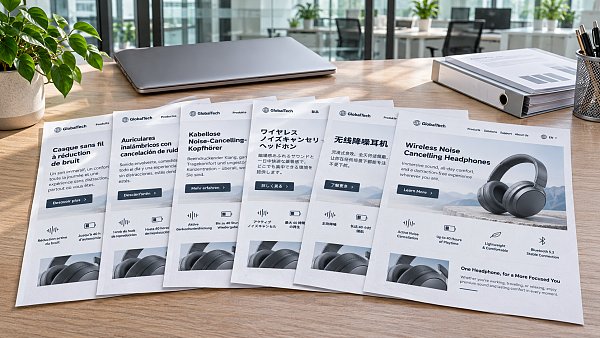
One of the most easily underestimated challenges with multilingual sites is managing versions after source content is updated. When product specifications, lead times, or certification information changes, can the system flag the affected language versions? If a translation is not yet complete, will the old page remain live, be temporarily taken down, or prompt an editor to take action? These workflows reveal more about practical maintenance capabilities than the number of supported languages.
Check that language selectors link to the corresponding page rather than always returning users to the homepage. Confirm whether titles, descriptions, and URLs can be configured independently for each language, and whether the system correctly outputs hreflang tags for language and regional variants. For right-to-left languages such as Arabic, test the navigation, forms, and mobile layouts directly rather than simply checking whether the backend offers a language option.
Machine translation can speed up the preparation of initial drafts, but technical specifications, industry terminology, and marketing claims still require human review. This is especially important for manufacturing websites: mistranslating a unit, model number, or condition of use can cause problems beyond the reading experience.
Apply Permission Controls to Pages, Data, and Publishing Actions
Multi-region collaboration usually involves headquarters, regional operations staff, translators, and external agencies. Simply distinguishing between “administrators” and “editors” is often insufficient. Demonstrate whether users can edit only designated sites, view inquiries from other regions, or publish content without changing templates.
Test permissions using real workflows. Have a regional editor modify a page, then have headquarters review and publish it. Next, simulate an agency account expiring and check whether its activity records are retained after the account is disabled. Audit logs should at least help teams trace who changed or published what and when, and explain how to recover from an accidental change. If the company already has a centralized identity management system, confirm how single sign-on, account deprovisioning, and permission synchronization are integrated.
Inquiries and customer information should be assessed separately: verify whether data storage locations, access scope, backup, and deletion mechanisms meet project requirements. Where privacy obligations differ across markets, verify compliance against local requirements and the company’s actual data flows. Do not rely solely on a vendor’s generic compliance claims.
Evaluate Website Capabilities Within the Marketing and Systems Integration Workflow
After a site goes live, technical teams must also manage form submissions, lead routing, ad tracking, and integration with customer relationship management systems. When evaluating a CMS, check its API documentation, rate limits, authentication methods, and error-retry mechanisms. Confirm that leads include necessary fields such as the referring page, language, market, and consent status. Testing should cover not only successful submissions but also API failures, to see whether data is lost and can be resubmitted.
Search and promotion capabilities should also be checked for each site. Can each page have its own canonical URL, redirects, and sitemap? Can advertising landing pages be iterated without affecting the main site's templates? Can tracking codes be configured by region? The availability of these settings does not guarantee search indexing or advertising results; content quality, technical implementation, and ongoing operations still require continuous verification.
For companies seeking to coordinate their websites and overseas customer acquisition, an integrated service can reduce handoffs between multiple vendors. For example, 易营宝 provides services such as intelligent website building, multilingual websites, SEO, and advertising marketing. When evaluating this type of solution, still ask the vendor to explain site configuration, data integrations, and the scope of deliverables for each service in the context of the actual project. Do not equate the stated service scope with specific functionality.
Use a Pilot to Validate Delivery and Exit Costs
Before making a purchase, consider piloting one headquarters site and one regional site with local variations. The pilot should cover content inheritance, translation updates, permission approvals, form integrations, and page rollback. Involving the people who will actually edit the sites is more likely to uncover limitations than watching a standardized demo.
Also ask the vendor to clearly itemize how fees are calculated for the number of sites and languages, storage, traffic, API calls, and custom development, and confirm who is responsible for upgrades, maintenance, and incident response. Ask what formats are available for exporting content, images, URL mappings, and inquiry data, and which templates or features would need to be rebuilt during migration. A successful launch is only the starting point. When the business expands, the organization changes, or the platform is replaced, the company’s ability to retain control of its content and data is the baseline worth validating when choosing a multi-site solution.
Related Articles
 How should global enterprises evaluate multi-site management capabilities when choosing a CMS?
 When Should Chinese Companies Use a Headless CMS for Global Websites?
 How Does Permission Management Differ Between Enterprise Multilingual CMS Platforms and Standard Systems?


Related Products
 Yiyingbao SaaS Intelligent Website Building and Marketing SystemYiyingbao SaaS Intelligent Website Building and Marketing System, AI-powered no-code website building, rapid creation of multilingual B2B international websites in 10 minutes, global server acceleration, AI-powered SEO optimization, helping businesses connect efficiently with global markets. The perfect integration of technology and operation makes building an international trade website remarkably simple
 AI+SEM Intelligent Advertising Marketing SystemAI+SEM drives intelligent ad creation, empowering full-funnel precision advertising marketing. The system automatically generates weekly/monthly reports, AI recommends keywords and target countries, monitors core metrics in real-time with intelligent alerts, and enables one-click high-conversion ad solutions to help quickly acquire customers and improve ROI.
 AI+SEO Dual-Engine System Optimization ServicesYiyingbao’s AI+SEO dual-engine optimization system helps foreign trade enterprises acquire high-quality organic traffic through AI-powered keyword research, content generation, and comprehensive technical optimization, significantly improving search rankings and conversion rates.
 AI+SNS Social Media Marketing SystemYingbao AI+SNS Social Media Marketing System - Precision social capture for the social media era. Supports one-click content synchronization across major platforms like Facebook and LinkedIn. AI intelligently rewrites posts for enhanced relevance. 24/7 AI customer service and user profiling analysis empower businesses to efficiently expand into global markets.
 AI+SEO营销解决方案易营宝AI+SEO营销解决方案,通过AI批量写作、智能生成TDK、精准关键词扩词等功能,全面优化网站SEO效果,提升流量与转化率。助力企业构建高效智能网站新生态。
 AI+SEM Advertising Marketing SolutionsAI+SEM Advertising Marketing Solution leverages AI technology to deeply empower SEM ad campaigns. It automatically generates weekly/monthly reports using AI, presenting account data across multiple dimensions for comprehensive insights into campaign performance and trends. The system precisely recommends keywords and target countries, intelligently generates high-conversion ad copy, and enables one-click activation of efficient campaign plans to help businesses rapidly acquire customers. Simultaneously, it monitors core metrics in real time, intelligently identifies abnormal fluctuations, and issues timely alerts to ensure stable, high-return advertising results.
 Domain Name ServicesEasyWin provides professional domain name services, including intelligent queries, one-stop registration, brand protection, and full lifecycle management, helping businesses build a digital brand image.
 EasyOperate B2C Cross-Border E-Commerce Platform & Independent WebsiteEasyStore B2C Cross-border E-commerce Independent Store is an intelligent website building and cross-border e-commerce integrated solution independently developed by EasyStore Information Technology (Beijing) Co., Ltd. The system is specially designed for small and medium-sized as well as large export enterprises, integrating 'website building, operation, marketing, advertising, and conversion' into one, helping enterprises quickly establish cross-border e-commerce independent stores to achieve brand globalization and global sales growth.
The platform supports multiple languages, multiple currencies, and multi-channel marketing, with built-in AI intelligent translation and SEO optimization systems, suitable for mainstream markets such as Southeast Asia, Europe and America, Latin America, and the Middle East, assisting Chinese manufacturing enterprises in efficiently deploying international e-commerce strategies. SSL证书易营宝提供专业SSL安全证书服务,包括单域名和泛域名证书,确保网站数据传输加密、身份验证和完整性保护,助力企业建立安全可信的在线业务环境。









