









- Which customer acquisition channels will be affected by cross-border marketing trends in 2026?Sep 06, 2026View details
- Which homogenization risks should be considered in an analysis of the AI-powered website building industry?Aug 30, 2026View details
- How Will AI Marketing Trends 2026 Change Advertising Budget AllocationAug 28, 2026View details
- Is the EV SSL certificate market shrinking or upgrading? How should companies assess certificate procurement?Aug 11, 2026View details
- Why the old AMP SEO 2020 practices no longer work and what has changed in current optimization prioritiesAug 02, 2026View details
- How to Choose Topics for an Industry News Section to Attract More Organic Search TrafficJul 29, 2026View details
How to evaluate a cross-border e-commerce website development company? First check whether payment, logistics, and multilingual capabilities match.
How to evaluate a cross-border e-commerce platform development company? Don't rush to look at the quote.
When choosing a cross-border e-commerce platform development company, many businesses first inquire about prices and then look at case studies. This order is not the best approach. What truly influences the outcome is often not the visual appeal of the homepage, but rather the payment methods, logistics, multilingual capabilities, and whether they are truly compatible with the target market.
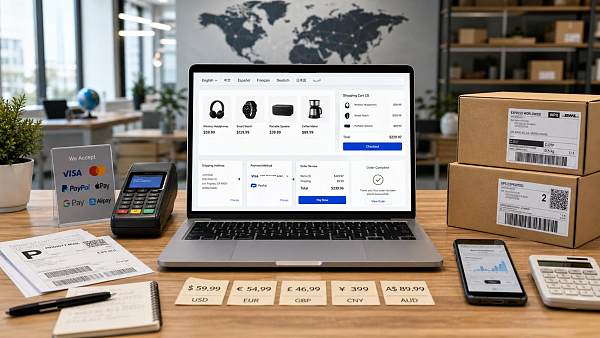
Recent project changes indicate that the difference between cross-border e-commerce platform development companies has shifted from website building speed to operational capabilities. Whether the platform can successfully receive payments, fulfill orders on time, and ensure content is understandable to local users directly determines conversion rates after launch.
Therefore, when evaluating cross-border e-commerce platform development companies, a more reasonable approach is to first consider business compatibility, then system capabilities, and finally budget. Service providers selected in this way typically have lower rework and hidden costs later on.
First, determine the target market, then determine if the cross-border e-commerce platform development company is a good fit.
The requirements for cross-border e-commerce vary greatly depending on the region. For the North American market, the focus is often on credit cards, PayPal, tax display, and fulfillment timeliness. For the Southeast Asian market, local wallets, cash on delivery, and mobile experience are more crucial. For the European market, compliance, taxation, and language support are often indispensable.
This also means that cross-border e-commerce platform development companies cannot simply "build a website." They need to understand the consumer habits, payment preferences, delivery expectations, and content expression styles of the target country. Otherwise, the system may appear complete on the surface, but actual conversion rates will be very difficult to achieve.
During the screening phase, requirements can be broken down into three layers: sales region, product attributes, and operating model. Region determines language and payment methods, product attributes determine logistics and taxes, and the operating model determines the site structure and marketing interfaces. Only by clearly defining these three layers can the evaluation of cross-border e-commerce platform development companies be based on a solid foundation.
Payment capability is the first hurdle in evaluating a cross-border e-commerce platform development company.
Many online shopping mall projects experience poor conversion rates after launch, and the problem isn't with traffic, but rather with order drops during the payment process. Users select their products, proceed to checkout, and find that familiar payment methods are unavailable or the payment process is too lengthy, easily leading to lost orders.
Therefore, when evaluating a cross-border e-commerce platform development company, first check which mainstream payment interfaces it supports, whether it has localized payment expansion capabilities, and whether it supports multiple currencies, tax calculation, risk control verification, and refund processes. These are not optional extras, but basic capabilities.
Focus on checking these four types of issues
- Does it support common payment methods in the target market, such as credit cards, PayPal, local wallets, or installment payments?
- Does it support multi-currency settlement, exchange rate display, and tax/fee linkage?
- Does it have mechanisms for handling chargebacks, risk control interception, and abnormal order warnings?
- After a payment fails, is there a clear remedial path and data tracking?
If a cross-border e-commerce platform development company can only access a few general interfaces but cannot expand payment solutions according to regions, then it may have to redevelop them every time it enters a new market, which will amplify the costs and time.
Logistics coordination capabilities determine whether an online store can generate stable transactions.
Cross-border e-commerce doesn't end with a successful order. Users are more concerned about transparent shipping costs, reliable delivery times, and package tracking. Many procurement teams, when choosing a cross-border e-commerce platform development company, tend to treat logistics as a secondary issue, when in fact it's a crucial part of the transaction experience.
A mature cross-border e-commerce platform development company typically considers logistics interfaces, shipping templates, warehousing rules, and order status management as a whole, rather than just focusing on the front-end pages. This is because if logistics rules become disconnected from products, promotions, and inventory, after-sales pressure will increase rapidly.
During the evaluation, it is recommended to focus on
- Can it connect with different fulfillment models such as international express, dedicated lines, parcels, and overseas warehouses?
- Can you set shipping rules based on country, weight, volume, and region?
- Can the estimated delivery time, freight, and customs clearance information be accurately displayed on the front end?
- Can it achieve delivery notification, tracking synchronization, abnormal shipment alerts, and after-sales linkage?
If a cross-border e-commerce platform development company only provides basic order functionality but cannot handle complex logistics rules, then as the business expands, the operations team will have to manually patch the vulnerabilities. Such a system may seem usable, but it will actually struggle to support scalable growth.
Multilingual capabilities are more than just translating web pages.
One of the most common misconceptions when evaluating cross-border e-commerce platform development companies is that multilingualism simply means "translating Chinese into a foreign language." A truly effective multilingual e-commerce platform needs to cover front-end content, product details, payment prompts, logistics notifications, marketing pages, and search rules.
An even clearer signal is that, when selling the same product, the focus of copywriting varies drastically across different countries. Some look at specifications first, some at the intended use case, and others prioritize after-sales service and delivery promises. If a cross-border e-commerce platform development company lacks a localized approach, its multilingual pages are often merely "literally readable," lacking persuasiveness.
Practical judgment criteria
- Does it support independent language sites, independent URL rules, and search indexing settings?
- Does it support unified management of multilingual products, categories, blogs, and event pages?
- Does it support switching currencies, taxes, shipping information, and customer service access by region?
- Does it have an SEO-friendly multilingual structure, rather than relying solely on plugin translation?
For businesses that need to generate organic traffic long-term, multilingual capabilities should be considered in conjunction with SEO. Otherwise, even if the page goes live, if search engines cannot correctly recognize the language version, the effectiveness of subsequent promotion will be significantly limited.
Don't overlook system scalability and marketing synergy
Many companies hire cross-border e-commerce platform development companies, focusing only on their initial launch needs. However, six months later, when they want to implement advertising, SEO, or social media campaigns, they find that the system interfaces are insufficient and data cannot be integrated. This results in marketing and the e-commerce platform becoming two isolated systems.
A more reliable selection criterion is to see if the cross-border e-commerce platform development company can integrate website building, promotion, and data analysis into a unified framework. In particular, conversion tracking, form data analysis, ad attribution, search engine optimization, and content management should ideally be planned holistically from the outset.
Taking YiYingBao as an example, as an integrated website and marketing service provider, its self-developed cloud-based intelligent website building system, cross-border e-commerce system, AI advertising and marketing system, and AI+SEO/GEO optimization system are suitable for companies that need to balance independent website construction and overseas customer acquisition. For brands that want to cover markets in North America, Europe, Southeast Asia, Japan, South Korea, the Middle East, and Latin America, this integrated solution makes it easier to reduce redundant investment.
A list to quickly select cross-border e-commerce platform development companies
If you are in the supplier evaluation stage, you can directly score them according to the checklist below. This is more effective than just looking at the demo site and is closer to real business needs.
Ultimately, the judgment should be based on business results.
When evaluating cross-border e-commerce platform development companies, the core focus isn't on who offers the most comprehensive explanation, but rather on who is best suited to the current stage of the business. If the company is preparing to enter a new market, prioritize payment options and multilingual support. If it already has stable orders, focus on logistics coordination and system scalability. If the company plans for long-term brand growth, also consider SEO, advertising, and content operation capabilities.
Ultimately, a reliable cross-border e-commerce platform development company doesn't just build the platform; it makes it truly functional. First, clearly verify the company's payment, logistics, and multilingual capabilities before discussing pricing and case studies. This approach usually leads to a more stable selection and is closer to long-term growth goals.
Related Articles



Related Products
 Yiyingbao SaaS Intelligent Website Building and Marketing SystemYiyingbao SaaS Intelligent Website Building and Marketing System, AI-powered no-code website building, rapid creation of multilingual B2B international websites in 10 minutes, global server acceleration, AI-powered SEO optimization, helping businesses connect efficiently with global markets. The perfect integration of technology and operation makes building an international trade website remarkably simple
 AI+SEM Intelligent Advertising Marketing SystemAI+SEM drives intelligent ad creation, empowering full-funnel precision advertising marketing. The system automatically generates weekly/monthly reports, AI recommends keywords and target countries, monitors core metrics in real-time with intelligent alerts, and enables one-click high-conversion ad solutions to help quickly acquire customers and improve ROI.
 AI+SEO Dual-Engine System Optimization ServicesYiyingbao’s AI+SEO dual-engine optimization system helps foreign trade enterprises acquire high-quality organic traffic through AI-powered keyword research, content generation, and comprehensive technical optimization, significantly improving search rankings and conversion rates.
 AI+SNS Social Media Marketing SystemYingbao AI+SNS Social Media Marketing System - Precision social capture for the social media era. Supports one-click content synchronization across major platforms like Facebook and LinkedIn. AI intelligently rewrites posts for enhanced relevance. 24/7 AI customer service and user profiling analysis empower businesses to efficiently expand into global markets.
 AI+SEO营销解决方案易营宝AI+SEO营销解决方案,通过AI批量写作、智能生成TDK、精准关键词扩词等功能,全面优化网站SEO效果,提升流量与转化率。助力企业构建高效智能网站新生态。
 AI+SEM Advertising Marketing SolutionsAI+SEM Advertising Marketing Solution leverages AI technology to deeply empower SEM ad campaigns. It automatically generates weekly/monthly reports using AI, presenting account data across multiple dimensions for comprehensive insights into campaign performance and trends. The system precisely recommends keywords and target countries, intelligently generates high-conversion ad copy, and enables one-click activation of efficient campaign plans to help businesses rapidly acquire customers. Simultaneously, it monitors core metrics in real time, intelligently identifies abnormal fluctuations, and issues timely alerts to ensure stable, high-return advertising results.
 Domain Name ServicesEasyWin provides professional domain name services, including intelligent queries, one-stop registration, brand protection, and full lifecycle management, helping businesses build a digital brand image.
 EasyOperate B2C Cross-Border E-Commerce Platform & Independent WebsiteEasyStore B2C Cross-border E-commerce Independent Store is an intelligent website building and cross-border e-commerce integrated solution independently developed by EasyStore Information Technology (Beijing) Co., Ltd. The system is specially designed for small and medium-sized as well as large export enterprises, integrating 'website building, operation, marketing, advertising, and conversion' into one, helping enterprises quickly establish cross-border e-commerce independent stores to achieve brand globalization and global sales growth.
The platform supports multiple languages, multiple currencies, and multi-channel marketing, with built-in AI intelligent translation and SEO optimization systems, suitable for mainstream markets such as Southeast Asia, Europe and America, Latin America, and the Middle East, assisting Chinese manufacturing enterprises in efficiently deploying international e-commerce strategies. SSL证书易营宝提供专业SSL安全证书服务,包括单域名和泛域名证书,确保网站数据传输加密、身份验证和完整性保护,助力企业建立安全可信的在线业务环境。









