









- Hapag-Lloyd’s $4.2 billion acquisition of ZIM faces a closing delay; ZIM reports third-quarter net profit of $830 millionNov 24, 2026View details
- SCFI falls for a third straight week to 3,503.78 points, with blank sailings on trans-Pacific routes rising to 10Nov 24, 2026View details
- Lazada 11.11 Mega Sale: LazMall Contributes Nearly Two-Thirds of GMVNov 23, 2026View details
- Shein’s European Revenue Falls 16% as Tighter Rules on Low-Value Direct Shipments Take EffectNov 23, 2026View details
- EU Low-Value Parcel Rules Impact Cargo Flows: Air Freight Volume from China to Europe Down 17% in OctoberNov 23, 2026View details
- Indonesia and the EU Sign Comprehensive Economic Partnership Agreement, 90.4% of Tariff Lines to Become Duty-Free ImmediatelyNov 23, 2026View details
When Does a Cross-Border Brand Website System Need Centralized Multi-Site Management

When overseas business is still at the trial stage in a single market, one standalone website is often sufficient to handle inquiries, showcase products, and run advertising. But as regional markets expand, product lines are split, and direct online stores go live, project leaders soon face a more complex situation: Europe requires compliance disclosures, North America prioritizes delivery efficiency, and Southeast Asia expects local languages and payment methods; meanwhile, headquarters requires visual identity, pricing strategies, and lead data to remain under control.
At this point, the question is usually not “whether to build another website,” but rather: has the existing cross-border brand website system reached the stage where unified multi-site management is needed? Deciding too early may increase organizational costs; deciding too late can easily turn websites, content, and marketing data into unmanageable silos.
Multi-site management is not an increase in the number of websites, but a change in management complexity
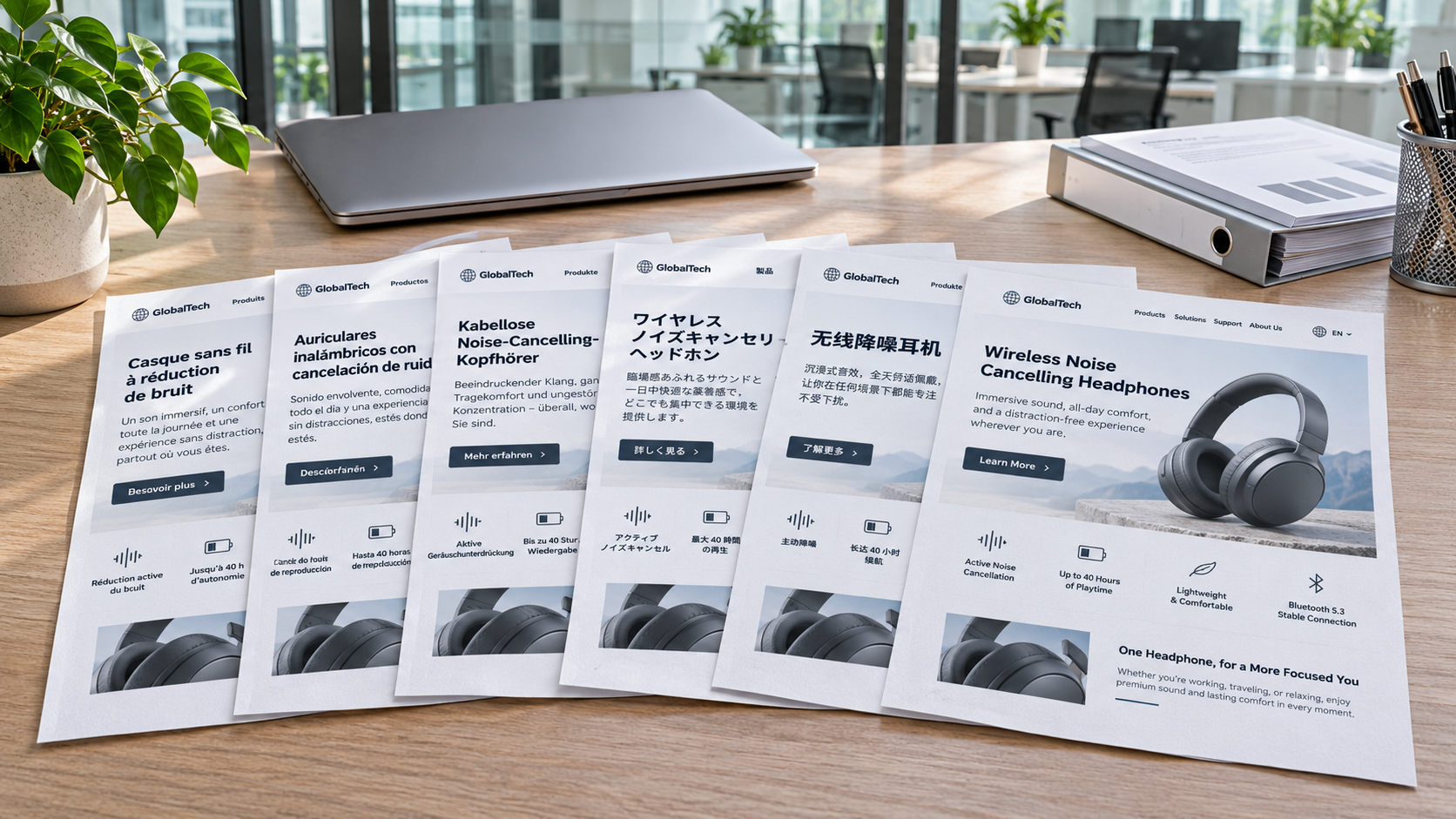
Many teams understand multi-site management as “copying an official website and then translating it into several languages.” In actual projects, what truly creates a gap is governance capability. Once the number of sites grows from two to five or ten, domains, templates, product information, form fields, privacy policies, tracking rules, SEO pages, and user roles all multiply. If regional teams still rely on separately finding vendors, exporting spreadsheets, and manually synchronizing content, headquarters can often only remedy issues after they arise.
Unified management does not mean that all sites must look exactly the same, nor does it mean completely taking autonomy away from regional teams. It is closer to a collaboration mechanism in which “headquarters sets boundaries while regions make adaptations”: brand assets, technical rules, and key data are unified, while language expression, priority product categories, campaign pages, and local content retain flexibility.
When these signals appear, the project should seriously evaluate a unified platform
The first type of signal is that content maintenance begins to lose momentum. Launching a new product requires creating separate pages for the English, German, and Japanese sites; after specifications are modified, some sites still retain older versions. If inconsistencies frequently appear in product materials, case studies, and download centers, it indicates that content is no longer suitable for decentralized maintenance.
The second type of signal is that marketing attribution cannot be aligned. Google Ads, organic search, social media campaigns, and email marketing each direct traffic to different sites, but form definitions, UTM rules, and conversion events are not standardized. Project managers may see reports showing that each region is “doing well in its own way,” yet cannot answer: What types of pages actually generate high-quality leads? Which markets are worth receiving additional budget?
The third type of signal is that the brand experience is continually diluted. The same brand uses different Logos, product names, page styles, and even contact details in different countries, which can make customers feel uncertain when visiting across sites. For manufacturing companies, B2B brands, and cross-border sellers building overseas recognition, this fragmentation can undermine trust in inquiries and increase the explanation burden on sales teams.
The fourth type of signal is that technical and compliance risks are scattered and concealed. A regional site may fail to update its Cookie notice or privacy policy in time, a promotional page may not have redirects configured correctly, or a newly created language site may omit search engine indexing settings. The more sites there are, the less feasible it is to rely solely on human memory and ad hoc checks.

Not every company needs “one system to manage everything”
Whether to unify management depends on the degree of business interconnection, rather than the number of sites itself. If different brands have independent supply chains, customer groups, pricing systems, and operating teams, maintaining relatively independent site architectures may be more reasonable. Conversely, if markets share core products, brand assets, and customer acquisition logic, it is worth establishing a unified foundation early, even if there are currently only three or four language sites.
When selecting a solution, do not only ask “how many sites can it build?”
The value of a cross-border brand website system lies not in whether the backend can create sites in batches, but in whether it can make ongoing operations controllable. Project leaders can focus their evaluation on four areas.
First, whether content reuse and localization can coexist. It is necessary to confirm whether product libraries, images, brand components, and foundational SEO fields can be reused; at the same time, assess whether regional teams can independently adjust language, ordering, landing pages, and local campaign content. A truly practical system should prevent a change in one place from incorrectly altering the entire site, while also ensuring that every local adjustment does not require waiting in line for development by headquarters.
Second, whether the permission system reflects actual collaboration. Headquarters marketing teams, overseas sales teams, regional operations teams, outsourced service providers, and technical personnel have different responsibilities. During selection, it should be clear who can publish, who can review, who can only edit a specific site or directory, and how permissions are revoked after personnel changes. Insufficient permission granularity is often the starting point of losing control over multi-site management.
Third, whether SEO and campaign delivery foundations can be unified. Multilingual URL rules, page titles, sitemaps, redirects, structured data, and form conversion events need mechanisms that can be checked, replicated, and traced. For companies that rely on Google SEO for long-term customer acquisition, it is not enough to see whether pages have been “translated”; attention must also be paid to whether search engines can correctly understand different regional and language versions.
Fourth, whether data can return to a single operational view. Unification does not mean looking only at total traffic; it means being able to break it down by site, country, channel, page, product line, and lead quality. If the system can connect with advertising, social media, CRM, or lead distribution processes, project teams can shift from “maintaining websites” to “managing the global customer acquisition journey.”
Implementation sequence matters more than a one-time migration
Many projects fail not because the platform lacks capabilities, but because they attempt to rebuild all sites within a short period. A more prudent approach is to first inventory existing assets: which pages still have organic traffic, which domains support advertising campaigns, which content requires regional review, and which form fields must enter the CRM. Then select a region or product line with high business relevance and manageable risk as a pilot.
During the pilot phase, three things should be validated first: whether content can be smoothly distributed from headquarters templates to regional sites; whether publishing, review, and rollback processes are clear; and whether traffic and conversion data can be tracked continuously. Once the rules are working smoothly, other markets can then be migrated in batches. For existing pages with rankings, 301 redirects, URL mapping, and indexing monitoring must be included in the project plan and cannot be left until the day before launch.
The ultimate purpose of unified management is to ensure growth no longer depends on “firefighting”
Yingyingbao provides foreign trade companies, manufacturing plants, and brand globalization teams with AI-powered website building, multilingual websites, cross-border online stores, and coordinated SEO, advertising, and social media services. For teams expanding into overseas markets, the more important consideration is not isolated features, but whether website building, content, localized promotion, and data analysis can form a continuous workflow.
When multiple sites have already affected project schedules, brand consistency, and customer acquisition decisions, unified management is no longer merely a technical upgrade, but an operational infrastructure initiative. The key to choosing the right cross-border brand website system is not to place more websites into the same backend, but to enable headquarters to see the direction, regions to execute in their markets, and every investment in content and budget to be more easily validated.
Related Articles
 How should global enterprises evaluate multi-site management capabilities when choosing a CMS?
 When Should Chinese Companies Use a Headless CMS for Global Websites?
 How Does Permission Management Differ Between Enterprise Multilingual CMS Platforms and Standard Systems?


Related Products
 Yiyingbao SaaS Intelligent Website Building and Marketing SystemYiyingbao SaaS Intelligent Website Building and Marketing System, AI-powered no-code website building, rapid creation of multilingual B2B international websites in 10 minutes, global server acceleration, AI-powered SEO optimization, helping businesses connect efficiently with global markets. The perfect integration of technology and operation makes building an international trade website remarkably simple
 AI+SEM Intelligent Advertising Marketing SystemAI+SEM drives intelligent ad creation, empowering full-funnel precision advertising marketing. The system automatically generates weekly/monthly reports, AI recommends keywords and target countries, monitors core metrics in real-time with intelligent alerts, and enables one-click high-conversion ad solutions to help quickly acquire customers and improve ROI.
 AI+SEO Dual-Engine System Optimization ServicesYiyingbao’s AI+SEO dual-engine optimization system helps foreign trade enterprises acquire high-quality organic traffic through AI-powered keyword research, content generation, and comprehensive technical optimization, significantly improving search rankings and conversion rates.
 AI+SNS Social Media Marketing SystemYingbao AI+SNS Social Media Marketing System - Precision social capture for the social media era. Supports one-click content synchronization across major platforms like Facebook and LinkedIn. AI intelligently rewrites posts for enhanced relevance. 24/7 AI customer service and user profiling analysis empower businesses to efficiently expand into global markets.
 AI+SEO营销解决方案易营宝AI+SEO营销解决方案,通过AI批量写作、智能生成TDK、精准关键词扩词等功能,全面优化网站SEO效果,提升流量与转化率。助力企业构建高效智能网站新生态。
 AI+SEM Advertising Marketing SolutionsAI+SEM Advertising Marketing Solution leverages AI technology to deeply empower SEM ad campaigns. It automatically generates weekly/monthly reports using AI, presenting account data across multiple dimensions for comprehensive insights into campaign performance and trends. The system precisely recommends keywords and target countries, intelligently generates high-conversion ad copy, and enables one-click activation of efficient campaign plans to help businesses rapidly acquire customers. Simultaneously, it monitors core metrics in real time, intelligently identifies abnormal fluctuations, and issues timely alerts to ensure stable, high-return advertising results.
 Domain Name ServicesEasyWin provides professional domain name services, including intelligent queries, one-stop registration, brand protection, and full lifecycle management, helping businesses build a digital brand image.
 EasyOperate B2C Cross-Border E-Commerce Platform & Independent WebsiteEasyStore B2C Cross-border E-commerce Independent Store is an intelligent website building and cross-border e-commerce integrated solution independently developed by EasyStore Information Technology (Beijing) Co., Ltd. The system is specially designed for small and medium-sized as well as large export enterprises, integrating 'website building, operation, marketing, advertising, and conversion' into one, helping enterprises quickly establish cross-border e-commerce independent stores to achieve brand globalization and global sales growth.
The platform supports multiple languages, multiple currencies, and multi-channel marketing, with built-in AI intelligent translation and SEO optimization systems, suitable for mainstream markets such as Southeast Asia, Europe and America, Latin America, and the Middle East, assisting Chinese manufacturing enterprises in efficiently deploying international e-commerce strategies. SSL证书易营宝提供专业SSL安全证书服务,包括单域名和泛域名证书,确保网站数据传输加密、身份验证和完整性保护,助力企业建立安全可信的在线业务环境。









