









- Which customer acquisition channels will be affected by cross-border marketing trends in 2026?Sep 06, 2026View details
- Which homogenization risks should be considered in an analysis of the AI-powered website building industry?Aug 30, 2026View details
- How Will AI Marketing Trends 2026 Change Advertising Budget AllocationAug 28, 2026View details
- Is the EV SSL certificate market shrinking or upgrading? How should companies assess certificate procurement?Aug 11, 2026View details
- Why the old AMP SEO 2020 practices no longer work and what has changed in current optimization prioritiesAug 02, 2026View details
- How to Choose Topics for an Industry News Section to Attract More Organic Search TrafficJul 29, 2026View details
What service items account for the differences in quotes from AI B2B platform companies
Many financial approvals get held up not because the question of whether to choose an AI B2B platform company has not been thought through, but because the quotations all look similar at first glance, while the real differences are hidden in the service items. Some people think they are only comparing website development costs, but later discover that the website is just the starting point. What truly drives up the total cost are ongoing activities such as SEO optimization, content localization, advertising, data tracking, and subsequent operation and maintenance.
If you are conducting a procurement review, the most common situation you may encounter is this: two proposals both mention “AI website development,” “foreign trade website,” and “marketing support”; one quotation is attractively low, while the other is expensive enough to cause hesitation. The problem is that if the service boundaries are not clearly broken down in advance, it is easy to encounter budget shortfalls, disputes between departments, or even the need to purchase additional services again after launch.
Do not compare the total price first; first check whether the quotation clearly explains what is included
The differences in the service items covered by AI B2B platform company quotations are usually not simply about the number of pages, but about the level of delivery. For the same website, some providers are only responsible for building the framework and basic pages, while others bundle multilingual content, inquiry forms, mobile adaptation, and a basic SEO structure. They may appear to be similar services, but the actual delivery depth can vary significantly.
During financial approval, it is advisable to ask three questions first: Which modules are included in the price? Which items are one-time deliverables? Which items are maintained monthly or charged based on usage? If these three points are not clarified, a low-cost proposal will often recover the difference later through additional items.
The items most likely to create price differences
The first item is usually the website development itself. The difference is not only whether the site uses a template or is custom-built, but also whether it supports multiple languages, is suitable for B2B inquiries, and facilitates subsequent content updates. A website used only for displaying pages and one that is expected to generate overseas leads involve completely different levels of workload.
The second item is SEO optimization. Many quotations include “basic SEO,” but the actual scope of “basic” can vary greatly. Some providers only modify titles and descriptions, while others handle basic tasks such as on-site structure, URL planning, keyword placement, image ALT text, and sitemaps. For finance teams, the most important point is whether the SEO is a one-time setup or includes ongoing optimization.
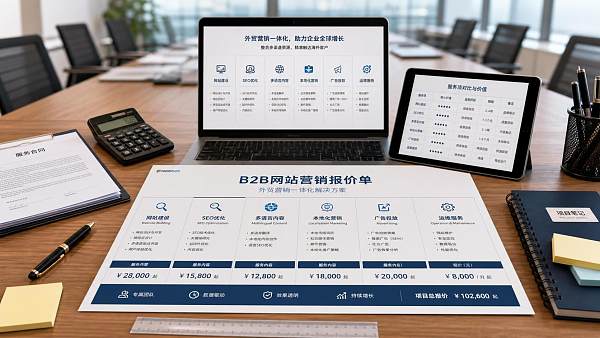
The third item is content localization, which is the easiest to underestimate. Many AI B2B platform company proposals state that they “support multiple languages,” but this may only mean mechanical translation. What truly influences procurement decisions is whether the industry-specific language fits the target market and whether the product benefits have been adapted to the customs of different regions. For foreign trade companies, content is not simply a matter of “having it”; it must be understandable and compelling enough to encourage potential customers to get in touch.
The fourth item is advertising and landing page support. Once the website is completed, connecting it to Google Ads and Facebook Ads makes the service considerably more complex. For example, whether the quotation includes account setup, pixel installation, conversion tracking, and landing page optimization will all affect the price. There can be a significant cost difference between only creating the pages without handling advertising and designing the pages and advertising campaigns together.
During financial approval, pay close attention to these hidden items
Some costs do not appear in the initial quotation but can easily arise later. Common examples include domains, servers, certificates, email, translation, image assets, copywriting, the number of page revisions, and technical support response times. Subsequent operation and maintenance is particularly important. Many procurement orders describe this area only briefly, but after launch, they may discover that modifying a section, replacing a batch of products, or adding another language version is charged separately.
If the proposal mentions a platform such as 易营宝 that focuses on AI website development and overseas marketing, it is best to review the service items separately: AI website development is the foundation layer, multilingual website development is the content layer, Google SEO optimization and advertising are the growth layer, while overseas social media management, short-form video marketing, and GEO generative engine optimization are more focused on long-term operations. Not every project needs to adopt everything at once, but you should know which layer you are purchasing.
How to determine whether a quotation is expensive or simply more comprehensive
Do not judge a quotation solely by whether it is cheap. A more practical approach is to see whether it can reduce subsequent rework. If a proposal considers the site structure, conversion path, basic SEO, and content language framework at the initial stage, subsequent operations are usually more efficient. If it only builds the pages first and adds advertising, content, and tracking later, the overall cost is often higher.
You can compare each quotation using the same checklist: Does it include website development? Does it include multiple languages? Does it include basic SEO setup? Does it include advertising tracking? Does it include a specified number of content updates? Does it include operation and maintenance support? In this way, the price difference is no longer just a number, but a reflection of the boundaries of responsibility.
A more prudent approach to procurement
If you need to promote an approval, do not rush to choose the lowest price. First ask the supplier to break down the services into verifiable details. It is best to separate what “must be included” from what “can be added later.” For example, website launch, basic inquiry functions, mobile adaptation, and basic SEO configuration are usually essential items, while outsourced social media management, ongoing advertising, and in-depth content expansion are more suitable as subsequent extensions.
For finance teams, the benefits are straightforward: the budget is easier to break down, payment milestones are clearer, and additional spending caused by items that were “not included originally” is less likely later. For business departments, it is also easier to determine whether the procurement is for a website or for a lead-generation tool that can be used continuously.
If you are still uncertain, ask one question first: Does this quotation solve the problem of “going live,” or does it ensure that the site can “continue operating after launch”? This question can usually reveal the real service differences between many seemingly similar AI B2B platform company proposals.
Related Articles


Related Products
 Yiyingbao SaaS Intelligent Website Building and Marketing SystemYiyingbao SaaS Intelligent Website Building and Marketing System, AI-powered no-code website building, rapid creation of multilingual B2B international websites in 10 minutes, global server acceleration, AI-powered SEO optimization, helping businesses connect efficiently with global markets. The perfect integration of technology and operation makes building an international trade website remarkably simple
 AI+SEM Intelligent Advertising Marketing SystemAI+SEM drives intelligent ad creation, empowering full-funnel precision advertising marketing. The system automatically generates weekly/monthly reports, AI recommends keywords and target countries, monitors core metrics in real-time with intelligent alerts, and enables one-click high-conversion ad solutions to help quickly acquire customers and improve ROI.
 AI+SEO Dual-Engine System Optimization ServicesYiyingbao’s AI+SEO dual-engine optimization system helps foreign trade enterprises acquire high-quality organic traffic through AI-powered keyword research, content generation, and comprehensive technical optimization, significantly improving search rankings and conversion rates.
 AI+SNS Social Media Marketing SystemYingbao AI+SNS Social Media Marketing System - Precision social capture for the social media era. Supports one-click content synchronization across major platforms like Facebook and LinkedIn. AI intelligently rewrites posts for enhanced relevance. 24/7 AI customer service and user profiling analysis empower businesses to efficiently expand into global markets.
 AI+SEO营销解决方案易营宝AI+SEO营销解决方案,通过AI批量写作、智能生成TDK、精准关键词扩词等功能,全面优化网站SEO效果,提升流量与转化率。助力企业构建高效智能网站新生态。
 AI+SEM Advertising Marketing SolutionsAI+SEM Advertising Marketing Solution leverages AI technology to deeply empower SEM ad campaigns. It automatically generates weekly/monthly reports using AI, presenting account data across multiple dimensions for comprehensive insights into campaign performance and trends. The system precisely recommends keywords and target countries, intelligently generates high-conversion ad copy, and enables one-click activation of efficient campaign plans to help businesses rapidly acquire customers. Simultaneously, it monitors core metrics in real time, intelligently identifies abnormal fluctuations, and issues timely alerts to ensure stable, high-return advertising results.
 Domain Name ServicesEasyWin provides professional domain name services, including intelligent queries, one-stop registration, brand protection, and full lifecycle management, helping businesses build a digital brand image.
 EasyOperate B2C Cross-Border E-Commerce Platform & Independent WebsiteEasyStore B2C Cross-border E-commerce Independent Store is an intelligent website building and cross-border e-commerce integrated solution independently developed by EasyStore Information Technology (Beijing) Co., Ltd. The system is specially designed for small and medium-sized as well as large export enterprises, integrating 'website building, operation, marketing, advertising, and conversion' into one, helping enterprises quickly establish cross-border e-commerce independent stores to achieve brand globalization and global sales growth.
The platform supports multiple languages, multiple currencies, and multi-channel marketing, with built-in AI intelligent translation and SEO optimization systems, suitable for mainstream markets such as Southeast Asia, Europe and America, Latin America, and the Middle East, assisting Chinese manufacturing enterprises in efficiently deploying international e-commerce strategies. SSL证书易营宝提供专业SSL安全证书服务,包括单域名和泛域名证书,确保网站数据传输加密、身份验证和完整性保护,助力企业建立安全可信的在线业务环境。









