









- Fujian Announces the First Batch of Provincial-Level Cross-Border E-Commerce Industrial Parks and Key Brands for CultivationNov 14, 2026View details
- Amazon Global Store Announces the Launch of the 2026 Black Friday Global Shopping SeasonNov 14, 2026View details
- CCTV.com Examines APEC’s Role in China’s Foreign TradeNov 12, 2026View details
- China’s Tariff Commission of the State Council Adjusts Additional Tariffs on U.S. Goods: 24% Tariff Suspended for Two MonthsNov 10, 2026View details
- APEC Shenzhen Spotlight: Cross-Border E-Commerce Orders Promote Asia-Pacific Trade and Economic CooperationNov 08, 2026View details
- China-Europe Railway Express and CIIE Hold Business Matchmaking Event, Focusing on Cross-Border E-commerce B2B ExportsNov 07, 2026View details
Should recommendations for AI website-building service providers consider long-term maintainability?
Yes, and it should be assessed before “website-building speed” and “initial quotation.” For procurement professionals, no matter how long the list of recommended AI website-building service providers may be, if the website can only rely on the original provider to change images, publish products, or adjust pages after launch—or if content changes affect indexing and advertising landing pages—the labor and costs saved upfront will soon be offset by subsequent operations.
This is especially true for foreign trade companies, manufacturing plants, and cross-border brands, for which an official website is typically not a one-time deliverable. New product launches, certification updates, marketing campaigns, multilingual content, inquiry forms, and search pages all change continuously. So-called “maintainability” is not simply about whether the backend can be accessed; it is about whether a company can continuously keep its website serving sales and lead generation with reasonable permissions, costs, and risks.
First, distinguish between being editable and being easy to maintain
When demonstrating the backend, many service providers showcase basic functions such as replacing banners, editing text, and uploading images. These functions are certainly necessary, but procurement teams should ask a more important question: can all changes required for daily operations be completed without coding and without affecting the existing page structure?
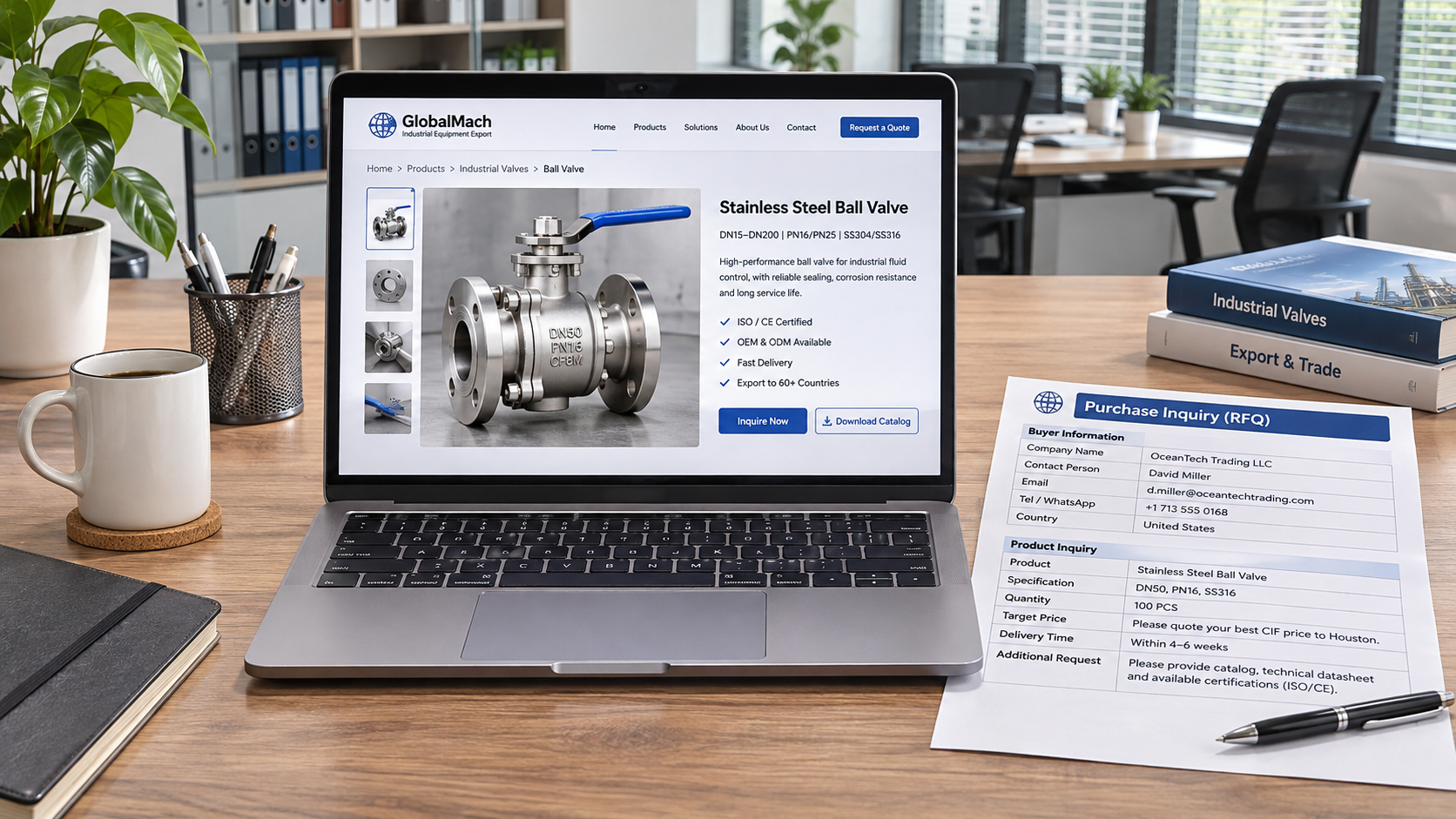
For a B2B export website, for example, a seemingly simple product update often involves product details, specification tables, downloadable materials, inquiry entry points, related products, English URLs, Meta information, and multilingual versions. If the system only supports directly editing copy on a page and lacks product fields, category management, and batch-processing capabilities, operations staff will soon be trapped in repetitive work. If every change requires submitting a ticket, response times will further constrain the marketing pace.
During procurement evaluation, companies can ask service providers to demonstrate backend operations using a task close to their own business, such as adding a product line, completing content in three languages, creating an advertising landing page, and then adjusting its inquiry fields. The demonstration results better reflect post-delivery usability than promises of “one-click AI website generation.”
Maintenance control should remain with the company
AI website building lowers the barrier to page production, but it does not automatically resolve website asset ownership. Who holds the domain name, hosting or cloud resources, website source content, image materials, form leads, analytics accounts, and verification permissions for search platforms must be clearly defined before procurement.
A more prudent approach is for the company to retain control of domain registration information and administrator permissions for key marketing accounts such as Google Analytics, Google Search Console, and advertising accounts, while the service provider receives the collaboration permissions required for execution. This way, even if the service team is changed later, historical data and website access points remain under the company's control.
Arrangements after contract termination or platform replacement should also be clarified. There is no need to insist that all technical files must be exportable without conditions, but at minimum the following boundaries should be defined:
- Whether website text, product materials, images, and downloadable files can be fully extracted;
- Whether the URL structure can be retained, or whether a 301 redirect plan can be supported;
- How inquiry records, form fields, and customer data can be exported and handed over;
- Who owns third-party accounts, plugins, template licenses, and content copyrights respectively;
- What the rules are for website access, backups, and data retention after renewal is discontinued.
The closed nature of some SaaS platforms is not necessarily a disadvantage. It can often reduce the burden of server maintenance, plugin conflicts, and security updates. However, closed platforms require even greater confirmation of migration paths. Procurement should not interpret “no technical maintenance required” as “no governance required”; the more managed the system is, the earlier its exit mechanism and asset permissions need to be confirmed.
SEO maintainability determines whether a website can continue to accumulate value
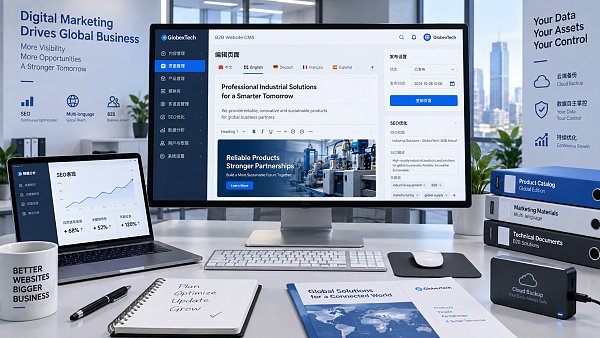
Many procurement decisions regard SEO as a value-added service after website development. In fact, whether the website's underlying infrastructure facilitates search optimization is largely determined during the website-building stage. A visually acceptable website will be significantly limited in the efficiency of later content investment and promotion if it cannot reliably manage page titles, descriptions, canonical tags, sitemaps, redirects, and multilingual tags.
For companies that rely on organic search to obtain inquiries, it is advisable to divide SEO maintenance capabilities into three levels of review.
The first level: page control
Operations personnel should be able to independently maintain page URLs, titles, descriptions, image alt text, and the basic structure of product and article pages. If these items must be handled by technical personnel, content update frequency will usually decline. It should be noted that automatically generated Meta content can improve first-draft efficiency, but should not replace manual proofreading. Product models, industry terminology, and expressions for target markets still require the company's own review.
The second level: structural stability
When redesigning a website, removing products, or merging categories, whether the system supports redirect management and whether it arbitrarily changes existing URLs directly affect the value of existing indexing and external links. During procurement, request an explanation of how page removal, section migration, and multilingual version adjustments are handled, rather than merely checking whether the homepage can be crawled by search engines.
The third level: data visibility
The website should support convenient integration with analytics and search monitoring tools, allowing the company to clearly view page traffic, inquiry sources, conversion paths, and indexing status. Without this basic data, when a service provider says it is “optimizing,” it is difficult for the company to determine whether the issue lies in content, technology, keyword direction, or sales follow-up.
Multilingual maintenance is the most easily underestimated area
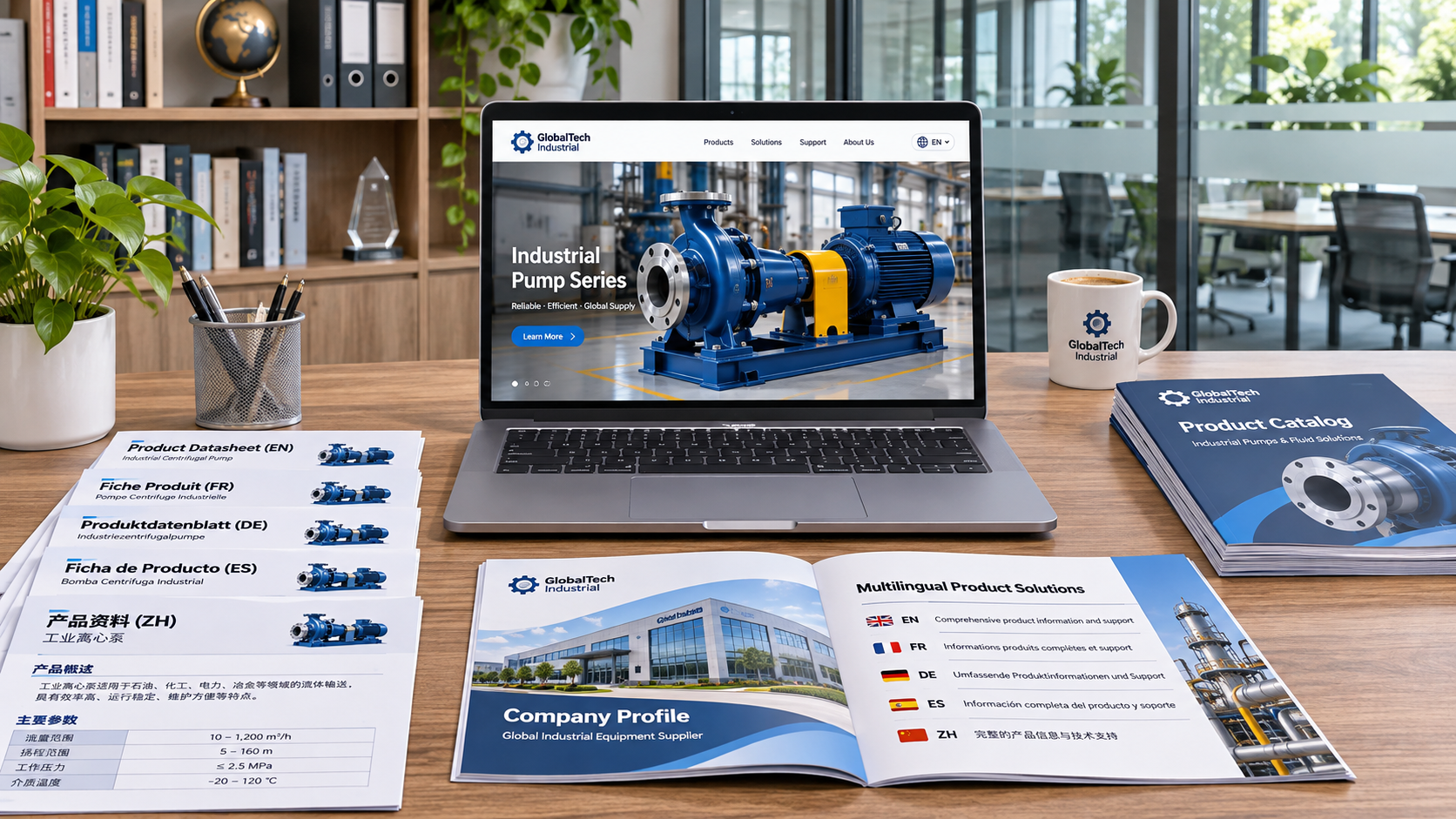
For websites targeting overseas markets, multilingual functionality cannot be assessed solely by whether languages can be switched. Machine translation can be used to generate initial drafts, but product terminology, delivery terms, compliance wording, and calls to action in different markets may not be directly reusable. Procurement personnel should confirm whether URLs, SEO information, images, and form fields can be edited independently for each language, and whether different product content and page layouts can be retained by market.
Another common issue is a disconnect between language versions and content versions: Chinese or English product information has been updated, while other languages still retain old specifications, outdated certificates, or invalid links. Whether the service provider offers content status management, translation reminders, version history, and permission allocation will affect the maintenance cost of multilingual sites after expansion. For companies just entering a single overseas market, there is no need to roll out too many languages at the outset; establishing a replicable content process is more important than piling up languages.
Assess service capabilities after delivery, not only on launch day
When selecting an AI website-building service provider, procurement teams should also break down, quote, and compare service models separately. Website design, content entry, technical support, SEO execution, advertising landing page iteration, and data analysis are usually not the same type of service. Grouping them broadly as “post-launch maintenance” can easily lead to inconsistent understandings of response scope and costs.
When comparing options, focus on confirming service levels: which issues can be resolved independently in the backend and which are handled by the service provider; whether routine content updates are included in the service; how responses to urgent failures, page errors, and invalid forms are agreed upon; whether SEO or advertising teams can directly propose and implement page changes; and whether training, account handover, and operating documentation are provided after internal personnel changes.
For companies that need to conduct website development, SEO, advertising, and social media lead generation simultaneously, the value of an integrated service provider lies not only in offering many types of projects, but in whether different channels use the same maintainable website foundation. For example, advertising teams need to quickly create and test landing pages, SEO teams need to control content structure and indexing, and sales teams need traceable inquiry sources. If all these activities require repeated coordination across multiple suppliers, website maintenance becomes a coordination issue rather than a technical issue.
Include maintenance testing in the selection process
When comparing recommended AI website-building service providers, the most common misjudgment is equating AI generation efficiency with long-term operational efficiency. The former addresses “how soon the first version of the website can appear,” while the latter determines “whether the website can still be continuously updated, promoted, and accumulate assets six months later.” They are related, but not the same.
Before procurement, it may be helpful to prepare a maintenance checklist based on the company's own business: how many products will be added each month, whether multilingual synchronization is required, whether marketing activities are frequent, who is responsible for content review, whether organic search is relied upon, and whether the service team may need to be replaced in the future. Then ask candidate service providers to demonstrate, quote, and define delivery boundaries according to this checklist.
The real risk of a website-building project often does not lie in the launch of the homepage, but after the website begins taking on lead-generation responsibilities. Solutions that allow companies to retain control of accounts and data, enable operations staff to complete most routine updates, and leave room for SEO and multilingual expansion are generally more suitable as long-term investments.
Related Articles
 What Customization Requirements Can a Global Website-Building SaaS Platform Meet?
 How Can You Tell Whether a Service Provider Can Improve Your Foreign Trade Website’s Conversion Rate?
 How can you evaluate the content quality of a Q&A content creation platform?

Related Products
 Yiyingbao SaaS Intelligent Website Building and Marketing SystemYiyingbao SaaS Intelligent Website Building and Marketing System, AI-powered no-code website building, rapid creation of multilingual B2B international websites in 10 minutes, global server acceleration, AI-powered SEO optimization, helping businesses connect efficiently with global markets. The perfect integration of technology and operation makes building an international trade website remarkably simple
 AI+SEM Intelligent Advertising Marketing SystemAI+SEM drives intelligent ad creation, empowering full-funnel precision advertising marketing. The system automatically generates weekly/monthly reports, AI recommends keywords and target countries, monitors core metrics in real-time with intelligent alerts, and enables one-click high-conversion ad solutions to help quickly acquire customers and improve ROI.
 AI+SEO Dual-Engine System Optimization ServicesYiyingbao’s AI+SEO dual-engine optimization system helps foreign trade enterprises acquire high-quality organic traffic through AI-powered keyword research, content generation, and comprehensive technical optimization, significantly improving search rankings and conversion rates.
 AI+SNS Social Media Marketing SystemYingbao AI+SNS Social Media Marketing System - Precision social capture for the social media era. Supports one-click content synchronization across major platforms like Facebook and LinkedIn. AI intelligently rewrites posts for enhanced relevance. 24/7 AI customer service and user profiling analysis empower businesses to efficiently expand into global markets.
 AI+SEO营销解决方案易营宝AI+SEO营销解决方案,通过AI批量写作、智能生成TDK、精准关键词扩词等功能,全面优化网站SEO效果,提升流量与转化率。助力企业构建高效智能网站新生态。
 AI+SEM Advertising Marketing SolutionsAI+SEM Advertising Marketing Solution leverages AI technology to deeply empower SEM ad campaigns. It automatically generates weekly/monthly reports using AI, presenting account data across multiple dimensions for comprehensive insights into campaign performance and trends. The system precisely recommends keywords and target countries, intelligently generates high-conversion ad copy, and enables one-click activation of efficient campaign plans to help businesses rapidly acquire customers. Simultaneously, it monitors core metrics in real time, intelligently identifies abnormal fluctuations, and issues timely alerts to ensure stable, high-return advertising results.
 Domain Name ServicesEasyWin provides professional domain name services, including intelligent queries, one-stop registration, brand protection, and full lifecycle management, helping businesses build a digital brand image.
 EasyOperate B2C Cross-Border E-Commerce Platform & Independent WebsiteEasyStore B2C Cross-border E-commerce Independent Store is an intelligent website building and cross-border e-commerce integrated solution independently developed by EasyStore Information Technology (Beijing) Co., Ltd. The system is specially designed for small and medium-sized as well as large export enterprises, integrating 'website building, operation, marketing, advertising, and conversion' into one, helping enterprises quickly establish cross-border e-commerce independent stores to achieve brand globalization and global sales growth.
The platform supports multiple languages, multiple currencies, and multi-channel marketing, with built-in AI intelligent translation and SEO optimization systems, suitable for mainstream markets such as Southeast Asia, Europe and America, Latin America, and the Middle East, assisting Chinese manufacturing enterprises in efficiently deploying international e-commerce strategies. SSL证书易营宝提供专业SSL安全证书服务,包括单域名和泛域名证书,确保网站数据传输加密、身份验证和完整性保护,助力企业建立安全可信的在线业务环境。









