









- Which customer acquisition channels will be affected by cross-border marketing trends in 2026?Sep 06, 2026View details
- Which homogenization risks should be considered in an analysis of the AI-powered website building industry?Aug 30, 2026View details
- How Will AI Marketing Trends 2026 Change Advertising Budget AllocationAug 28, 2026View details
- Is the EV SSL certificate market shrinking or upgrading? How should companies assess certificate procurement?Aug 11, 2026View details
- Why the old AMP SEO 2020 practices no longer work and what has changed in current optimization prioritiesAug 02, 2026View details
- How to Choose Topics for an Industry News Section to Attract More Organic Search TrafficJul 29, 2026View details
How Many People Are Needed to Manage Overseas Social Media Accounts?
How many people are needed to manage overseas social media accounts? This is not a question with a fixed numerical answer, but rather a question of operational objectives. For most companies expanding overseas, the team size for account management usually ranges from 1 to 6 people. The core factors include the number of platforms, content types, update frequency, whether advertising coordination is required, and whether the ultimate goal is simply brand exposure or directly generating inquiries and conversions.
Many companies tend to go to two extremes during the early stages: either assigning one part-time employee to “update the accounts on the side,” resulting in inconsistent content and poor data, or building a large team from the outset, incurring high costs without establishing stable conversions. The truly reasonable approach is to work backward from business objectives to determine staffing, ensuring that everyone is accountable for results.
The conclusion first: How many people are usually needed to manage overseas social media accounts?
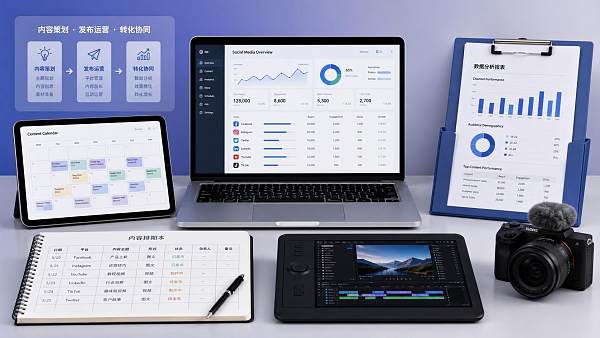
If a company currently operates only 1 to 2 overseas social media platforms, such as Facebook and LinkedIn, with content focused on graphic and text updates, basic engagement, and brand presentation, 1 to 2 people are usually sufficient to support basic operations. One person can be responsible for content and publishing, while the other handles design, data organization, or customer service coordination.
If a company operates 3 to 4 platforms simultaneously and adds short videos, event planning, direct-message follow-up, and lead collection, it usually needs 3 to 4 people. At this stage, the work is no longer as simple as “publishing content”; it has entered a phase of continuous growth and refined operations, with significantly higher requirements for role specialization.
If a company regards overseas social media as one of its core customer acquisition channels and needs to cover multiple languages, regions, and account matrices, while coordinating with advertising, independent website conversions, and sales lead follow-up, a more common staffing model is 5 to 6 people. External service providers may also need to participate to ensure efficiency and results.
What are companies really concerned about when they search for “how many people are needed to manage overseas social media accounts”?
On the surface, companies are asking about the number of people. In reality, they are more concerned about three things: first, the minimum staffing required to prevent the accounts from being poorly managed; second, how to allocate personnel without wasting costs; and third, whether the investment in these people can genuinely generate brand growth and business opportunities.
For foreign trade companies, manufacturing factories, cross-border brands, and independent website sellers in particular, overseas social media operations are not simply about creating attractive content. They serve customer acquisition, brand trust, and the conversion process. Therefore, when determining staffing, companies must consider not only the number of accounts but also their requirements for lead quality, content depth, and response speed.
This is why one company can maintain three accounts with just one person, while another needs a small team for the same number of accounts. The difference does not lie in the platforms themselves, but in the different operational objectives, content complexity, and requirements for conversion results.
4 key variables that determine staffing
The first variable is the number of platforms. The more platforms there are, the greater the workload involved in topic selection, content adaptation, publishing schedules, and engagement management. Although Facebook, Instagram, LinkedIn, YouTube, and TikTok are all overseas social media platforms, their audience preferences, content formats, and operating rhythms are entirely different. Content cannot simply be published identically across all platforms.
The second variable is the content type. If the work consists only of basic graphic and text content, production costs are relatively manageable. However, if the company needs to produce short videos, case studies, product demonstrations, factory footage, livestream promotion, or multilingual content, greater manpower is required, often involving design, video editing, and scriptwriting capabilities.
The third variable is update frequency. Publishing 2 to 3 pieces of content per week is entirely different from maintaining consistent daily updates in terms of personnel efficiency requirements. The higher the frequency, the more important content reserves, scheduling mechanisms, and collaboration processes become. Otherwise, the company may experience interruptions, declining quality, and repetitive topics.
The fourth variable is the depth of conversion. If social media is responsible only for brand exposure, the team can be smaller. If it also needs to handle direct-message responses, lead screening, comment management, event follow-up, or provide content materials for the official website and advertising, both staffing levels and collaboration requirements will increase significantly.
What staffing model is suitable for companies at different stages?
For companies that are just beginning to expand overseas, it is recommended to start with “one person in charge plus external support.” Internally, there should be at least one person who understands the products, market, and customers well and is responsible for content direction, publishing schedules, and basic engagement. Design, video, and English proofreading can be completed with the assistance of an external team so that the accounts can first become operational.
For companies with stable business operations that want to continuously generate exposure and inquiries through overseas social media, a “2- to 3-person team” is more suitable. A common division of responsibilities is one person for content planning and copywriting, one person for visual and video production, and one person for publishing, engagement, and data review. This makes it easier to establish a stable operating rhythm.
For companies with higher brand-oriented operation requirements, such as cross-border brands, independent website brand merchants, or manufacturing companies focusing on expanding overseas markets, a “3- to 5-person team” can be considered. Such teams generally need to cover content planning, visual production, short videos, social media operations, and data analysis, while coordinating with advertising or sales.
If a company targets multiple regional markets, such as North America, Europe, the Middle East, and Southeast Asia at the same time, and also needs to handle different languages and localized expressions, it is difficult for a single internal employee to manage the work in depth. A more common approach is to establish a small internal team and work with localized service providers externally.
Can one person manage overseas social media operations? Yes, but there are limits.
Many companies initially ask whether one person can successfully build up their overseas social media presence. The answer is yes, but only if the objectives are not too ambitious. One person is suitable for basic setup, content testing, platform familiarization, and establishing an initial operating rhythm. It is not suitable for sustaining high-frequency updates, multi-platform account matrices, and strong conversion tasks over the long term.
This is because overseas social media operations essentially include multiple processes, such as content planning, copywriting, design, video production, publishing, engagement, and data analysis. Although a one-person model can reduce costs, common problems include unstable content quality, easily interrupted schedules, and unsystematic data reviews. As a result, the account may appear to be updated regularly while achieving limited actual results.
If a company currently has a limited budget, the most practical approach is not to focus on whether “one person is enough,” but to first clarify what results that person is expected to deliver. Is the priority to establish brand presence, test content directions, or directly generate inquiries? The clearer the objective, the easier it is for a one-person setup to produce meaningful data.
More important than the number of people is whether responsibilities are clearly divided.
The poor performance of social media at many companies is not caused by insufficient staffing, but by unclear responsibilities. Copywriters do not understand customer profiles, designers only mechanically produce graphics, operations staff focus solely on publishing without considering conversions, and sales teams do not follow up on social media leads. Even with 3 to 4 people, it is difficult to establish a genuinely effective growth cycle under these circumstances.
A reasonable division of roles generally includes: content planners responsible for topic selection and content frameworks; designers or video specialists responsible for producing materials; operations staff responsible for publishing, engagement, and account maintenance; and data specialists or managers responsible for analyzing results and making adjustments. If lead conversion requirements are high, sales or customer service teams also need to establish a coordination mechanism.
For many small and medium-sized companies expanding overseas, it is not necessary to hire a separate person for every role, but each responsibility must have a clearly designated owner. Otherwise, accounts can remain stuck in a state of “content without results” for a long time. The company may appear to be doing a great deal of work, but it will be difficult to accumulate brand assets and customer leads.
How can you determine whether the current team structure is reasonable?
There are four signals to consider. First, does the company frequently stop updating or rush content at the last minute? If content is always published temporarily, this indicates insufficient staffing or inadequate processes. Second, is there long-term exposure without engagement or conversions? If the data remains at a superficial level, it indicates that collaboration among roles has not been properly connected.
Third, is the company active on every platform but unable to develop any priority platform successfully? If resources are too dispersed, personnel efficiency is usually diluted. Fourth, do the owner, sales team, or product team frequently submit last-minute requests, disrupting the operating rhythm? When these problems arise, the company may need to adjust not only its staffing levels, but more importantly its objectives and division of responsibilities.
The standard for reasonable staffing is not whether the team appears complete, but whether each additional person can noticeably improve content output, response efficiency, or lead quality. Whether the team can support stable output, establish reusable processes, and gradually amplify effective content is the key to evaluating whether the staffing structure is reasonable.
A more reliable approach for companies expanding overseas: internal leadership with coordinated tools and services
Under current conditions, relying solely on a large team of employees to manage overseas social media is not inexpensive, and management can also be difficult. A more reliable approach is to retain core decision-making and business judgment internally, while using professional tools and external services for coordinated execution. This can improve content efficiency, data analysis capabilities, and multi-platform collaboration.
For example, companies can use AI tools to improve the efficiency of topic selection, copywriting, multilingual adaptation, and data organization. They can then connect professional website development, SEO, advertising, and social media operations to direct social traffic to their independent websites and inquiry systems. In this way, social media is no longer an isolated activity, but a part of the entire overseas marketing process.
For companies that want to balance brand exposure with actual customer acquisition, the model of “a small internal team + a systematic platform + professional service support” is generally more effective than blindly expanding the workforce and is also more suitable for long-term development in overseas markets.
Conclusion: There is no standard answer to how many people are needed to manage overseas social media accounts, but there is a clear way to make the decision.
Returning to the original question, how many people are needed to manage overseas social media accounts? For basic operations, 1 to 2 people can get started. For stable growth, 2 to 4 people are generally needed. If the goal is multi-platform, multilingual, and strongly conversion-oriented coordination, it is more appropriate to have 5 or more people or to work with an external professional team.
What companies should truly focus on is not the number of people on the surface, but whether objectives are clear, responsibilities are well defined, content is published consistently, and social media genuinely serves brand growth and customer acquisition. Only by evaluating staffing within the context of the overall marketing process can companies make more rational investment decisions.
For companies expanding overseas, overseas social media has never been as simple as “just publishing content.” It affects both the brand’s international image and customer trust and inquiry efficiency. With appropriate staffing, social media can become a growth asset; with an imbalanced structure, even extensive effort may produce few visible results.
Related Articles

Related Products
 Yiyingbao SaaS Intelligent Website Building and Marketing SystemYiyingbao SaaS Intelligent Website Building and Marketing System, AI-powered no-code website building, rapid creation of multilingual B2B international websites in 10 minutes, global server acceleration, AI-powered SEO optimization, helping businesses connect efficiently with global markets. The perfect integration of technology and operation makes building an international trade website remarkably simple
 AI+SEM Intelligent Advertising Marketing SystemAI+SEM drives intelligent ad creation, empowering full-funnel precision advertising marketing. The system automatically generates weekly/monthly reports, AI recommends keywords and target countries, monitors core metrics in real-time with intelligent alerts, and enables one-click high-conversion ad solutions to help quickly acquire customers and improve ROI.
 AI+SEO Dual-Engine System Optimization ServicesYiyingbao’s AI+SEO dual-engine optimization system helps foreign trade enterprises acquire high-quality organic traffic through AI-powered keyword research, content generation, and comprehensive technical optimization, significantly improving search rankings and conversion rates.
 AI+SNS Social Media Marketing SystemYingbao AI+SNS Social Media Marketing System - Precision social capture for the social media era. Supports one-click content synchronization across major platforms like Facebook and LinkedIn. AI intelligently rewrites posts for enhanced relevance. 24/7 AI customer service and user profiling analysis empower businesses to efficiently expand into global markets.
 AI+SEO营销解决方案易营宝AI+SEO营销解决方案,通过AI批量写作、智能生成TDK、精准关键词扩词等功能,全面优化网站SEO效果,提升流量与转化率。助力企业构建高效智能网站新生态。
 AI+SEM Advertising Marketing SolutionsAI+SEM Advertising Marketing Solution leverages AI technology to deeply empower SEM ad campaigns. It automatically generates weekly/monthly reports using AI, presenting account data across multiple dimensions for comprehensive insights into campaign performance and trends. The system precisely recommends keywords and target countries, intelligently generates high-conversion ad copy, and enables one-click activation of efficient campaign plans to help businesses rapidly acquire customers. Simultaneously, it monitors core metrics in real time, intelligently identifies abnormal fluctuations, and issues timely alerts to ensure stable, high-return advertising results.
 Domain Name ServicesEasyWin provides professional domain name services, including intelligent queries, one-stop registration, brand protection, and full lifecycle management, helping businesses build a digital brand image.
 EasyOperate B2C Cross-Border E-Commerce Platform & Independent WebsiteEasyStore B2C Cross-border E-commerce Independent Store is an intelligent website building and cross-border e-commerce integrated solution independently developed by EasyStore Information Technology (Beijing) Co., Ltd. The system is specially designed for small and medium-sized as well as large export enterprises, integrating 'website building, operation, marketing, advertising, and conversion' into one, helping enterprises quickly establish cross-border e-commerce independent stores to achieve brand globalization and global sales growth.
The platform supports multiple languages, multiple currencies, and multi-channel marketing, with built-in AI intelligent translation and SEO optimization systems, suitable for mainstream markets such as Southeast Asia, Europe and America, Latin America, and the Middle East, assisting Chinese manufacturing enterprises in efficiently deploying international e-commerce strategies. SSL证书易营宝提供专业SSL安全证书服务,包括单域名和泛域名证书,确保网站数据传输加密、身份验证和完整性保护,助力企业建立安全可信的在线业务环境。









