









- Which customer acquisition channels will be affected by cross-border marketing trends in 2026?Sep 06, 2026View details
- Which homogenization risks should be considered in an analysis of the AI-powered website building industry?Aug 30, 2026View details
- How Will AI Marketing Trends 2026 Change Advertising Budget AllocationAug 28, 2026View details
- Is the EV SSL certificate market shrinking or upgrading? How should companies assess certificate procurement?Aug 11, 2026View details
- Why the old AMP SEO 2020 practices no longer work and what has changed in current optimization prioritiesAug 02, 2026View details
- How to Choose Topics for an Industry News Section to Attract More Organic Search TrafficJul 29, 2026View details
Which platform rules should you adapt to first when managing overseas social media for the Middle Eastern market?
When operating social media in the Middle East, you must first understand platform rules, cultural taboos, and content review mechanisms in order to avoid reduced reach or account suspension and improve customer acquisition efficiency. For many companies engaged in foreign trade, independent websites, or global brand expansion, the real question is not “Should we enter the Middle East?” but rather “Can social media in this market still be managed in the way we are familiar with?” The answer is usually no.
The Middle East may appear to be a single market, but in reality it is a combination of multiple language communities, religious customs, regulatory standards, and platform ecosystems. In the early stages, many teams treat it as “creating another version of overseas social media,” copying European and American content styles, campaign schedules, and advertising tactics. The result is either content review triggers, unstable engagement rates, or even repeated risk-control actions against account assets within a short period. For companies still in the information research stage, understanding the rules is more important than chasing trends.
First, understand one reality: the Middle East is not a market where simply publishing content is enough
When operating social media in the Middle East, platforms are not merely traffic channels; they function more like filters. They assess content safety, advertising compliance, account behavior, landing-page experience, and user reports at the same time. In other words, the problem often does not lie in a single post, but in the overall consistency of the content matrix, creative expression, advertising path, and website conversion process.
This is why many companies initially feel that “a certain platform is performing well, but the volume suddenly dropped later.” In reality, the platform may not have abandoned you. Your content structure, audience targeting, or off-platform conversion process may have triggered new review rules. This is especially true in the Middle East, where content involving religion, gender expression, political sensitivity, pharmaceutical and cosmetics claims, financial promises, sweepstakes, and promotions is generally subject to more cautious review.
Look at the platform first, then the content
Different platforms have different levels of content tolerance and user habits. For B2B companies, the most common misjudgments fall into three categories:
- Treating short-video platforms purely as exposure tools while overlooking the conversion path through comments and direct messages.
- Treating image-and-text social media as a “low-barrier customer acquisition” channel while overlooking Arabic localization and visual semantics.
- Managing paid advertising and organic operations separately, resulting in inconsistent messaging across the homepage, creatives, and landing pages.
These issues can affect results in mature markets as well, but they are more likely to be amplified in the Middle East. Users there are more sensitive to brand credibility, linguistic affinity, and compliance boundaries, especially in high-value B2B, cross-border e-commerce, healthcare, education and training, and financial services.
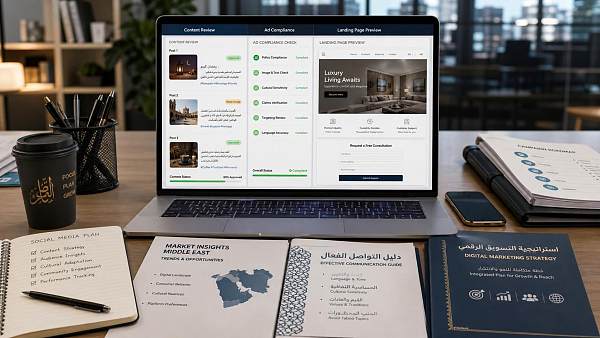
What needs to be adapted first is not the tactics, but the boundaries of the rules
Many teams ask, “What are the mainstream platforms in the Middle East?” In fact, this question comes too late in the process. A more practical question is: Can your industry communicate consistently on these platforms? Which types of content are off-limits? Could your account operations be considered abnormal by the system?
In practice, operating social media in the Middle East requires confirming at least four types of boundaries in advance.
1. Content boundaries
The Middle East is generally more sensitive to religion, politics, sexual exposure, alcohol, gambling, adult content, and exaggerated claims. This does not mean that related industries cannot operate there at all; rather, their wording, presentation, and advertising methods must be more cautious. For example, the same promotional message may use highly stimulating copy directly in European and American markets, while in the Middle East it may be necessary to reduce its aggressiveness and avoid overly suggestive, offensive, or exaggerated wording.
For B2B companies, content boundaries apply not only to copy, but also to visuals. Clothing, gestures, interactions between people, background music, and scene design can all affect account security and brand perception. In many cases, a violation does not occur because something was “said incorrectly,” but because it was “presented inappropriately.”
2. Account boundaries
The Middle East market is generally more sensitive to abnormal logins, frequent IP switching, bulk following, high-frequency posting within a short period, and highly repetitive creatives. If an operations team is accustomed to using standardized templates for bulk distribution, normal operations can easily become risk-control signals. Account assets must be stabilized before scaling, and trust must be built before pursuing efficiency.
This means that when building a social media matrix, companies must consider not only content production capacity, but also the account environment, permission management, regional settings, login security, and creative reuse strategy. For companies planning long-term market penetration, these are not technical details; they are infrastructure.
3. Advertising boundaries
Advertising review in the Middle East generally pays closer attention to landing-page consistency, industry qualification statements, contact information, refund and after-sales policies, and whether misleading promises are present. Many advertising campaigns fail not because the creatives are rejected, but because the off-platform landing experience is inadequate: mismatched page language, unclear CTAs, missing company information, overly long forms, and slow mobile loading can all reduce overall performance.
If your social media is responsible only for “driving traffic,” while your independent website or landing page lacks a corresponding localized conversion experience, advertising efficiency will often be difficult to stabilize. What is most easily overlooked is that social media review and website review are becoming increasingly interconnected. Platforms assess comprehensively whether you are a trustworthy commercial entity.
4. Cultural boundaries
Cultural boundaries are not merely about broadly “respecting local culture.” They involve specific considerations such as holiday schedules, image usage, language tone, on-camera appearances, and interaction timing. For example, during Ramadan and Eid al-Fitr, content style, advertising schedules, and the way discounts are presented all need to be reassessed. If a company follows only its own promotional calendar, it may miss more suitable communication opportunities or use inappropriate wording.
Cultural adaptation for the Middle East is not achieved simply by “adding a few Arabic words.” It is more like recalibrating the brand voice so that the content feels written for local business scenarios rather than translated from content intended for external markets.
Beyond platform rules, pay closer attention to how users evaluate you
For people conducting market research, what truly deserves attention is not how many users a platform has, but how those users determine whether a brand is trustworthy. User decisions in the Middle East often place greater emphasis on relationships, stability, and professional credentials. Social media is not a standalone conversion tool; it is a trust-building stage before conversion.
Therefore, when operating social media in the Middle East, the following matters more than “what content is most popular”:
- Does the homepage clearly display the company identity, service scope, and contact details?
- Is the content published consistently and steadily, rather than surging for a short period and then remaining silent for a long time?
- Is there local-language or at least bilingual communication, with translations that do not sound excessively machine-generated?
- Do comments, direct messages, forms, and the official website form a closed loop?
- Can the landing page quickly help users confirm what you do, where you provide services, and how they can cooperate with you?
If these links are disconnected, even a lively social media presence will be difficult to turn into effective leads. This is particularly true for B2B businesses, because customers generally will not place an order directly after seeing a short video; they will continue checking your homepage, website, case studies, and contact details.
Several common misconceptions in the Middle East should be avoided in advance
The first misconception is treating Arabic as the only solution. Arabic is certainly important, but the Middle East does not mean operating only in Arabic. Different countries, industries, and audience levels have different levels of acceptance of English, Arabic, French, and other languages. In some B2B scenarios, English may be more suitable for professional communication, while Arabic can be used to strengthen local trust. More languages are not necessarily better; the key is to match the language strategy to the target customer’s decision-making process.
The second misconception is equating platform popularity with customer acquisition capability. A platform may be highly active locally, but that does not mean it is suitable for conversion in your industry. For example, some platforms are more suitable for brand exposure, recruitment, and product education, while others are better for private-domain conversion, inquiry collection, or scaling advertising. Platforms are tools; industry fit is the core factor.
The third misconception is overlooking off-platform assets. Many companies devote all their efforts to social media accounts, only to find that leads are cut off as soon as the accounts fluctuate. A more reliable approach is to connect social media with independent websites, email, WhatsApp, forms, and CRM systems, giving traffic multiple destinations. Especially in the Middle East, social media does not necessarily generate one-time transactions; it provides an entry point for subsequent communication.
How to determine whether you are ready to enter the market now
If a company meets the following conditions, social media operations in the Middle East are worth prioritizing:
If these conditions are not yet met, improving the website and conversion process is usually more effective than blindly launching social media accounts. For many manufacturers, foreign trade companies, and cross-border sellers, social media is not the first step, but the second or third. First stabilize the independent website, inquiry forms, product pages, and basic SEO, and then distribute content through social media in the Middle East. This will generally lead to a higher overall success rate.
What changes should you monitor next
The social media environment in the Middle East will not remain static. Platform reviews may become stricter or be adjusted, user content preferences may change, and advertising attribution and privacy policies may also affect customer acquisition efficiency. What deserves continued attention is not “which platform has suddenly become popular,” but three types of changes: trends in platform reviews of commercial content, changes in local-language and video-content consumption habits, and the ability to connect data between social media and independent websites.
For companies, the truly mature approach is not to chase platforms, but to first understand the rules clearly and establish the account, website, content, and conversion infrastructure. In this way, even when platforms fluctuate, market operations will not become completely uncontrollable. Whether the Middle East market can be developed often depends not on whether traffic exists, but on whether you are prepared to operate there within the rules over the long term.
Related Articles



Related Products
 Yiyingbao SaaS Intelligent Website Building and Marketing SystemYiyingbao SaaS Intelligent Website Building and Marketing System, AI-powered no-code website building, rapid creation of multilingual B2B international websites in 10 minutes, global server acceleration, AI-powered SEO optimization, helping businesses connect efficiently with global markets. The perfect integration of technology and operation makes building an international trade website remarkably simple
 AI+SEM Intelligent Advertising Marketing SystemAI+SEM drives intelligent ad creation, empowering full-funnel precision advertising marketing. The system automatically generates weekly/monthly reports, AI recommends keywords and target countries, monitors core metrics in real-time with intelligent alerts, and enables one-click high-conversion ad solutions to help quickly acquire customers and improve ROI.
 AI+SEO Dual-Engine System Optimization ServicesYiyingbao’s AI+SEO dual-engine optimization system helps foreign trade enterprises acquire high-quality organic traffic through AI-powered keyword research, content generation, and comprehensive technical optimization, significantly improving search rankings and conversion rates.
 AI+SNS Social Media Marketing SystemYingbao AI+SNS Social Media Marketing System - Precision social capture for the social media era. Supports one-click content synchronization across major platforms like Facebook and LinkedIn. AI intelligently rewrites posts for enhanced relevance. 24/7 AI customer service and user profiling analysis empower businesses to efficiently expand into global markets.
 AI+SEO营销解决方案易营宝AI+SEO营销解决方案,通过AI批量写作、智能生成TDK、精准关键词扩词等功能,全面优化网站SEO效果,提升流量与转化率。助力企业构建高效智能网站新生态。
 AI+SEM Advertising Marketing SolutionsAI+SEM Advertising Marketing Solution leverages AI technology to deeply empower SEM ad campaigns. It automatically generates weekly/monthly reports using AI, presenting account data across multiple dimensions for comprehensive insights into campaign performance and trends. The system precisely recommends keywords and target countries, intelligently generates high-conversion ad copy, and enables one-click activation of efficient campaign plans to help businesses rapidly acquire customers. Simultaneously, it monitors core metrics in real time, intelligently identifies abnormal fluctuations, and issues timely alerts to ensure stable, high-return advertising results.
 Domain Name ServicesEasyWin provides professional domain name services, including intelligent queries, one-stop registration, brand protection, and full lifecycle management, helping businesses build a digital brand image.
 EasyOperate B2C Cross-Border E-Commerce Platform & Independent WebsiteEasyStore B2C Cross-border E-commerce Independent Store is an intelligent website building and cross-border e-commerce integrated solution independently developed by EasyStore Information Technology (Beijing) Co., Ltd. The system is specially designed for small and medium-sized as well as large export enterprises, integrating 'website building, operation, marketing, advertising, and conversion' into one, helping enterprises quickly establish cross-border e-commerce independent stores to achieve brand globalization and global sales growth.
The platform supports multiple languages, multiple currencies, and multi-channel marketing, with built-in AI intelligent translation and SEO optimization systems, suitable for mainstream markets such as Southeast Asia, Europe and America, Latin America, and the Middle East, assisting Chinese manufacturing enterprises in efficiently deploying international e-commerce strategies. SSL证书易营宝提供专业SSL安全证书服务,包括单域名和泛域名证书,确保网站数据传输加密、身份验证和完整性保护,助力企业建立安全可信的在线业务环境。









