









- Which customer acquisition channels will be affected by cross-border marketing trends in 2026?Sep 06, 2026View details
- Which homogenization risks should be considered in an analysis of the AI-powered website building industry?Aug 30, 2026View details
- How Will AI Marketing Trends 2026 Change Advertising Budget AllocationAug 28, 2026View details
- Is the EV SSL certificate market shrinking or upgrading? How should companies assess certificate procurement?Aug 11, 2026View details
- Why the old AMP SEO 2020 practices no longer work and what has changed in current optimization prioritiesAug 02, 2026View details
- How to Choose Topics for an Industry News Section to Attract More Organic Search TrafficJul 29, 2026View details
How to Develop a Cross-Time-Zone Posting Schedule for Overseas Social Media Operations
When the Beijing team is preparing to leave work, North American customers may just be picking up their phones; when Europe enters its lunch break, users in Southeast Asia may be finishing their commute. For those responsible for content scheduling, the most common misjudgment in overseas social media operations is treating “a convenient time to post during domestic working hours” as “the time when overseas audiences are most willing to engage.” The quality of a piece of content does not decline because of time differences, but it may quickly be buried by subsequent information before target users come online.
The core of a cross-time-zone publishing plan is not mechanically converting the same post into several time slots. Instead, it is about establishing a reviewable publishing mechanism around target markets, platform usage habits, content objectives, and team collaboration rhythms. This enables social media content to gain initial exposure during appropriate windows and create more stable entry points for website visits, inquiries, or brand awareness.
First clarify: You are dealing with “market time zones,” not a global clock
Many teams write “8 p.m. U.S. time” or “10 a.m. UK time” in their scheduling calendars. While this may seem clear, it is still insufficient in practice. The United States itself spans multiple time zones, as do markets such as Canada, Australia, and Russia. The dates for daylight saving time changes in Europe and North America are also not entirely consistent. If you use only a fixed calculation such as “Beijing time minus a certain number of hours,” publication times may shift by a full hour during seasonal changes.
A more practical approach is to retain three fields in your scheduling tool or spreadsheet: the team’s time zone, the primary time zone of the target market, and the time zone used by the platform backend. If customers are mainly concentrated in the eastern United States, New York time can be used as the operational benchmark. If your audience covers the entire United States, divide content into Eastern and Pacific time zone groups for observation rather than expecting one time slot to cover everyone.
It is also important to note that time zones are only a starting point for judgment, not the answer. B2B buyers, cross-border consumers, engineering professionals, and creative industry practitioners may have completely different social media browsing patterns. The former often view industry content during weekday mornings or afternoons, while the latter may be more likely to engage with short videos and product content in the evenings or on weekends.
Use platform data to identify the first batch of “effective time windows”
Before developing a plan, it is recommended to continuously review native platform data from the past 28 to 90 days, including follower locations, active hours, content reach sources, engagement peaks, link clicks, and direct message arrival times. While Facebook, Instagram, LinkedIn, TikTok, YouTube, and other platforms present backend metrics differently, they can all help operators move beyond purely experience-based judgments.
One common misconception is to regard the time with the most likes as the best time to publish. This approach is acceptable for brand-awareness content; however, if the goal is to generate B2B inquiries, focus should be placed on link clicks, form visits, direct message inquiries, or on-site dwell performance after visitors enter an independent website. Some posts may generate lively engagement at night but fail to bring effective visits, while some industry-focused content may receive few comments during weekday daytime hours but continue to attract clicks from decision-makers.
It is recommended to divide content into three categories by objective: brand awareness, such as team stories, values, and holiday engagement; professional trust, such as product applications, factory capabilities, and technical Q&A; and conversion guidance, such as document downloads, inquiry forms, event registration, or landing page visits. Different objectives can use different time windows, with no need to force everything into a single “universal posting schedule.”
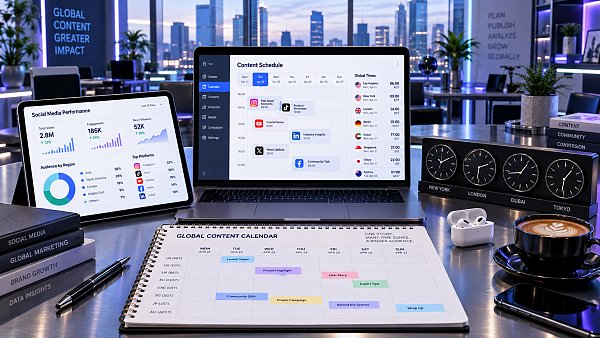
What information should an executable cross-time-zone scheduling table include?
What truly reduces daily pressure is not a calendar containing only dates and copy, but a content action plan that everyone can understand. In addition to publication dates, it is recommended to include the following items:
- Target country and reference time zone: For example, U.S. Eastern Time, the UK, the UAE, or Singapore, avoiding overly broad labels such as “North America” or “Europe.”
- Platform and account: Whether the same topic is suitable for LinkedIn’s professional tone, Instagram’s visual presentation, or TikTok’s short-video rhythm should be clarified in advance.
- Local publishing time and Beijing time: Record both times side by side to facilitate review, on-duty coverage, and exception handling.
- Content objective and action entry point: Is the goal to encourage comments, visit a multilingual website, watch a video, or submit an inquiry? Each piece of content should ideally retain only one primary action.
- Asset status: Mark items as pending translation, pending design, pending legal confirmation, scheduled, or published to avoid omissions during cross-departmental handovers.
- Review fields: Record reach, engagement, clicks, direct messages, and exceptional situations to provide a basis for the next scheduling cycle.
For example, a manufacturing company targeting the German and U.S. markets can schedule LinkedIn technical case studies for local weekday mornings and test product demonstration short videos after work or on weekends. Event notifications aimed at Southeast Asian distributors can avoid local religious holidays, public holidays, and major industry exhibitions. A plan is not necessarily better when it is denser; the key is to give important content a sufficient observation period.
Do not rely solely on scheduling for overseas social media operations: retain a handoff for “human response”
Scheduled publishing ensures content goes live on time, but it does not mean operations are complete. Engagement immediately after a post is published often affects the atmosphere of subsequent discussions. If the target market’s active hours happen to fall late at night for the China-based team, relying entirely on staff to stay online is not realistic. However, if no one handles comments, direct messages, and questions from potential customers, high-quality traffic may quietly be lost.
A “scheduled publishing + duty window + tiered response” approach can be adopted. For common questions such as price ranges, product specifications, and delivery lead times, pre-approved response materials can be prepared in advance. For matters involving quotations, technical customization, or after-sales disputes, escalation rules should be established to ensure that sales personnel or relevant responsible parties follow up within the agreed time limit. For B2B accounts, a timely and clear reply with a path to the next step is often more valuable than adding another promotional post.
If the team manages many accounts, unified content calendars, asset libraries, and approval workflows can be used to manage different regions. Yiyingbao provides intelligent website building, multilingual websites, and overseas marketing collaboration services for companies expanding internationally. Social media scheduling should not exist in isolation: when a post points to a product page, case study page, or advertising landing page, the link language, regional version, form fields, and UTM tags must remain consistent. Only then can it be clearly determined afterward which market, platform, and publishing time actually generated visits and conversions.
Do not copy “golden hours”; use small-scale testing instead of guesswork
Recommendations commonly found in industry articles, such as “weekday mornings” and “prime evening hours,” can serve as a starting point but cannot replace data from your own account. New accounts have a weak follower base, and their content reach depends more on tags, search, and platform recommendations; mature accounts are more influenced by follower online behavior. The evaluation criteria differ at different stages.
Select two or three candidate time windows and test them continuously for several weeks using similar content types and audience regions. For example, test product knowledge content published on Tuesday mornings, Thursday midday, and Saturday evenings in the target market, then compare organic reach, effective engagement, and link click-through rates within 24 hours and 7 days. During testing, avoid making major changes to headlines, asset formats, tags, and advertising budgets at the same time; otherwise, it will be difficult to determine whether timing or the content itself caused the difference.
Management processes are also worth documenting at the same time. For discussions related to cross-team collaboration, data archiving, and digital management approaches, refer to the relevant discussion in An Analysis of Strategies for the Digital Transformation of Human Resource Management in Public Institutions in the Intelligent Era. Although the application scenarios differ, the approach of “unified standards, clear responsibilities, and continuous review” is equally applicable to multi-market social media content management.
Several details that can easily cause schedules to fail
First, ignoring daylight saving time. It is recommended to use scheduling tools that support automatic time zone conversion and check scheduled tasks for the following two weeks before every daylight saving time transition. Second, copying and pasting content across all platforms for publication at exactly the same time. User habits and content decay rates vary across platforms, so posts can be published at intervals, with adjustments to the opening, images, or engagement questions.
Third, looking only at individual viral posts. Exceptionally high engagement on one occasion may result from trending events, external reposts, or accidental recommendations, and should not immediately become the basis for long-term scheduling. Fourth, forgetting the local cultural context. Holidays, commemorative days, workweek structures, and even religious activities can affect whether users are willing to stop and read commercial content. Fifth, publishing without collecting data. Without monthly reviews, a scheduling table will quickly become a visually appealing calendar that has lost its guiding value.
The value of a cross-time-zone publishing plan lies in shifting overseas social media operations from “posting content by instinct” to “making decisions based on market rhythms.” First select key countries and platforms, then establish dual-time-zone schedules, test content windows, connect engagement responses, and align website landing pages. As data gradually accumulates, teams will find that the most suitable publishing time is not hidden in generic answers, but in every real reach and every piece of user feedback.
Related Articles



Related Products
 Yiyingbao SaaS Intelligent Website Building and Marketing SystemYiyingbao SaaS Intelligent Website Building and Marketing System, AI-powered no-code website building, rapid creation of multilingual B2B international websites in 10 minutes, global server acceleration, AI-powered SEO optimization, helping businesses connect efficiently with global markets. The perfect integration of technology and operation makes building an international trade website remarkably simple
 AI+SEM Intelligent Advertising Marketing SystemAI+SEM drives intelligent ad creation, empowering full-funnel precision advertising marketing. The system automatically generates weekly/monthly reports, AI recommends keywords and target countries, monitors core metrics in real-time with intelligent alerts, and enables one-click high-conversion ad solutions to help quickly acquire customers and improve ROI.
 AI+SEO Dual-Engine System Optimization ServicesYiyingbao’s AI+SEO dual-engine optimization system helps foreign trade enterprises acquire high-quality organic traffic through AI-powered keyword research, content generation, and comprehensive technical optimization, significantly improving search rankings and conversion rates.
 AI+SNS Social Media Marketing SystemYingbao AI+SNS Social Media Marketing System - Precision social capture for the social media era. Supports one-click content synchronization across major platforms like Facebook and LinkedIn. AI intelligently rewrites posts for enhanced relevance. 24/7 AI customer service and user profiling analysis empower businesses to efficiently expand into global markets.
 AI+SEO营销解决方案易营宝AI+SEO营销解决方案,通过AI批量写作、智能生成TDK、精准关键词扩词等功能,全面优化网站SEO效果,提升流量与转化率。助力企业构建高效智能网站新生态。
 AI+SEM Advertising Marketing SolutionsAI+SEM Advertising Marketing Solution leverages AI technology to deeply empower SEM ad campaigns. It automatically generates weekly/monthly reports using AI, presenting account data across multiple dimensions for comprehensive insights into campaign performance and trends. The system precisely recommends keywords and target countries, intelligently generates high-conversion ad copy, and enables one-click activation of efficient campaign plans to help businesses rapidly acquire customers. Simultaneously, it monitors core metrics in real time, intelligently identifies abnormal fluctuations, and issues timely alerts to ensure stable, high-return advertising results.
 Domain Name ServicesEasyWin provides professional domain name services, including intelligent queries, one-stop registration, brand protection, and full lifecycle management, helping businesses build a digital brand image.
 EasyOperate B2C Cross-Border E-Commerce Platform & Independent WebsiteEasyStore B2C Cross-border E-commerce Independent Store is an intelligent website building and cross-border e-commerce integrated solution independently developed by EasyStore Information Technology (Beijing) Co., Ltd. The system is specially designed for small and medium-sized as well as large export enterprises, integrating 'website building, operation, marketing, advertising, and conversion' into one, helping enterprises quickly establish cross-border e-commerce independent stores to achieve brand globalization and global sales growth.
The platform supports multiple languages, multiple currencies, and multi-channel marketing, with built-in AI intelligent translation and SEO optimization systems, suitable for mainstream markets such as Southeast Asia, Europe and America, Latin America, and the Middle East, assisting Chinese manufacturing enterprises in efficiently deploying international e-commerce strategies. SSL证书易营宝提供专业SSL安全证书服务,包括单域名和泛域名证书,确保网站数据传输加密、身份验证和完整性保护,助力企业建立安全可信的在线业务环境。









