









- 21st Century Business Herald: AI and CTV Become Core Growth Engines for Digital Marketing in Overseas MarketsNov 18, 2026View details
- China Presents 25 Cooperation Outcomes in Areas Including Cross-Border E-Commerce During APECNov 18, 2026View details
- AI Products Drive Hong Kong Exports Up 64.9% in September, Fastest Growth in Over 40 YearsNov 17, 2026View details
- National Bureau of Statistics: Foreign trade grew rapidly in October, providing stable support for global tradeNov 17, 2026View details
- The U.S. has ended the $800 de minimis exemption for non-postal shipments; express courier packages must be formally declared.Nov 16, 2026View details
- ASEAN Signs Digital Economy Framework Agreement, Moving Toward Harmonized Cross-Border E-Commerce RulesNov 15, 2026View details
For Overseas Social Media Marketing, Should You Choose Platforms First or Define Your Audience First?
When conducting overseas social media marketing, should companies choose the platform first or identify the audience first? For business evaluators, the answer affects budget efficiency, lead quality, and the path to global growth.
Conclusion first: identify the audience before evaluating platforms

When companies conduct overseas social media marketing, they should generally define their target audience first, rather than immediately investing resources simply because a platform has a large user base, many trending topics, or widespread competitor activity. Platforms are merely channels for reach; audience needs determine whether marketing has commercial value.
However, “identifying the audience first” does not mean ignoring platform differences. A more accurate decision-making sequence is to first clarify who the customers are, which markets they are in, and what stage of the purchasing process they are at, then work backward to determine their commonly used platforms, content preferences, reach costs, and trackable conversion paths.
For business evaluators, this sequence prevents impressions, likes, and follower counts from being mistaken for growth outcomes. What overseas social media marketing truly needs to assess is whether a channel can consistently generate qualified visits, sales leads, opportunity progression, and reusable customer assets.
Why choosing a platform first often reduces budget efficiency
The common logic behind selecting a platform first is that “Facebook has many users,” “LinkedIn is suitable for B2B,” or “TikTok traffic is growing quickly.” These judgments are not entirely wrong, but without considering specific customer segments, product decision-making chains, and country markets, they can easily remain at the level of experience.
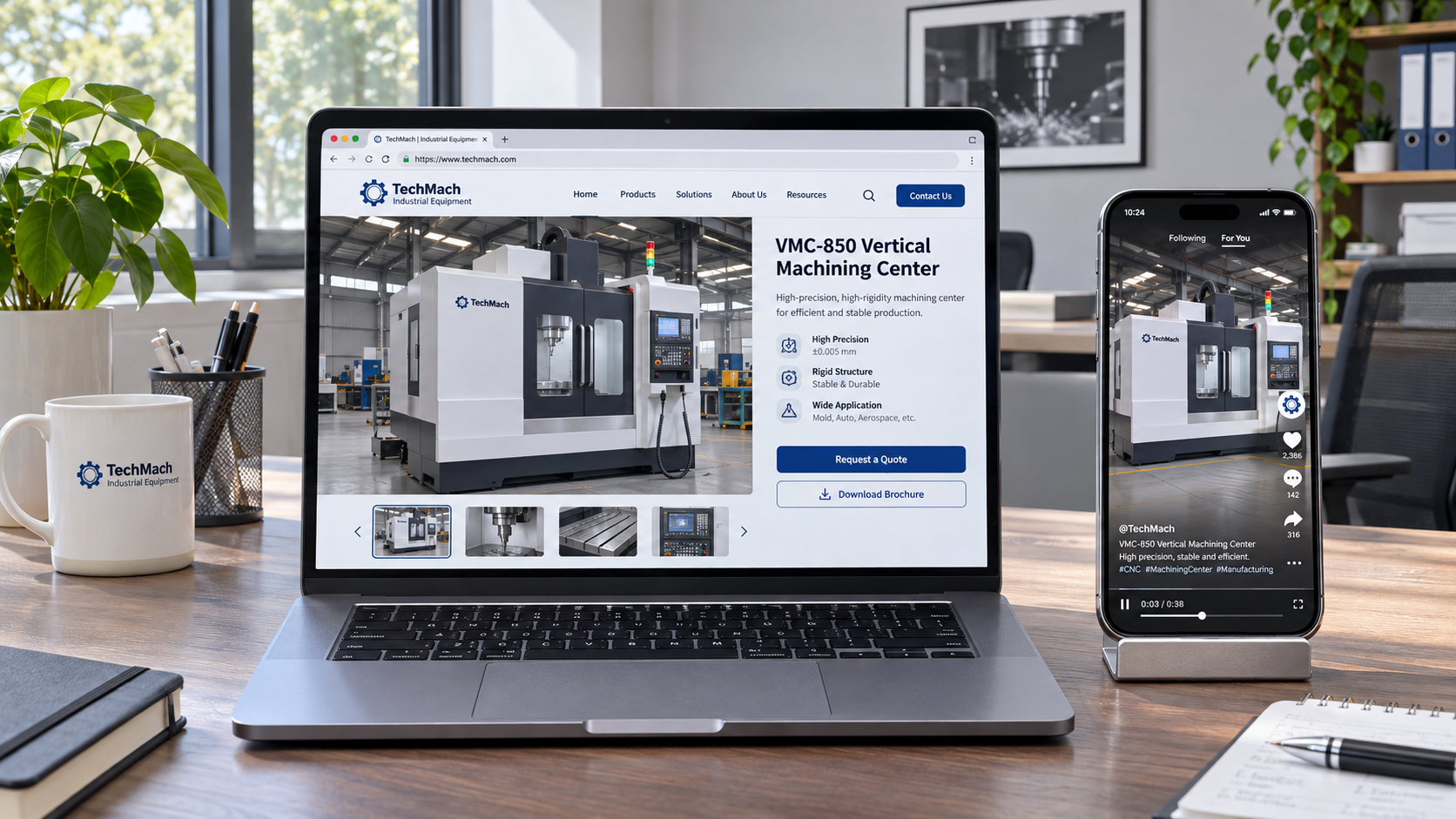
For example, for the export of industrial equipment, LinkedIn may help establish professional touchpoints for complex B2B business targeting procurement managers. However, if customers mainly search Google for suppliers and then visit company websites to compare specifications, social media should not bear the entire responsibility for lead generation.
Similarly, for cross-border brands targeting young consumers, short-video platforms may be highly effective at building product interest. However, when products have high unit prices, long delivery cycles, or require repeated proof of quality, relying solely on content exposure may not complete the conversion loop from interest to purchase.
A platform-first approach can also lead to misinterpretation of data. Teams may invest substantial time pursuing engagement metrics without unified lead criteria, landing page conversion capabilities, or CRM attribution mechanisms. Ultimately, while an account may appear to be growing, the sales department receives no qualified customers to follow up with.
What audience-related questions should business evaluations answer first?
First, identify the actual decision-making unit. Overseas customers may not have only one contact person; procurement, technical, finance, user departments, and management may all be involved. Different roles focus differently on price, delivery time, certifications, case studies, after-sales service, and risk control.
Second, clarify market and language boundaries. Social media usage habits, business communication methods, and content acceptance vary significantly across North America, Europe, the Middle East, Latin America, and Southeast Asia. The same English content may not be suitable for potential customers in every region.
Third, distinguish the stage that customers are in. Users in the awareness stage need to understand product value and application scenarios; users in the consideration stage need specifications, case studies, and evidence of differentiation; users in the procurement stage are more concerned with quotations, delivery time, compliance, and service capabilities. Different stages correspond to different content and channel tasks.
Fourth, quantify customer value. Companies should consider average order value, gross margin, repurchase cycle, sales cycle, and sales follow-up costs to determine which audiences are worth ongoing investment. Overseas social media marketing without a customer value model can easily fall into competition for low-quality traffic.
Working backward from the audience to select platforms: establishing an actionable selection framework
Once the audience profile is relatively clear, platform selection can be evaluated from four dimensions: whether target customers are active there, whether the content format is suitable, whether customer acquisition costs are controllable, and whether platform data can be integrated with the company’s existing marketing and sales systems.
For B2B foreign trade companies, LinkedIn is generally more suitable for reaching decision-makers, procurement leaders, and industry professionals with clearly defined professional identities. Its value lies not only in posting content, but also in building professional credibility, targeted advertising, employee advocacy, and ongoing relationship nurturing.
Facebook and Instagram have broad reach and are suitable for brand presentation, remarketing, community operations, and visual product promotion. They often make it easier to achieve ongoing content reach for consumer goods, home products, apparel, beauty products, lifestyle products, or categories with strong scenario-based presentation capabilities.
Video platforms such as TikTok and YouTube are more suitable for demonstrating product usage processes, manufacturing capabilities, customer cases, and industry knowledge. Manufacturing companies should not produce only general entertainment content; they should turn production processes, testing procedures, application results, and frequently asked questions into credible video assets.
At the same time, the synergistic role of search channels must not be overlooked. Many overseas buyers first become aware of a brand on social media, then search Google for the company name, product terms, or solutions. Without a multilingual website, SEO content, and conversion-oriented landing pages, social media investment will be difficult to accumulate into long-term growth.
How to determine whether platform investment is worth further expansion
Business evaluations should not focus solely on cost per click, but should establish a complete metrics chain from impressions to closed deals. Basic metrics include reach, click-through rate, landing page dwell time, form submissions, direct-message inquiries, qualified lead rate, opportunity rate, transaction value, and customer acquisition cost.
Among these, the qualified lead rate deserves more attention than the total number of leads. Companies should define qualified leads in advance, such as the customer’s country, company size, procurement role, required product category, expected purchasing time, and budget range, to avoid repeated screening of irrelevant inquiries by the sales team.
The evaluation period should also align with business characteristics. Low-priced B2C products can observe add-to-cart activity and orders relatively quickly, while high-value B2B products should also assess inquiry quality, sample requests, meeting appointments, quotation opportunities, and sales-stage progress. Channel value should not be dismissed based on short-term transactions.
It is advisable to replace one-time large-scale spending with small-scale testing. First select one or two priority markets, one clearly defined customer segment, and one core product direction; test platform combinations, content themes, audience targeting, and landing pages; then gradually increase the budget based on actual conversion data.
Three common decision-making risks in overseas social media marketing
The first risk is defining the audience too broadly. Treating “overseas customers” and “cross-border buyers” as a single group makes content, advertising, and landing pages lack relevance. Companies should at least segment core audiences by industry, region, job title, demand scenario, and procurement stage.
The second risk is a disconnect between platforms and business objectives. If the goal is to obtain B2B inquiries but most resources are used to pursue follower growth, or if the goal is to build brand awareness but only highly promotional ads are placed, there will be a misalignment between metrics and business outcomes.
The third risk is a broken social media chain. Content publishing, advertising, website conversion, lead assignment, and sales follow-up may be carried out by different teams, but without unified data standards, companies cannot determine whether the issue lies with the platform, content, or conversion process.
Therefore, overseas social media marketing is better incorporated into an end-to-end digital marketing system. By using multilingual independent websites to capture visits, enhancing search visibility through SEO and GEO content, and combining advertising, social media operations, and data tracking, every touchpoint can move closer to measurable growth.
Conclusion: platform selection is the outcome; audience insight is the starting point
For business evaluators, the answer to “choose the platform first or identify the audience first” is not complicated: first define the audience based on customer value and the purchasing journey, then select the most suitable overseas social media marketing mix. Platform popularity cannot replace business judgment, and traffic volume cannot replace lead quality.
Companies should view social media as one link in the global customer acquisition chain, rather than as an isolated content channel. Only by connecting audience insights, platform testing, marketing websites, data attribution, and sales conversion can overseas social media marketing shift from a budget expense to a sustainable growth investment.
Related Articles
 How can you avoid duplicate content when distributing it across multiple social media platforms?
 What Types of Traffic Can Social Media Marketing Bring to a Cross-Border Independent Website?
 How to Track the Sources of Inquiries to Your Website from Overseas Social Media


Related Products
 Yiyingbao SaaS Intelligent Website Building and Marketing SystemYiyingbao SaaS Intelligent Website Building and Marketing System, AI-powered no-code website building, rapid creation of multilingual B2B international websites in 10 minutes, global server acceleration, AI-powered SEO optimization, helping businesses connect efficiently with global markets. The perfect integration of technology and operation makes building an international trade website remarkably simple
 AI+SEM Intelligent Advertising Marketing SystemAI+SEM drives intelligent ad creation, empowering full-funnel precision advertising marketing. The system automatically generates weekly/monthly reports, AI recommends keywords and target countries, monitors core metrics in real-time with intelligent alerts, and enables one-click high-conversion ad solutions to help quickly acquire customers and improve ROI.
 AI+SEO Dual-Engine System Optimization ServicesYiyingbao’s AI+SEO dual-engine optimization system helps foreign trade enterprises acquire high-quality organic traffic through AI-powered keyword research, content generation, and comprehensive technical optimization, significantly improving search rankings and conversion rates.
 AI+SNS Social Media Marketing SystemYingbao AI+SNS Social Media Marketing System - Precision social capture for the social media era. Supports one-click content synchronization across major platforms like Facebook and LinkedIn. AI intelligently rewrites posts for enhanced relevance. 24/7 AI customer service and user profiling analysis empower businesses to efficiently expand into global markets.
 AI+SEO营销解决方案易营宝AI+SEO营销解决方案,通过AI批量写作、智能生成TDK、精准关键词扩词等功能,全面优化网站SEO效果,提升流量与转化率。助力企业构建高效智能网站新生态。
 AI+SEM Advertising Marketing SolutionsAI+SEM Advertising Marketing Solution leverages AI technology to deeply empower SEM ad campaigns. It automatically generates weekly/monthly reports using AI, presenting account data across multiple dimensions for comprehensive insights into campaign performance and trends. The system precisely recommends keywords and target countries, intelligently generates high-conversion ad copy, and enables one-click activation of efficient campaign plans to help businesses rapidly acquire customers. Simultaneously, it monitors core metrics in real time, intelligently identifies abnormal fluctuations, and issues timely alerts to ensure stable, high-return advertising results.
 Domain Name ServicesEasyWin provides professional domain name services, including intelligent queries, one-stop registration, brand protection, and full lifecycle management, helping businesses build a digital brand image.
 EasyOperate B2C Cross-Border E-Commerce Platform & Independent WebsiteEasyStore B2C Cross-border E-commerce Independent Store is an intelligent website building and cross-border e-commerce integrated solution independently developed by EasyStore Information Technology (Beijing) Co., Ltd. The system is specially designed for small and medium-sized as well as large export enterprises, integrating 'website building, operation, marketing, advertising, and conversion' into one, helping enterprises quickly establish cross-border e-commerce independent stores to achieve brand globalization and global sales growth.
The platform supports multiple languages, multiple currencies, and multi-channel marketing, with built-in AI intelligent translation and SEO optimization systems, suitable for mainstream markets such as Southeast Asia, Europe and America, Latin America, and the Middle East, assisting Chinese manufacturing enterprises in efficiently deploying international e-commerce strategies. SSL证书易营宝提供专业SSL安全证书服务,包括单域名和泛域名证书,确保网站数据传输加密、身份验证和完整性保护,助力企业建立安全可信的在线业务环境。









