









- Which customer acquisition channels will be affected by cross-border marketing trends in 2026?Sep 06, 2026View details
- Which homogenization risks should be considered in an analysis of the AI-powered website building industry?Aug 30, 2026View details
- How Will AI Marketing Trends 2026 Change Advertising Budget AllocationAug 28, 2026View details
- Is the EV SSL certificate market shrinking or upgrading? How should companies assess certificate procurement?Aug 11, 2026View details
- Why the old AMP SEO 2020 practices no longer work and what has changed in current optimization prioritiesAug 02, 2026View details
- How to Choose Topics for an Industry News Section to Attract More Organic Search TrafficJul 29, 2026View details
How to Validate Search Intent for TDK After Website Translation
How to Validate Search Intent in TDK After Website Translation
When a multilingual website goes live, completing the content translation is often only the first step. The real hidden risk is that TDK information, such as page titles, descriptions, and keywords, may still follow the source language's expression logic: the grammar may seem correct, but users in the target market simply would not search that way. For technical evaluators, the answer to “Does TDK need manual adjustment after website translation?” is usually yes. Moreover, it is not enough to simply polish the language; the search intent corresponding to the page needs to be revalidated.
Especially in projects involving export manufacturing, cross-border online stores, and brand websites, the same product may correspond to completely different search paths in different markets. Domestic pages emphasize “manufacturer,” “customization,” and “quotation,” while buyers in English-speaking markets may search for “manufacturer,” “supplier,” or “bulk order,” or directly search for specific materials, specifications, or application scenarios. Japanese, German, and Russian pages are also influenced by industry terminology, local purchasing habits, and compound word formation. Translating Chinese TDK word for word does not mean translating users’ search needs.
First Determine: What Search Does This Page Intend to Capture?
The starting point for TDK validation is not checking whether the translation reads smoothly, but redefining the page. Is the page a product detail page, product category page, industry solution page, brand introduction page, or advertising landing page? Different page types correspond to different search intents.
For example, on a category page for an equipment manufacturer, users are usually at the stage of filtering suppliers or comparing products. The title should prioritize the product category, key attributes, and supplier relationship. A detail page, on the other hand, requires more specific information such as model, application, material, compatibility requirements, or technical features. If a category page is written as “best solution,” both search engines and users will find it difficult to quickly determine what the page sells. Conversely, stuffing a brand story page with numerous product terms will also make visitors find that the content does not match their expectations.
During technical evaluation, each core page can first be assigned one primary intent: information gathering, product comparison, purchase inquiry, brand verification, or after-sales support. When one TDK attempts to cover all intents at once, it often loses focus. Particularly for B2B websites, procurement professionals often first search for general category terms, then gradually add qualifiers such as “custom,” “OEM,” “industrial,” or “for packaging.” The page needs to address a particular segment of that demand rather than attempting to capture all traffic.
Correct Translation Does Not Mean Correct Keyword Semantics
The most common issue with multilingual TDK is mistaking “dictionary equivalence” for “industry equivalence.” For example, if the Chinese term for “export trade website development” is directly converted into a literal expression, it may not be a commonly used search term among businesses in overseas markets. Users are more likely to search around specific needs such as “B2B website design,” “export website,” or “multilingual ecommerce website.” The final term to use should not be decided solely by translators; it should also be determined by the search results page in the target language.
A practical method is to search candidate keywords in the search environment of the target country or region and examine what types of pages rank highly in organic results. If the leading results are mostly product catalogs, supplier directories, and procurement platform pages, the term indicates transactional or commercial investigation intent. If the results mainly consist of tutorials, definitions, and media content, it is more informational in intent. If the content format of a website page does not align with the dominant format on the results page, it will be difficult to achieve stable matching even if the keyword appears in the title.
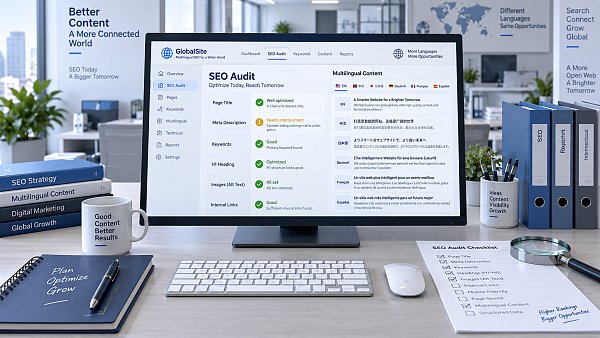
It is not advisable to look only at search volume. For manufacturers, a long-tail keyword with low search volume but clear product specifications, application industries, or purchasing conditions is often closer to generating inquiries than a broad high-volume term. For cross-border retail websites, it is also necessary to determine whether a term suggests price, reviews, discounts, delivery, or brand comparison, as these signals determine whether users expect to see a product page, collection page, or campaign page.
TDK Validation Should Be Performed Separately, Not as a One-Time “Copy Revision”
Title is the focus of search intent validation. It should clearly state the page subject, core object, and necessary distinguishing conditions. A product page title does not need to stack multiple synonyms, nor should the company name be placed at the beginning and take up valuable expression space. For websites with an established level of brand awareness, placing the brand name at the end of the title is usually more conducive to balancing recognition. For websites entering a new market, the product or service topic should appear closer to the front.
Meta Description does not directly replace page content; it is more like a “preview description” in search results. During validation, check whether it answers the user’s next-level question: a product page can explain key specifications, customization capabilities, or applicable scenarios, while a service page can supplement the service scope, target clients, and regional conditions. When the description promises content such as “factory direct price” or “fast delivery,” the page content must provide supporting evidence and must not make claims beyond actual capabilities merely to improve click-through rates.
As for Meta Keywords, Google does not use them as a standard ranking factor for webpages, so substantial effort should not be spent filling keyword tags. If the website-building system still retains this field, it can be used for internal content categorization, migration verification, or compatibility with other platforms, but it should not replace optimization of titles, page content themes, and page link structures.
A Validation Sequence Better Suited for Technical Acceptance
In actual projects, it is recommended not to wait until the entire website has been translated before reworking pages one by one. A more reliable approach is to first select the homepage, top-level category pages, key product pages, core solution pages, and inquiry pages to establish sample rules, then expand them in batches after confirming accuracy. During acceptance, each page can be checked against the following questions:
- Is the core term in the title a genuine, understandable industry term in the target market rather than a direct translation from Chinese?
- When searching for this term, does the mainstream content on the results page match the type of page on this website?
- Are the objects expressed in the title, description, H1, above-the-fold content, and main visual consistent?
- Do category pages and detail pages in the same language compete with each other due to keyword duplication?
- Do local currency, units of measurement, delivery time, certifications, contact details, and other information match the page for that market?
- Is the page indexable, with language version relationships and canonical URLs configured correctly?
The final item is easily overlooked. No matter how accurate the search intent is, if an English page is incorrectly set as canonical to a Chinese page, or if language versions are not properly associated, search engines may still be unable to consistently display the correct page. Therefore, TDK review cannot be separated from technical SEO: URL structure, hreflang, canonical, index status, and internal links should all be included in the same round of review.
Machine Translation Can Improve Speed, but Humans Must Make Critical Judgments
AI translation and bulk-generation tools are suitable for handling drafts, terminology consistency, and highly repetitive pages, but they are not suitable for independently determining commercial keywords and page positioning. The reason is simple: tools can recognize linguistic similarities, but they may not know whether buyers in a particular country are more accustomed to calling a type of product a “component,” “part,” or “accessory.” Nor can they make business decisions about whether to prioritize brand terms, category terms, or high-intent long-tail keywords.
Yiyingbao has long served multilingual website development and overseas marketing scenarios. Its cloud intelligent website-building, AI+SEO/GEO optimization, and advertising marketing systems can help teams improve the efficiency of multilingual page production and management. However, in actual delivery, system capabilities are better suited to identifying issues, standardizing rules, and reducing repetitive operations. Final confirmation of product naming, market priorities, inquiry paths, and local expression should still be completed by people who understand the business.
To determine whether TDK needs manual adjustment after website translation, consider one result: when target users search for the term and see the title and description, would they reasonably expect to find the information they need on the page? If the answer is unclear, the issue is usually not the language itself, but that the search intent has not yet been calibrated. Calibrate key pages thoroughly first, then expand to the entire website, and rework costs will be much lower.
Related Articles


Related Products
 Yiyingbao SaaS Intelligent Website Building and Marketing SystemYiyingbao SaaS Intelligent Website Building and Marketing System, AI-powered no-code website building, rapid creation of multilingual B2B international websites in 10 minutes, global server acceleration, AI-powered SEO optimization, helping businesses connect efficiently with global markets. The perfect integration of technology and operation makes building an international trade website remarkably simple
 AI+SEM Intelligent Advertising Marketing SystemAI+SEM drives intelligent ad creation, empowering full-funnel precision advertising marketing. The system automatically generates weekly/monthly reports, AI recommends keywords and target countries, monitors core metrics in real-time with intelligent alerts, and enables one-click high-conversion ad solutions to help quickly acquire customers and improve ROI.
 AI+SEO Dual-Engine System Optimization ServicesYiyingbao’s AI+SEO dual-engine optimization system helps foreign trade enterprises acquire high-quality organic traffic through AI-powered keyword research, content generation, and comprehensive technical optimization, significantly improving search rankings and conversion rates.
 AI+SNS Social Media Marketing SystemYingbao AI+SNS Social Media Marketing System - Precision social capture for the social media era. Supports one-click content synchronization across major platforms like Facebook and LinkedIn. AI intelligently rewrites posts for enhanced relevance. 24/7 AI customer service and user profiling analysis empower businesses to efficiently expand into global markets.
 AI+SEO营销解决方案易营宝AI+SEO营销解决方案,通过AI批量写作、智能生成TDK、精准关键词扩词等功能,全面优化网站SEO效果,提升流量与转化率。助力企业构建高效智能网站新生态。
 AI+SEM Advertising Marketing SolutionsAI+SEM Advertising Marketing Solution leverages AI technology to deeply empower SEM ad campaigns. It automatically generates weekly/monthly reports using AI, presenting account data across multiple dimensions for comprehensive insights into campaign performance and trends. The system precisely recommends keywords and target countries, intelligently generates high-conversion ad copy, and enables one-click activation of efficient campaign plans to help businesses rapidly acquire customers. Simultaneously, it monitors core metrics in real time, intelligently identifies abnormal fluctuations, and issues timely alerts to ensure stable, high-return advertising results.
 Domain Name ServicesEasyWin provides professional domain name services, including intelligent queries, one-stop registration, brand protection, and full lifecycle management, helping businesses build a digital brand image.
 EasyOperate B2C Cross-Border E-Commerce Platform & Independent WebsiteEasyStore B2C Cross-border E-commerce Independent Store is an intelligent website building and cross-border e-commerce integrated solution independently developed by EasyStore Information Technology (Beijing) Co., Ltd. The system is specially designed for small and medium-sized as well as large export enterprises, integrating 'website building, operation, marketing, advertising, and conversion' into one, helping enterprises quickly establish cross-border e-commerce independent stores to achieve brand globalization and global sales growth.
The platform supports multiple languages, multiple currencies, and multi-channel marketing, with built-in AI intelligent translation and SEO optimization systems, suitable for mainstream markets such as Southeast Asia, Europe and America, Latin America, and the Middle East, assisting Chinese manufacturing enterprises in efficiently deploying international e-commerce strategies. SSL证书易营宝提供专业SSL安全证书服务,包括单域名和泛域名证书,确保网站数据传输加密、身份验证和完整性保护,助力企业建立安全可信的在线业务环境。









