









- APEC Shenzhen Spotlight: Cross-Border E-Commerce Orders Promote Asia-Pacific Trade and Economic CooperationNov 08, 2026View details
- China-Europe Railway Express and CIIE Hold Business Matchmaking Event, Focusing on Cross-Border E-commerce B2B ExportsNov 07, 2026View details
- China’s Ministry of Commerce Responds to Additional Charges on Low-Value Imports Imposed by the EUNov 06, 2026View details
- Two Internet Development Reports Released at the 2026 World Internet ConferenceNov 05, 2026View details
- Internet Business Revenue of Enterprises Above the Designated Size Reached RMB 1.716 Trillion in the First Three Quarters, with Profits Up 17.6%Nov 05, 2026View details
- Shopify's Third-Quarter Revenue and GMV Fall Short of Expectations, Sending Shares Tumbling Before the Market OpensNov 04, 2026View details
New Japanese METI Regulations Take Effect: Japan-Facing B2B Websites Must Comply with JIS Z 8305-2026
Starting September 1, 2026, Chinese B2B standalone websites conducting business with Japanese buyers will face more explicit accessibility compliance requirements. This change stems from the revised Web Accessibility Guidelines for B2B Suppliers issued by Japan’s Ministry of Economy, Trade and Industry (METI) on August 3, 2026. Its impact extends beyond website presentation and is directly linked to overseas customer acquisition, eligibility for supplier directories, document delivery methods, and procurement communication efficiency. It is therefore of practical importance to companies engaged in trade with Japan, manufacturing suppliers, website development service providers, and teams responsible for digital operations.
The Compliance Requirements Targeted by the New Rules Are Already Clear
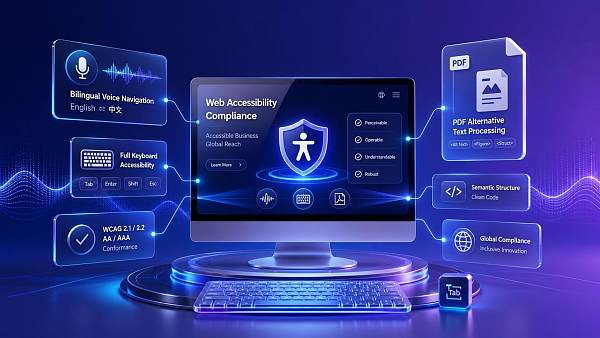
According to the information provided, Japan’s Ministry of Economy, Trade and Industry (METI) issued the revised Web Accessibility Guidelines for B2B Suppliers on August 3, 2026, requiring Chinese B2B standalone websites targeting Japanese buyers to comply with the JIS Z 8305-2026 standard from September 1, 2026.
The confirmed requirements include support for bilingual Japanese-English voice navigation, automatic generation of alternative text for PDFs, a page contrast ratio of at least 4.5:1, and full keyboard operability throughout the user journey.
At the same time, it has been confirmed that websites failing to meet the above requirements will be removed from the JETRO Recommended Supplier Directory.
The Impact Is Extending from the Website Front End to the Pre-Transaction Process
For Foreign Trade Companies Directly Targeting Japanese Buyers
Based on the analysis, these companies will be affected most directly because their standalone websites are important channels for reaching Japanese buyers. Once a website fails to meet the requirements of JIS Z 8305-2026, the initial impact will be seen in external presentation and procurement lead generation, particularly in visibility and credibility related to the JETRO Recommended Supplier Directory. What deserves greater attention now is that website compliance is no longer merely a technical issue but has become part of the sales front end.
For Processing and Manufacturing Companies and Supplier Teams
From an industry perspective, manufacturing companies may be practically affected even if they do not operate complex marketing systems themselves, because product information, specification sheets, catalogs, and other documents are primarily delivered through websites and PDFs. The requirement for automatic generation of alternative text for PDFs means that the document delivery method itself has entered the scope of compliance. Relevant teams need to consider whether product documents, download centers, and multilingual information presentation can adapt to the new access requirements.
For Distribution Channels, Supply Chains, and Service Support Providers
Distribution companies, supply chain service providers, and service providers offering website development, content management, translation, and website maintenance for foreign trade companies will also face supporting pressure. This is because requirements concerning contrast, keyboard operability, and bilingual voice navigation involve page templates, front-end interactions, content structures, and document processing procedures. In practice, their impact will be reflected in delivery standards, acceptance methods, and the allocation of subsequent maintenance responsibilities.
Impact on the Communication Threshold for Japanese Buyers
This requirement also changes how buyers access supplier information. For visitors who rely on keyboard operation or voice navigation, or who require higher readability, website compliance will directly affect browsing efficiency and the experience of obtaining documents. Therefore, this change is not merely a rule adjustment on the supplier side; it will also feed back into supplier screening and initial communication during procurement.
Where Companies Should Focus Their Attention Now
First Distinguish Between Being Accessible and Being Compliant
From a practical perspective, many company websites already provide basic browsing functions, but this does not mean that they comply with JIS Z 8305-2026. What needs to be assessed now is whether voice navigation covers both Japanese and English scenarios, whether the contrast ratio meets the specified threshold, whether keyboard operation covers the entire process, and whether PDF materials support automatic generation of alternative text. Companies should first conduct a function-by-function review before deciding whether a redesign is necessary.
Include PDFs and Information Pages in the Review Scope
These rules do not target only the homepage or primary sections. Based on the available information, automatic generation of alternative text for PDFs has been explicitly included in the requirements, which means that downloadable product manuals, certification documents, specification tables, and explanatory materials should all be included in the review checklist. For companies that rely on document-driven inquiries, this area is often more easily overlooked than visual adjustments to web pages.
Monitor the Link Between Directory Eligibility and Customer Reach
The confirmed information indicates that non-compliant websites will be removed from the JETRO Recommended Supplier Directory. For relevant companies, this consequence requires a separate assessment because it concerns the stability of their exposure channels among Japanese buyers. What deserves greater attention now is the connection between the pace of website rectification, continuity of customer access, and directory eligibility, rather than a one-time technical fix alone.
Continue Monitoring Subsequent Wording and Implementation Details
Companies should also continue to monitor whether subsequent official statements provide supplementary explanations during implementation. This is not because the existing requirements are unclear, but because companies generally need to convert the standards into internal acceptance criteria, supplier delivery requirements, and customer communication guidelines during actual implementation. For teams upgrading their websites or preparing to enter the Japanese market, such differences will directly affect project planning.
This Appears More Like a Signal That the Entry Standard Is Moving Upstream
Based on the analysis, this information should not be understood merely as a notice concerning website experience optimization. It is more appropriate to view it as a sign that B2B digital touchpoints are being incorporated into clearer access and screening logic. The confirmed outcome is specific: non-compliant websites will lose their eligibility for the JETRO Recommended Supplier Directory. From an industry observation perspective, however, the market needs to continue monitoring whether such requirements will remain limited to specific directories and procurement entry points or eventually become a routine threshold for business with Japan.
In other words, in the short term, this change appears as a compliance task for standalone websites; in the medium to long term, it looks more like a signal that the procurement side is imposing more detailed requirements on suppliers’ digital infrastructure. It is not yet appropriate to infer broader certain outcomes from this, but its direction is already sufficiently clear.
At This Stage, It Is More Appropriate to Understand This as a Mandatory Checkpoint at the Business Front End
Overall, the message conveyed by METI’s new rules is quite direct: for Chinese B2B standalone websites targeting Japanese buyers, accessibility is no longer merely an optional feature but is entering the business front end as an element that can be inspected and can affect directory eligibility. For companies, the immediate priority is not to discuss trends in general terms, but to promptly confirm whether their websites, materials, and interaction processes comply with the specified requirements.
From an observational perspective, this information contains both short-term implementation pressure and a long-term regulatory signal. At this stage, it is more appropriate to understand it as a compliance requirement that has already taken effect, as well as an evolving direction in procurement rules that warrants continued monitoring.
Basis of This Article and Directions for Further Verification
This article was generated based on the information title, event date, and event summary provided by the user. The core information includes the release and effective dates of METI’s new rules, the applicable entities, the requirements related to JIS Z 8305-2026, and the consequence that non-compliant websites will be removed from the JETRO Recommended Supplier Directory.
This type of information generally also requires continued verification against official announcements, documents from standards organizations, corporate announcements, industry association information, and reports from authoritative media. Since no specific official source links were provided in the input, this article does not cite specific links, and the relevant statements still need to be further verified through subsequent tracking. Areas worth monitoring include whether official authorities issue further implementation guidance, the acceptance criteria companies apply when implementing specific functions, and the level of enforcement of these requirements in actual procurement scenarios.
Related Articles
 Does Spanish-language content for the Latin American market need to be localized by country?
 Should URLs Be Kept in Their Original Language After Website Content Is Translated?
 How can you evaluate the copywriting capabilities of a marketing website translation provider?

Related Products
 Yiyingbao SaaS Intelligent Website Building and Marketing SystemYiyingbao SaaS Intelligent Website Building and Marketing System, AI-powered no-code website building, rapid creation of multilingual B2B international websites in 10 minutes, global server acceleration, AI-powered SEO optimization, helping businesses connect efficiently with global markets. The perfect integration of technology and operation makes building an international trade website remarkably simple
 AI+SEM Intelligent Advertising Marketing SystemAI+SEM drives intelligent ad creation, empowering full-funnel precision advertising marketing. The system automatically generates weekly/monthly reports, AI recommends keywords and target countries, monitors core metrics in real-time with intelligent alerts, and enables one-click high-conversion ad solutions to help quickly acquire customers and improve ROI.
 AI+SEO Dual-Engine System Optimization ServicesYiyingbao’s AI+SEO dual-engine optimization system helps foreign trade enterprises acquire high-quality organic traffic through AI-powered keyword research, content generation, and comprehensive technical optimization, significantly improving search rankings and conversion rates.
 AI+SNS Social Media Marketing SystemYingbao AI+SNS Social Media Marketing System - Precision social capture for the social media era. Supports one-click content synchronization across major platforms like Facebook and LinkedIn. AI intelligently rewrites posts for enhanced relevance. 24/7 AI customer service and user profiling analysis empower businesses to efficiently expand into global markets.
 AI+SEO营销解决方案易营宝AI+SEO营销解决方案,通过AI批量写作、智能生成TDK、精准关键词扩词等功能,全面优化网站SEO效果,提升流量与转化率。助力企业构建高效智能网站新生态。
 AI+SEM Advertising Marketing SolutionsAI+SEM Advertising Marketing Solution leverages AI technology to deeply empower SEM ad campaigns. It automatically generates weekly/monthly reports using AI, presenting account data across multiple dimensions for comprehensive insights into campaign performance and trends. The system precisely recommends keywords and target countries, intelligently generates high-conversion ad copy, and enables one-click activation of efficient campaign plans to help businesses rapidly acquire customers. Simultaneously, it monitors core metrics in real time, intelligently identifies abnormal fluctuations, and issues timely alerts to ensure stable, high-return advertising results.
 Domain Name ServicesEasyWin provides professional domain name services, including intelligent queries, one-stop registration, brand protection, and full lifecycle management, helping businesses build a digital brand image.
 EasyOperate B2C Cross-Border E-Commerce Platform & Independent WebsiteEasyStore B2C Cross-border E-commerce Independent Store is an intelligent website building and cross-border e-commerce integrated solution independently developed by EasyStore Information Technology (Beijing) Co., Ltd. The system is specially designed for small and medium-sized as well as large export enterprises, integrating 'website building, operation, marketing, advertising, and conversion' into one, helping enterprises quickly establish cross-border e-commerce independent stores to achieve brand globalization and global sales growth.
The platform supports multiple languages, multiple currencies, and multi-channel marketing, with built-in AI intelligent translation and SEO optimization systems, suitable for mainstream markets such as Southeast Asia, Europe and America, Latin America, and the Middle East, assisting Chinese manufacturing enterprises in efficiently deploying international e-commerce strategies. SSL证书易营宝提供专业SSL安全证书服务,包括单域名和泛域名证书,确保网站数据传输加密、身份验证和完整性保护,助力企业建立安全可信的在线业务环境。









