









- Amazon Raises Fulfillment Fees Twice, Yet the Median Platform Fee Remains Around 40%Oct 22, 2026View details
- AliExpress and YouTube Partner to Expand Marketing Opportunities for Chinese Brands Going GlobalOct 22, 2026View details
- Publicis says AI marketing is developing at two speeds, with agentic AI helping win clientsOct 21, 2026View details
- Salesforce Plans to Acquire Braze for $5.66 Billion to Enhance AI Marketing CapabilitiesOct 21, 2026View details
- Levanta’s Inaugural China Summit Held in Shenzhen, Focusing on AI and Cross-Border Brand GrowthOct 20, 2026View details
- The October Edition of the 2026 GGE Shenzhen Cross-Border E-Commerce Expo OpensOct 20, 2026View details
How Can Automotive Parts Export Websites Shorten Multilingual Launch Cycles?
For multilingual launches of automotive parts export websites, what truly slows down projects is often not translation speed, but scattered product information, inconsistent terminology, repeated page structure revisions, and unclear boundaries for content approval across different markets. Transforming a brake pad, control arm, or automotive light product from Chinese materials into a page that overseas customers can understand, search engines can index, and can support inquiry conversion involves more than language conversion. It also requires reorganizing vehicle fitment, part numbers, material parameters, certification information, application scenarios, and commercial messaging.
If multilingual work is understood as “translating pages one by one after the Chinese pages are completed,” the launch timeline will usually quickly get out of control as the number of languages and SKUs increases. The key to shortening the timeline is not compressing translators' working time, but turning content production, translation, localization validation, and website publishing into a reusable process.
First Identify the Real Bottleneck: Automotive Parts Content Is Not Ordinary Product Copy
Automotive parts websites have a typical characteristic: products may look similar, but fitment relationships, technical specifications, and compliance statements cannot be mixed. For example, even for brake discs, different vehicle models, years, axle positions, diameters, bolt patterns, and OE numbers may correspond to different products. Likewise, for LED work lights, application descriptions, certification requirements, and customer concerns are not exactly the same in the European, Middle Eastern, and North American markets.
Therefore, common reasons for slow multilingual content launches include:
- Product data is stored in Excel files, ERP systems, PDF catalogs, sales quotations, and old websites, with inconsistent field definitions;
- Chinese product names themselves are not standardized, with the same part referred to as a “swing arm,” “control arm,” or “suspension arm,” making stable English terminology impossible;
- The translation team receives isolated text without specifications, images, and fitment information, and can only ask repeated follow-up questions;
- The website backend requires editing pages one by one, so adding a new language requires repeatedly creating categories, uploading images, and entering SEO information;
- Overseas sales, technical, and quality departments all participate in reviews, but there are no rules defining who is responsible for which fields;
- In pursuit of making “every market completely different,” too many localized versions are produced at the initial launch stage, exceeding actual business needs.
Many companies attribute delays to translation quality, but the deeper issue is that content sources have not been organized into manageable data assets. Without unified source data, even the fastest translation tools and website-building systems can only accelerate rework.
Split Product Information into a “Global Shared Layer” and a “Market Adaptation Layer”
The first step in shortening the timeline is to stop treating complete pages as content management units and instead divide content into reusable fields. For automotive parts export websites, a practical approach is to establish a two-layer content structure.
The global shared layer should include relatively objective and stable information: product name, product code, OE number, interchange number, dimensions, materials, processes, packaging specifications, images, installation position, vehicle fitment range, test items, and existing certifications or test documents. This layer is the common foundation for multilingual pages and should be extracted as much as possible from ERP, PIM, or unified product tables rather than manually copied by editors.
The market adaptation layer handles information that needs to vary by country, language, or channel: commonly used local search terms, unit display formats, market-specific names for compatible vehicle models, delivery term descriptions, after-sales statements, case content, CTA buttons, and regulatory notices. For example, the U.S. market typically places greater emphasis on Year/Make/Model fitment searches and after-sales assurance information; European buyers may pay more attention to OE cross-reference numbers, certifications, and technical specifications; while Middle Eastern and Latin American markets may rely more on clear images, weather resistance descriptions, and supply stability information.
The significance of this approach is that when adding German, French, or Spanish, there is no need to build an entirely new website. It is only necessary to add language content and required differences for the relevant market on top of stable product data. For companies with many SKUs, page reuse rates often determine the overall timeline more than the efficiency of a single translation.
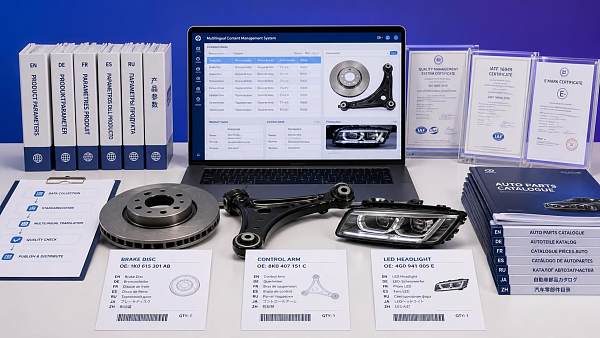
Build a Terminology Database Before Starting Batch Translation
Many translation errors in the automotive parts industry are not grammatical issues, but rather the use of professional terms that do not match purchasing practices or shifts in technical meaning. For example, “bushing” may correspond to different, more accurate expressions in specific contexts; terms such as “assembly,” “repair kit,” “left/right-hand part,” and “front/rear axle” can easily become inconsistent across batch pages if they are not agreed upon in advance.
It is recommended to establish a minimum viable terminology database before the first launch batch. There is no need to aim to cover all products at once, but it should at least include:
- Standard Chinese and English names and common aliases for core categories;
- Retention rules for brand names, product line names, models, and product codes;
- Formatting rules for technical fields such as OE numbers, dimensions, torque, and material grades;
- Standard translations for sensitive statements regarding certifications, testing, and warranties;
- Common target-market expressions for vehicle models, part locations, and application scenarios;
- A list of marketing language that is prohibited because it is exaggerated or unsupported.
The terminology database should be confirmed by personnel familiar with the products rather than being left entirely to the language team. In particular, when statements such as “compliant with,” “certified,” “suitable for,” and “replacement for original parts” are involved, it is essential to distinguish between documents already held, testing capabilities that can be provided, and general product descriptions, so as to avoid inaccurate compliance commitments after translation.
On this basis, machine translation can be used to improve first-draft efficiency, while human proofreading focuses on technical terminology, fitment relationships, parameter units, and commercial tone. A more reasonable goal is not to make every paragraph as meticulously polished as advertising copy, but to ensure that overseas visitors can accurately understand what the product is, where it is applicable, how to purchase it, and what support the company can provide.
Page Templates Determine Whether Adding Languages Will Lead to Repeated Rework
Many websites use a “one product, one freely designed layout” approach during the Chinese-language stage. Although this may appear visually flexible, high maintenance costs become evident during the multilingual stage: text length changes after translation and tables become misaligned; specification fields are embedded in images and cannot be translated or searched; and modules need to be manually adjusted for every country site.
For automotive parts B2B websites, field-based and component-based pages are more suitable. Product detail pages can consistently retain modules such as product overview, key advantages, specifications, OE/cross-reference numbers, fitment information, packaging and lead time, quality control, and inquiry entry points. Text content should be placed in translatable fields, while dimension drawings, installation drawings, and label images should retain replaceable versions or use multilingual layers.
Such templates do not mean that all pages become identical. Content that genuinely requires differentiation, such as application cases for key products, fault solutions, technical articles, and regional landing pages, can be assigned dedicated editorial resources. Basic SKU pages should prioritize complete structure, accurate data, and usable indexing.
Whether a website-building system supports language-version inheritance, batch duplication, translation status management, field-level updates, and multilingual URL rules directly affects launch efficiency. If every product parameter update must be manually synchronized across five or six language sites, subsequent maintenance costs are often higher than the initial construction cost.
Do Not Schedule by “Language”; Schedule by “Product Priority”
The most common pitfall in multilingual projects is trying to launch all products, all countries, and all languages at the same time. The result is usually that every language has a large number of unfinished pages, while even core products cannot be put into promotion for a long time.
A more executable approach is to tier products based on business value. The first tier consists of core categories that contribute the majority of inquiries and sales, including products with mature supply chains, complete specifications, complete image materials, and clear fitment relationships. The second tier consists of regular SKUs used to supplement catalog completeness. The third tier consists of long-tail products with incomplete information, low margins, or market demand that has not yet been verified.
The first multilingual launch should prioritize coverage of first-tier products and be supported by a small number of category pages and technical content pieces that can answer purchasing questions. For example, a suspension system supplier should not merely translate hundreds of control arm SKUs, but should also have pages covering materials, forging or stamping processes, bushing selection, OE number matching, and quality testing. Such content can help customers conduct an initial supplier screening and reduce the sales team's need to explain repetitive questions.
Language selection should likewise follow market data rather than blindly pursuing broad coverage. Companies that already have a foundation of English inquiries can first develop the English site in depth, then determine whether to prioritize Spanish, French, German, Russian, Arabic, or other languages based on customer sources, trade show regions, advertising data, and sales coverage capabilities. Languages without clear business follow-up capabilities may not generate effective value even if launched quickly.
Change Reviews from “Page-by-Page Confirmation” to “Risk-Based Confirmation”
Review is another major variable affecting launch speed. Having multiple people review all content page by page may appear cautious, but in practice it often leads to version confusion. A more effective approach is to define review depth based on content risk.
Product names, basic specifications, and packaging information can be centrally sampled and checked by product owners. High-risk fields such as OE numbers, compatible vehicle models, certifications, test results, and warranty scope should have clearly designated technical or quality approvers. Brand stories, general capability introductions, and routine process descriptions can be published in batches after adopting unified templates. Verified template content should not be required to go through the complete approval chain again simply because 100 new SKUs are added.
At the same time, clear publishing statuses should be established, such as “information pending completion,” “pending translation,” “language proofreading completed,” “technical confirmation completed,” “published,” and “pending update.” Statuses must be visible within one collaboration interface. Using WeChat groups, emails, and multiple Excel files to track versions is often where multilingual projects begin to lose control.
Launch Speed Must Not Come at the Expense of Visibility and Credibility
After a website is published quickly, several easily overlooked issues still need to be checked. Each language version should have an independent, accessible URL and use proper language and regional tags to help search engines understand page relationships. All languages should not be placed on the same page, nor should users be expected to rely entirely on automatic browser translation after entering a page.
Text in images, PDF catalogs, download instructions, and inquiry forms must also be included within the multilingual scope. Inquiry forms in particular can significantly improve lead quality when fields for vehicle model, OE number, quantity, destination port, purchasing purpose, and similar information are designed clearly enough. If overseas customers understand the page but cannot submit their requirements in a familiar way, the value of multilingual development will be weakened.
It is also necessary to avoid directly copying meta titles, descriptions, and product introductions across pages in different languages. Even when the product is the same, titles and page priorities need to be adjusted based on locally common search methods. For automotive parts, product type, OE number, vehicle fitment, and key specifications usually have greater search and decision-making value than vague claims such as “high-quality supplier.”
Replace a One-Time “Major Translation Project” with Continuous Updates
A mature multilingual website should not be a one-time project, but should become part of the product information update process. New product development, model changes, packaging adjustments, new certifications, and changes in key markets should all trigger update tasks for relevant language content. This can prevent the situation in which Chinese-site information has already been iterated months later while overseas sites still remain on old versions.
To determine whether the multilingual launch timeline has truly been shortened, it is also not enough to look only at “how many pages have been published.” More valuable metrics include the number of days required for core SKUs to move from information confirmation to multilingual publication, the technical rework rate after translation, indexing performance of pages in different languages, the proportion of qualified inquiries containing OE numbers or vehicle model information, and feedback from the sales team on the usability of website materials.
Ultimately, shortening the multilingual content launch cycle for automotive parts export websites is not about requiring teams to translate each page faster, but about enabling product data, terminology rules, page components, review responsibilities, and publishing mechanisms to operate continuously. Once the content foundation has been properly organized, adding languages, adding SKUs, and entering new markets no longer become projects that start from zero, but rather an expansion of an established process.
Related Articles
 Building a Website for the Russian-Speaking Market: Is Translating the Website Enough?
 Does the quote for building a website in a less commonly used language include localization and translation?
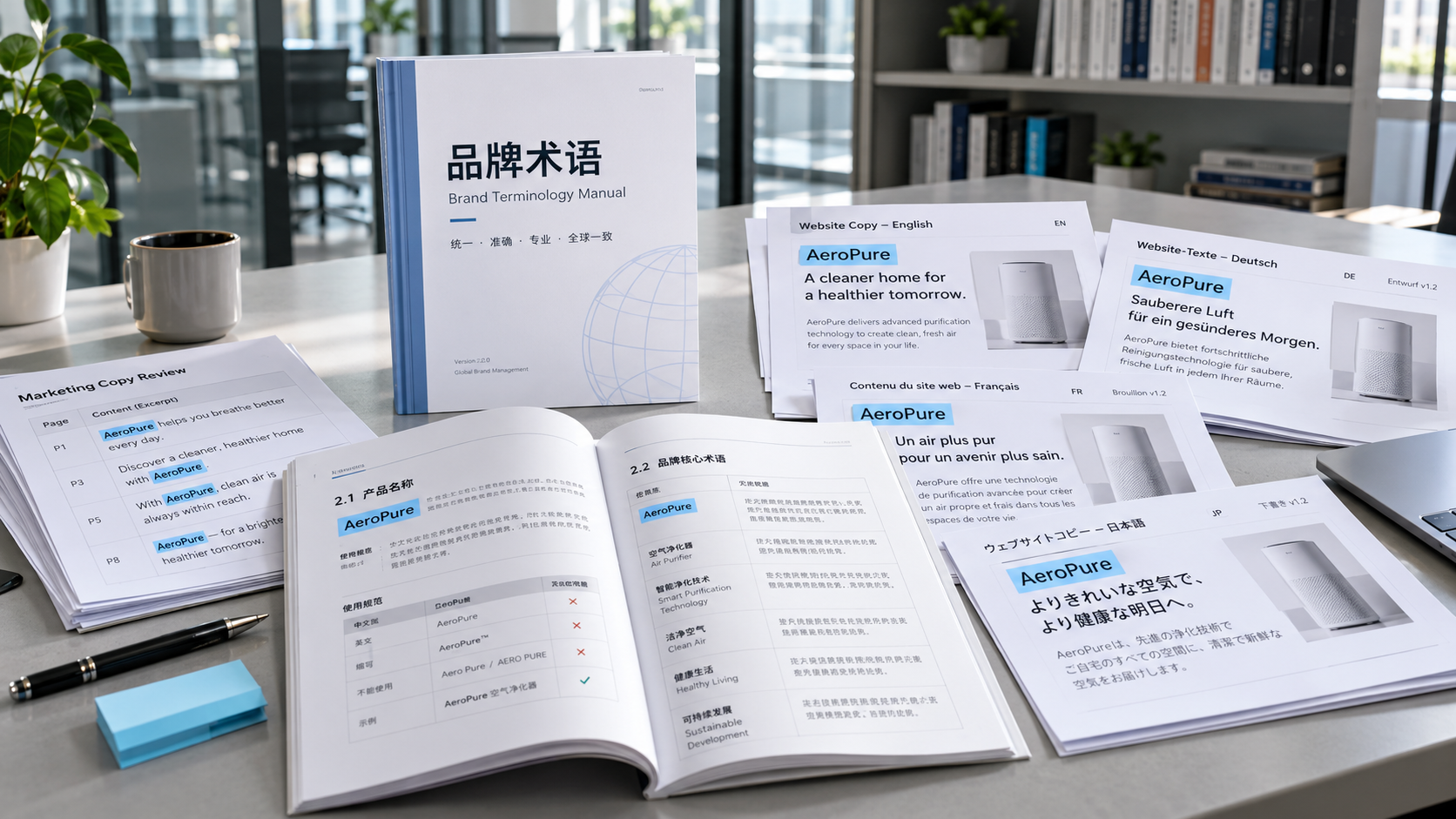
 Can an AI translation platform standardize brand terminology across multilingual websites?


Related Products
 Yiyingbao SaaS Intelligent Website Building and Marketing SystemYiyingbao SaaS Intelligent Website Building and Marketing System, AI-powered no-code website building, rapid creation of multilingual B2B international websites in 10 minutes, global server acceleration, AI-powered SEO optimization, helping businesses connect efficiently with global markets. The perfect integration of technology and operation makes building an international trade website remarkably simple
 AI+SEM Intelligent Advertising Marketing SystemAI+SEM drives intelligent ad creation, empowering full-funnel precision advertising marketing. The system automatically generates weekly/monthly reports, AI recommends keywords and target countries, monitors core metrics in real-time with intelligent alerts, and enables one-click high-conversion ad solutions to help quickly acquire customers and improve ROI.
 AI+SEO Dual-Engine System Optimization ServicesYiyingbao’s AI+SEO dual-engine optimization system helps foreign trade enterprises acquire high-quality organic traffic through AI-powered keyword research, content generation, and comprehensive technical optimization, significantly improving search rankings and conversion rates.
 AI+SNS Social Media Marketing SystemYingbao AI+SNS Social Media Marketing System - Precision social capture for the social media era. Supports one-click content synchronization across major platforms like Facebook and LinkedIn. AI intelligently rewrites posts for enhanced relevance. 24/7 AI customer service and user profiling analysis empower businesses to efficiently expand into global markets.
 AI+SEO营销解决方案易营宝AI+SEO营销解决方案,通过AI批量写作、智能生成TDK、精准关键词扩词等功能,全面优化网站SEO效果,提升流量与转化率。助力企业构建高效智能网站新生态。
 AI+SEM Advertising Marketing SolutionsAI+SEM Advertising Marketing Solution leverages AI technology to deeply empower SEM ad campaigns. It automatically generates weekly/monthly reports using AI, presenting account data across multiple dimensions for comprehensive insights into campaign performance and trends. The system precisely recommends keywords and target countries, intelligently generates high-conversion ad copy, and enables one-click activation of efficient campaign plans to help businesses rapidly acquire customers. Simultaneously, it monitors core metrics in real time, intelligently identifies abnormal fluctuations, and issues timely alerts to ensure stable, high-return advertising results.
 Domain Name ServicesEasyWin provides professional domain name services, including intelligent queries, one-stop registration, brand protection, and full lifecycle management, helping businesses build a digital brand image.
 EasyOperate B2C Cross-Border E-Commerce Platform & Independent WebsiteEasyStore B2C Cross-border E-commerce Independent Store is an intelligent website building and cross-border e-commerce integrated solution independently developed by EasyStore Information Technology (Beijing) Co., Ltd. The system is specially designed for small and medium-sized as well as large export enterprises, integrating 'website building, operation, marketing, advertising, and conversion' into one, helping enterprises quickly establish cross-border e-commerce independent stores to achieve brand globalization and global sales growth.
The platform supports multiple languages, multiple currencies, and multi-channel marketing, with built-in AI intelligent translation and SEO optimization systems, suitable for mainstream markets such as Southeast Asia, Europe and America, Latin America, and the Middle East, assisting Chinese manufacturing enterprises in efficiently deploying international e-commerce strategies. SSL证书易营宝提供专业SSL安全证书服务,包括单域名和泛域名证书,确保网站数据传输加密、身份验证和完整性保护,助力企业建立安全可信的在线业务环境。









