









- Levanta’s Inaugural China Summit Held in Shenzhen, Focusing on AI and Cross-Border Brand GrowthOct 20, 2026View details
- The October Edition of the 2026 GGE Shenzhen Cross-Border E-Commerce Expo OpensOct 20, 2026View details
- Dongguan’s foreign trade imports and exports reached RMB 1.29 trillion in the first three quarters, a record high for the same periodOct 20, 2026View details
- Liaoning Holds Province-Wide Meeting to Advance Cross-Border E-Commerce, Emphasizing the Need to Explore Differentiated Development PathsOct 20, 2026View details
- Advanced Manufacturing Seizes Global Opportunities as Guangdong’s Q3 Foreign Trade Surpasses RMB 3 Trillion for the First TimeOct 20, 2026View details
- Can the average annual growth rate reflect real opportunities in overseas markets?Oct 07, 2026View details
Can an AI translation platform standardize brand terminology across multilingual websites?
Can an AI translation platform unify brand terminology across multilingual websites?
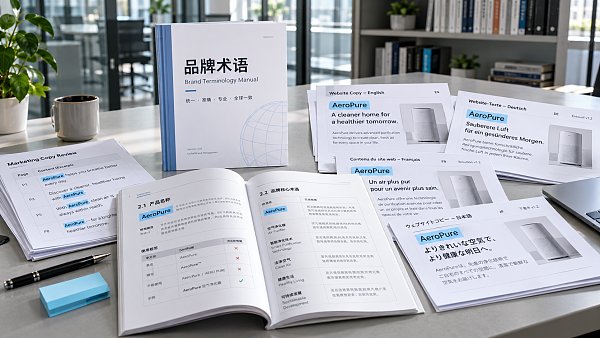
The same product has one name on the company website, a different translation on an advertising landing page, and an outdated name in a downloadable manual. Customers may not point out the translation issue, but they may wonder whether these are actually the same product. When evaluating an “AI translation platform solution,” what you really need to verify is not whether the translations read smoothly, but whether brand terminology can be controlled across pages, languages, and updates.
The answer is yes, but you cannot rely solely on a model remembering a prompt. A reliable solution needs to integrate a terminology database, contextual constraints, automated checks, and human review into the website publishing workflow. A platform’s ability to generate consistent translations does not mean the company has established a terminology management process that will remain effective over time.
First, define “consistent”: it does not mean using the same word everywhere
Brand names, product lines, model numbers, and proprietary technical names usually require strict control. General product terms and marketing descriptions, however, should allow expressions that align with local search habits. For example, the same equipment category may require the precise industry term on a technical specifications page, but a more easily understood expression in an advertising headline. Locking down every term can undermine the reading experience.
A terminology database should therefore contain more than two columns for “source text” and “translation.” At a minimum, it should record the target language and region, applicable products, recommended translations, prohibited translations, whether to retain the original text, permitted inflections, and the approver and version. If the same source term has different meanings in different business contexts, clarify the concepts to distinguish them and prevent the platform from consistently translating the term incorrectly.
When evaluating platforms, ask: How are terminology conflicts flagged? Which takes precedence, regional rules or global rules? Can historical pages be searched after an old name is retired? These questions reveal differences in delivery more clearly than “How many languages do you support?”
Even with a terminology database in place, check how its rules are enforced
Some platforms simply add terminology as reference information to a translation request. Others also check for omissions, prohibited terms, and capitalization after generating the translation. These should not be treated as the same capability. The former may deviate from rules in long or complex text; the latter may also damage grammar through simple substitution. Ask the provider to demonstrate the complete process, from retrieving rules to handling exceptions, rather than looking only at a translation demo.
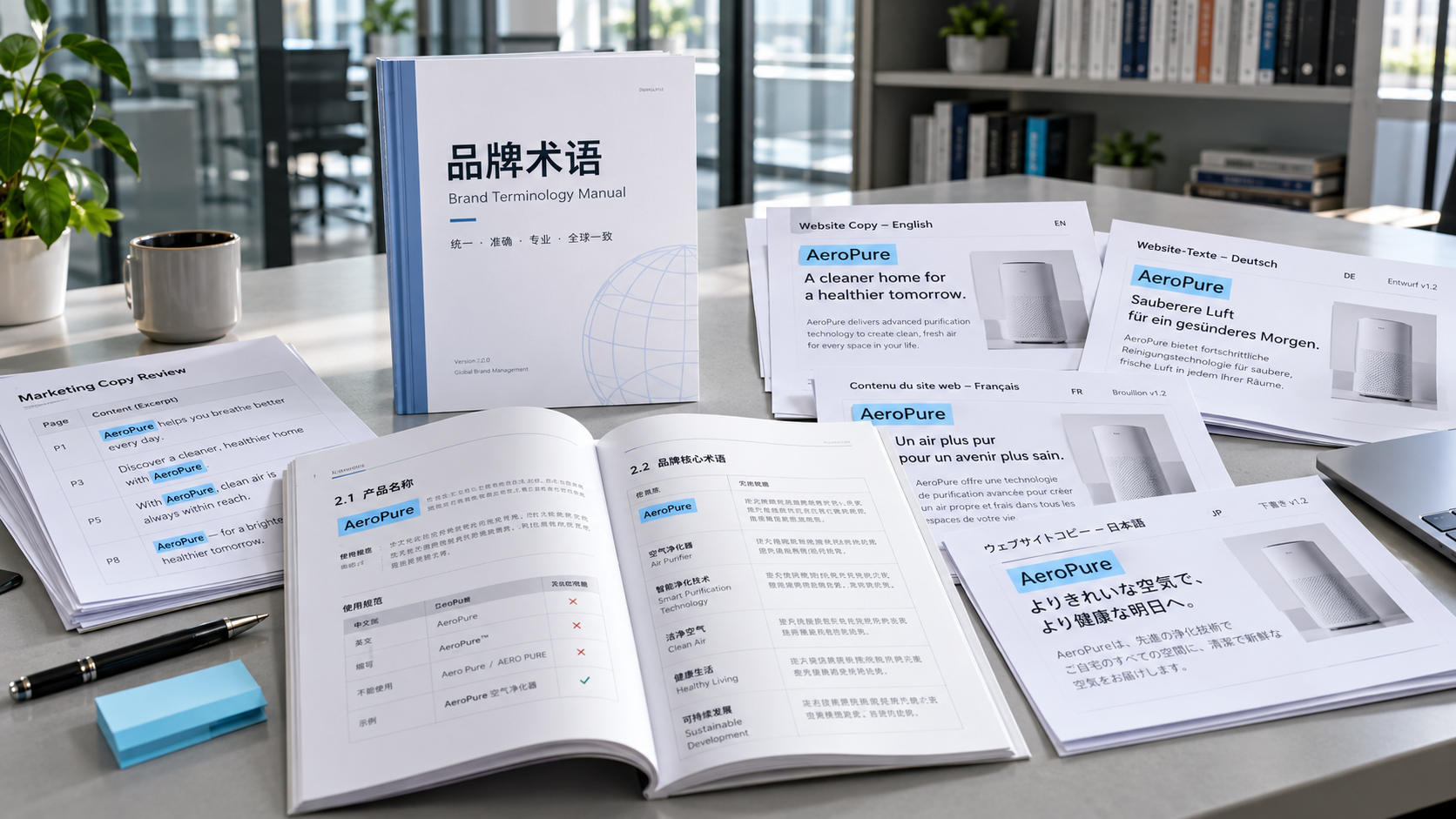
Context also determines whether terminology is used correctly. In isolation, “drive” could refer to software, a mechanical component, or an action. Translation requests should be able to include the page type, product category, heading level, and necessary surrounding content, while protecting links, variables, units of measurement, and model numbers. Navigation, image alt text, form prompts, page titles, and descriptions must not be overlooked just because they are outside the body text editor.
An ideal workflow is: identify source content → match terminology and context → generate translation → check rules → review by risk level → publish and archive. Conflicts should enter a pending queue rather than directly overwrite live content.
Use a set of real pages to evaluate the platform, not the demo
Start the trial with content drawn from the existing website, covering product detail pages, solutions, news, advertising landing pages, and forms. The test set should include unambiguous terminology as well as ambiguous terms, historical names, similar model numbers, and new terms not yet in the database. For key languages, reviewers familiar with the business should confirm the reference translations.
- Check where controlled terms should appear, and record correct usage, omissions, and incorrect application separately. Do not just count keyword matches.
- Change a terminology rule and observe whether affected pages can be identified, and whether the platform supports diff previews, re-review, and rollback.
- Translate the same batch of content repeatedly to confirm that rules continue to be applied, and check that model numbers, links, and variables are preserved intact.
- After publishing, check the live pages to confirm that outdated versions are not still displayed in the cache, on mobile, or through other content entry points.
Acceptance criteria should be tiered by risk. Errors in brand names and model numbers should usually block publishing; general marketing language can be sampled for review. Reports should present terminology accuracy, language naturalness, and content completeness separately to prevent a single, generic “translation quality score” from obscuring critical errors.
When website and marketing services are integrated, responsibilities must be clearly defined
Even if terminology is consistent on the website, customers will still encounter inconsistent names if advertising materials and social media content follow a separate set of rules. For businesses expanding overseas across multiple channels, clarify which content shares a terminology source, which content can be adapted locally, and who is responsible for notifying channel owners when changes are made. Terminology consistency helps reduce barriers to understanding, but it does not justify promising higher search rankings or more inquiries.
Yiyingbao Information Technology (Beijing) Co., Ltd. was established in 2013 and is headquartered in Beijing. Its services cover AI-powered website building, multilingual websites, SEO, advertising, and overseas social media operations. For an integrated website and marketing service of this kind, the evaluation should focus on whether content workflows can be connected, rather than assuming that all systems already share terminology. Whether terminology interfaces, approvals, version rollback, and cross-channel synchronization are supported should be confirmed through solution documentation and practical demonstrations.
Contracts and delivery checklists should also specify ownership of terminology assets, export formats, update responsibilities, review fees, and data retention and model-training rules for non-public product information. In particular, distinguish initial translation fees from the costs of retranslation and review resulting from subsequent terminology changes.
Before making a decision, ask candidate providers to complete a closed-loop test: “add a new term → translate → review → publish → revise → roll back.” A platform is not merely capable of translating; it can maintain brand messaging across multilingual websites only if the provider can explain and demonstrate how each step is controlled.
Related Articles

Related Products
 Yiyingbao SaaS Intelligent Website Building and Marketing SystemYiyingbao SaaS Intelligent Website Building and Marketing System, AI-powered no-code website building, rapid creation of multilingual B2B international websites in 10 minutes, global server acceleration, AI-powered SEO optimization, helping businesses connect efficiently with global markets. The perfect integration of technology and operation makes building an international trade website remarkably simple
 AI+SEM Intelligent Advertising Marketing SystemAI+SEM drives intelligent ad creation, empowering full-funnel precision advertising marketing. The system automatically generates weekly/monthly reports, AI recommends keywords and target countries, monitors core metrics in real-time with intelligent alerts, and enables one-click high-conversion ad solutions to help quickly acquire customers and improve ROI.
 AI+SEO Dual-Engine System Optimization ServicesYiyingbao’s AI+SEO dual-engine optimization system helps foreign trade enterprises acquire high-quality organic traffic through AI-powered keyword research, content generation, and comprehensive technical optimization, significantly improving search rankings and conversion rates.
 AI+SNS Social Media Marketing SystemYingbao AI+SNS Social Media Marketing System - Precision social capture for the social media era. Supports one-click content synchronization across major platforms like Facebook and LinkedIn. AI intelligently rewrites posts for enhanced relevance. 24/7 AI customer service and user profiling analysis empower businesses to efficiently expand into global markets.
 AI+SEO营销解决方案易营宝AI+SEO营销解决方案,通过AI批量写作、智能生成TDK、精准关键词扩词等功能,全面优化网站SEO效果,提升流量与转化率。助力企业构建高效智能网站新生态。
 AI+SEM Advertising Marketing SolutionsAI+SEM Advertising Marketing Solution leverages AI technology to deeply empower SEM ad campaigns. It automatically generates weekly/monthly reports using AI, presenting account data across multiple dimensions for comprehensive insights into campaign performance and trends. The system precisely recommends keywords and target countries, intelligently generates high-conversion ad copy, and enables one-click activation of efficient campaign plans to help businesses rapidly acquire customers. Simultaneously, it monitors core metrics in real time, intelligently identifies abnormal fluctuations, and issues timely alerts to ensure stable, high-return advertising results.
 Domain Name ServicesEasyWin provides professional domain name services, including intelligent queries, one-stop registration, brand protection, and full lifecycle management, helping businesses build a digital brand image.
 EasyOperate B2C Cross-Border E-Commerce Platform & Independent WebsiteEasyStore B2C Cross-border E-commerce Independent Store is an intelligent website building and cross-border e-commerce integrated solution independently developed by EasyStore Information Technology (Beijing) Co., Ltd. The system is specially designed for small and medium-sized as well as large export enterprises, integrating 'website building, operation, marketing, advertising, and conversion' into one, helping enterprises quickly establish cross-border e-commerce independent stores to achieve brand globalization and global sales growth.
The platform supports multiple languages, multiple currencies, and multi-channel marketing, with built-in AI intelligent translation and SEO optimization systems, suitable for mainstream markets such as Southeast Asia, Europe and America, Latin America, and the Middle East, assisting Chinese manufacturing enterprises in efficiently deploying international e-commerce strategies. SSL证书易营宝提供专业SSL安全证书服务,包括单域名和泛域名证书,确保网站数据传输加密、身份验证和完整性保护,助力企业建立安全可信的在线业务环境。









