









- Which customer acquisition channels will be affected by cross-border marketing trends in 2026?Sep 06, 2026View details
- Which homogenization risks should be considered in an analysis of the AI-powered website building industry?Aug 30, 2026View details
- How Will AI Marketing Trends 2026 Change Advertising Budget AllocationAug 28, 2026View details
- Is the EV SSL certificate market shrinking or upgrading? How should companies assess certificate procurement?Aug 11, 2026View details
- Why the old AMP SEO 2020 practices no longer work and what has changed in current optimization prioritiesAug 02, 2026View details
- How to Choose Topics for an Industry News Section to Attract More Organic Search TrafficJul 29, 2026View details
How Can Cross-Border Brand Websites Synchronize Multilingual Content?
Multilingual content synchronization for cross-border brand websites is not about batch-translating Chinese pages into English, French, or Arabic and publishing them. It is about establishing a content management mechanism that can operate continuously: after source content changes, which languages need updating, which content can be reused, which markets require rewriting, and how different versions can maintain consistency in product information and brand messaging.
What truly affects overseas user experience and search visibility is often not the number of languages, but whether synchronization is controllable. A product parameter may have been updated while the English website still retains the old specification; a model may have been removed from the main website while related pages are still being promoted on the German website; a global campaign may have ended while landing pages in some languages are still collecting leads—these issues directly weaken website credibility and cause the information used by advertising, SEO, and sales teams to conflict with one another.
First distinguish between “content synchronization” and “language localization”
The two are often confused. Content synchronization addresses consistency of information versions, such as product models, technical parameters, certificate status, pricing rules, inventory notices, downloadable materials, brand guidelines, and legal terms. Language localization addresses whether the expression is suitable for a specific market, including terminology, units of measurement, currencies, date formats, purchasing habits, case selection, and compliance notices.
Therefore, the key to multilingual content synchronization for cross-border brand websites is not to make the word count and page structure of every language exactly the same, but to clarify which fields must be unified and which fields can be maintained independently by local markets.
Content more suitable for centralized synchronization includes:
- Product names, SKUs, models, core specifications, compatibility information, and manual versions;
- Brand visual assets, general company introductions, and standardized service processes;
- Product listing and delisting status, site-wide navigation, internal search indexes, and download center materials;
- Fixed instructions directly related to product safety and usage restrictions.
Content more suitable for localized maintenance includes marketing campaign copy, payment methods, delivery coverage, customer cases, application scenarios, contact information, after-sales commitments, and sales messaging with clear cultural and commercial-context differences. If the latter is also forcibly “synchronized with one click,” the website may appear unified but will in fact lose usability in the local market.
The content model determines subsequent synchronization costs
The most common structural issue with multilingual websites is treating each language as an independent website. After pages are copied, titles, body text, images, product parameters, and CTA buttons are scattered across different back ends or different pages. Initial launch is fast, but once content enters a continuous update cycle, maintenance costs rise rapidly.
A more reliable approach is to use “content entities” rather than “page copies” as the basis for management. A product, an industry solution, or a knowledge article should each have a unique content ID and a primary-language version; different languages should exist only as language versions under that entity. Pages are responsible for calling this content rather than repeatedly storing multiple unrelated data sets.
For example, a product entity can be divided into model, parameter table, certification information, applicable scope, main image, download files, SEO fields, and market-oriented descriptions. Models and parameters can be uniformly pushed through master data; market-oriented descriptions, FAQs, and landing-page call-to-action buttons can be edited independently for each language. This enables the back end to clearly identify the status of “source content changed but translation not updated,” rather than relying on manual page-by-page checks.
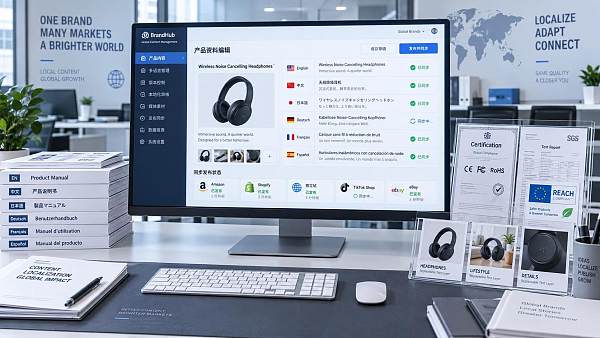
Content fields should not be split excessively. Splitting every sentence in the body text into an independent field increases editing difficulty, while placing an entire page in one rich-text box makes it difficult to identify which information has changed. Modules suitable for stable reuse, such as technical parameters, applicable industries, downloadable materials, and fixed Q&As, can be managed structurally; for highly narrative brand stories, market articles, and solution pages, retaining space for full-paragraph editing is usually more effective.
Establish a version relationship of “source language—translation—publication”
The synchronization mechanism should record versions, rather than only whether a page has been translated. After each modification to source-language content, the system or content owner needs to determine which category the change belongs to:
- Mandatory update: Information involving safety instructions, key specifications, compliance documents, product status, and similar items. Relevant language versions should have automatic publication suspended or be marked as pending update;
- Recommended update: Changes involving selling points, images, feature additions, or FAQs. The original version may remain accessible, but the content needs to enter the translation task queue;
- No translation required: Adjustments only to internal links, primary-language grammar, or content that does not affect foreign-language understanding. No multilingual task needs to be generated.
This step avoids the inefficient practice of triggering retranslations for all languages whenever any change is made. For websites with large product catalogs and many languages, full retranslations are both costly and likely to create backlogs in translation queues. Conversely, ignoring updates creates information gaps. Managing tasks by change level is a more reasonable balance between synchronization efficiency and content accuracy.
After translation is completed, the old page should not be overwritten directly. Each language version should retain at least such statuses as draft, under review, published, and pending update. When product parameters, regulatory wording, or technical terminology present higher risks, reviewers familiar with the local market also need to confirm terminology and expression, rather than merely checking whether the wording reads smoothly.
Machine translation is suitable for acceleration, not for replacing publication decisions
AI translation and machine translation can be used to generate first drafts, identify repeated paragraphs, build terminology databases, detect source-text changes, and reuse approved fixed wording on new pages. For specification descriptions, routine help-center content, and product pages with highly repetitive structures, such tools are especially suitable for reducing repetitive work.
However, automatic translation cannot directly solve localization issues. Common Chinese expressions such as “leading capabilities,” “full-process assurance,” and “high cost performance” may not fit overseas B2B procurement contexts after translation; some product names may already have established names in target markets; and dimensions, voltage, certification names, and material terminology should not be inferred by general-purpose models on their own.
A callable terminology database and prohibited-word list should be established to standardize at least brand names, product line names, component names, certification names, unit formats, and core selling points. A translation memory is suitable for retaining reviewed and approved sentences and segments, preventing inconsistent translations of the same concept across different pages and languages. The value of automation lies in assigning repetitive content and change identification to the system, while concentrating human time on aspects that affect comprehension, conversion, and compliance.
Do not turn synchronization into “multilingual copying”
Many websites use exactly the same page structure, images, and keyword layout for their English, French, and Spanish pages, replacing only the body language. This approach is convenient for management, but may not be effective for search or user decision-making.
Different language versions should have independent URLs and use correct hreflang annotations to help search engines understand the language or region targeted by a page. hreflang does not mean arbitrarily pointing all language pages to each other: each corresponding page should form a verifiable bidirectional relationship, and language and region codes must also comply with standards. For example, a page for all English-language users may use en, while an independent page for the UK market may use en-GB. Language versions without corresponding content should not be forcibly associated simply to complete the markup.
Visible text in page titles, descriptions, image alt text, breadcrumbs, internal links, and structured data is also part of multilingual content. If the body text has been translated but navigation remains in Chinese, key parameters in images have not been processed, or download files are available in only one language, users will feel that the page has not truly been localized. At the SEO level, this can also easily lead to inconsistencies between the indexing language and the page language.
For sites using the same language but serving different regions, it is even more important to determine whether separate sites are truly necessary. An independent regional version is worth maintaining only when currencies, logistics, regulations, contact information, product combinations, or commercial terms have stable differences. Simply changing the country name while retaining the same content increases the maintenance burden and creates highly similar content.
The synchronization scope also includes media, forms, and system information
Multilingual management omissions often occur outside the page body. Text embedded in images, product labels, video subtitles, PDF tables of contents, form error messages, automated email replies, Cookie consent notices, and no-results pages for internal search may all be directly exposed to overseas visitors.
Forms in particular need to be synchronized with the sales process. The fields collected by forms in different languages, privacy consent text, lead assignment rules, and automated email content should align with actual local service capabilities. If a market does not have sales support in the corresponding language, the page promise of “rapid response from local consultants” should not simply be copied over.
For images and videos, it is recommended to store visual assets separately from text layers. Baking large amounts of text into posters or main product images means every language update requires redesign, and it is also detrimental to mobile reading and accessibility. When multilingual labels need to be displayed, replaceable layers can be prepared, or key information can be placed in HTML text areas.
Use an update dashboard to control outdated content rather than relying on memory
Once content synchronization enters daily operations, the most valuable management tool is often not a complex translation feature, but an update dashboard that displays version relationships. At a minimum, it should show the source content's last modified time, the current version of each language, fields pending translation, the person responsible for pending review, published links, outdated files, and abnormal pages.
Websites with frequent product updates should also establish clear interfaces between the content system and product information, inventory, or document repositories, but external data should not be allowed to directly overwrite front-end copy without review. Structured parameters can be synchronized automatically; marketing descriptions, market commitments, and FAQs still require confirmation at the content layer. Automation should reduce copying actions, not eliminate business judgment.
Pre-launch checks should also focus on actual risks: whether language switching enters the corresponding version of the same content entity; whether URLs, currencies, forms, and navigation match after switching; whether source language remains on the page; whether parameter units are correct; whether hreflang, canonical, and sitemaps reflect actual publication status; and whether delisted pages are still accessible through language navigation or advertising links.
The core of a multilingual website is not “translating faster,” but enabling every piece of key content to be traceable to its source, identifiable by version, scheduled for updating, and reviewed. By managing unified information separately from localized expression, cross-border brand websites can remain maintainable as they expand into more languages, rather than turning every product adjustment into a site-wide investigation.
Related Articles



Related Products
 Yiyingbao SaaS Intelligent Website Building and Marketing SystemYiyingbao SaaS Intelligent Website Building and Marketing System, AI-powered no-code website building, rapid creation of multilingual B2B international websites in 10 minutes, global server acceleration, AI-powered SEO optimization, helping businesses connect efficiently with global markets. The perfect integration of technology and operation makes building an international trade website remarkably simple
 AI+SEM Intelligent Advertising Marketing SystemAI+SEM drives intelligent ad creation, empowering full-funnel precision advertising marketing. The system automatically generates weekly/monthly reports, AI recommends keywords and target countries, monitors core metrics in real-time with intelligent alerts, and enables one-click high-conversion ad solutions to help quickly acquire customers and improve ROI.
 AI+SEO Dual-Engine System Optimization ServicesYiyingbao’s AI+SEO dual-engine optimization system helps foreign trade enterprises acquire high-quality organic traffic through AI-powered keyword research, content generation, and comprehensive technical optimization, significantly improving search rankings and conversion rates.
 AI+SNS Social Media Marketing SystemYingbao AI+SNS Social Media Marketing System - Precision social capture for the social media era. Supports one-click content synchronization across major platforms like Facebook and LinkedIn. AI intelligently rewrites posts for enhanced relevance. 24/7 AI customer service and user profiling analysis empower businesses to efficiently expand into global markets.
 AI+SEO营销解决方案易营宝AI+SEO营销解决方案,通过AI批量写作、智能生成TDK、精准关键词扩词等功能,全面优化网站SEO效果,提升流量与转化率。助力企业构建高效智能网站新生态。
 AI+SEM Advertising Marketing SolutionsAI+SEM Advertising Marketing Solution leverages AI technology to deeply empower SEM ad campaigns. It automatically generates weekly/monthly reports using AI, presenting account data across multiple dimensions for comprehensive insights into campaign performance and trends. The system precisely recommends keywords and target countries, intelligently generates high-conversion ad copy, and enables one-click activation of efficient campaign plans to help businesses rapidly acquire customers. Simultaneously, it monitors core metrics in real time, intelligently identifies abnormal fluctuations, and issues timely alerts to ensure stable, high-return advertising results.
 Domain Name ServicesEasyWin provides professional domain name services, including intelligent queries, one-stop registration, brand protection, and full lifecycle management, helping businesses build a digital brand image.
 EasyOperate B2C Cross-Border E-Commerce Platform & Independent WebsiteEasyStore B2C Cross-border E-commerce Independent Store is an intelligent website building and cross-border e-commerce integrated solution independently developed by EasyStore Information Technology (Beijing) Co., Ltd. The system is specially designed for small and medium-sized as well as large export enterprises, integrating 'website building, operation, marketing, advertising, and conversion' into one, helping enterprises quickly establish cross-border e-commerce independent stores to achieve brand globalization and global sales growth.
The platform supports multiple languages, multiple currencies, and multi-channel marketing, with built-in AI intelligent translation and SEO optimization systems, suitable for mainstream markets such as Southeast Asia, Europe and America, Latin America, and the Middle East, assisting Chinese manufacturing enterprises in efficiently deploying international e-commerce strategies. SSL证书易营宝提供专业SSL安全证书服务,包括单域名和泛域名证书,确保网站数据传输加密、身份验证和完整性保护,助力企业建立安全可信的在线业务环境。









